Is AP African American Studies Hard? The Newest AP
AP African American Studies is not an easy A, but its numbers run friendlier than most APs: a 79.2% pass rate and a 3.41 mean score in 2025, per College Board score distribution data. The honest answer to whether the course is hard depends on what you count as hard. The reading spans more disciplines than a single-subject AP, the document-based question demands the same analytical writing as the AP history exams, and a graded three-week research project sits inside the score in a way no multiple-choice cram can rescue. Media coverage of this course has been loud; the actual exam is quieter and more conventional than the headlines suggest.
Is AP African American Studies Hard?
AP African American Studies sits at moderate difficulty by AP standards. Its 2025 pass rate of 79.2% beats AP World History and APUSH, but the score still rewards strong analytical writing and steady source work across four units. The reading load is heavier than the page count suggests because the course pulls from history, literature, political science, and the arts at once. The project, not the exam, is where unprepared students lose the most ground.
The 2025 Score Distribution
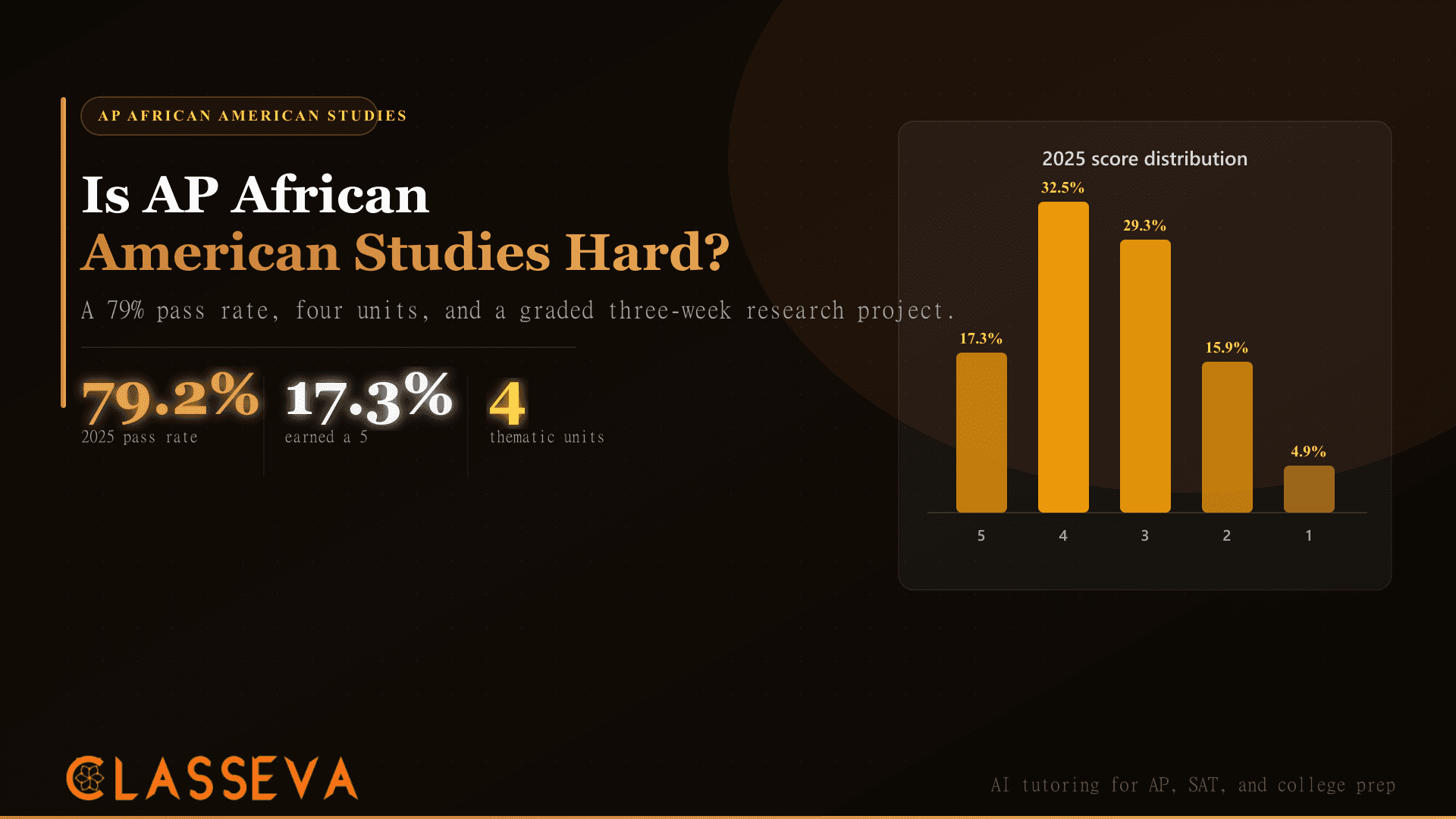
The 2025 distribution ran 17.3% fives, 32.5% fours, 29.3% threes, 15.9% twos, and 4.9% ones, for a 79.2% pass rate and a 3.41 mean across 21,435 students. Nearly half the cohort (49.8%) earned a 4 or 5, the band most colleges reward with credit. For a first-year operational exam, that distribution skews high, which usually signals a motivated, self-selected pilot population rather than a soft test.
| AP Score | % of 2025 Test-Takers | College Readiness Signal |
|---|---|---|
| 5 | 17.3% | Extremely well qualified |
| 4 | 32.5% | Well qualified |
| 3 | 29.3% | Qualified |
| 2 | 15.9% | Possibly qualified |
| 1 | 4.9% | No recommendation |
2025 AP African American Studies score distribution. Source: College Board, 21,435 test-takers, mean 3.41.
Why This Is One of the Newest APs
AP African American Studies entered a pilot in 60 schools during 2022-23, expanded to roughly 700 schools the next year, and opened to any school that wanted it in 2024-25. That makes 2025 the first year with a full operational exam and published score data. A young AP carries practical consequences: fewer released past exams, thinner third-party prep material, and college credit policies that have not fully caught up. The 2025 cohort of 21,435 students is small next to APUSH, which draws closer to half a million annually.
What Are the 4 Units of AP African American Studies?
AP African American Studies organizes its content into four chronological units that span from roughly 900 BCE to the 2000s. The four units move from the origins of African societies through enslavement and emancipation to twentieth-century movements and present-day debates. Each unit blends history with literature, political science, geography, and the arts, which widens the reading beyond a single discipline. College Board lays out the full unit framework on its AP African American Studies course page.
How the Four Units Split the Timeline
Unit 1 covers African societies from roughly 900 BCE through the 16th century, including kingdoms, trade networks, and cultural traditions that predate the transatlantic slave trade. Unit 2 runs from the 16th century to 1865 and centers enslavement, resistance, and the path to emancipation. Unit 3, from 1865 to the 1940s, traces Reconstruction, Jim Crow, the Great Migration, and the Harlem Renaissance. Unit 4 carries from the 1940s to the 2000s, covering the civil rights movement, Black political thought, and contemporary debates. The chronology never doubles back, which helps students who struggle with the period-hopping structure of APUSH.
How Is the AP African American Studies Exam Structured?
The AP African American Studies exam combines a fully digital written test with a teacher-scored project. The written portion runs about 2 hours and 45 minutes inside the Bluebook app and weighs 90% of the score: 60 multiple-choice questions, a short project-validation question, three short-answer questions, and one document-based question. The Individual Student Project supplies the other 10%. Both halves count, so a strong exam cannot fully offset a weak project. College Board details every section weight on its AP African American Studies exam page.
| Exam Component | Format | Time | Weight |
|---|---|---|---|
| Section I: Multiple Choice | 60 questions in source-based sets | 70 min | 60% |
| Project Validation Question | 1 written response | 10 min | 1.5% |
| Section II: Short Answer | 3 questions (text, visual, thematic) | 40 min | 18% |
| Section II: Document-Based Question | 1 question, 5 documents | 45 min | 12% |
| Individual Student Project | Teacher-scored, 3-week research | Out of class | 8.5% |
AP African American Studies exam structure and weighting. Source: College Board exam and project overview.
The written exam is 90% of the score and the project is 10%, but those weights hide the real risk. A student who skips the project entirely caps out around 90% of available points, which usually drops a likely 5 to a 4 or a borderline 4 to a 3. The project is small in weight and large in consequence at the score boundaries.
The 60-Question Multiple-Choice Section
Section I gives students 70 minutes for 60 multiple-choice questions, all built around shared source material. Questions arrive in sets of three or four tied to a document, image, map, or data table, so the section tests source analysis as much as recall. About half the sources come from required course content; the rest are unseen, which rewards students who can apply skills rather than memorize facts. At 70 seconds per question, pacing matters less here than on a math AP, but careful reading of each source set decides most points.
Short-Answer and the Document-Based Question
Section II splits into three short-answer questions (40 minutes) and one document-based question (45 minutes). The three short-answer prompts each carry three or four parts and rotate through a text-based, a visual-based, and a thematic source. The DBQ hands students five documents and asks for a defensible thesis, outside historical context, evidence from at least three sources, and source analysis, the same skill set APUSH and the AP European History exam reward. Students who can already write a tight DBQ thesis transfer that skill directly.
The Individual Student Project Explained
The Individual Student Project is the feature that separates AP African American Studies from every history AP. It counts for 8.5% of the score directly, plus a 1.5% validation question on exam day, for 10% total. Over about three weeks, students define a research question, gather sources from multiple disciplines, build a presentation, and defend it orally to their teacher and class. The teacher scores the work against an official AP rubric.
What the Project Actually Demands
The project tests research design, not test stamina. Students choose a topic connected to the course, frame a focused line of inquiry, and analyze authentic sources from several disciplines rather than summarizing a textbook. The oral defense asks students to explain how each source shaped their thinking, which exposes shallow work fast. Strong projects show a clear question, real source engagement, and an argument the student can defend live. The skill overlaps with AP Research, where independent inquiry and a defense also drive the grade.
Students who pick a topic they genuinely want to study finish the project faster and defend it more convincingly. The rubric rewards depth of source engagement, so a narrow question with five rich sources beats a broad question with fifteen shallow ones. Lock your topic in the first week and spend the remaining two on source analysis and your defense.
Media Narratives vs What Is Actually Tested
AP African American Studies drew national headlines, but the exam itself follows a conventional AP format. The political coverage focused on framework revisions and state-level disputes, not on what students answer in May. On the test, students analyze sources, write a thesis-driven DBQ, and defend a research project, the same academic skills measured across AP history and social science exams. The gap between the media narrative and the exam day experience is wide.
The Media Narrative
- •Framing centered on framework revisions and political disputes
- •State-level adoption fights drew most of the coverage
- •Debate over which topics and figures appear in the curriculum
- •Coverage rarely described the actual exam tasks
- •Created an impression that the course is unusually controversial to take
What Students Actually Do
- •Analyze documents, images, maps, and data in source sets
- •Write a thesis-driven DBQ from five documents
- •Answer three short-answer questions on text, visuals, and themes
- •Complete and defend a three-week research project
- •Use the same analytical skills as APUSH and AP World History
State Adoption and Availability
Availability is the variable students should check first. College Board opened AP African American Studies to all schools in 2024-25, but several states limited, declined, or scrutinized the course during the pilot, so access is not uniform. Whether you can take it depends on your state and district, not on your own readiness. If your school offers it, the course has completed the AP Course Audit and the exam will be scored like any other AP. If it does not, the self-study path is blocked by the project requirement, which a non-enrolled student cannot validly submit.
The 2025 exam was the first to produce an official score distribution, because earlier years were pilot administrations. That means 2025 is the baseline year for this AP. Future distributions may shift as the test-taking population grows beyond the early-adopter schools that drove the 79.2% pass rate.
How Should You Prepare for AP African American Studies?
Preparation splits into two tracks: the writing skills for the exam and the sustained work for the project. For the exam, drill source analysis and DBQ thesis construction using the released materials College Board publishes on AP Central. For the project, start early, pick a focused question, and rehearse the oral defense out loud. Because the course pulls from several disciplines, retrieval practice across mixed source types beats re-reading any single unit.
Research on learning backs the mixed-source approach. Roediger and Karpicke's work on the testing effect shows that practicing retrieval, answering questions from memory, outperforms re-reading for durable recall. For a course built on source sets, that means working through practice question sets and writing timed responses rather than highlighting the reading. Students mapping a wider schedule can compare this load against the AP Seminar workload, which shares the project-and-defense structure.
Project Your AP Score
If you are mid-course, mapping your practice performance to a likely score band tells you whether to push the exam writing or the project harder before May. Classeva's AP Score Predictor turns your practice results into a projected band so you can target the weaker half.
AP Score Predictor
Enter your AP African American Studies practice results to project your score band and see whether to prioritize the written exam or the Individual Student Project before May.
For broader context on how AP scores translate into placement, the College Board AP scores overview explains what each 1-to-5 score signals and how colleges read it. Pair that with each target school's published credit policy, since a newer exam like this one earns credit less uniformly than established subjects.
Key Takeaways
- AP African American Studies posted a 79.2% pass rate in 2025 with 17.3% fives and 32.5% fours across 21,435 test-takers, one of the gentler AP distributions, though built on a small self-selected first cohort.
- The course covers four chronological units: Origins of the African Diaspora; Freedom, Enslavement, and Resistance; The Practice of Freedom; and Movements and Debates, spanning roughly 900 BCE to the 2000s.
- The exam is fully digital and weighs 90% of the score: 60 multiple-choice questions, three short-answer questions, and a five-document DBQ, all inside the Bluebook app.
- The Individual Student Project supplies the other 10% through a three-week research task and oral defense that a strong test-taker cannot bypass and a non-enrolled student cannot validly submit.
- The reading feels heavier than four units suggest because each unit blends history, literature, political science, geography, and the arts across nearly 3,000 years of context.
- Media coverage focused on politics, not the exam. On test day students analyze sources and write a DBQ, the same skills APUSH and AP World History reward.
- Check availability first. The course opened to all schools in 2024-25, but several states restricted it during the pilot, so access depends on your state and district.