Is AP Seminar Hard? The Year-Long Performance Tasks
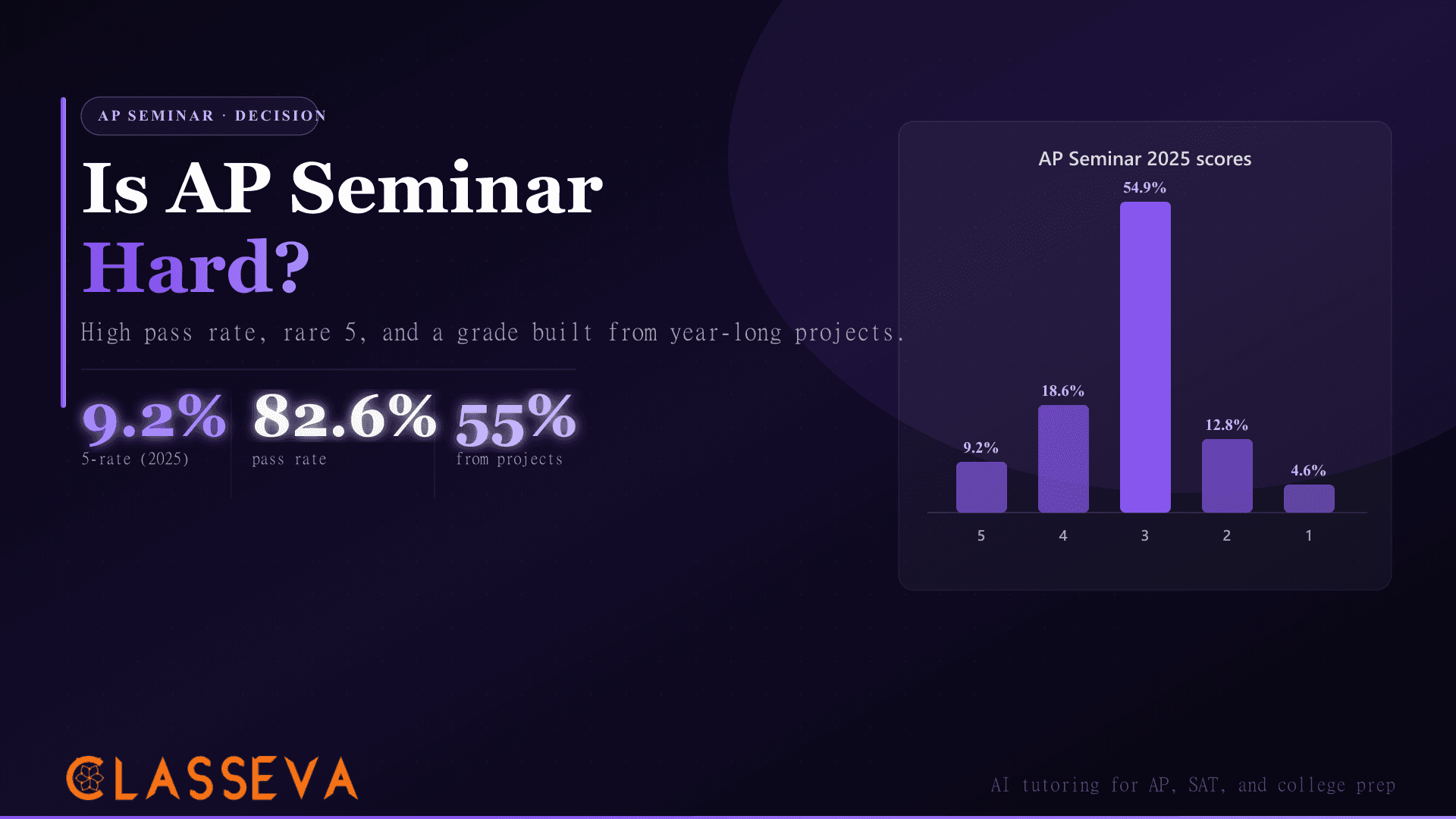
AP Seminar passes 82.6% of test-takers yet awards a 5 to only 9.2%, a split you will not find on any standard content AP. The reason sits in the structure: more than half your score comes from two research projects you submit weeks before the May exam, not from a single high-stakes test. Building tutoring tools around the AP Capstone program, the pattern that kept surfacing was simple, most students who miss a 5 do not fail the exam, they under-execute the year-long performance tasks.
Is AP Seminar Hard?
AP Seminar is hard in a different way than a content AP. There is nothing to memorize and no equation sheet, so the difficulty lives in self-directed research, teamwork, and managing a stack of deadlines across the school year. Students who plan ahead and write cleanly tend to pass comfortably. Students who procrastinate on the performance tasks lose points they can never recover on exam day.
AP Seminar Score Distribution
In May 2025, AP Seminar drew 130,723 test-takers worldwide, and the scores clustered hard around the middle: 9.2% earned a 5, 18.6% earned a 4, and a striking 54.9% earned a 3. Only 4.6% scored a 1. The mean landed at 3.15, per the College Board AP Seminar score distributions. That tight clustering tells you most of the story before you read another word.
| AP Score | % of Test-Takers (2025) | College Readiness Signal |
|---|---|---|
| 5 | 9.2% | Extremely well qualified |
| 4 | 18.6% | Well qualified |
| 3 | 54.9% | Qualified |
| 2 | 12.8% | Possibly qualified |
| 1 | 4.6% | No recommendation |
May 2025 AP Seminar score distribution. Source: College Board AP Score Distributions.
Why the 82.6% Pass Rate Misleads
An 82.6% pass rate sounds like an easy exam. It is not. The performance-task structure rewards steady, competent work with a 3, which is why the middle band swells to nearly 55%. Pushing from a 3 to a 5 demands research that interrogates sources, an argument that holds under defense questions, and clean writing under deadline pressure across two separate projects. Most students reach competent; few reach excellent.
What Are the Three AP Seminar Components?
AP Seminar grades three pieces: Performance Task 1 (the Team Project, 20%), Performance Task 2 (the Individual Research-Based Essay, 35%), and a two-hour end-of-course exam (45%). The first two are year-long projects submitted through the AP Digital Portfolio before May. Only the third happens on a single exam day. That weighting defines everything about how the course feels.
Performance Task 1: The Team Project (20%)
Performance Task 1 splits into two graded pieces. You write an Individual Research Report of about 1,200 words, scored by the College Board, and your team delivers an 8 to 10 minute Team Multimedia Presentation and Defense, scored by your AP teacher. Your group of three to five students picks a real-world problem, researches it from competing perspectives, then defends a recommendation under questioning. The College Board details these tasks on the AP Seminar assessment page.
Performance Task 2: The Individual Essay (35%)
Performance Task 2 carries the most weight of any single task at 35%. You build a 2,000-word Individual Written Argument from a stimulus packet released by the College Board, then deliver a 6 to 8 minute Individual Multimedia Presentation and field an Oral Defense of two teacher questions. The written argument alone drives most of this 35%, so a sloppy essay sinks your score no matter how strong the presentation looks.
The End-of-Course Exam (45%)
The end-of-course exam runs two hours and counts for 45%, the largest single slice. It contains four questions: three short-answer questions tied to one source, plus one essay question that synthesizes four different sources into an evidence-based argument. Unlike the projects, you cannot revise this work or lean on a team. It tests the same analysis and argumentation skills you built all year, compressed into a single timed session.
The two-hour end-of-course exam is 45% of your score, but the Team Project (20%) and the Individual Essay (35%) together total 55%. You can walk into the May exam with more than half your grade already submitted and scored. That changes the math: a student who nails both performance tasks needs only a solid exam to pass, while a student who neglected the projects cannot rescue the score on exam day.
How Is the AP Seminar Grade Actually Built?
The AP Seminar grade rewards execution over recall. There is no formula sheet to memorize and no unit content to cram, so your score reflects how well you researched, argued, and wrote across an entire year. The College Board scores the Individual Research Report, the Individual Written Argument, and the exam centrally. Your AP teacher scores the two multimedia presentations and the oral defense, all submitted through the AP Digital Portfolio.
| Component | Graded Pieces | Score Weight | Scored By |
|---|---|---|---|
| Team Project (PT1) | Individual Research Report + Team Presentation | 20% | College Board + Teacher |
| Individual Essay (PT2) | Written Argument + Presentation + Oral Defense | 35% | College Board + Teacher |
| End-of-Course Exam | 3 short-answer + 1 synthesis essay | 45% | College Board readers |
The three AP Seminar scored components and their weights. Source: College Board AP Seminar assessment.
Where the Points Are Won and Lost
The largest controllable lever is Performance Task 2. At 35%, the Individual Written Argument is the single heaviest scored piece, and you write it from a stimulus packet with weeks of lead time. Students who treat it as a real research paper, refining the thesis and stress-testing sources, separate themselves here. Students who write it the night before the deadline cap their ceiling at a 3.
The exam, at 45%, rewards practiced synthesis rather than memorization. The four-source essay asks you to build one argument from competing sources under time pressure, the exact skill the performance tasks trained. If you actually engaged with the year-long projects, the exam feels familiar. If you outsourced the projects to teammates, the exam exposes the gap.
What Makes AP Seminar Hard?
AP Seminar is hard because the difficulty is logistical and interpersonal, not informational. You manage multiple deadlines, depend partly on teammates, and produce polished research without a textbook to anchor you. Strong writers who struggle with group work or time management often find it tougher than a content AP, even though it has nothing to memorize.
The Team Dependency Problem
Part of your score depends on people you did not choose. The Team Multimedia Presentation is graded as a group, so a disengaged teammate can drag down a component that feeds your individual AP score. This is the complaint I hear most about AP Capstone Seminar from students. The fix is structural: divide the research early, document who owns each section, and rehearse the defense as a group rather than improvising on presentation day.
Treating the Team Project as the easy task because the work is shared. The opposite is true. Shared work means shared risk, and the team presentation is the one component where a strong individual cannot fully control the outcome. Lock in roles, deadlines, and a rehearsal schedule in the first two weeks of the project, not the week it is due.
The Deadline Stack
AP Seminar spreads its grade across the year, which sounds forgiving but punishes procrastinators. The Team Project runs first, then the Individual Essay, then the May exam, each with hard College Board submission deadlines in the AP Digital Portfolio. Miss a portfolio deadline and you forfeit that component entirely. The students who earn 5s map these dates in the fall and work backward; the students who earn 2s discover the deadlines in the spring.
Students Who Earn a 5
- •Map all AP Digital Portfolio deadlines in the fall
- •Treat the 2,000-word Individual Written Argument as a multi-draft paper
- •Lock team roles and a rehearsal schedule in week one
- •Practice four-source synthesis essays before the May exam
- •Interrogate sources rather than summarizing them
Students Who Land a 2
- •Discover performance-task deadlines late in the spring
- •Write the Individual Written Argument in one rushed draft
- •Rely on teammates and skip group rehearsal
- •Walk into the exam without practicing synthesis
- •Summarize sources instead of evaluating them
How Does AP Seminar Lead to the AP Capstone Diploma?
AP Seminar is the first of two courses in the AP Capstone Diploma program. To earn the AP Capstone Diploma, you need a 3 or higher in both AP Seminar and AP Research, plus a 3 or higher on four additional AP exams of your choosing. Pass Seminar and Research but not four other exams, and you earn the AP Seminar and Research Certificate instead.
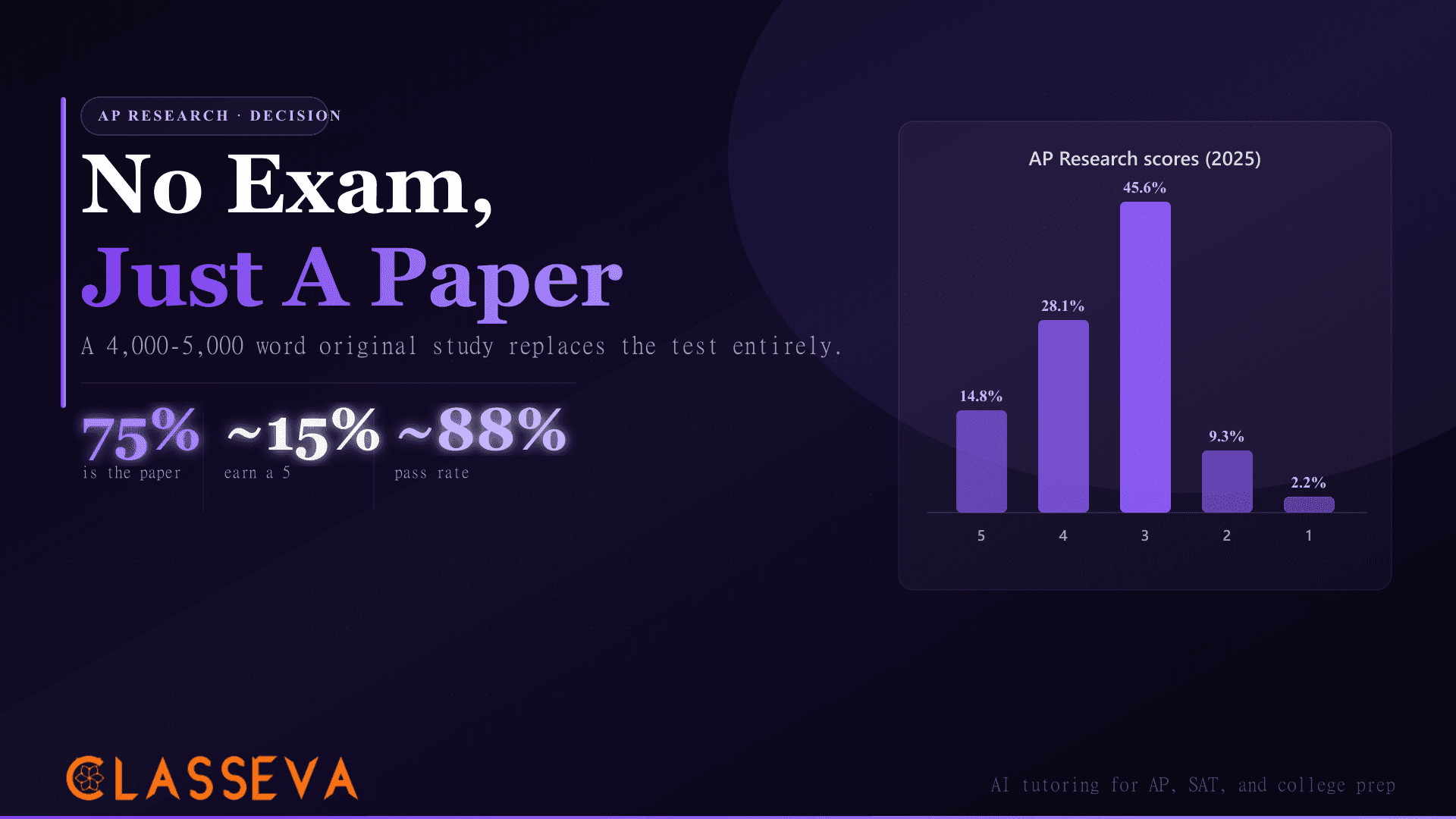
AP Research follows Seminar and pushes further: a 4,000 to 5,000 word academic paper plus a presentation and oral defense, with no end-of-course exam at all. The College Board lays out both award paths on the AP Capstone Award page. Seminar exists to build the research and argumentation foundation that AP Research then stretches into a full independent study. If you are stacking the four additional exams the diploma requires, the AP credit and college tuition savings guide shows how those scores translate into dollars.
The research and writing skills AP Seminar develops transfer directly to college applications. The same source evaluation and argument-building that earns Seminar points strengthens a Common App activities list and supplemental essays. Admissions readers at selective schools recognize the AP Capstone Diploma as evidence that a student can run independent research, a signal that a single high test score does not send.
AP Score Predictor
If you are mid-year in AP Seminar, the most useful question is where your current performance-task quality projects on the 1 to 5 scale. Classeva's AP Score Predictor maps your practice results to a projected score band so you know whether to push harder on the Individual Written Argument or the exam synthesis essay before May.
AP Score Predictor
Enter your AP Seminar performance-task and exam practice results to project your score band and see which component needs the most work before the May exam.
For broader scheduling context, students weighing how AP Seminar fits alongside a content-heavy load often compare it against decision posts like the AP Computer Science A difficulty breakdown, the AP Statistics difficulty guide, and the AP Precalculus difficulty post. Seminar pairs well with content APs because its workload peaks at different points in the year, but only if you respect the performance-task deadlines. When you map your full senior schedule, weigh how each AP affects your senior-year course rigor for admissions.
Key Takeaways
- AP Seminar passes 82.6% of students but awards a 5 to only 9.2% (May 2025 College Board data). The wide gap reflects a structure that rewards competent work with a 3 and reserves the 5 for sustained quality across two projects.
- Roughly 55% of your score is submitted before exam day. The Team Project (20%) and the Individual Research-Based Essay (35%) finish in the AP Digital Portfolio weeks before the two-hour end-of-course exam, which counts for the remaining 45%.
- Performance Task 2 is the heaviest single piece at 35%. The 2,000-word Individual Written Argument drives most of it, so treating it as a multi-draft research paper rather than a one-night assignment is the highest-leverage move in the course.
- The Team Multimedia Presentation introduces dependency risk. Part of your individual AP score rides on a group-graded component, which makes early role assignment and group rehearsal worth more than extra solo research.
- AP Seminar cannot be self-studied. Teacher-scored presentations, the supervised team project, and verified portfolio submissions require enrollment in an authorized AP Capstone course.
- Missed portfolio deadlines forfeit whole components. Mapping every College Board submission date in the fall and working backward separates the 5-earners from the 2-earners.
- The AP Capstone Diploma needs Seminar, AP Research, and four more exams at 3 or higher. Pass Seminar and Research alone, and you earn the AP Seminar and Research Certificate.