Is AP Research Hard? The Year-Long Research Paper
AP Research replaces the exam with something most students have never done: an original, year-long study that ends in a 4,000-5,000 word academic paper and a live oral defense. The pass rate runs near 88%, among the highest of any AP, yet the course quietly demands more hours than AP Chemistry or AP Calculus BC. Watching how the AP Capstone program works up close, the pattern is consistent: students rarely fail AP Research because the material is too hard, they struggle because the workload never stops arriving.
Is AP Research Hard?
AP Research is hard in workload and independence, not in content difficulty. There is no syllabus to memorize and no exam to cram for, so the challenge lives in designing your own study, collecting real data, and writing a rigorous paper across an entire year. Students who manage long projects well tend to pass comfortably. Students who need external deadlines and structure find the open-ended format punishing.
AP Research Score Distribution
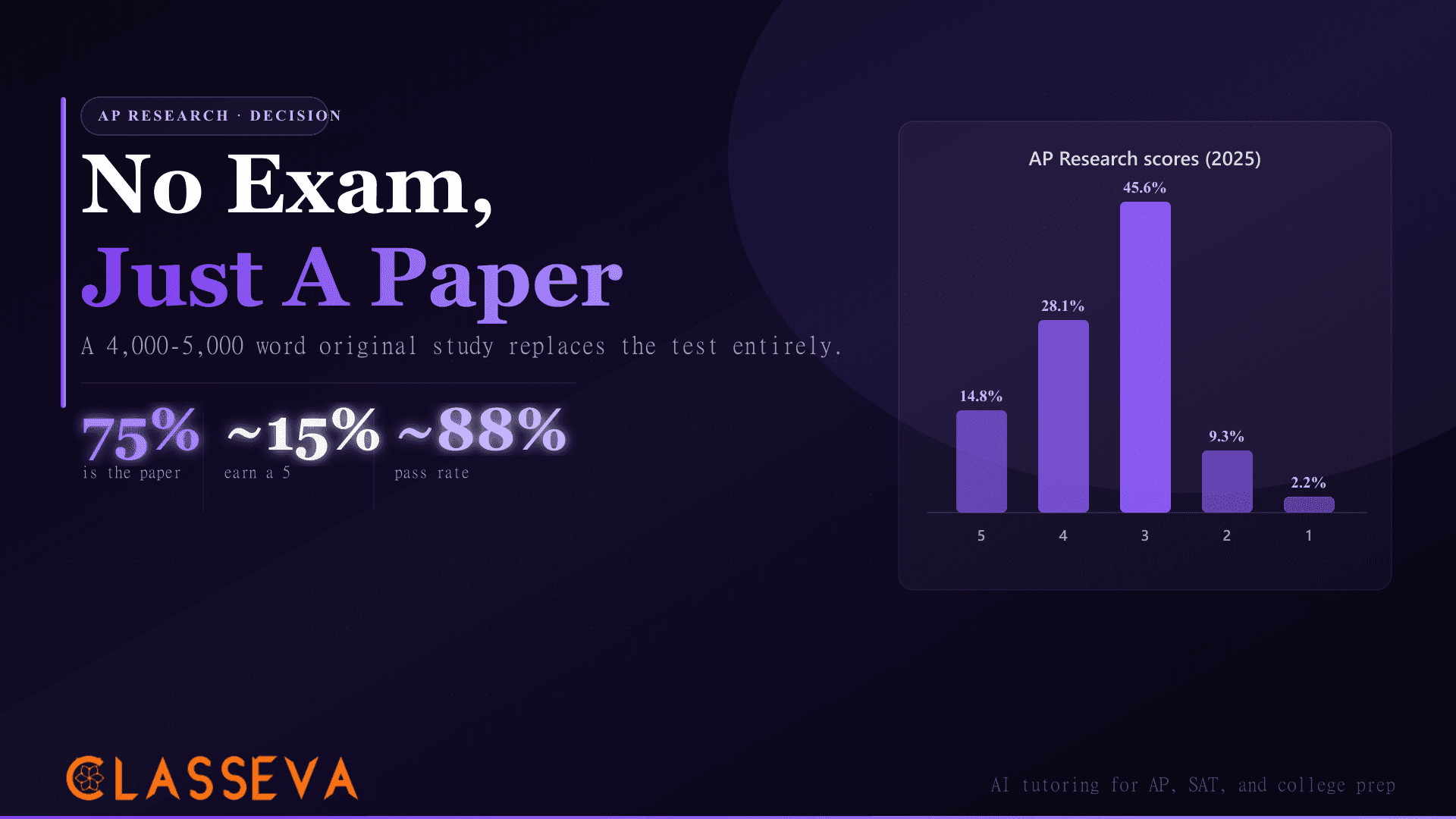
In May 2025, AP Research drew roughly 43,000 test-takers, and the scores skewed high: about 14.8% earned a 5, 28.1% earned a 4, and 45.6% earned a 3, per the College Board AP Research score distributions. Only 2.2% scored a 1, and the mean landed near 3.44. [VERIFY: 2025 College Board AP Research score distributions] That distribution looks generous until you account for who sits in the room.
| AP Score | % of Test-Takers (2025) | College Readiness Signal |
|---|---|---|
| 5 | ~14.8% | Extremely well qualified |
| 4 | ~28.1% | Well qualified |
| 3 | ~45.6% | Qualified |
| 2 | ~9.3% | Possibly qualified |
| 1 | ~2.2% | No recommendation |
Approximate May 2025 AP Research score distribution. [VERIFY: 2025 College Board AP Research score distributions]
Why the 88% Pass Rate Misleads
An 88% pass rate looks like an easy A. It hides a brutal selection filter. Every AP Research student already passed AP Seminar, chose to continue into a second Capstone year, and committed to an independent study with no exam safety net. That pool self-selects for students who write well and finish long projects. The high pass rate measures a filtered population, not a low bar.
What Does AP Research Actually Grade?
AP Research grades two things: a 4,000-5,000 word academic paper worth 75% of your score, and a 15-20 minute presentation with oral defense worth 25%. There is no multiple-choice section and no written exam. The College Board scores the paper centrally through the AP Digital Portfolio, and a panel including your AP Research teacher scores the defense. That two-part structure defines the entire course.
The Academic Paper (75%)
The academic paper carries 75% of your AP Research score, and it reads like a college thesis in miniature. You frame a research question, review the existing literature, design and justify a method, collect or analyze data, and report findings in 4,000 to 5,000 words. The College Board details the academic paper requirements on the AP Research assessment page. A vague question or a thin method caps your score no matter how clean the prose looks.
The Presentation and Oral Defense (25%)
The presentation and oral defense count for 25% and run 15 to 20 minutes total. You present your research question, your method, and your findings, then field 3 to 4 questions from a panel that includes your AP Research teacher and additional adult evaluators. The College Board recommends keeping the presentation near 15 minutes so at least 5 minutes remain for defense questions. This is where a student who actually understands their own study separates from one who outsourced the thinking.
Three out of every four points in AP Research come from one document. A student who treats the academic paper as a real research project, refining the question over months and stress-testing the method, controls the dominant share of the grade. A student who writes it in the final weeks cannot recover those points in a strong oral defense, because the defense is only worth 25%. Start the paper early, and revise it often.
Why There Is No AP Research Exam
AP Research drops the exam because the course aims to measure something a timed test cannot: the ability to run an independent inquiry from question to conclusion. A multiple-choice section rewards recall. An original paper rewards research design, source evaluation, and sustained argument. The College Board built AP Research as the capstone of the two-year sequence precisely so students demonstrate the full research arc, not a single afternoon of test-taking.
How Big Is the AP Research Time Commitment?
AP Research demands one of the heaviest time commitments of any AP because the work runs across the entire school year, not the weeks before a May exam. Students commonly invest 100-plus hours across the literature review, method design, data collection, analysis, and multiple paper drafts. The hours arrive in waves tied to internal deadlines. There is no way to cram an original study the night before it is due.
Where the Hours Actually Go
The single largest time sink is data collection and analysis, not writing. Designing a survey, running interviews, building a dataset, or analyzing a corpus eats weeks that students rarely budget for. Writing the paper feels like the assignment, but the research behind it consumes more calendar time. Students who underestimate the method phase end up writing 4,000 words around thin evidence, which the readers notice.
Picking a question too broad to answer in one school year. A student who asks how social media affects teenagers cannot finish; a student who asks whether a specific notification setting changes study-session length in their own school can. Narrow the scope until the method becomes feasible with the time and access you actually have. Ambitious questions with no workable method produce thin papers and low scores.
The Submission Deadline Trap
AP Research runs on hard College Board submission deadlines inside the AP Digital Portfolio, and a missed deadline forfeits points you cannot recover. The academic paper has a fixed submission date in the spring, typically in late April or early May. Miss it, and there is no makeup paper and no exam to fall back on. Students who map these dates in the fall and reverse-engineer their schedule finish calmly; students who discover them in March scramble.
How Does AP Research Lead to the AP Capstone Diploma?
AP Research is the second and final course in the AP Capstone Diploma sequence. To earn the AP Capstone Diploma, you need a 3 or higher in both AP Seminar and AP Research, plus a 3 or higher on four additional AP exams of your choosing. Pass Seminar and Research but not four other exams, and you earn the AP Seminar and Research Certificate instead.
The College Board lays out both award paths on the AP Capstone Award page. AP Research exists to prove a student can run a full independent study, the capstone skill the two-year program builds toward. If you are stacking the four additional exams the diploma requires, the AP credit and college tuition savings guide shows how those scores translate into real dollars.
AP Seminar (Year 1)
- •Stimulus packets and a structured end-of-course exam
- •Team project plus an individual research-based essay
- •Exam counts for 45% of the score
- •Builds research and argumentation foundations
- •The required prerequisite for AP Research
AP Research (Year 2)
- •A fully self-designed, original year-long study
- •A 4,000-5,000 word academic paper (75% of score)
- •No exam at all; an oral defense covers the other 25%
- •Heaviest sustained time commitment of the two
- •Completes the AP Capstone Diploma sequence
Is AP Research Worth the Workload?
For students aiming at selective colleges or research-heavy majors, AP Research is worth the hours. It produces something most applicants never have: a real research paper and a defended thesis you completed in high school. Admissions readers recognize the AP Capstone Diploma as a signal that a student can run independent work, which a high test score alone does not show. The skills also transfer directly to college coursework.
The independent research AP Research develops feeds straight into college applications. The same question-framing and source evaluation that earns AP Research points strengthens a Common App activities list and supplemental essays. A finished, defended research paper gives a student concrete material to write about, and it pairs with strong course rigor. When you plan a demanding senior load, weigh how AP Research affects your senior-year course rigor for admissions.
AP Score Predictor
If you are mid-year in AP Research, the useful question is where your current paper draft and defense readiness project on the 1 to 5 scale. Classeva's AP Score Predictor maps your practice performance to a projected score band so you know whether to push harder on the method, the writing, or the oral defense before the spring submission deadline.
AP Score Predictor
Estimate your AP Research score band from your current paper draft quality and defense readiness, and see which part of the project needs the most work before the spring submission deadline.
Students weighing how AP Research fits alongside a content-heavy schedule often compare it against decision posts like the AP Computer Science A difficulty breakdown, the AP Statistics difficulty guide, and the AP Precalculus difficulty post. AP Research pairs well with content APs because its peak workload lands in winter rather than May, but only if you respect the paper deadline.
Key Takeaways
- AP Research has no exam. Your full AP score comes from a 4,000-5,000 word academic paper (75%) and a 15-20 minute presentation with oral defense (25%), both tied to a year-long original study.
- The pass rate is high but the bar is not low. Roughly 88% scored 3 or higher in May 2025 and about 14.8% earned a 5, yet every test-taker already cleared AP Seminar first. [VERIFY: 2025 College Board data]
- The academic paper drives the grade. At 75%, a sharp question and a rigorous method matter more than a polished oral defense, which is only worth 25%.
- The time commitment dwarfs almost any other AP. The work spreads across the whole year, often 100-plus hours, with the heaviest load in the winter data-collection and drafting phases.
- Scope is the most common failure point. Questions too broad to answer in one school year produce thin papers; narrow until the method becomes feasible with your real time and access.
- Missed portfolio deadlines forfeit points with no makeup. The spring paper submission is fixed, and there is no exam to fall back on, so mapping deadlines in the fall is the safest move.
- AP Research completes the AP Capstone Diploma. A 3 or higher in AP Seminar and AP Research, plus four more AP exams at 3 or higher, earns the diploma; pass only the two Capstone courses and you earn the certificate.