Is AP Precalculus Hard? The Newest AP Exam Decoded
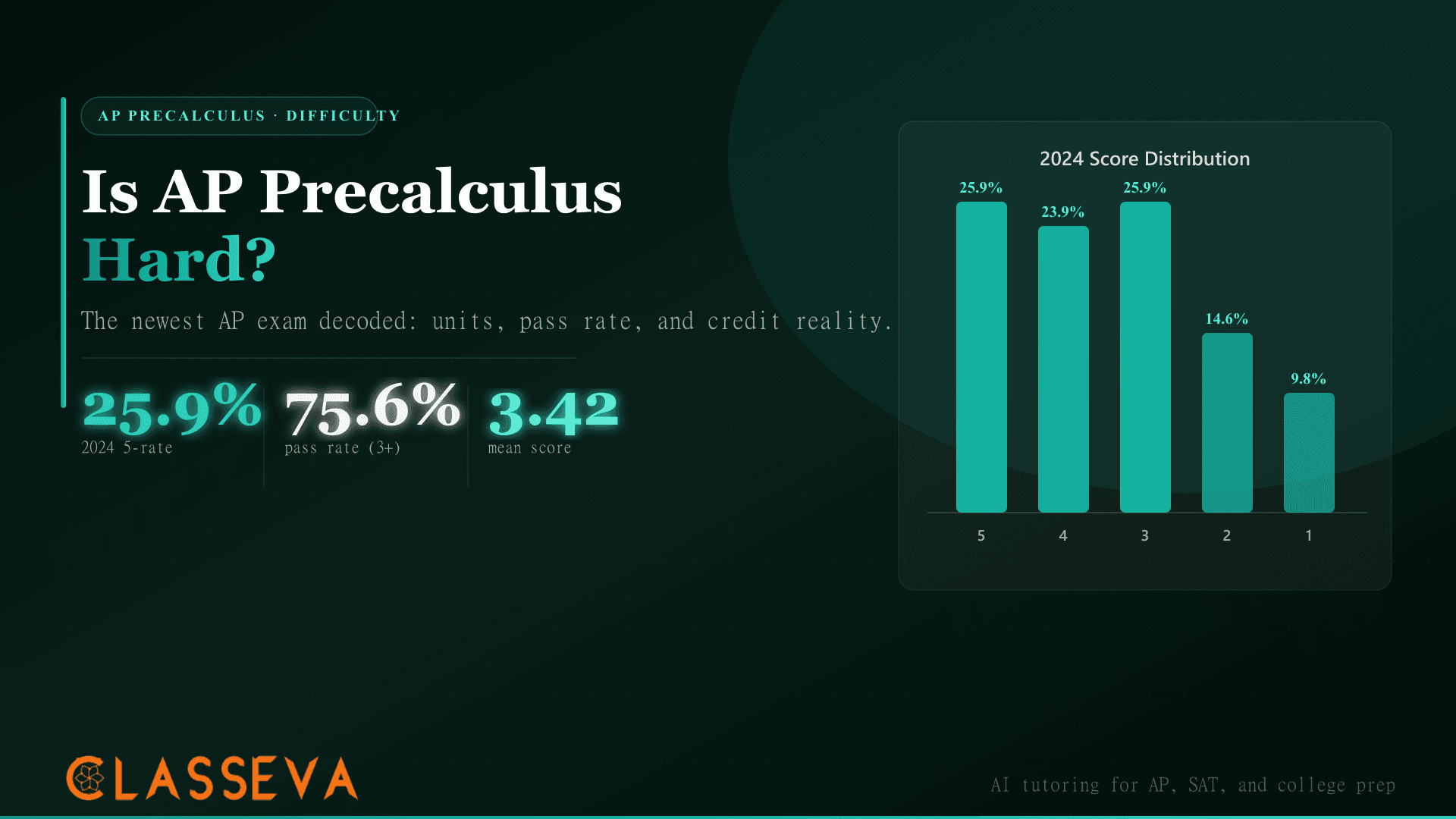
AP Precalculus posted a 25.9% 5-rate and a 75.6% pass rate in its 2024 debut, numbers that look forgiving next to almost any other AP math exam. The honest read is more complicated. This is the newest AP exam, and the first cohort that sat for it in May 2024 chose to be there. Most were strong math students at schools that adopted the course early, so the score distribution reflects a self-selected pool rather than a low difficulty ceiling. Whether AP Precalculus is hard depends less on the exam and more on who is sitting next to you.
Is AP Precalculus Hard?
AP Precalculus rates as moderate difficulty, easier than AP Calculus AB and most lab sciences, harder than a standard Algebra II course. The 2024 mean score of 3.42 confirms a forgiving curve for the inaugural group. But the real challenge hides in the trigonometry and modeling work, where students who coasted through earlier courses on procedure alone tend to stumble.
The 2024 Score Distribution
AP Precalculus 2024 broke down as 25.9% fives, 23.9% fours, 25.9% threes, 14.6% twos, and 9.8% ones, per the College Board AP Precalculus score distributions. The pass rate landed at 75.6% and 184,394 students took the exam in its first year. Half of all test-takers scored a 4 or 5, a strong showing that places this exam near the top of AP math results on paper.
| AP Score | 2024 % of Test-Takers | College Readiness Signal |
|---|---|---|
| 5 | 25.9% | Extremely well qualified |
| 4 | 23.9% | Well qualified |
| 3 | 25.9% | Qualified |
| 2 | 14.6% | Possibly qualified |
| 1 | 9.8% | No recommendation |
Source: College Board 2024 AP Precalculus Score Distributions. Mean score 3.42 across 184,394 test-takers.
Why the High 5-Rate Misleads
A 25.9% 5-rate sounds like an easy exam. It is not. The 184,394 students who sat for AP Precalculus in 2024 came overwhelmingly from schools that adopted the course in its very first year. Early-adopter schools skew toward well-resourced math departments and motivated students, so the pool that produced that distribution was not a cross-section of US high schoolers. As thousands more schools add the course and routine enrollment replaces enthusiastic pilots, the 5-rate will almost certainly compress toward the AP math norm.
This pattern is not unique to AP Precalculus. The AP Physics C: Mechanics distribution reads as generous for the same reason: the students who reach that course have already cleared a long math and science gauntlet. The honest framing for any new or heavily filtered AP is to read the distribution as a statement about the test-takers, not the test.
What Does AP Precalculus Test?
AP Precalculus tests fluency across function families, modeling with those functions, and reasoning about rates of change. The course covers polynomial, rational, exponential, logarithmic, trigonometric, and polar functions, then asks students to model real scenarios and interpret behavior. It is not a single-topic course. It is a survey of the functions calculus will later differentiate and integrate.
The Four Units Explained
The College Board organizes AP Precalculus into four units that build from familiar functions toward the more abstract. The first three carry the exam weight. Each unit layers modeling and rate-of-change reasoning on top of raw computation, which is where the course separates itself from a procedural Algebra II class.
The Unit 4 Twist Nobody Mentions
Here is a fact that surprises most students: Unit 4, covering parameters, vectors, and matrices, is not assessed on the AP exam. The College Board AP Precalculus exam page confirms that only Units 1 through 3 appear on the end-of-course test. Unit 4 exists to round out college readiness, and many teachers cover it after the May exam date or compress it. That reduces the effective tested scope to three units, one quiet reason the difficulty feels manageable.
The AP Precalculus exam draws only from Units 1, 2, and 3. Unit 4 (Functions Involving Parameters, Vectors, and Matrices) is part of the curriculum but does not appear on the May exam. When you build a study plan, weight your time toward the first three units and treat Unit 4 as preparation for future courses, not exam content.
How Is the AP Precalculus Exam Structured?
The AP Precalculus exam runs about 3 hours and splits into 40 multiple-choice questions and 4 free-response questions of equal section weight. Part A of the multiple-choice has 28 no-calculator questions in 80 minutes. Part B adds 12 calculator questions in 40 minutes. The free-response section pairs no-calculator and calculator questions, and students handwrite their work.
The Hybrid Bluebook Format
AP Precalculus uses a hybrid digital format that confuses first-time test-takers. Students answer the multiple-choice questions and view the free-response prompts inside the Bluebook testing app, then handwrite their free-response answers in a paper exam booklet. Knowing this format ahead of time matters. A student expecting a fully paper exam, or a fully digital one, can lose momentum adjusting on test day.
| Section | Questions | Time | Calculator | Approx. Weight |
|---|---|---|---|---|
| MCQ Part A | 28 | 80 min | No calculator | ~44% |
| MCQ Part B | 12 | 40 min | Graphing calculator | ~19% |
| FRQ (no calc) | 2 | 30 min | No calculator | ~19% |
| FRQ (calc) | 2 | 30 min | Graphing calculator | ~19% |
Source: College Board AP Precalculus Exam structure. Sections carry equal overall weight between multiple-choice and free-response.
The Free-Response Reality
The four free-response questions are where AP Precalculus earns its AP label. Students model scenarios, justify reasoning in writing, and interpret function behavior, not just compute answers. The 2024 scoring guidelines reward correct setup and clear justification, so partial credit flows to students who show structured work even when a final value goes wrong. Blank responses earn nothing. A defensible attempt almost always banks points.
AP Precalculus free-response rubrics award points for correct modeling and reasoning, not only final answers. If a problem asks you to justify why a function is increasing, write the justification even if your computation stalls. Students who leave the justification blank surrender easy points that the rubric hands to anyone who explains their thinking clearly.
AP Precalculus vs Calc AB: How Do They Compare?
AP Calculus AB is harder than AP Precalculus for most students. Calc AB opens limits, derivatives, and integrals, ideas that are genuinely new and conceptually dense. AP Precalculus consolidates function families many students have partially met before. The AP Precalculus vs Calc AB question usually resolves the same way: precalc is the foundation, and calculus is the new building raised on top of it.
AP Precalculus
- •Function families: polynomial, rational, exp, log, trig, polar
- •40 MCQ + 4 FRQ, hybrid Bluebook format
- •2024 pass rate 75.6%, 5-rate 25.9%
- •Only Units 1-3 tested; Unit 4 not assessed
- •Best as the on-ramp to calculus
- •College credit policies still being finalized
AP Calculus AB
- •New branch: limits, derivatives, integrals
- •45 MCQ + 6 FRQ, established exam format
- •Pass rate around 60% with a lower 5-rate
- •Conceptually denser and newer for students
- •Widely accepted for college Calc 1 credit
- •Standard target for STEM-leaning students
Precalc as Calculus Preparation
AP Precalculus was designed to standardize calculus readiness, and that is its strongest value. Students who enter Calc AB with shaky trigonometry or weak function-transformation instincts often struggle, not because of calculus itself but because the precalculus scaffolding never set. A solid AP Precalculus year closes those gaps before they compound. Think of it as the difference between learning calculus while still patching algebra holes versus learning calculus from a stable base.
The same self-selection logic that lifts the precalc 5-rate also shapes results in the calculus courses that follow. For the full picture on the next step, the AP Calculus BC difficulty breakdown walks through how filtered the BC pool is and why its distribution looks the way it does.
Does AP Precalculus Earn College Credit?
Some colleges award credit or placement for AP Precalculus scores of 3 or higher, but many institutions are still finalizing policy because the exam launched in 2024. The American Council on Education recommends credit for a 3 or above. In practice, AP Precalculus more often grants placement out of a remedial or introductory college math course than transcript credit, especially at selective schools.
Because policies vary widely and remain in flux, verify every target school directly. The College Board AP Credit Policy Search lists each institution current stance, and AP Precalculus is one of the most actively updated entries given its newness. Do not assume a 4 or 5 converts to dollars off tuition until you confirm it school by school.
Students often assume any AP exam with a 4 or 5 means college credit. For AP Precalculus, that assumption fails more than for older exams. Many colleges grant placement (skipping a course) without granting credit (transcript hours). Placement still helps you start in the right math course, but it does not always reduce the number of credits you must pay for. Confirm the exact policy before banking on savings.
Who Should Take AP Precalculus?
AP Precalculus fits students who want a college-level math credential and plan to take calculus, whether AP or college calculus, afterward. It works especially well for students who are strong but not yet ready to jump straight into Calc AB. The course gives them an AP-level math experience while solidifying the function fluency calculus demands.
It also widens access. Before AP Precalculus existed, students whose schools did not offer calculus had no AP math option at all. This exam changes that, which is the entire reason College Board built it. For students weighing how AP math fits a broader schedule, the AP Statistics difficulty guide offers a useful contrast: stats and precalc are the two most common non-calculus AP math paths, and they suit different goals.
How Should You Study for AP Precalculus?
Effective AP Precalculus study front-loads trigonometry, drills function transformations, and practices written justification early. Most students underestimate Unit 3, then run short on time when polar functions and identities arrive late in the year. Building a structured plan around the tested units, with deliberate practice on the weakest function family, beats passive review every time.
Past free-response questions are the highest-value practice resource. College Board publishes them with full scoring guidelines on AP Central, so you can see exactly how each point is awarded. Working released free-response sets under timed conditions, then comparing your justification against the rubric, surfaces the gap between getting an answer and earning the points. For full course content, the broader AP difficulty analysis approach used across these guides applies the same self-selection lens to other subjects.
Project Your AP Precalculus Score
If you are mid-course, mapping your practice results to a likely score band tells you where to focus before May. Classeva AP Score Predictor takes your recent practice performance and projects a score range, so you can decide whether trigonometry, modeling, or function transformations deserve the next block of study time.
AP Score Predictor
Enter your AP Precalculus practice results to project your score band and pinpoint which units to prioritize before the May exam.
For families weighing whether the exam pays off, AP credit can translate into real tuition savings, but only when a target school actually grants credit. The AP credit savings explainer walks through how to estimate that value before committing to the course.
Key Takeaways
- AP Precalculus launched in 2024 and posted a 25.9% 5-rate with a 75.6% pass rate. The mean score was 3.42 across 184,394 test-takers, a forgiving debut shaped by early-adopter self-selection rather than an easy exam.
- Only Units 1-3 are tested. Polynomial/Rational, Exponential/Logarithmic, and Trigonometric/Polar appear on the exam. Unit 4 (Parameters, Vectors, Matrices) is taught for college readiness but not assessed.
- The exam is a hybrid Bluebook format: 40 multiple-choice questions answered digitally plus 4 free-response questions handwritten in a paper booklet. Know the format before test day.
- It is a real AP with free-response questions, not a relabeled Algebra II course. The free-response section rewards modeling and written justification, and partial credit flows to defensible attempts.
- AP Precalculus is easier than AP Calculus AB and serves best as the standardized on-ramp to calculus. Strong precalc foundations prevent the trigonometry and function gaps that sink Calc AB students.
- College credit policies remain unsettled. Many schools grant placement rather than transcript credit, and some have not finalized a policy. Verify each target school on the College Board AP Credit Policy Search.
- Trigonometry is the highest-leverage study target. Unit 3 trips up the most students, so front-load the unit circle, identities, and inverse trig instead of saving them for the end of the year.