Is AP Physics C: Mechanics Hard? The Self-Selection Effect
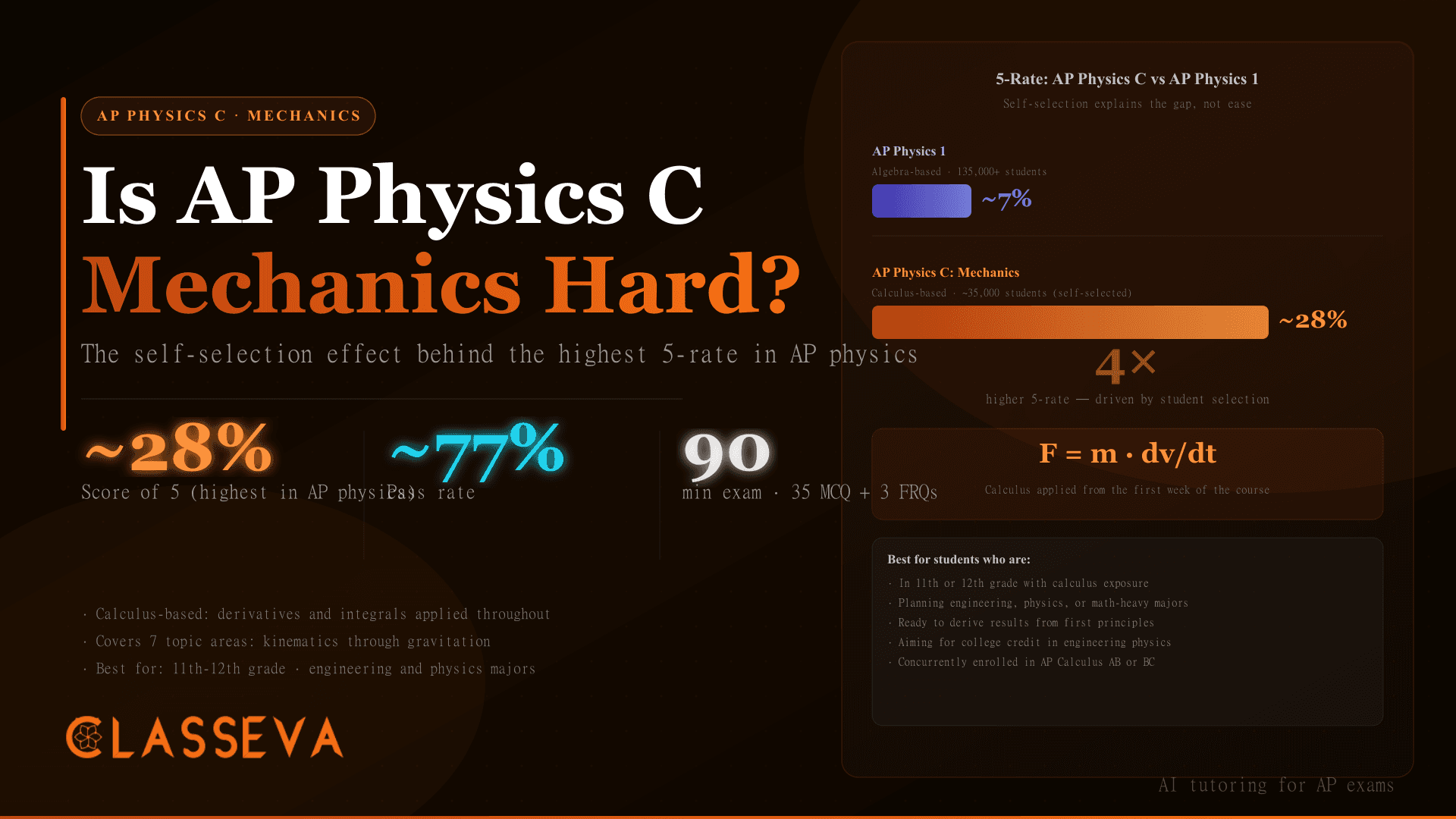
Pull up the College Board's AP score distributions and sort by 5-rate. AP Physics C: Mechanics lands near the top, around 25-30%, the highest of any AP physics exam. The instinctive reaction for most students is to conclude the course must be relatively straightforward compared to AP Physics 1's 7% 5-rate. That reading misses the underlying dynamic. The 5-rate reflects who takes the exam, not how simple the material is. The pool taking Physics C consists almost entirely of juniors and seniors who have already succeeded in a prior physics course and are concurrently enrolled in or have completed calculus. Comparing Physics C's 5-rate to Physics 1's is like comparing a varsity team's win rate to a JV team's: the populations do not compete from the same starting line. This breakdown covers what the course actually demands and who should take it.
Is AP Physics C: Mechanics Hard?
AP Physics C: Mechanics is a demanding, calculus-based course covering the same mechanics territory as AP Physics 1 but treating every concept through derivatives and integrals. The pass rate runs approximately 70-75% and the 5-rate approximately 25-30%. [VERIFY: 2025 College Board data at AP Central] For a student who has not yet taken calculus, or who found algebra-based physics difficult, the calculus layer adds genuine mathematical depth that most prep books underestimate.
Score Distribution and 5-Rate
Roughly 35,000-40,000 students take AP Physics C: Mechanics annually, compared to roughly 135,000 for AP Physics 1. [VERIFY: 2025 College Board] The score distribution leans sharply toward the upper end, reflecting the filtered cohort:
| Score | Approximate % | What It Means |
|---|---|---|
| 5 | ~28% | Exceptional: college credit at virtually all universities |
| 4 | ~27% | Strong: credit at most universities |
| 3 | ~22% | Pass: credit at many universities |
| 2 | ~14% | Below passing for most purposes |
| 1 | ~9% | No credit |
Source: College Board AP Physics C: Mechanics Score Distributions (approximate figures; verify at apcentral.collegeboard.org). [VERIFY: 2025 data] Mean score approximately 3.4-3.6. Pass rate ~77%.
Why the 5-Rate Does Not Tell the Whole Story
The 25-30% 5-rate does not mean AP Physics C: Mechanics is easier than AP Physics 1. It means the students who take it are not a random cross-section of AP test-takers. The cohort arrives with a specific profile: they have usually passed AP Physics 1 (or a rigorous pre-AP physics course), they are enrolled in or have completed Calculus AB or BC, and a teacher or counselor has recommended them for the course based on demonstrated math ability.
A student who earned a 3 in AP Physics 1 and has not yet taken calculus would face a genuinely harder experience in Physics C than the 5-rate implies. The calculus adds a layer of mathematical reasoning that algebra-based physics never requires. Students who underestimate this consistently report that rotational dynamics and oscillations hit harder than expected, because those topics require setting up and solving differential equations of motion, not just substituting values into formulas.
Before citing AP Physics C: Mechanics' 5-rate in conversations about difficulty, add this qualifier: “among students who were strong enough in calculus and physics to attempt the course in the first place.” That population is genuinely different from the one taking AP Physics 1. The 5-rate tells you something real about the quality of the students, not the leniency of the exam.
What Calculus Do You Need for AP Physics C?
AP Physics C: Mechanics requires working knowledge of derivatives (rates of change) and integrals (accumulated quantities). Students who have completed AP Calculus AB carry the tools needed for most of the course. AP Calculus BC adds series, parametric equations, and more integration techniques, which Physics C uses in oscillations and gravitation. Most students take Physics C concurrently with Calculus BC.
Derivatives with respect to time (dx/dt, dv/dt)
The foundation of kinematics. Velocity is the derivative of position with respect to time; acceleration is the derivative of velocity. AP Physics C requires deriving these relationships, not just applying v = v₀ + at from memory.
Integrals for accumulated quantities (∫F·dx, ∫F·dt)
Work equals the integral of force over displacement: W = ∫F·dx. Impulse equals the integral of force over time: J = ∫F·dt. These appear in the work-energy and momentum units and show up in FRQs as area-under-curve problems.
Second-order differential equations (d²x/dt² = -(ω²)x)
Oscillations and simple harmonic motion require solving a differential equation of motion. AP Calculus AB does not cover differential equations explicitly, but Physics C requires recognizing the SHM form and applying the standard solution x(t) = A·cos(ωt + φ).
Integration of 1/r² functions (gravitation)
Gravitational potential energy and field calculations require integrating inverse-square functions. This appears in the gravitation unit and in some FRQ parts involving orbital mechanics or escape velocity derivations.
Moment of inertia via integration (∫r²·dm)
The rotation unit requires computing moment of inertia for continuous mass distributions using integration. For a solid disk, rod, or sphere, this means setting up and evaluating a definite integral, a skill that AP Calculus AB covers in general terms but that Physics C applies specifically to mass distributions.
Calculus Operations by Topic Area
Every topic in AP Physics C: Mechanics uses calculus, but the operations differ by unit. The table below maps each topic to the primary calculus tools it demands. Rotational motion and oscillations use the most advanced calculus; kinematics and Newton's laws use the most foundational.
AP Calculus AB covers derivatives and basic integrals, which handles kinematics, Newton's laws, work-energy, and momentum well. The two areas where Calculus BC helps most are oscillations (which use a second-order differential equation) and the gravitation unit (which uses inverse-square integration). Taking Physics C concurrently with Calculus BC is the most common path for a reason: you learn the calculus exactly when Physics C needs it.
What Does AP Physics C: Mechanics Cover?
AP Physics C: Mechanics covers seven topic areas, each treated with calculus-level rigor. Unlike AP Physics 1, which introduces these concepts algebraically, Physics C requires deriving results from first principles, not just applying pre-built formulas. A student who can recite v = v₀ + at without being able to derive it from F = m(dv/dt) will hit a wall in the first unit.
The 7 Topic Areas and Their Calculus Demands
| Topic Area | What It Covers | Calculus Required |
|---|---|---|
| Kinematics | Position, velocity, acceleration in 1D and 2D; projectile motion | Derivatives and integrals with respect to time |
| Newton's Laws | F = m(dv/dt); equations of motion; friction; circular motion | First-order differential equations of motion |
| Work, Energy, Power | W = ∫F·dx; conservative and non-conservative forces; potential energy functions | Definite integrals; F = -dU/dx |
| Systems of Particles and Linear Momentum | Impulse, collisions, center of mass for continuous distributions | J = ∫F dt; integration for center of mass |
| Rotation | Torque, rotational inertia, angular momentum, rolling motion | I = ∫r²dm; angular impulse |
| Oscillations | Simple harmonic motion; mass-spring; pendulums; damped and driven oscillations | Second-order differential equations: d²x/dt² = -(ω²)x |
| Gravitation | Gravitational fields, orbital mechanics, escape velocity, gravitational potential energy | Integration of 1/r² functions; energy conservation with integral forms |
Source: AP Physics C: Mechanics Course and Exam Description, College Board (AP Central). [VERIFY: 2025-26 CED at AP Central for current topic weighting]
How Does AP Physics C Compare to AP Physics 1?
AP Physics C: Mechanics and AP Physics 1 cover the same mechanics territory. The difference is mathematical depth. Physics 1 treats kinematics algebraically; Physics C derives everything through calculus. The same kinematic situation that Physics 1 describes with v = v₀ + at, Physics C arrives at by integrating F = m(dv/dt) with respect to time, starting from Newton's second law and first principles.
Side-by-Side Comparison
AP Physics 1: Algebra-Based
- •Algebra-based: no calculus required
- •Covers 7 units: mechanics + oscillations + waves
- •~7% 5-rate, ~43% pass rate
- •135,000+ students annually
- •3-hour exam: 50 MCQ + 5 FRQs
- •Best for: 10th-11th graders, non-engineering paths
AP Physics C: Mechanics
- •Calculus-based: requires concurrent or prior calc
- •Covers 7 mechanics topics only (no waves)
- •~28% 5-rate, ~77% pass rate (self-selected cohort)
- •~35,000 students annually
- •90-minute exam: 35 MCQ + 3 FRQs
- •Best for: 11th-12th graders, engineering and physics majors
Engineering programs at most US universities require the calculus-based physics sequence (two semesters) for degree completion. A score of 4 or 5 on AP Physics C: Mechanics typically satisfies the first semester of that requirement. A score of 4 or 5 on AP Physics 1 usually does not, because Physics 1 is algebra-based and most engineering sequences are explicitly calculus-based. That distinction matters when evaluating the two courses for college planning purposes.
Should You Take AP Physics 1 First?
Most students benefit from taking AP Physics 1 before AP Physics C: Mechanics, but the College Board imposes no prerequisite beyond concurrent or prior calculus enrollment. Whether Physics 1 first makes sense depends on your grade level, calculus timing, and prior physics exposure.
Students starting physics in 10th or 11th grade without any prior calculus should take Physics 1 first. The algebra-based mechanics foundation builds physical intuition for force, energy, and momentum that Physics C assumes you already have. Students who jump from zero physics background directly into Physics C simultaneously learn mechanics concepts and their calculus treatment from scratch, a load that compresses a natural learning progression into a single semester.
The most efficient path for engineering-bound students: take AP Physics 1 in 11th grade while completing AP Calculus AB, then take AP Physics C: Mechanics (and AP Calculus BC if not already completed) in 12th grade. This path builds mechanics intuition algebraically first, then adds the calculus layer when both Physics C and Calc BC are running simultaneously. Students who follow this sequence consistently report that Physics C feels like a deeper re-examination of familiar ideas rather than a scramble to learn everything at once.
Students in 12th grade who are already enrolled in Calculus BC and have a strong pre-AP physics background from 9th or 10th grade can often succeed in Physics C without taking Physics 1 first. The decision hinges on whether your prior physics course built genuine mechanics intuition or just covered topics without depth. If you passed a pre-AP physics course and understand why F = ma rather than just how to plug numbers into it, you are likely ready to take Physics C directly.
How Is the AP Physics C: Mechanics Exam Structured?
The AP Physics C: Mechanics exam runs 90 minutes total, split into two equal sections of 45 minutes each. Section I covers 35 multiple-choice questions, and Section II covers 3 free response questions. [VERIFY: 2025-26 AP Physics C: Mechanics CED at AP Central] This makes Physics C notably shorter than AP Physics 1's 3-hour exam, though the depth of calculus reasoning required per question is greater.
The 3 FRQs and What They Require
The three FRQs in Section II each carry roughly equal weight and each span multiple parts. Unlike AP Physics 1's five FRQ types, Physics C does not name its FRQ categories officially. But reviewing released exams at AP Central reveals consistent patterns across exam years:
All three FRQs share a common requirement: students must show calculus work explicitly. A correct numerical answer without a supporting derivative or integral derivation earns partial credit at best. This is different from AP Physics 1, where showing a formula and substituting values can earn full marks on many parts. The Physics C scoring guidelines reward mathematical derivation, not just correct results.
Who Should Take AP Physics C: Mechanics?
AP Physics C: Mechanics fits a specific student profile. Not every student who performs well in AP Physics 1 or AP Calculus AB should take it, and not every student who does should take it in junior year. Use the readiness criteria below to assess fit.
You have completed or are concurrently enrolled in AP Calculus AB or BC
This is the non-negotiable starting condition. Physics C applies calculus from the first week. Students who have not yet encountered derivatives and integrals will spend the opening units simultaneously learning both calculus and physics, which compresses the learning curve significantly.
You understand why F = ma, not just how to use it
Students who can explain why Newton's second law produces a specific outcome in a given situation, rather than just plugging variables into the equation, are already thinking at the level Physics C demands. If you can only use formulas without explaining their physical meaning, Physics C will be harder than the 5-rate suggests.
You plan to major in engineering, physics, or a math-intensive science
Engineering programs universally require the calculus-based physics sequence. A 4 or 5 on Physics C places you out of the first semester of that sequence at most universities. For non-engineering majors who need only one physics course, AP Physics 1 or AP Physics 2 credit is often sufficient and more accessible.
You have time to study 4-6 hours per week outside of class
Physics C covers seven topic areas in a year-long or semester-length course. The derivation-heavy FRQs require practice beyond what any in-class instruction provides. Released AP Central FRQs are the most direct preparation; reading scored student responses at each point level reveals the exact standard the rubric requires.
Estimate Your AP Score
If you want to see where your current AP Physics C practice maps onto the actual 5-point scale, use Classeva's AP Score Predictor. It projects a likely score band from your practice MCQ accuracy and FRQ point totals. The AP Credit Savings Calculator shows what a 4 or 5 in Physics C earns in tuition credit at your target schools. Engineering programs with established AP credit policies grant an average of $4,000-$8,000 in tuition savings per semester course waived, based on published AP credit policies.
AP Score Predictor
Enter your AP Physics C: Mechanics practice results to project your score range and identify which section to prioritize in your remaining preparation time.
For the complete AP Physics C: Mechanics resource archive, including past FRQs with scoring guidelines and unit-by-unit coverage notes, visit the AP Physics C: Mechanics resources hub. Students weighing their AP science and math lineup can also find the difficulty breakdowns for AP Calculus AB and AP Calculus BC useful for scheduling decisions alongside Physics C. College Board publishes the official AP Physics C: Mechanics course description and past exam materials at AP Students.
Key Takeaways
- The ~25-30% 5-rate reflects self-selection, not ease. AP Physics C: Mechanics draws roughly 35,000 students per year, most of them juniors and seniors already strong in both physics and calculus. Comparing this 5-rate to AP Physics 1's 7% is a population mismatch. [VERIFY: 2025 College Board]
- The course is calculus-based throughout. Derivatives and integrals appear in every topic area, from kinematics to gravitation. Students who have not yet encountered d/dt or ∫F dx will face a steep adjustment in the opening weeks.
- The 90-minute exam format is shorter than most AP exams. Section I is 35 MCQ in 45 minutes; Section II is 3 FRQs in 45 minutes. Every FRQ requires explicit calculus derivation, not just numerical substitution. [VERIFY: current CED at AP Central]
- AP Calculus AB provides sufficient foundation for most of the course. Calculus BC adds the differential equations and advanced integration techniques that help with oscillations and gravitation. Taking Physics C concurrently with Calculus BC is the most common successful path.
- AP Physics C: Mechanics earns significantly more engineering credit than AP Physics 1. A score of 4 or 5 typically satisfies the first semester of the calculus-based physics sequence at most US universities. Physics 1 credit rarely achieves the same result at engineering programs.
- Taking AP Physics 1 first helps most students. The algebra-based mechanics foundation builds physical intuition that Physics C assumes. Students who skip Physics 1 can succeed, but they face a steeper first-semester adjustment while learning both concepts and calculus simultaneously.
- Released FRQs from AP Central are the most direct exam preparation. Reading scored student responses at each rubric point level reveals the calculus derivation standard more concretely than any prep book. College Board publishes scored samples for every released exam year.
Frequently Asked Questions
What percentage of students get a 5 on AP Physics C: Mechanics?
Approximately 25-30% of AP Physics C: Mechanics test-takers earn a 5 in a typical year, the highest 5-rate among the AP physics exams. [VERIFY: 2025 College Board AP Score Distributions at collegeboard.org] This figure reflects a highly self-selected test-taking population, not an easier course. Most students who take Physics C have already completed AP Physics 1 and are enrolled in or have completed AP Calculus BC.
Is AP Physics C: Mechanics harder than AP Physics 1?
AP Physics C: Mechanics covers the same mechanics topics as AP Physics 1 but applies calculus throughout, adding derivation requirements and differential equation reasoning that Physics 1 does not include. A student who struggled with algebra-based mechanics will find calculus-based mechanics significantly harder. The 5-rate comparison between the two exams is misleading because Physics C draws a far more self-selected cohort of students already strong in both math and physics.
Do I need AP Calculus BC to take AP Physics C: Mechanics?
You do not need to have completed AP Calculus BC before starting AP Physics C: Mechanics. AP Calculus AB covers the derivatives and basic integration skills sufficient for most of the course. Many students take Physics C concurrently with Calculus BC, learning calculus and applying it to physics simultaneously. Comfort with derivatives and basic integrals before the second half of the course matters most, since rotational motion and oscillations require more advanced calculus applications.
Should I take AP Physics 1 before AP Physics C: Mechanics?
Taking AP Physics 1 before AP Physics C: Mechanics helps most students build physical intuition for mechanics concepts before adding calculus. Students who skip Physics 1 and jump straight to Physics C sometimes struggle in the opening weeks because they are learning both physics mechanics and calculus application simultaneously. Students with strong math backgrounds and prior physics exposure from a rigorous pre-AP course can succeed in Physics C without Physics 1, but this path requires stronger self-directed preparation.
How long is the AP Physics C: Mechanics exam?
The AP Physics C: Mechanics exam runs 90 minutes total, split into two equal sections: Section I is 35 multiple-choice questions in 45 minutes, and Section II is 3 free response questions in 45 minutes. [VERIFY: 2025-26 CED at AP Central] This is notably shorter than AP Physics 1, which runs 3 hours. Calculators are not permitted in Section I; scientific and graphing calculators are permitted in Section II.
Does AP Physics C: Mechanics count toward engineering college credit?
Yes. AP Physics C: Mechanics is the AP exam most likely to earn credit toward the calculus-based physics sequence required by engineering programs. A score of 4 or 5 typically places students out of the first semester of calculus-based physics at most US universities, equivalent to courses titled "General Physics I for Engineers" or "Mechanics." AP Physics 1 credit rarely satisfies calculus-based physics requirements at engineering schools. Always verify the specific transfer credit policy at each target school.
Can I take AP Physics C: Mechanics without taking AP Physics 1 or 2 first?
Yes. AP Physics C: Mechanics has no official College Board prerequisite beyond concurrent or prior calculus enrollment. Many students skip AP Physics 1 and 2 entirely and take only AP Physics C. The main risk is that building calculus-based mechanics intuition from scratch takes longer than building on an algebra-based foundation. Students who have never taken any physics course should plan for a steeper first-semester adjustment and budget extra study time in the opening units.
Is AP Physics C: Mechanics worth it for pre-engineering students?
AP Physics C: Mechanics ranks among the highest-value AP exams for pre-engineering students. It earns credit at most universities for the calculus-based physics sequence, saves one course (typically 4 semester credits), and provides genuine preparation for the engineering physics curriculum. Students who score a 4 or 5 often enter college with a full semester of physics already credited, which opens schedule space for major-specific courses sooner.
Score data sourced from College Board AP Physics C: Mechanics page and AP Central AP Physics C: Mechanics course page (approximate figures; verify at collegeboard.org). FRQ structure from AP Central past exam questions. [VERIFY all figures against the July 2025 College Board annual score report.]