Is AP Physics 1 Hard? Why the 5-Rate Stays Among the Lowest
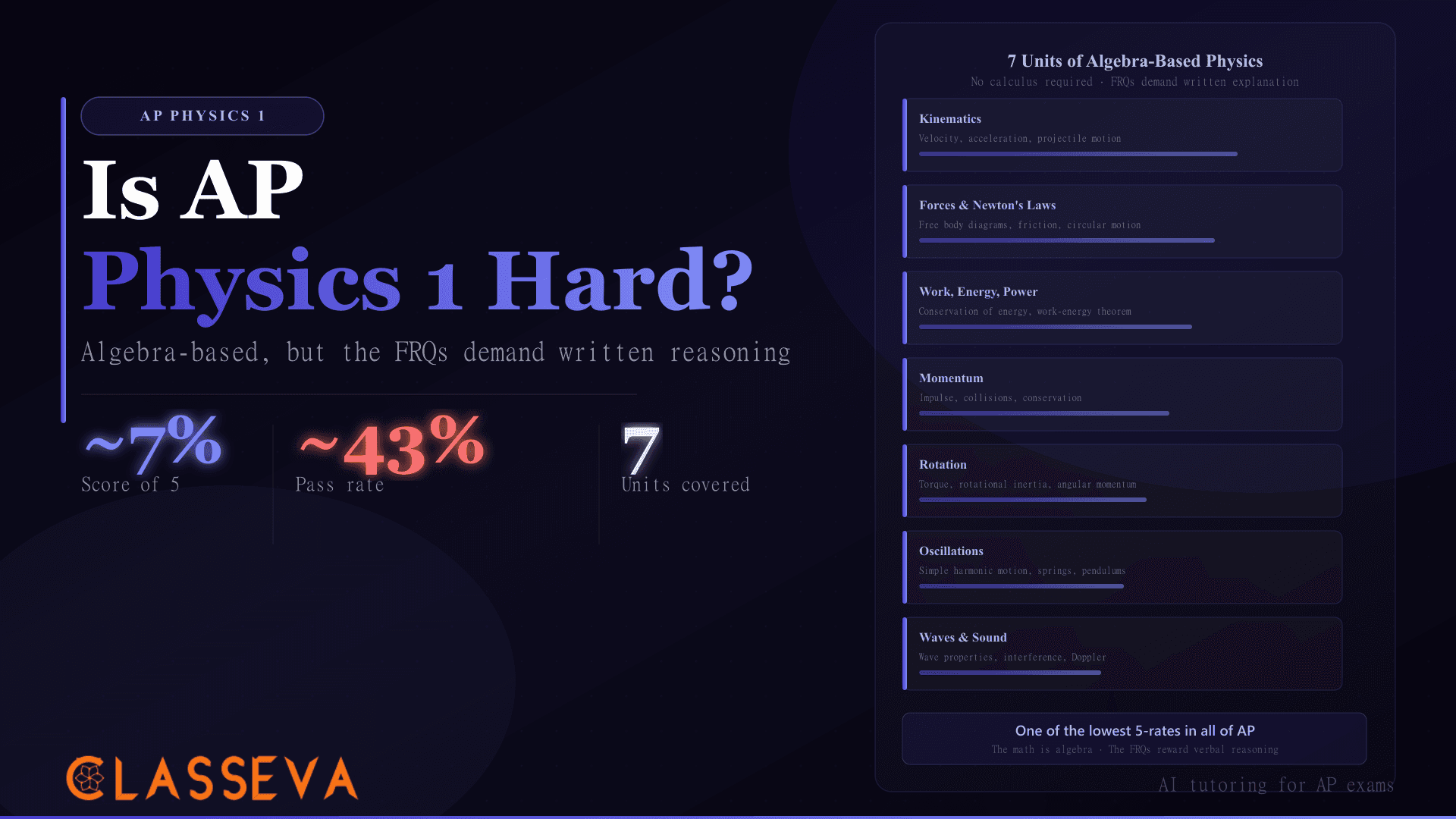
AP Physics 1's 5-rate sits near 7-9%, and the pass rate lands around 43%. Those two numbers place it among the hardest AP exams in the entire catalog. Here is the fact that surprises most students: the math is algebra-based. No calculus. Most students take the course alongside Algebra 2 or Precalculus, and the computational side is accessible to anyone who can solve a system of equations. The reason the 5-rate stays this low is the Free Response section, which rewards a skill that AP Calculus does not test and that most high school physics courses never explicitly teach: clear, precise, written explanation of physical reasoning. Students who prepare for a computation-heavy exam, the way they prepare for AP Calc, consistently stall on the FRQs. This breakdown covers what the exam actually rewards and how to prepare for the right skill.
Is AP Physics 1 Hard?
AP Physics 1 is one of the hardest AP exams by both 5-rate and pass rate. The 5-rate hovers between 7% and 9% annually, placing it consistently below AP Chemistry (~11-13%), AP Biology (~19%), and AP Calculus AB (~20%). The pass rate of approximately 43% lands near the bottom of the AP catalog. [VERIFY: 2025 College Board AP Score Distributions at College Board AP Physics 1 page] The exam runs 3 hours and covers 7 units of algebra-based physics across a multiple-choice section and a free-response section.
Score Distribution and Pass Rate
AP Physics 1 draws roughly 135,000-145,000 test-takers per year, making it one of the most-taken AP science courses. Here is the approximate score distribution based on recent College Board data [VERIFY: exact 2025 figures]:
| Score | Approximate % | What It Means |
|---|---|---|
| 5 | ~7% | Exceptional: college credit at most schools |
| 4 | ~17% | Strong: credit at many schools |
| 3 | ~19% | Pass: credit at some schools |
| 2 | ~28% | Below passing |
| 1 | ~29% | No credit |
Source: College Board AP Physics 1 Score Distributions (approximate figures; verify at apstudents.collegeboard.org). [VERIFY: 2025 data] Mean score approximately 2.25-2.40.
How AP Physics 1 Compares to Other AP Sciences
AP Physics 1 sits at the harder end of the AP science spectrum when ranked by 5-rate and pass rate. The table below compares it to related AP courses. The AP Physics C numbers look much more favorable, but the populations are not comparable: AP Physics C draws a smaller, more self-selected group of students who have completed or are concurrently enrolled in calculus.
| AP Exam | 5-Rate | Pass Rate | Math Required | Core Challenge |
|---|---|---|---|---|
| AP Physics 1 | ~7% | ~43% | Algebra | Written physics reasoning |
| AP Physics C: Mechanics | ~35-40% | ~70% | Calculus | Derivations and calculus-based reasoning |
| AP Chemistry | ~11-13% | ~56% | Algebra+ | Lab reasoning and stoichiometry |
| AP Biology | ~19% | ~70% | None | Content breadth and lab design |
| AP Environmental Science | ~8% | ~50% | None | Data interpretation and environmental systems |
Sources: College Board Score Distributions (approximate 2025 data; verify at collegeboard.org). AP Physics C figures reflect the smaller, more selected test-taker population. [VERIFY: 2025 data]
Why Is the 5-Rate So Low?
AP Physics 1's 5-rate stays near 7-9% because the exam rewards a specific skill most high school physics courses do not explicitly teach: writing clear, precise verbal explanations of physical reasoning under timed conditions. The math is not the obstacle. The FRQs are.
The Computation Trap
Students who excel in Algebra 2 bring a specific expectation to AP Physics 1: that strong preparation means learning formulas and practicing plugging numbers into them. That approach earns points on the multiple-choice section. It does not earn points on the FRQs, which explicitly penalize responses that compute without explaining.
A typical AP Physics 1 FRQ prompt reads something like: “A ball is launched at an angle. Explain, using physics principles, why the vertical component of its velocity is zero at the peak of its trajectory.” No numbers given. No formula to apply. The answer is pure reasoning: net vertical force (gravity) continuously decelerates the ball, and at the peak, the vertical velocity momentarily reaches zero before reversing direction. A student who writes “because v = v₀ + at and when a = −g, v reaches 0 at the peak” earns partial credit at best. A student who explains the physics of why that relationship holds earns full marks.
Studying the AP Physics 1 Chief Reader commentary across exam years, I noticed the same observation repeated in different forms: students demonstrated correct final answers but could not articulate the physics that produced them. That gap between computing and explaining accounts for the bulk of lost FRQ points.
Writing a formula without explaining what each variable represents physically, and why the relationship applies to this specific situation, earns partial credit on most AP Physics 1 FRQs. The rubric awards points for physics reasoning, not algebraic manipulation. Every numerical answer on an FRQ needs a justification sentence connecting the computation to the underlying principle.
What the FRQ Rubric Actually Rewards
The AP Physics 1 scoring guidelines, published for every exam year at AP Central, consistently award points across three categories: identifying the correct physics principle, applying it correctly to the specific scenario, and communicating the reasoning clearly in writing. The third category is where most partial-credit responses stop short.
| Rubric Element | Points | What Earns It |
|---|---|---|
| Physics principle | 1-2 | Naming or demonstrating the correct law, equation, or concept that governs the situation |
| Application | 1-2 | Correctly connecting the principle to the specific variables and physical context in the problem |
| Justification | 1-2 | Writing (in prose or annotated equations) why the relationship holds for this scenario, not just that it does |
Source: AP Physics 1 Scoring Guidelines, College Board (AP Central). Structure is illustrative; specific FRQs vary in point allocation and weighting.
What Does AP Physics 1 Actually Test?
AP Physics 1 covers 7 units of algebra-based physics organized by the AP Physics 1 Course and Exam Description at AP Central. The course runs at the pace of a first-semester college physics course, covering roughly one unit every three to four weeks in a year-long class.
The 7 Units and Exam Weighting
The AP Physics 1 CED organizes content into 7 units. Kinematics and dynamics (Units 1 and 2) carry the largest combined exam weighting, but every unit receives free-response coverage in most exam years. [VERIFY: exact unit weights from 2025-26 AP Physics 1 CED at College Board]
The 5 FRQs Explained
Section II of AP Physics 1 contains 5 Free Response Questions and runs 1 hour and 30 minutes. [VERIFY: 2025-26 CED exam structure at AP Central] The FRQ section carries the majority of the total exam score. Each question type demands a different mode of physics communication, but all five share the same underlying demand: written justification of physical reasoning.
One FRQ asks for a complete paragraph explaining a physics phenomenon. No numbers. No formula required. The grader awards points based entirely on whether your written explanation correctly identifies the relevant principle and applies it to the scenario. Most students skip this question type during practice and face it on exam day without preparation. That choice consistently costs them points that could not be recovered elsewhere in Section II.
How Does AP Physics 1 Compare to Physics 2 and Physics C?
Three AP Physics courses exist, and they serve different students with different math backgrounds and intended career paths. AP Physics 1 is the algebra-based mechanics course. AP Physics 2 is the algebra-based electricity, magnetism, and modern physics course, though College Board announced changes to the AP Physics lineup for 2025-26 that affect course availability. AP Physics C comes in two separately examined versions, both calculus-based. [VERIFY: current AP Physics 2 and Physics C status for 2025-26 from College Board AP Central]
AP Physics 1 vs AP Physics 2
AP Physics 2 builds on Physics 1's mechanics foundation but shifts entirely to electricity, magnetism, thermodynamics, fluid mechanics, optics, and modern physics. Both are algebra-based. Physics 2 carries a higher 5-rate than Physics 1 in most years (roughly 14-16%), but the comparison is not straightforward. The Physics 2 test-taking population (around 25,000-35,000 students annually) is far smaller and more self-selected than Physics 1's 135,000+, consisting largely of students who already succeeded in Physics 1. College Board revised the AP Physics course lineup for 2025-26, so verify the current Physics 2 course status before planning your sequence. [VERIFY: AP Physics 2 availability 2025-26 at AP Central]
AP Physics 1 vs AP Physics C: Mechanics
AP Physics C: Mechanics covers the same core mechanics topics as AP Physics 1 (kinematics, forces, energy, momentum, rotation) but uses calculus throughout. Derivatives and integrals appear in virtually every derivation. The 5-rate for Physics C: Mechanics runs around 35-40%, which initially looks much more favorable than Physics 1. But the pool taking Physics C is smaller and more self-selected: mostly juniors and seniors who have completed or are concurrently enrolled in Calculus BC. A direct 5-rate comparison misrepresents the relative difficulty of the two courses.
AP Physics 1
- •Algebra-based: no calculus required
- •Covers mechanics, oscillations, waves
- •~7% 5-rate, ~43% pass rate
- •135,000+ students annually
- •Best for: 10th-11th graders, non-engineering paths
AP Physics C: Mechanics
- •Calculus-based: requires concurrent or prior calc
- •Covers mechanics only, at calculus depth
- •~35-40% 5-rate, ~70% pass rate
- •~35,000 students (more selected group)
- •Best for: 11th-12th graders, pre-engineering
How Much Should You Study for AP Physics 1?
Students who score a 4 or 5 on AP Physics 1 typically study between 4 and 6 hours per week during the school year. Over a 35-week course, that totals roughly 140-210 hours. The time investment per week is comparable to AP Chemistry and somewhat higher than AP Biology, but the nature of the work differs. AP Physics 1 rewards active problem-solving with written explanation, not passive content review.
Study Timeline by Month
September-November: Build units with explanation habits from the start
For every formula you learn, write one sentence explaining what each variable represents physically and when the relationship applies. This is not optional review. It directly builds the FRQ explanation skill that the rubric rewards. Do not wait until spring to start writing physics sentences.
December-February: Begin timed free-response practice
Pull released AP Physics 1 FRQs from AP Central and complete them under timed conditions, one or two per week. After finishing each FRQ, grade it against the official scoring guidelines before reading the published student samples. The gap between your score and the rubric score reveals exactly which explanation habits need work.
March-April: Full practice exams and targeted FRQ drilling
Complete at least two full timed practice exams and increase FRQ practice to three or four per week. Prioritize the paragraph-length argument FRQ and experimental design FRQ, which most students skip during early practice. By April, you need fluency in all five types, not just the computational ones.
Final two weeks: Targeted review of weak units only
Use practice exam results to identify the units where you lose the most FRQ points. Do targeted review of those units' question types only. Content re-reading at this stage produces minimal score improvement. Explanation fluency and FRQ practice volume matter far more in the final stretch.
What Is the Right Preparation Approach?
The highest-return AP Physics 1 preparation activity is not solving more problems. It is solving fewer problems and explaining every answer fully. A student who solves 50 kinematics problems but cannot write a sentence explaining why their answer follows from Newton's second law will earn partial credit on the FRQ. A student who solves 20 problems and writes a justification for each will earn full marks on the same question.
Practicing Verbal Explanation
Verbal explanation practice means, after every solved problem, writing one or two sentences answering these questions: What physics principle applies here? How does it connect to this specific situation? What does the answer reveal about the physical system? That habit does not develop from passive reading or from watching worked examples on video.
The AP Central past exam questions page publishes scored student responses for every released FRQ at every score level from 1 to 7. Reading a 3-point response and a 6-point response on the same question makes the explanation standard concrete in a way no prep book can replicate. The higher-scoring responses do not contain more formulas. They contain more sentences explaining why the formulas apply.
After solving any AP Physics 1 problem, cover your work and answer this question aloud: “Which physics principle applies here, and why does it apply to this specific situation?” If you cannot answer fluently, you have not finished the problem. This drill directly prepares you for the paragraph-length argument FRQ, which asks exactly that question in writing under time pressure.
How to Know If You Are Ready for AP Physics 1
AP Physics 1 does not require prior physics experience, but students who enter with strong algebra habits and some comfort with vector concepts build skills noticeably faster in the first semester. Use the checklist below to assess readiness before 10th or 11th grade.
You can solve a two-variable algebra problem without a calculator in under 3 minutes
The multiple-choice section moves at roughly 90 seconds per question. Students who need calculator support for basic algebraic manipulation frequently run short on time before reaching the harder conceptual questions at the end of the section.
You can explain the difference between speed and velocity
Speed is a scalar (magnitude only); velocity is a vector (magnitude and direction). Students who can explain this distinction already have the core physics intuition the course builds on. Students who cannot usually need the first month of AP Physics 1 to build that intuition from scratch.
You are comfortable writing explanatory sentences under time pressure
AP Physics 1 FRQs demand written justifications across all five question types. Students who struggle to write complete, coherent sentences quickly under exam conditions will find the FRQ section the hardest part of the exam, separate from any physics content issues.
You have completed or are concurrently taking Algebra 2
The mathematical ceiling of AP Physics 1 is roughly Algebra 2 level, with trigonometry appearing in projectile motion and wave topics. Students behind in Algebra 2 can take the course but will spend more cognitive bandwidth on the math than on physics reasoning, which is where the exam points actually live.
Where Does Your Practice Performance Put You?
If you want to see where your current AP Physics 1 preparation maps on the actual 5-point scale, use Classeva's AP Score Predictor. It takes your practice scores by section and projects the likely composite band. The AP Credit Savings Calculator shows what a 4 or 5 earns in tuition credit at your target schools.
AP Score Predictor
Enter your AP Physics 1 practice results to see your projected score and which section to prioritize in your remaining preparation time.
For the full AP Physics 1 resource archive, including past FRQs with scoring guidelines and unit-by-unit coverage, visit the AP Physics 1 resources hub. Students weighing the AP science lineup may also find the difficulty breakdowns for AP Chemistry and AP Biology useful for scheduling decisions. College Board publishes the official AP Physics 1 course description, past exam materials, and current CED at AP Central.
Key Takeaways
- AP Physics 1 is one of the hardest AP exams. A ~7% 5-rate and ~43% pass rate place it near the bottom of the AP difficulty rankings by both measures. [VERIFY: 2025 College Board data]
- The math is not what makes it hard. The course is algebra-based with no calculus. The low 5-rate reflects the verbal explanation demands of the FRQ section, not computational complexity.
- Five FRQ types test distinct physics communication skills. Experimental design, quantitative/qualitative translation, paragraph-length argument, and two short-answer questions each reward written justification over computation alone.
- AP Physics 1 and AP Physics C: Mechanics overlap in content but differ in mathematical level. Physics 1 suits 10th-11th graders on algebra-level math; Physics C is calculus-based and earns more college placement credit at engineering programs.
- Study 4-6 hours per week with explanation built into every practice session. After every problem, write one sentence explaining which physics principle applies and why. That habit directly builds the FRQ skill the rubric tests.
- The paragraph-length argument FRQ surprises the most students. It has no numbers and no formula required. It asks for a clear, physics-grounded explanation of a phenomenon. Practice this type from the start of the year, not two weeks before the exam.
- College Board publishes scored sample FRQs for free at AP Central. Reading the difference between a 3-point and a 6-point response on the same question reveals the explanation standard more clearly than any prep book.
Frequently Asked Questions
What percentage of students get a 5 on AP Physics 1?
Approximately 7-9% of AP Physics 1 test-takers earn a 5 in any given year, based on College Board score distribution data. [VERIFY: 2025 College Board AP Score Distributions] This places AP Physics 1 among the lowest 5-rates of any AP exam, consistently below AP Chemistry, AP Biology, and AP Calculus AB. The low rate reflects the FRQ explanation demands, not the algebra complexity of the math.
Is AP Physics 1 the hardest AP exam?
AP Physics 1 ranks among the hardest AP exams by 5-rate, which sits near 7-9% versus the overall AP average of roughly 13-15%. By pass rate, it lands near the bottom of the AP catalog at approximately 43%, compared to 70% for AP Biology and 64% for AP Calculus AB. AP Physics C: Electricity and Magnetism rivals it in some years, but AP Physics 1 consistently places near the bottom across both metrics.
Do I need calculus for AP Physics 1?
No. AP Physics 1 is algebra-based and requires no calculus. You need to solve equations, work with vectors, and apply algebraic reasoning, but derivatives and integrals do not appear. That is the defining difference between AP Physics 1 (algebra-based) and AP Physics C: Mechanics (calculus-based). Most students take AP Physics 1 in 10th or 11th grade alongside Algebra 2 or Precalculus.
Is AP Physics 1 algebra-based or calculus-based?
AP Physics 1 is algebra-based. The official course title is "AP Physics 1: Algebra-Based," and the College Board Course and Exam Description explicitly positions the course for students who have not yet taken calculus. The calculus-based alternatives are AP Physics C: Mechanics and AP Physics C: Electricity and Magnetism, both of which require concurrent or prior calculus enrollment.
Should I take AP Physics 1 or AP Physics C: Mechanics?
Take AP Physics 1 if you are in 10th or 11th grade, have not yet taken calculus, or plan to pursue a non-engineering major that requires one physics course. Take AP Physics C: Mechanics if you are in 11th or 12th grade, are concurrently taking or have completed Calculus AB or BC, and plan to major in engineering, physics, or a math-intensive science. Most engineering programs prefer AP Physics C credit over AP Physics 1 credit for placement purposes.
Can I self-study AP Physics 1?
Self-studying AP Physics 1 is possible but difficult, particularly because the FRQs demand a verbal explanation skill that is hard to calibrate without feedback. Students who self-study and score a 4 or 5 typically spend 150-200 hours over four to six months, complete all released College Board exams under timed conditions, and find a physics teacher or tutor to grade their FRQs against the official rubric. The explanation skill does not develop from reading or video-watching alone.
Why is the AP Physics 1 5-rate so low?
The AP Physics 1 5-rate sits near 7-9% because the FRQs reward a skill most students do not practice: writing precise verbal explanations of physical reasoning. The math on the exam is algebra-level, which is accessible. But a question that asks you to "explain, using physics principles, why the velocity is zero at the peak" cannot be answered with a formula. Students who prepare for computation get stuck on explanation-based FRQs, which carry more rubric weight than numerical answers alone.
Does AP Physics 1 credit count toward engineering majors?
AP Physics 1 credit alone rarely satisfies the calculus-based physics sequence required for engineering degrees. Most engineering programs require two semesters of calculus-based physics, equivalent to AP Physics C: Mechanics and AP Physics C: Electricity and Magnetism. A score of 4 or 5 on AP Physics 1 may earn general elective credit or placement out of an introductory algebra-based physics course at some schools, but will not typically waive the calculus-based physics requirement for engineering majors.
Score data sourced from College Board AP Physics 1 page and AP Central AP Physics 1 course page (approximate figures; verify at collegeboard.org). FRQ types and rubric structure from AP Central past exam questions. [VERIFY all figures against the July 2025 College Board annual score report.]