Is AP Chemistry Hard? The Lowest 5-Rate of Any AP Science
Looking at the College Board's AP score data, one number stands out from every other AP science: AP Chemistry's 5-rate of roughly 11-13%, year after year, sits well below AP Biology (18.9% in 2025), AP Environmental Science, and both AP Physics exams except the highly self-selected Physics C. Yet the pass rate runs around 75%, higher than AP Biology. That gap (where most students reach a 3 but almost no one reaches a 5) is not an accident. It reflects something specific about how AP Chemistry is structured, and understanding it is the first step toward planning around it rather than getting blindsided by it.
Is AP Chemistry Hard?
AP Chemistry earns a pass rate around 75% and a 5-rate of roughly 11-13%, placing it among the most difficult AP sciences by top-score accessibility. The difficulty is not evenly distributed across the exam. Units covering thermodynamics, equilibrium, kinetics, and electrochemistry each require multi-step quantitative reasoning where one algebraic error propagates through an entire problem. A student who can write electron configurations and balance redox equations by hand on the same exam is already doing more simultaneous skills than any AP Biology unit demands.
The 2025 Score Distribution
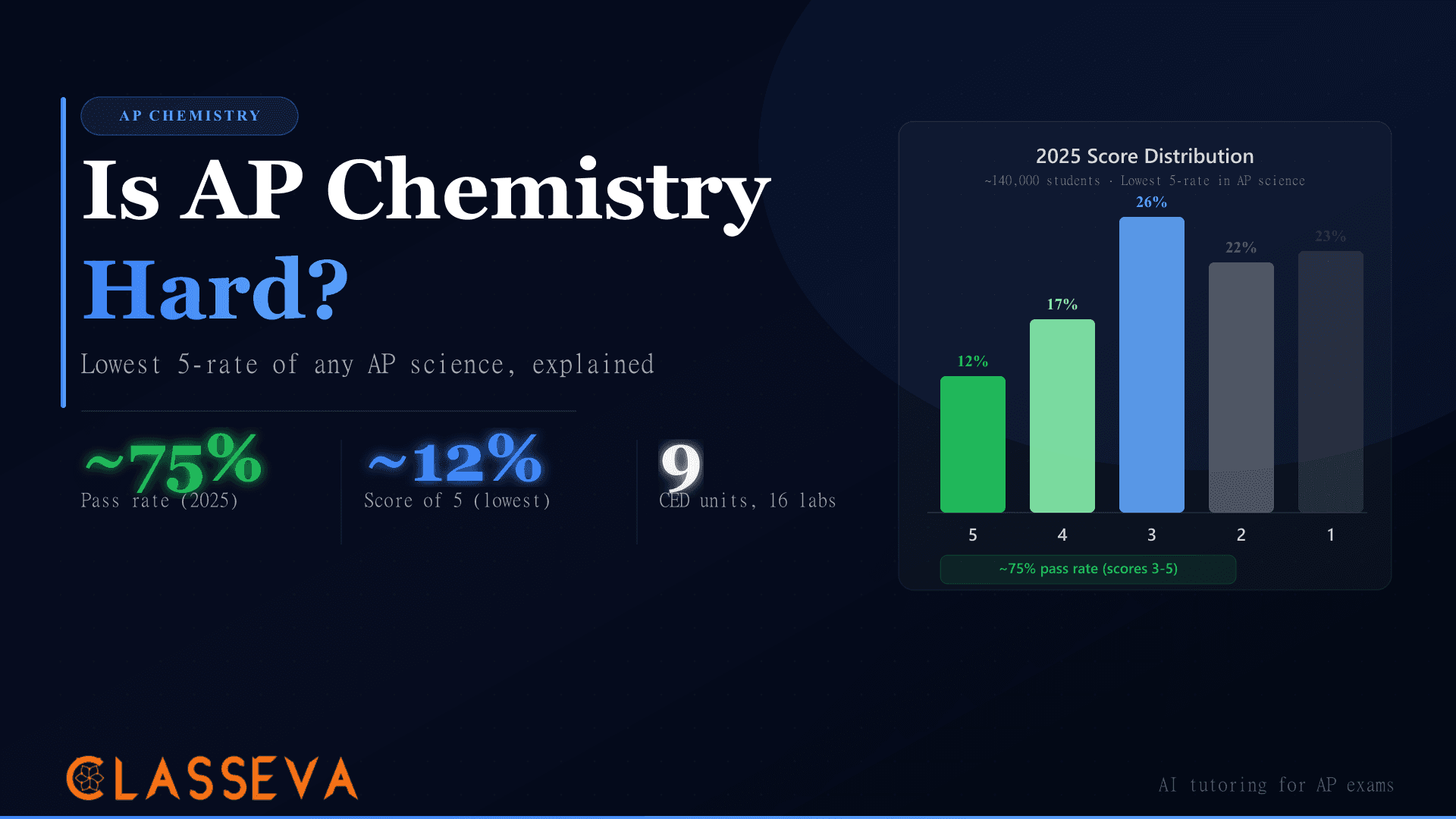
According to College Board's 2025 AP score distribution data, approximately 140,000-150,000 students sit the AP Chemistry exam each May. The distribution breaks down roughly as follows:
| Score | Approximate % | What It Means |
|---|---|---|
| 5 | 11-13% | Exceptional — college credit at most schools |
| 4 | 16-18% | Strong — credit at many schools |
| 3 | 25-27% | Pass — credit at some schools |
| 2 | 21-23% | Below passing |
| 1 | 22-25% | No credit |
Source: College Board AP Chemistry Score Distributions, 2025. Approximate ranges based on recent years; official distributions released annually in July.
Why the Pass Rate and 5-Rate Tell Different Stories
The pass rate and 5-rate diverge on AP Chemistry more sharply than on any other major AP science. A 75% pass rate means most students who take the course earn at least a 3. But a 12% 5-rate means earning the top score demands a different tier of preparation entirely.
Score 3 on AP Chemistry signals general chemistry literacy: you can balance equations, apply stoichiometry, identify reaction types, and interpret basic graphs. Score 5 requires sustained quantitative fluency across at least four calculation-intensive units simultaneously. The College Board writes the AP Chemistry FRQs to test exactly that layered fluency, which is why the distribution piles up at Score 3 rather than spreading toward 5.
Why AP Chem Has the Lowest 5-Rate of Any AP Science
AP Chemistry's 5-rate sits below AP Biology, AP Environmental Science, and AP Physics 2. The reason is not that AP Chemistry is unusually obscure or poorly taught. It is that the exam demands two things simultaneously that most AP courses demand separately: mathematical precision and conceptual depth. AP Chemistry asks for both in the same multi-part FRQ, on the same exam, across nine distinct content units.
Mathematical Density Across Multiple Units
At least five AP Chemistry units require sustained calculation under exam pressure. Stoichiometry (Unit 4) demands mole conversions across multi-step reaction pathways. Thermodynamics (Unit 6) requires calculating enthalpy, entropy, and Gibbs free energy and interpreting their signs. Kinetics (Unit 5) demands rate law derivations and integrated rate law calculations. Equilibrium (Unit 7) builds ICE tables and solves Ka, Kb, Kp, and Kc expressions. Electrochemistry (Unit 9) runs cell potential calculations using the Nernst equation under non-standard conditions.
No other AP science exam clusters this density of calculation-required units into a single test. AP Biology has quantitative sections (Hardy-Weinberg, chi-square), but they occupy a fraction of the exam. AP Chemistry's quantitative units account for roughly 50-60% of its total exam weight.
Conceptual Depth on Top of the Math
Mathematical fluency alone does not earn a 5. AP Chemistry FRQs regularly ask students to explain why a calculated result makes physical sense, predict reaction directions without calculation, or design an experiment to measure an equilibrium constant. These conceptual questions demand chemistry intuition built through lab work and deliberate practice, not just equation manipulation.
The 16 required lab investigations in the AP Chemistry Course and Exam Description are not optional practice. They map directly to FRQ questions that ask students to design experiments, identify procedural errors, or interpret real data collected under uncertainty. Students who treat labs as a peripheral course component miss the FRQ points most cleanly available to thorough preparation.
Every AP Chemistry exam since 2015 has included at least one FRQ explicitly testing lab skills: experimental design, data analysis, or identifying sources of error. Reviewing the released AP Chemistry FRQs from the past five years reveals how predictable this FRQ type is, and how directly it rewards students who engaged with the 16 CED lab investigations.
What Units Cost Students the Most Points?
The AP Chemistry CED organizes content into nine units with explicit exam-weighting ranges. Not all units are equal, and the heaviest units also tend to be the ones students reach latest in the school year, which leaves them least prepared for exam day.
Unit Weightings from the CED
| Unit | Topic | Exam Weight |
|---|---|---|
| 1 | Atomic Structure and Properties | 7-9% |
| 2 | Molecular and Ionic Compound Structure | 7-9% |
| 3 | Intermolecular Forces and Properties | 18-22% |
| 4 | Chemical Reactions | 7-9% |
| 5 | Kinetics | 7-9% |
| 6 | Thermodynamics | 7-9% |
| 7 | Equilibrium | 7-9% |
| 8 | Acids and Bases | 11-15% |
| 9 | Applications of Thermodynamics | 7-9% |
Source: AP Chemistry Course and Exam Description (CED). Unit 3 and Unit 8 carry the highest individual weights.
Unit 3 (Intermolecular Forces and Properties) carries the single largest exam weight at 18-22%. This surprises students who expect equilibrium or thermodynamics to dominate. Unit 3 spans polarity, intermolecular forces, phase diagrams, and gas laws: deceptively broad content that underpins nearly every other unit. Unit 8 (Acids and Bases) at 11-15% builds directly on Unit 7, meaning equilibrium mastery is a prerequisite for both of the exam's two heaviest-weighted units.
Why Equilibrium Is the Score Separator
Unit 7 (Equilibrium) carries 7-9% of the exam weight by itself, but its true impact compounds through Units 8 and 9. Acid-base chemistry (Unit 8, 11-15% of the exam) runs entirely on equilibrium mathematics: Ka, Kb, buffer calculations, and titration curves all require fluency with ICE tables and equilibrium constant expressions built in Unit 7. Applications of Thermodynamics (Unit 9) connects Gibbs free energy to equilibrium constants through the relationship ΔG = -RT ln K.
Students who leave Unit 7 shaky lose points on all three of these units simultaneously. That is why equilibrium preparation deserves disproportionate study time relative to its isolated exam weight.
Units 7, 8, and 9 together account for roughly 25-33% of the AP Chemistry exam. They also build on each other sequentially. A student who masters equilibrium before starting acid-base chemistry earns points across all three units. A student who reaches Unit 8 with a shaky Unit 7 foundation works under a compounding disadvantage.
How AP Chemistry Compares to AP Biology and AP Physics 1
Decision-stage students frequently ask whether AP Chemistry, AP Biology, or AP Physics 1 is the harder exam. The honest answer depends on what kind of difficulty you handle better.
AP Chemistry
- •5-rate: 11-13%
- •Pass rate: ~75%
- •9 units, calculation-heavy
- •16 required lab investigations
- •Scientific/graphing calculator required
- •Hardest to score a 5 of the three
AP Biology
- •5-rate: 18.9% (2025)
- •Pass rate: ~70%
- •8 units, conceptual-heavy
- •13 required lab investigations
- •No calculator needed
- •Broader content, less math density
AP Physics 1
- •5-rate: ~7%
- •Pass rate: ~46%
- •7 units, algebra-based
- •No dedicated lab list
- •No calculator on MCQ
- •Lowest pass rate of all AP sciences
AP Physics 1 actually posts a lower 5-rate than AP Chemistry (around 7%), but its 46% pass rate tells a more brutal overall story. AP Chemistry's 75% pass rate with a 12% 5-rate describes a different failure mode: most students can work through the material to a 3, but few reach the level of simultaneous quantitative fluency the exam rewards at the top.
For pre-med students, the relevant comparison is AP Chemistry versus AP Biology. AP Chemistry provides direct chemistry prerequisite credit. AP Biology provides direct biology prerequisite credit. Both earn college credit at most schools for scores of 4 or 5. The question is which fits your current preparation: AP Chemistry requires stronger algebra skills and greater tolerance for calculation-heavy homework; AP Biology requires more time spent on breadth across eight units but rewards readers who engage with the material carefully.
How Much Should You Study for AP Chemistry?
The 5-7 hours per week figure cited by most AP preparation resources is accurate for students aiming at a 4 or 5. Students aiming to pass (score 3) can often manage with 3-4 hours per week of consistent work. The distinction matters because AP Chemistry rewards depth over coverage: 5 hours of deliberate problem practice beats 7 hours of re-reading notes.
During the School Year
The school-year preparation split that works: spend 60% of your study time on problem sets and 40% on concept review. AP Chemistry punishes students who understand concepts but cannot execute calculations quickly. The only way to build calculation speed is repetitive problem practice, not additional reading.
Follow the CED unit order exactly
The AP Chemistry CED units build on each other. Unit 3 (Intermolecular Forces) depends on Units 1 and 2. Units 7-9 build sequentially. Taking shortcuts or skipping units creates compounding deficits.
Do every single practice problem, not just the chapter summaries
Worked examples in textbooks show you the answer. Practice problems force you to reproduce the reasoning. Aim for at least 20-30 practice problems per unit, prioritizing multi-step FRQ-style problems over single-calculation drills.
Complete every lab investigation (do not outsource or skip)
The 16 required labs are not busywork. FRQ questions on lab design and data analysis appear every year. Students who engaged with real lab data recognize the question structure immediately; students who skipped labs treat these FRQ sections as unfamiliar territory.
Build a formula reference sheet for the calculation-heavy units
AP Chemistry provides a formula sheet on exam day, but knowing when to apply each formula under time pressure requires prior familiarity. Build your own reference sheet during the school year, organized by unit, and practice applying formulas without referring to it.
The Final 8 Weeks Before May
The 8-week pre-exam push for AP Chemistry follows a specific sequence that most students get wrong. They review units chronologically (Units 1, 2, 3...) rather than by exam weight. The better sequence:
Start with Units 7, 8, and 9 (equilibrium, acids, and thermodynamics applications) since they are the most recently taught, the most interconnected, and the most likely to appear on FRQs. Then consolidate Unit 3 (intermolecular forces), which has the highest exam weight and rewards fresh review. Then work backward through the remaining units. Reserve the final two weeks for full-length timed practice exams using released College Board materials only.
AP Chemistry's free-response section includes long FRQs worth 10-15 points each. These take sustained time to complete correctly. Students who have practiced only short drills or multiple-choice questions often run out of time or lose partial credit on multi-part FRQs. Practice timed FRQs from College Board's released past exam questions starting at least 6 weeks before the exam.
Is AP Chemistry Worth Taking for Pre-Med Students?
For pre-med students, AP Chemistry provides the clearest ROI of any AP science. Medical school prerequisites require two semesters of general chemistry. A score of 4 or 5 on AP Chemistry can place out of one or both semesters at most universities, saving $4,000-$8,000 in tuition and freeing semester slots for upper-level coursework, research, or clinical experience earlier in your undergraduate career. Use the AP Credit Savings Calculator to estimate how much your specific target school awards for AP Chemistry credit.
The caveat applies to a specific subset of pre-med programs. Some universities and some medical school application reviewers prefer students to have taken college-level chemistry even with AP credit already on the transcript. Stanford's pre-med advisory explicitly recommends verifying whether your chemistry placement credit satisfies medical school chemistry prerequisites at the institutions you plan to apply to. Check each school's pre-med advising guidelines before assuming a 4 or 5 fully satisfies the requirement.
For students genuinely considering both AP Chemistry and AP Biology, the relevant question is sequencing. AP Chemistry builds the quantitative foundation that upper-level biochemistry and organic chemistry demand. AP Biology provides the systems-level understanding that MCAT Biology rewards. Taking both, if your schedule and bandwidth allow, positions pre-med students well for both college-level science and the MCAT.
How to Know If You Are Ready for AP Chemistry
AP Chemistry's prerequisites on paper are Algebra 2 and one year of high school chemistry. In practice, students who thrive in AP Chemistry also bring comfort with logarithms (used in pH, kinetics, and equilibrium calculations), facility with unit analysis (dimensional analysis across multi-step conversions), and some experience with reading scientific data. If logarithms feel unfamiliar, spend three hours reviewing them before the course starts.
Evaluate your algebra fluency honestly
Can you solve a quadratic equation by hand without a formula? Can you manipulate logarithms and exponents confidently? AP Chemistry uses both regularly in equilibrium and kinetics calculations. Algebra gaps compound through the course.
Check whether your school covers the CED fully
Some AP Chemistry courses do not reach Units 8 and 9 before the May exam due to pacing. Ask your teacher directly which units the course covers by exam week. If Units 8 and 9 are at risk of being rushed, plan independent study for those units starting in March.
Look at the time commitment realistically
AP Chemistry requires 5-7 hours of weekly study for a 4 or 5 outcome. If you are also taking AP Calculus, AP Physics, or another calculation-heavy course in the same year, stack those commitments deliberately. AP Chemistry in the same year as AP Physics 1 is common but demanding.
Ask whether the course fits your college goals
AP Chemistry earns direct credit toward chemistry prerequisites at most universities for scores of 4 or 5. If you are pre-med, pre-engineering, or any STEM major where chemistry prerequisites appear, the course-and-exam investment pays off in reduced college credit hours and lower tuition.
AP Score Predictor
If you want a realistic estimate of where your current preparation puts you on the AP Chemistry score scale, the AP Score Predictor takes your self-assessed content mastery and practice test performance and outputs a score projection with a unit-by-unit breakdown of where additional study time pays off most.
AP Score Predictor
Enter your subject and current preparation level to get a score projection and see which units to prioritize before exam day.
Key Takeaways
- AP Chemistry's 5-rate of 11-13% is the lowest of any AP science, but its ~75% pass rate sits above AP Biology and well above AP Physics 1.
- The 5-rate is low because the exam requires simultaneous quantitative fluency across at least four calculation-heavy units: equilibrium, thermodynamics, kinetics, and electrochemistry.
- Unit 3 (Intermolecular Forces, 18-22% of exam weight) is the single highest-weight unit. Units 7, 8, and 9 build on each other sequentially and together account for 25-33% of the exam.
- The 16 required lab investigations map directly to FRQ questions. Treating labs seriously is free FRQ preparation.
- Pre-med students should verify whether their target university's AP Chemistry credit satisfies medical school chemistry prerequisites before assuming the credit transfers cleanly.
- Students who score 4 or 5 typically study 5-7 hours per week during the school year and add 40-60 focused hours in the final 8 weeks.
- The final 8-week study sequence should start with Units 7-9 (not Unit 1), then Unit 3, then the remaining units by weight before capping with full-length timed practice exams.
For sibling posts in this series, see the breakdown of AP Biology difficulty and score distribution, AP Calculus AB difficulty, and whether APUSH is hard. For the AP Chemistry resources hub with CED unit guides, FRQ libraries, and scoring data, visit the AP Chemistry resources page.