AP Chemistry Unit 1 Review: Atomic Structure
This AP Chemistry Unit 1 review covers Atomic Structure and Properties, the foundation that the other eight units build on. Unit 1 looks deceptively small at 7-9% of the exam, yet electron configuration explains bonding, periodic trends explain reactivity, and Coulombic attraction explains why anything in chemistry sticks together at all. [VERIFY: 2025-26 AP Chemistry CED unit weighting] Skip Unit 1 and the rest of the course turns into memorization with no scaffolding.
Building an AI chemistry tutor that stays aligned to the College Board AP Chemistry course framework, the pattern I kept running into was this: students lose points on photoelectron spectroscopy more than any other Unit 1 skill. They can write an electron configuration. They can rank atomic radius. But hand them a PES graph and ask them to name the element, and the answers fall apart. The sections below walk through atomic mass, electron configuration, PES interpretation, and periodic trends, with the PES FRQ pattern broken down step by step. For a sense of how the full course compares to others, see how hard AP Chemistry actually is.
What Does AP Chemistry Unit 1 Cover?
AP Chemistry Unit 1 covers atomic structure and the properties that flow from it: how atoms get their mass, how electrons arrange themselves, and how that arrangement produces periodic trends. The unit answers one question across eight topics: why do elements behave the way the periodic table predicts? Every later unit assumes you can answer it.
Topics 1.1 Through 1.8
The AP Chemistry Course and Exam Description splits Unit 1 into eight numbered topics. They move from counting atoms to predicting periodic behavior in a tight logical sequence.
| Topic | Content Area | Core Skill |
|---|---|---|
| 1.1 | Moles and Molar Mass | Convert between mass, moles, and number of particles using Avogadro number |
| 1.2 | Mass Spectrometry of Elements | Calculate average atomic mass from isotope masses and abundances |
| 1.3 | Elemental Composition of Pure Substances | Find percent composition and empirical formula from mass data |
| 1.4 | Composition of Mixtures | Distinguish pure substances from mixtures using composition data |
| 1.5 | Atomic Structure and Electron Configuration | Write configurations using Aufbau, Pauli, and Hund |
| 1.6 | Photoelectron Spectroscopy (PES) | Read binding energy and electron count from a PES spectrum |
| 1.7 | Periodic Trends | Rank radius, ionization energy, and electronegativity |
| 1.8 | Valence Electrons and Ionic Compounds | Connect valence configuration to ion formation and bonding |
Source: AP Chemistry Course and Exam Description, College Board (2025-26 CED).
How Much Is Unit 1 Worth on the Exam?
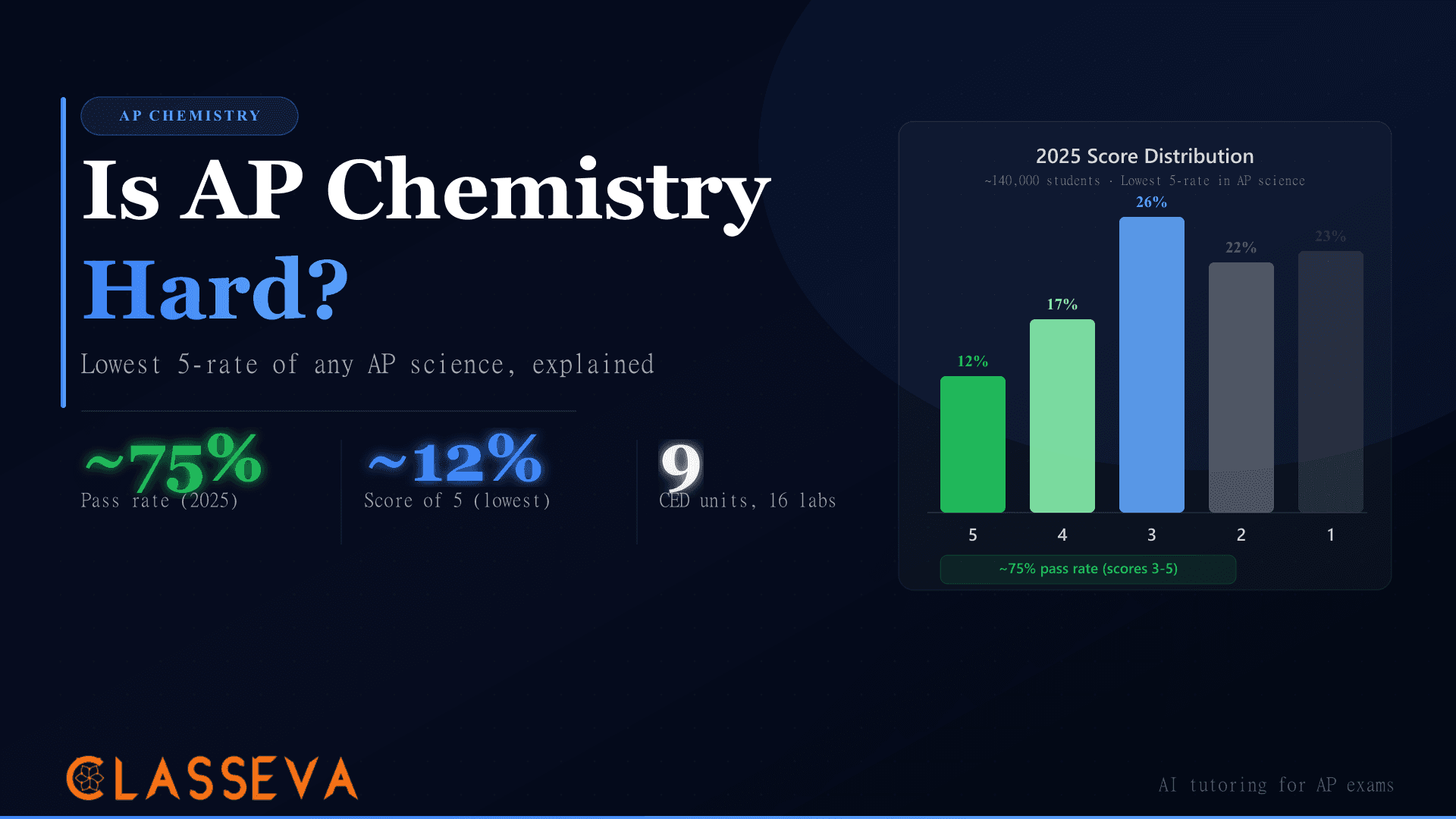
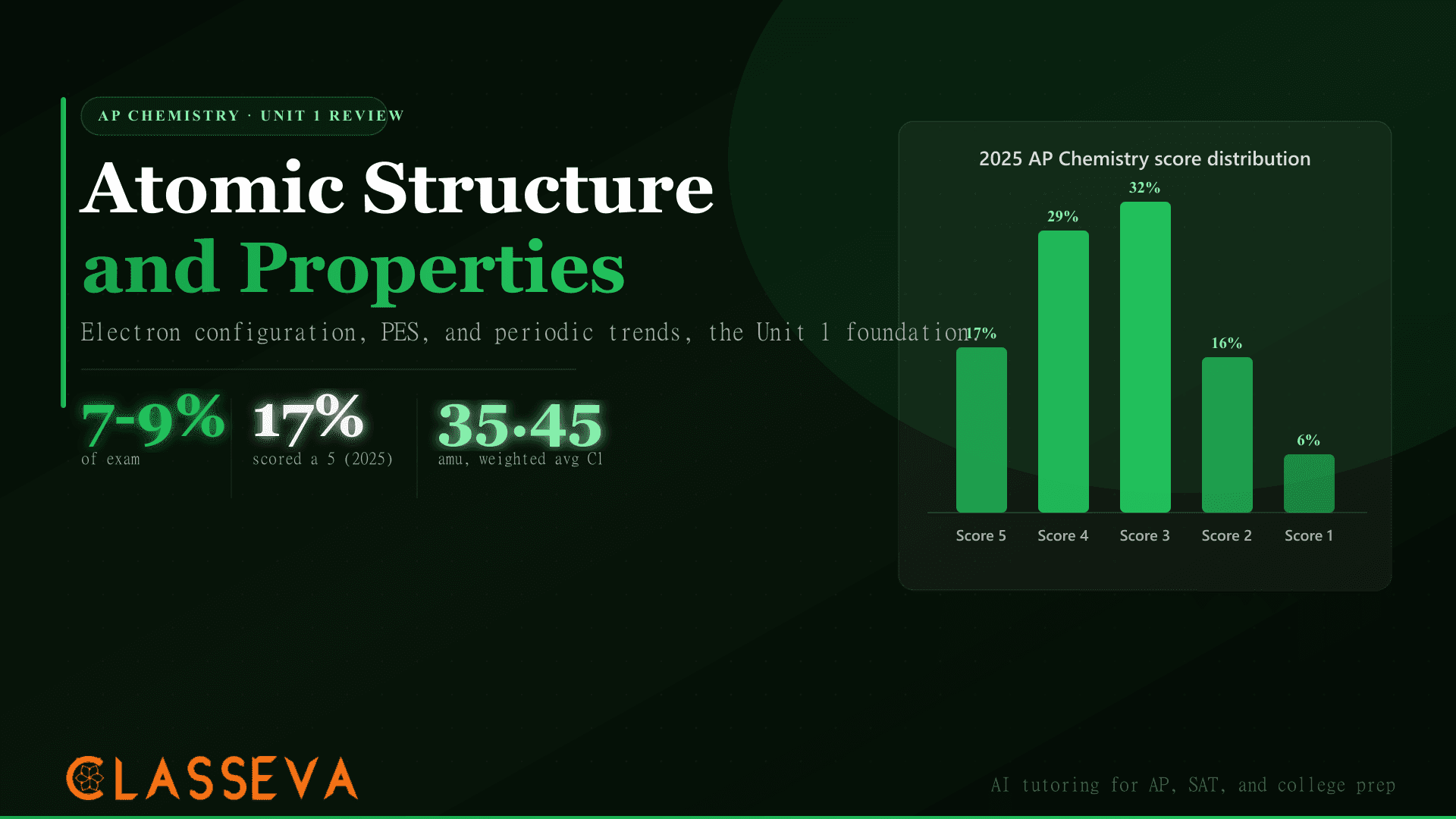
Unit 1 contributes roughly 7-9% of the AP Chemistry multiple-choice score, one of the lighter units by direct weighting. [VERIFY: 2025-26 AP Chemistry CED unit weighting] But raw weight misleads here. The 2025 AP Chemistry exam posted a 5-rate of 17% and a pass rate near 78%, per the College Board 2025 score distributions, and the students who reached a 5 almost always nailed Unit 1 fundamentals first. Electron configuration and Coulombic reasoning thread through every FRQ on bonding and energetics.
The 2025 AP Chemistry exam recorded its strongest score distribution under the current format: 17% scored a 5, 29% scored a 4, and roughly 78% earned a 3 or higher across about 168,000 test-takers. A solid Unit 1 foundation correlates with that upper band, because every harder unit reuses atomic structure logic.
How Do You Find Average Atomic Mass and Read a Mass Spectrum?
Average atomic mass is the weighted average of an element isotope masses, found by multiplying each isotope mass by its fractional abundance and summing the results. A mass spectrum displays this data visually: each peak marks one isotope, the horizontal position gives the mass-to-charge ratio, and the peak height gives relative abundance.
The most common exam version uses chlorine. Chlorine-35 makes up about 75.77% of natural chlorine and chlorine-37 about 24.23%. The calculation: (35 amu times 0.7577) plus (37 amu times 0.2423) equals 35.48 amu. That weighted result, not a simple midpoint, is why the periodic table lists chlorine at 35.45 rather than 36.
The Mass Spectrometry Calculation
On an ap chem unit 1 frq, the mass spectrometry question usually hands you a spectrum and asks two things: identify the element and justify your answer. The high-scoring move is to read each peak height as a percent abundance, compute the weighted average, and match it to the periodic table. A common error is averaging the masses without weighting, which gives 36 instead of 35.45 and loses the point.
Isotope: atoms of the same element with different neutron counts. Relative abundance: the fraction of atoms that are a given isotope, shown by peak height. m/z: mass-to-charge ratio, shown on the horizontal axis. Weighted average: the sum of each isotope mass times its fractional abundance. Use these exact terms; writing “the bigger peak is more common” without naming relative abundance earns no credit.
How Do You Write an Electron Configuration?
An electron configuration lists how electrons fill an atom subshells in order of increasing energy. For a neutral atom, you place electrons one subshell at a time following three rules, until you have placed all of the atom electrons. Iron, with 26 electrons, configures as 1s2 2s2 2p6 3s2 3p6 4s2 3d6.
Aufbau, Pauli, and Hund Explained
Three rules govern every ap chemistry electron configuration, and the exam expects you to apply all three correctly. The Aufbau principle fills the lowest-energy subshells first. The Pauli exclusion principle limits each orbital to two electrons with opposite spins. Hund rule spreads electrons singly across degenerate orbitals before pairing them, which minimizes repulsion.
Noble-Gas and Ion Configurations
Noble-gas notation replaces filled inner shells with the nearest preceding noble gas in brackets. Iron becomes [Ar] 4s2 3d6 instead of the full 1s2 2s2 2p6 3s2 3p6 4s2 3d6. The exam accepts both, but noble-gas notation saves time and reduces transcription errors.
Ion configurations follow one twist that students miss constantly: when a transition metal forms a cation, it loses 4s electrons before 3d electrons, even though 4s filled first. Iron(II) is [Ar] 3d6, not [Ar] 4s2 3d4. For main-group ions, add or remove electrons to reach the nearest noble-gas configuration. A chloride ion gains one electron to become [Ar], matching argon.
When a transition metal loses electrons to form a cation, the 4s electrons leave first, not the 3d. Iron(III) is [Ar] 3d5, reached by removing both 4s electrons and one 3d electron. Writing [Ar] 4s2 3d3 is wrong and a frequent FRQ point-loser. The rule: 4s fills first but empties first.
How Do You Interpret a PES Spectrum?
A photoelectron spectrum (PES) plots the binding energy of electrons against the relative number of electrons at each energy. Each peak represents one subshell. Peak height is proportional to the number of electrons in that subshell, and peak position (binding energy) reflects how tightly the nucleus holds those electrons. Electrons closer to the nucleus require more energy to remove, so they sit further left at higher binding energy.
Reading Peak Height and Binding Energy
Two readings unlock every PES question. First, peak height tells you electron count: a peak twice as tall as another holds twice as many electrons. A 1s peak and a 2s peak both hold two electrons, so they share the same height; a 2p peak holding six electrons stands three times as tall. Second, binding energy tells you the subshell location: 1s electrons sit at the highest binding energy because they feel the full nuclear pull at the shortest distance.
Worked PES FRQ: Identify the Element
The PES identification FRQ is the differentiator of Unit 1, and most students fumble it. The graph above maps to magnesium. Here is the exact reasoning a high-scoring response walks through, in the order the rubric awards points.
Prompt style: “The PES spectrum shows four peaks. From high to low binding energy, the relative heights are 2, 2, 6, and 2. Identify the element and explain.”
Step 1, assign subshells by binding energy: the leftmost peak at highest binding energy is 1s, then 2s, then 2p, then 3s at lowest binding energy. Inner electrons bind tightest.
Step 2, read electron counts from height: the peaks give 1s², 2s², 2p⁶, 3s². The tall 2p peak holds six electrons because p subshells hold up to six.
Step 3, sum and identify: 2 + 2 + 6 + 2 = 12 total electrons. A neutral atom with 12 electrons has 12 protons, atomic number 12, which is magnesium.
Step 4, justify the binding-energy gap: the 1s peak sits far left because 1s electrons feel the full nuclear charge at the shortest distance, so they require the most energy to remove.
The differentiation here is in step 4. Many students identify the element and stop. The College Board rubric reserves a point for explaining why binding energy increases toward the nucleus, which traces back to Coulombic attraction: shorter distance and full nuclear charge mean a stronger hold. That is the connection between PES and the periodic trends in the next section.
What Are the AP Chemistry Periodic Trends?
The AP Chemistry periodic trends describe how atomic properties change across periods and down groups. The three the exam tests most are atomic radius, ionization energy, and electronegativity. Atomic radius decreases across a period and increases down a group. Ionization energy and electronegativity do the opposite: they increase across a period and decrease down a group.
Across a Period (left to right)
- •Atomic radius decreases
- •Ionization energy increases
- •Electronegativity increases
- •Cause: effective nuclear charge rises, same shell
Down a Group (top to bottom)
- •Atomic radius increases
- •Ionization energy decreases
- •Electronegativity decreases
- •Cause: more shells, greater distance and shielding
Coulomb Law: The Reason Behind Every Trend
Coulomb law states that the attractive force between the nucleus and an electron grows with larger charges and shrinks with greater distance. Every periodic trend reduces to this one relationship. Across a period, protons accumulate while electrons fill the same shell, so effective nuclear charge climbs and pulls the shell tighter: radius shrinks, and electrons get harder to remove. Down a group, each new shell adds distance and inner-shell shielding, weakening the pull: radius grows, and electrons leave more easily.
The Ionization Energy Exceptions
Two ionization energy dips break the smooth left-to-right increase, and the exam loves them. The first appears between Group 2 and Group 13 (beryllium to boron): boron loses an electron from a higher-energy 2p subshell, which is easier to remove than beryllium 2s electron. The second appears between Group 15 and Group 16 (nitrogen to oxygen): oxygen first paired 2p electron experiences extra repulsion, making it easier to remove than expected.
These exceptions reward students who understand subshell energies rather than memorizing a single rule. A first ionization energy FRQ that asks you to rank nitrogen, oxygen, and fluorine is testing whether you know oxygen sits below the smooth trend line. Name the half-filled p subshell stability of nitrogen and the pairing repulsion in oxygen, and you capture the point.
The valence electron configuration you write in Unit 1 directly predicts the bonding behavior in Unit 2. An atom with seven valence electrons (a halogen) gains one electron to reach a noble-gas configuration, forming a 1- ion. Carrying Unit 1 mastery forward means Unit 2 ionic and covalent bonding feels like applied periodic trends rather than fresh memorization.
Estimate Your AP Chemistry Score
Once you can write configurations, interpret PES graphs, and rank periodic trends, the next question is where that leaves your overall score. Practice scores on Unit 1 questions are a reasonable early signal, since the unit underpins later material. Run your projected results through the AP Score Predictor to see which band you are tracking toward and where to focus next.
AP Score Predictor
Enter your AP Chemistry practice results to project your score band and see which units, starting with atomic structure, to prioritize before the May exam.
If your Unit 1 practice scores lag, the fastest fix is targeted practice on the exact skills above rather than rereading notes. A free AI tutoring session can walk you through a PES graph or an ionization-energy ranking in real time, which beats passive review for retention. The research on active recall versus passive review backs this directly.
Key Takeaways
- Unit 1 is the foundation, not a footnote. At roughly 7-9% direct weighting, its concepts (electron configuration, Coulomb law, periodic trends) resurface in bonding, intermolecular forces, and thermodynamics. [VERIFY: 2025-26 CED weighting]
- Average atomic mass is a weighted average. Multiply each isotope mass by its fractional abundance and sum. For chlorine, that gives 35.45 amu, not a simple midpoint of 36.
- Three rules govern electron configuration. Aufbau fills lowest energy first, Pauli caps orbitals at two opposite-spin electrons, and Hund fills degenerate orbitals singly before pairing.
- PES is the most-missed Unit 1 skill. Peak height equals electron count in a subshell, peak position equals binding energy, and inner electrons bind tightest because of Coulombic attraction.
- Cations lose 4s before 3d. Iron(III) is [Ar] 3d5. The 4s subshell fills first but empties first when transition metals ionize.
- Coulomb law explains every periodic trend. Stronger nuclear charge and shorter distance mean tighter binding, which sets radius, ionization energy, and electronegativity.
- Know the two ionization-energy dips. Beryllium to boron and nitrogen to oxygen break the smooth period trend, and the exam tests them often.
Frequently Asked Questions
These cover the AP Chemistry Unit 1 questions students ask most, beyond the sections above. For a parallel science walkthrough, the AP Biology Unit 1 chemistry of life post shows how the same atomic concepts appear in biology, and pairing atomic structure practice with spaced practice over cramming is what moves Unit 1 from recognized to retained.