Is AP Chinese Language Hard? The Native-Speaker Reality
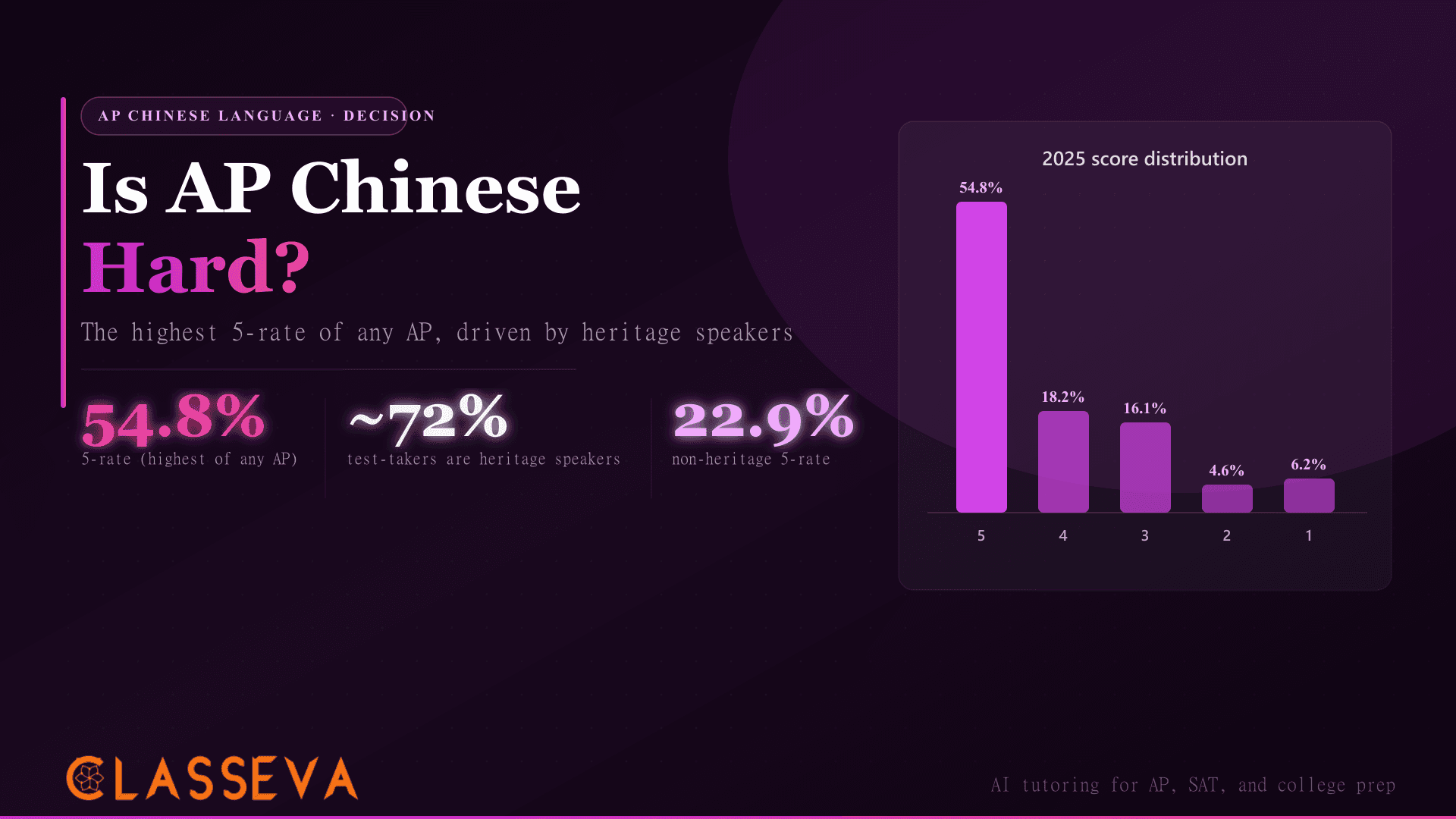
AP Chinese Language and Culture carries a 54.8% 5-rate, the highest of any AP exam, and on paper that makes it look like the easiest 5 on the board. The catch hides in who sits for it: about 72% of 2025 test-takers were heritage speakers who grew up hearing Mandarin at home. Studying how language exams reward existing fluency over classroom drilling, I kept returning to this exam because no other AP splits its population so sharply. This post separates the two groups so a non-heritage learner can predict an honest outcome instead of trusting a number that describes someone else.
Is AP Chinese Language Hard?
AP Chinese Language is easy for fluent heritage speakers and hard for nearly everyone else. The exam tests real-time listening, reading, typing, and speaking in Mandarin, so students who already think in the language move through it fast. A student who started Mandarin in 9th grade faces tone-dependent listening, a writing system with thousands of characters, and a computer-based format that times every task. The honest read on AP Chinese difficulty: your starting fluency predicts your score far better than any study plan you build in junior year.
The Score Distribution and Pass Rate
The 2025 numbers from the College Board score distributions set the AP Chinese 5-rate at 54.8%, with 18.2% fours, 16.1% threes, 4.6% twos, and 6.2% ones, for an 89.2% pass rate and a mean of 4.11 across 18,518 students. No other AP exam puts more than half its candidates at a 5. But that distribution does not describe the difficulty of the content. It describes a pool dominated by students who learned Mandarin before they ever opened a textbook.
| AP Score | % of Test-Takers (2025) | Readiness Signal |
|---|---|---|
| 5 | 54.8% | Extremely well qualified |
| 4 | 18.2% | Well qualified |
| 3 | 16.1% | Qualified |
| 2 | 4.6% | Possibly qualified |
| 1 | 6.2% | No recommendation |
2025 AP Chinese Language and Culture Total Group distribution. Source: College Board (18,518 test-takers, mean 4.11).
Why the 5-Rate Misleads Everyone
AP Chinese draws the smallest and most self-selected pool of any major AP language exam. Per College Board commentary on the 2025 results, roughly 72% of test-takers were heritage speakers of Mandarin. Heritage speakers grew up hearing or speaking the language at home, so the listening, speaking, and reading tasks test fluency they already own. The 54.8% 5-rate does not mean AP Chinese is easy. It means most of the people taking it were fluent before the course began.
Compare the pool with a mass-enrollment AP. AP Spanish Language drew 182,670 test-takers in 2025; AP Chinese drew 18,518, about a tenth as many. Spanish blends large numbers of true beginners into its average, which drags the headline rate down toward the classroom-learner experience. AP Chinese does the opposite: its tiny pool concentrates heritage speakers, so the average drifts toward fluency. A non-heritage student reading the 54.8% figure is seeing a number built mostly from people who learned Mandarin at the dinner table, not in a classroom.
What Does the AP Chinese Exam Test?
The AP Chinese exam tests communication in Mandarin across four skills: listening, reading, writing, and speaking. It never asks you to recite grammar rules or define a character in isolation. Instead, every task drops you into a real situation: follow a conversation, read an announcement, narrate a story from pictures, reply to an email, hold a simulated chat, deliver a cultural presentation. The exam measures whether you can use Mandarin in real time, not whether you can describe how it works.
The Computer-Based Format
AP Chinese runs entirely on a computer, which sets it apart from most paper-and-pencil AP exams. Students take it on school-controlled devices through a dedicated exam application, reading on screen, listening through a headset, typing with the keyboard, and speaking into a microphone. The format matters: you cannot handwrite a character you half-remember, and you cannot slow the audio down. Every input passes through the same machine that times you.
You choose your character system before the exam starts. Per College Board, on-screen Chinese text displays in either simplified or traditional characters, and you type using Pinyin Simplified, Pinyin Traditional, or Bopomofo. The choice has no effect on your score, so pick the system you learned and never switch mid-exam.
The Four Skills and Score Weights
The exam splits into two equally weighted halves. Section I is multiple choice (listening and reading, 50% of the score) and Section II is free response (writing and speaking, 50%). Within free response, written tasks count 25% and spoken tasks count 25%. The structure rewards balance: a student who reads characters well but freezes when speaking forfeits a quarter of the exam to one weak skill. The full task breakdown lives on the AP Students assessment page.
| Section | Tasks | Skill | % of Score |
|---|---|---|---|
| I-A Multiple Choice | Listening: rejoinders + listening selections | Interpretive | 25% |
| I-B Multiple Choice | Reading: texts, announcements, ads | Interpretive | 25% |
| II-A Free Response | Story narration + email reply (typed) | Presentational + interpersonal writing | 25% |
| II-B Free Response | Simulated conversation + cultural presentation | Interpersonal + presentational speaking | 25% |
AP Chinese Language and Culture exam structure. Source: College Board AP Students assessment page.
Typing Chinese Characters Under a Clock
The single feature that separates AP Chinese from every other AP language exam is character input. You do not handwrite Chinese on the AP exam. You type it phonetically and pick the right character from a list, all while a clock runs down. That mechanic rewards a skill heritage speakers built unconsciously and punishes the exact gap most classroom learners carry into the exam.
How the Input Method Works
To write a Chinese word, you type its pronunciation in Pinyin or Bopomofo, and the software shows candidate characters that match those sounds. You then select the correct one. The trap is that many characters share the same pronunciation, so the candidate list often holds several near-identical options. A student who recognizes a character when reading may still pick the wrong homophone under time pressure. The two written tasks, a picture-based story and an email reply, both run on this typed input.
Recognition vs Production
Reading a character and producing it are different skills, and the gap between them defines the AP Chinese difficulty for non-heritage students. You can recognize 是 in a sentence and still hesitate when four homophones appear in the candidate list. Heritage speakers collapse that gap because they associate sounds with meanings automatically. Classroom learners often read at one level and produce at a lower one, which the typed writing tasks expose immediately.
Many non-heritage students prepare by reading and listening, then discover on exam day that they cannot produce characters fast enough. Reading builds recognition; the writing tasks demand production. Drill typed output every week, composing short responses from picture prompts, so the candidate-list selection becomes automatic instead of a timed scramble.
How Hard Is AP Chinese for Non-Heritage Learners?
AP Chinese is one of the hardest AP exams for a student who started Mandarin in high school. The listening moves at native speed, the reading assumes a wide character base, and the typed writing punishes any gap between recognition and production. A non-heritage learner who reaches a 4 has done something genuinely difficult. The blended 89.2% pass rate does not describe that student, because the average is built mostly from people who were fluent before they enrolled.
Total Group vs Standard Group
College Board reports a Total Group and a Standard Group for AP Chinese. Standard Group students learned Mandarin mostly in US schools, do not regularly speak or hear it at home, and did not live a month or more in a Chinese-speaking region. In 2025, the Total Group earned a 5 about 54.8% of the time with a mean of 4.11, while the Standard Group earned a 5 only 22.9% of the time with a mean of 3.14 and a 69.0% pass rate. That gap is the native-speaker reality, and it should anchor every non-heritage student's expectations.
| Score Band | Total Group (2025) | Standard Group (2025) |
|---|---|---|
| 5 | 54.8% | 22.9% |
| 4 | 18.2% | 17.2% |
| 3 | 16.1% | 29.0% |
| Pass rate (3+) | 89.2% | 69.0% |
| Mean score | 4.11 | 3.14 |
2025 AP Chinese: Total Group (18,518) vs Standard Group of non-heritage classroom learners (4,777). Source: College Board score distributions.
Heritage / Native Speaker
- •Grew up hearing or speaking Mandarin at home
- •Listening and speaking test fluency already owned
- •Distinguishes homophones in the typed candidate list fast
- •Realistic target is a 5; a 4 signals a fixable slip
- •Roughly 72% of the 2025 test-taker pool
- •Needs format and typed-accuracy practice, not language practice
Non-Heritage Classroom Learner
- •Started Mandarin in middle or high school
- •Faces native-speed listening and a thin character base
- •Hesitates choosing the right homophone under the clock
- •A 3 or 4 is a strong outcome; a 5 is a multi-year stretch
- •Concentrated in the Standard Group (22.9% 5-rate in 2025)
- •Needs daily production reps and native-audio listening for years
If you grew up hearing Mandarin, your realistic target is a 5, and a typed-writing slip is what stands between you and one. If you started Mandarin in a US classroom, a 3 or 4 is a strong outcome, and a 5 takes years of daily exposure plus deliberate typing practice. The 89.2% pass rate describes neither student cleanly. It is the math of two very different populations averaged into one number.
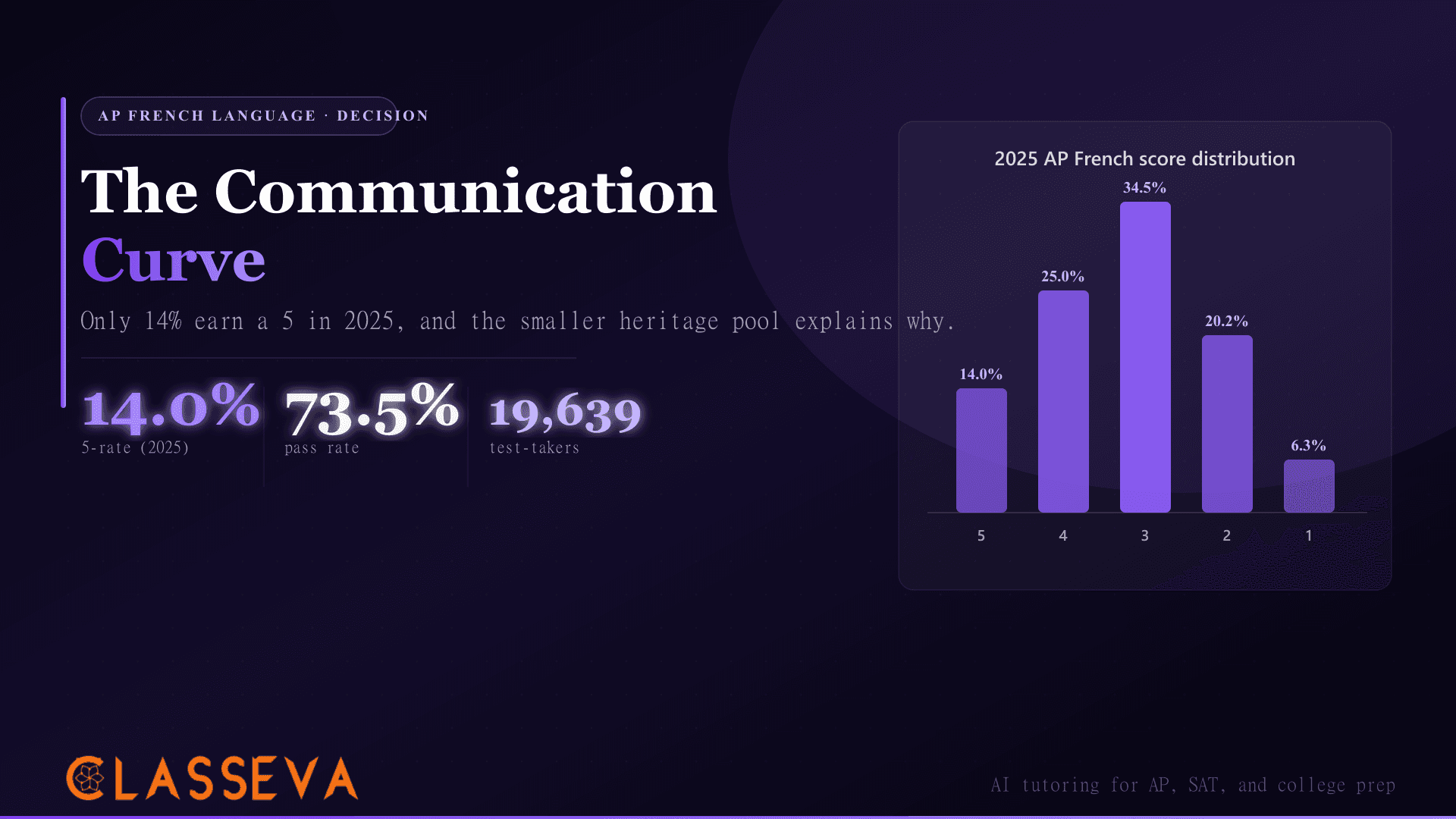
Students mapping a full AP language slate often compare these heritage dynamics across exams. The AP Spanish Language difficulty breakdown and the AP French Language post show the same native-speaker curve, though both lean less heavily on heritage speakers than AP Chinese does. For an analytical writing comparison, the AP English Language difficulty post walks through an exam that rewards argument construction over fluency.
How Should You Study for AP Chinese?
Study AP Chinese by producing the language daily, not by memorizing character lists in isolation. Listen to native audio, read short texts, and type responses every day, because the exam scores real-time use, not rule recall. The highest-leverage habit for non-heritage learners is typed output: compose a short story or email reply from a prompt, then check every character against meaning. Listening speed follows from daily native audio, not from slowed-down classroom recordings.
Study Plans by Starting Point
Your starting fluency sets your plan. A heritage speaker needs format practice and typing precision, not language practice. A classroom learner needs daily production reps and native-speed listening across years, not months. Matching the plan to the gap is what separates a 3 from a 5 for non-heritage students and a 4 from a 5 for fluent ones.
| Starting Point | Main Gap | Where to Spend Study Time |
|---|---|---|
| Heritage / native speaker | Exam format and typed accuracy | Released FRQs, picture-story structure, homophone selection speed |
| Strong classroom learner | Native-speed listening and production | Daily native audio, timed typed writing, simulated speaking reps |
| Building fluency | Character base and listening | Multi-year character exposure, daily listening, conversation practice |
Match your study time to the gap your starting point creates.
For the two months before May, type one released writing prompt every day on a keyboard set to your character system, then read it back aloud. Mark every character where you almost picked a homophone and every place you reached for an English structure. Non-heritage students who drill typed production close the writing gap faster than students who only read and listen, because the exam scores what you can produce, not what you can recognize.
Project Your AP Chinese Score
If you are mid-course, the fastest way to know where you stand is to score released practice tasks and map them to a projected band. Classeva's AP Score Predictor turns your practice results into a likely score so you can target the skill dragging you down, whether that is native-speed listening, the typed picture-story, or the recorded speaking tasks.
AP Score Predictor
Enter your AP Chinese Language practice results to project your score band and pinpoint which of the four skills to prioritize before the May exam.
Students weighing how AP credit translates into tuition savings can pair this with the broader AP slate. The AP Computer Science A difficulty post shows the same self-selection dynamic in a different subject, and the AP Precalculus difficulty post helps you build a schedule where each AP earns credit without overloading a single semester.
Key Takeaways
- The 54.8% 5-rate is the highest of any AP, and the most misleading. AP Chinese posted an 89.2% pass rate in 2025, but roughly 72% of test-takers were heritage speakers who were fluent before the course began.
- The native-speaker reality splits the exam in two. Heritage speakers concentrate in the 5s; the non-heritage Standard Group earned a 5 only 22.9% of the time with a 69.0% pass rate in 2025.
- The exam is fully computer-based. You read on screen, listen through a headset, type with the keyboard, and speak into a microphone, all on school-controlled devices through a dedicated app, not Bluebook.
- You type Chinese characters, you do not handwrite them. Phonetic input in Pinyin or Bopomofo plus homophone selection rewards heritage speakers and exposes the recognition-versus-production gap in classroom learners.
- Section I and Section II each count 50%. Listening and reading make up half; typed writing and recorded speaking split the other half, so one weak skill costs a full quarter.
- For non-heritage learners, AP Chinese is genuinely hard. A 3 or 4 is a strong outcome; a 5 takes years of native-speed listening plus deliberate typing practice.
- Study by producing, not by memorizing. Daily typed output and native-audio listening move non-heritage scores more than any character flashcard stack.