Is AP French Language Hard? The Communication Curve
AP French Language and Culture posted a 14.0% 5-rate and a 73.5% pass rate in 2025, numbers that look modest next to AP Spanish Language's 21.9% 5-rate. The gap is not about the French exam being harder question by question; the two exams share an identical four-section blueprint. What differs is who shows up. Studying how a tutoring system should adapt to a learner's starting fluency pushed me to compare these two language exams closely, and the score data points to population, not difficulty. This post explains the communication curve so you can predict your own score from the group you actually belong to.
Is AP French Language Hard?
AP French Language is hard for classroom learners and manageable for fluent speakers, the same split that defines every AP language exam. The test rewards real communication, not memorized verb charts, so students who already think in French move quickly through interpretive and speaking tasks. Students who translate from English in their heads run short on time and stumble on the recorded speaking section. Your honest difficulty read on AP French depends on starting fluency far more than on any study plan you build in junior year.
The 2025 Score Distribution
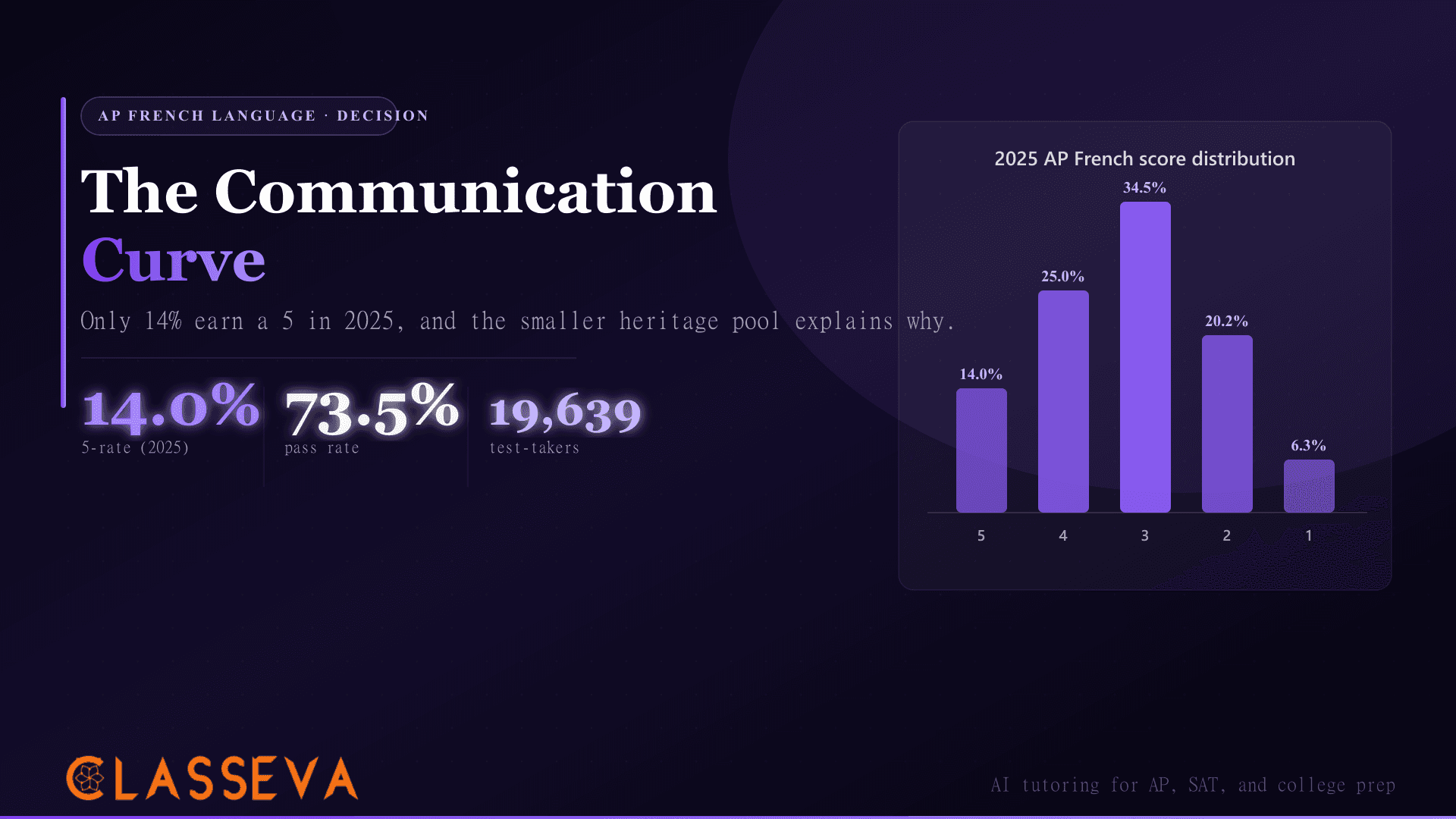
The 2025 numbers from the College Board score distributions set the AP French 5-rate at 14.0%, with 25.0% fours, 34.5% threes, 20.2% twos, and 6.3% ones, for a 73.5% pass rate and a mean of 3.20 across 19,639 test-takers. The distribution peaks at 3, not 4, which already separates French from Spanish, where the 4 band dominates. AP French clears the bar on pass rate but produces far fewer 5s as a share of the pool, and the reason traces straight to who sits the exam.
| AP Score | % of Test-Takers (2025) | Readiness Signal |
|---|---|---|
| 5 | 14.0% | Extremely well qualified |
| 4 | 25.0% | Well qualified |
| 3 | 34.5% | Qualified |
| 2 | 20.2% | Possibly qualified |
| 1 | 6.3% | No recommendation |
2025 AP French Language and Culture Total Group distribution. Source: College Board (19,639 test-takers, mean 3.20).
Why the 5-Rate Sits Below AP Spanish
AP French's 5-rate runs below AP Spanish because the heritage-speaker pool taking French is much smaller. In the United States, far more students grow up hearing Spanish at home than French, so the AP Spanish exam draws a large bloc of near-native speakers who concentrate in the 5s. AP French draws roughly 19,600 students; AP Spanish draws over 182,000, and a big share of that larger pool arrives already fluent. With fewer heritage scorers lifting the top of the French curve, the 5-rate stays near 14%.
College Board confirms the split inside the French data itself. The Total Group earned a 5 at 14.0% with a mean of 3.20, while the Standard Group, students who learned French mostly in US classrooms and do not regularly use it at home, earned a 5 at only 8.8% with a mean of 3.04. The 14,313 Standard-Group students make up the bulk of the pool, which is why the headline 5-rate is already close to the classroom-learner reality, unlike AP Spanish where the two figures diverge sharply.
If you grew up speaking French at home or lived in a French-speaking country, your realistic target is a 5, and the small heritage pool means you face less competition at the top. If you reached AP French through French I to French IV in a US classroom, a 3 or 4 is a strong outcome and a 5 takes a year of deliberate production work. The 14.0% 5-rate already reflects the classroom learner more honestly than the AP Spanish average does.
What Does the AP French Language Exam Test?
The AP French Language exam tests communication in real contexts, not isolated grammar. It runs about 3 hours and never asks you to conjugate a verb on a blank line. Every task drops you into a situation: read an article, listen to a broadcast, reply to an email, defend a position, hold a conversation, compare two cultures. The exam measures whether you can use French under pressure, which is exactly why classroom learners who can read well still lose points when they have to produce.
The 4 AP French Language Sections
Four scored components split across two halves carry equal weight: multiple choice is 50% and free response is 50%. Within free response, written tasks count 25% (a 12.5% email reply and a 12.5% argumentative essay) and spoken tasks count 25%. The structure rewards balance, so a student who reads fluently but freezes when speaking forfeits a quarter of the exam to one weak skill.
| Section | Tasks | Time | % of Score |
|---|---|---|---|
| I-A Multiple Choice | Interpretive reading: 30 print-text questions | 40 min | 23% |
| I-B Multiple Choice | Interpretive reading and listening: 35 questions | 55 min | 27% |
| II-A Written FRQ | Email reply (12.5%) + argumentative essay (12.5%) | 70 min | 25% |
| II-B Spoken FRQ | Simulated conversation + cultural comparison | 18 min | 25% |
AP French Language and Culture exam format. Source: College Board AP Central exam page.
The 3 Modes of Communication
Every task on the exam maps to one of three modes. Interpretive communication is one-way input: you read or listen, then answer. Interpersonal communication is two-way exchange: you reply to an email or respond inside a live-feeling conversation. Presentational communication is one-way output to an audience: you write the essay or deliver the spoken cultural comparison. Students who recognize which mode a task demands stop guessing what the rubric rewards and start producing it.
The 6 Course Themes
The course organizes content around six themes that feed every reading passage, audio clip, and prompt. They are families and communities, personal and public identities, beauty and aesthetics, science and technology, contemporary life, and global challenges. No question quizzes a theme by name, but knowing the six helps you predict the topic range and build relevant vocabulary instead of memorizing scattered word lists. The full breakdown lives on the AP Students assessment page.
The audio sets in Section I-B and the spoken-task prompts play more than once, which surprises students who expect a single pass. Use the first listen for the gist and the next for the specific detail the question targets. College Board publishes the full audio format and timing on the AP French Language exam page.
Why Do the Production Tasks Bite?
The production tasks bite because the exam rewards spontaneous output, and classroom learning builds recognition faster than production. You can recognize a French word you cannot summon on command, and the speaking section gives you seconds to respond with no script. The argumentative essay then demands a structured argument in a second language under a clock. Both tasks expose the gap between understanding French and producing it, which is where most classroom learners lose their path to a 5.
The Speaking Tasks Reward Fluency
The simulated conversation gives you five chances to respond, 20 seconds each, with no preview of where the exchange heads. The cultural comparison gives you 4 minutes to prepare and 2 minutes to speak about a feature of the French-speaking world set against your own community. Classroom learners lose points to long pauses, English-style sentence order, and translating mid-sentence. Fluent speakers fill the time naturally because they are talking, not assembling sentences from rules. That difference lands directly in the recorded spoken-section scores.
The Argumentative Essay Separates Scores
The argumentative essay hands you three sources, a written article, a chart or table, and an audio clip, and asks you to take a position and defend it with all three. You get 55 minutes total, including 15 minutes to read and listen before writing. Students who merely describe the sources instead of building an argument cap out in the middle of the scale. The rubric rewards a clear thesis, integrated evidence from every source, and accurate connectors. Working released prompts from AP Central teaches the structure faster than any vocabulary list.
Many classroom learners treat the argumentative essay as a summary of the three sources. Summarizing earns partial credit at best. The rubric wants a defended position with evidence pulled from all three sources and woven together, not a paragraph about each source in turn. Write your thesis first in French, then mine the sources for support that backs it.
Students mapping a full language slate often compare this exam to its closest sibling. The AP Spanish Language difficulty breakdown shows the same heritage-speaker dynamic with a much larger pool, and the AP Chinese Language post walks through a third language exam where the heritage population reshapes the curve again.
AP French vs AP Spanish: Which Is Harder?
AP French and AP Spanish run the same four-section format, the same three communication modes, and parallel rubrics, so the question is not which test is harder but which pool you join. AP Spanish posts a higher 5-rate because its larger heritage bloc concentrates in the 5s. AP French gives a fluent learner less competition at the top, while a classroom learner faces a similar challenge in either language. Pick the language you can produce in, not the one with the friendlier headline rate.
AP French Language and Culture
- •Tests interpretive, interpersonal, and presentational communication
- •No required reading list; content drawn from six cultural themes
- •Four tasks: reading, listening, writing, speaking
- •73.5% pass rate, 14.0% 5-rate in 2025 (19,639 test-takers)
- •Small heritage pool; most students arrive after 3-4 years of French
- •Credit usually maps to intermediate college French
AP Spanish Language and Culture
- •Identical four-section format and three-mode framework
- •Same content themes and rubric structure as French
- •Four tasks: reading, listening, writing, speaking
- •85.0% pass rate, 21.9% 5-rate in 2025 (182,670 test-takers)
- •Large heritage pool concentrates in the 5s, lifting the average
- •Credit usually maps to intermediate college Spanish
The honest read on AP French vs AP Spanish: the exams are twins, the populations are not. A fluent French speaker chasing a 5 competes against a smaller top tier than a fluent Spanish speaker does. A classroom learner in either language should expect a 3 or 4 unless they put in a year of daily production work. For a parallel decision in another subject area, the AP English Language difficulty post walks through the same argument-construction skill the French essay tests.
How Should You Study for AP French Language?
Study AP French by producing the language every day, not by drilling grammar tables in isolation. Speak it, write it, and consume native French audio and text daily, because the exam scores production and comprehension, not rule recall. The highest-leverage habit is daily output: a short spoken recording or a written paragraph, then a review pass for accuracy. Vocabulary follows naturally once you read and listen within the six themes rather than memorizing detached word lists.
Study Plans by French Background
Your starting fluency sets your plan. A heritage speaker needs format practice, not language practice. A strong French IV student needs daily spoken reps to convert recognition into production. A student still building intermediate fluency needs a year of output across all four skills. Matching the plan to the gap separates a 3 from a 5 for classroom learners and a 4 from a 5 for fluent ones.
| Starting Point | Main Gap | Where to Spend Study Time |
|---|---|---|
| Heritage / lived abroad | Exam format and written accents | Released FRQs, essay structure, accent and spelling precision |
| Strong French IV student | Spontaneous speaking | Daily timed speaking reps, audio immersion, essay drills |
| Building intermediate fluency | Production under time pressure | Year-long daily output, theme vocabulary, conversation practice |
Match your study time to the gap your French background creates.
Record yourself answering one released spoken prompt every day for the two months before May. Play it back and mark every pause longer than two seconds and every place you reached for an English structure. Classroom learners who do this close the spoken-section gap faster than students who only build vocabulary, because the AP French exam tests talking, not knowing.
Project Your AP French Score
If you are mid-course, the fastest way to know where you stand is to score released practice tasks and map them to a projected band. Classeva's AP Score Predictor turns your practice results into a likely score so you can target the section dragging you down, whether that is listening, the argumentative essay, or the recorded speaking tasks.
AP Score Predictor
Enter your AP French Language practice results to project your score band and pinpoint which of the four sections to prioritize before the May exam.
Students weighing how AP credit translates into tuition savings can pair this with the rest of their slate. The AP English Literature difficulty post and the workload framing in AP Statistics help you build a schedule where each exam earns credit without stacking three production-heavy tests in one semester.
Key Takeaways
- AP French Language posted a 14.0% 5-rate and a 73.5% pass rate in 2025 across 19,639 test-takers, with a mean of 3.20 and the distribution peaking at the 3 band.
- The 5-rate sits below AP Spanish for a structural reason. The French heritage-speaker pool is far smaller, so fewer near-native scorers lift the top of the curve.
- The Standard Group 5-rate was 8.8%. Because most French test-takers are classroom learners, the headline 14.0% already reflects that group more honestly than the AP Spanish average does its own.
- The exam has four equally weighted skill areas. Reading and listening make up 50% as multiple choice; writing and speaking split the other 50% as free response.
- The speaking tasks and argumentative essay separate scores. Both reward spontaneous, structured production, which classroom learning builds slower than recognition.
- AP French and AP Spanish are format twins. Same four sections, same three modes, same rubrics; only the test-taking populations differ.
- Study by producing, not memorizing. Daily spoken and written output across a full year moves classroom-learner scores more than any vocabulary list, and it is the bridge from a 3 to a 5.