Is AP English Literature Hard? Why the Poetry FRQ is the Wall
AP English Literature's 5-rate sits around 13-15%, and the pass rate lands near 56%. The multiple-choice section rewards any student who reads carefully and consistently. The writing section tells a different story. Of the three FRQs, the poetry analysis essay catches students off guard more reliably than any other AP English question type, because it demands skills that most high school courses build least: reading simultaneously for literal meaning, sound pattern, structural form, and figurative device, all within a 40-minute window on an unseen poem. This post breaks down the exam section by section, with the poetry FRQ front and center.
Is AP English Literature Hard?
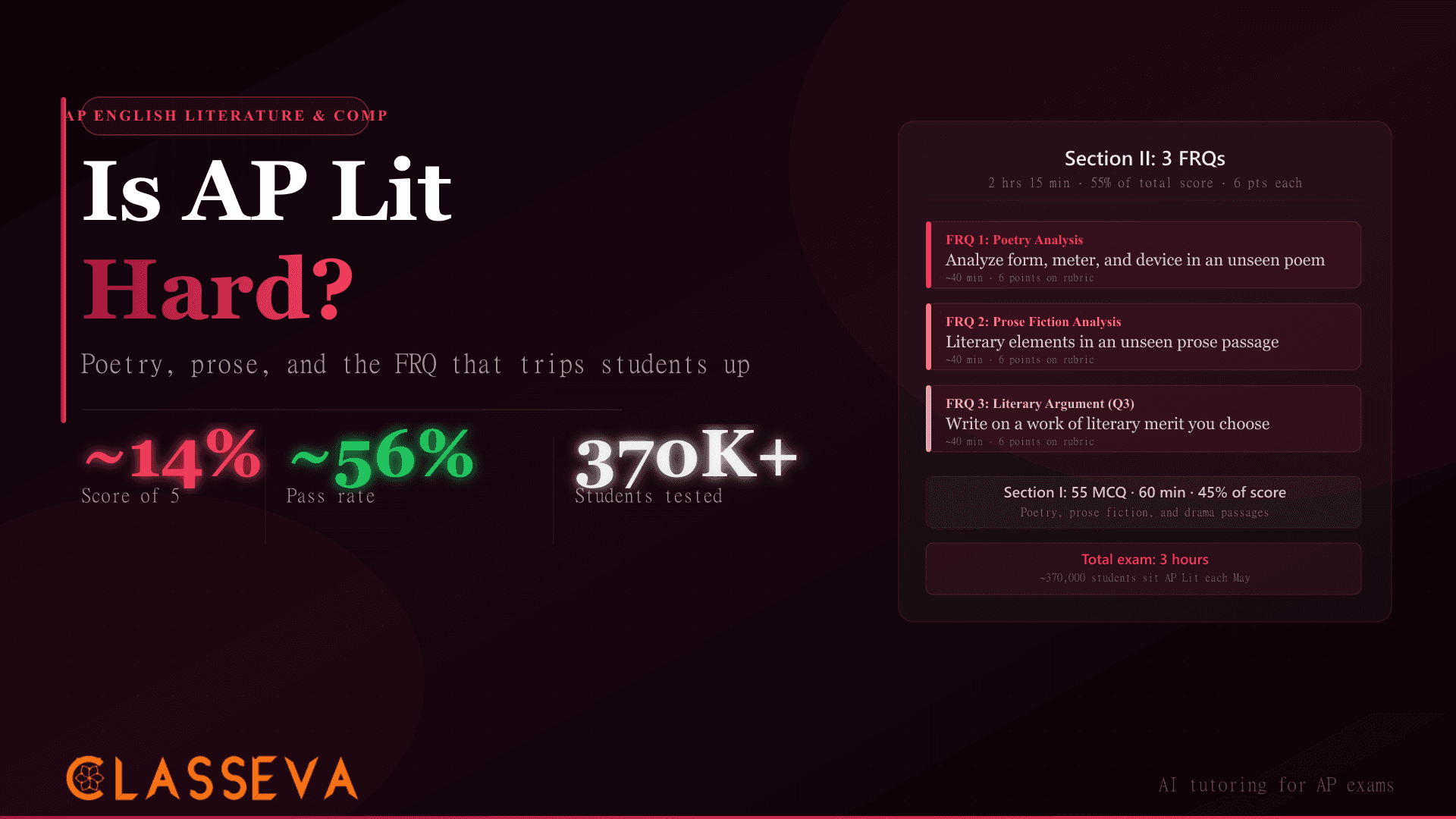
AP English Literature has an ~14% 5-rate and ~56% pass rate across roughly 370,000 annual test-takers. [VERIFY: 2025 College Board data] That puts it in the moderate range of AP difficulty, harder than AP Environmental Science but more accessible than AP Physics 1 by raw pass-rate. The challenge concentrates in the writing section: the 3 FRQs carry 55% of the total score, and the poetry analysis essay (FRQ 1) pulls scores down more than any other question on the exam.
Score Distribution and Pass Rate
AP English Literature draws roughly 370,000 test-takers per year, making it one of the ten most-taken AP exams. Here is the approximate score distribution based on recent College Board data [VERIFY: exact 2025 figures from College Board AP English Literature Score Distributions]:
| Score | Approximate % | What It Means |
|---|---|---|
| 5 | ~14% | Exceptional: college credit at most schools |
| 4 | ~19% | Strong: credit at most schools |
| 3 | ~23% | Pass: credit at some schools |
| 2 | ~22% | Below passing |
| 1 | ~22% | No credit |
Source: College Board AP English Literature Score Distributions (approximate 2025 figures; verify at apstudents.collegeboard.org). Mean score approximately 2.70-2.90.
How AP Lit Compares to Other AP Humanities
AP Lit sits in the middle of the AP humanities difficulty range. Its 5-rate edges above AP Lang but below APUSH and AP European History. The table below uses 2025 data where available.
| AP Exam | 5-Rate | Pass Rate | Core Challenge |
|---|---|---|---|
| AP Physics 1 | ~7% | ~43% | Conceptual physics reasoning |
| AP English Language | ~11% | ~59% | Timed rhetorical writing |
| AP English Literature | ~14% | ~56% | Poetry + literary analysis |
| APUSH | 14.2% | 73.7% | Historical argumentation |
| AP Biology | 18.9% | 70.4% | Content breadth + lab design |
| AP Calculus AB | 20.3% | 64.2% | Calculus problem-solving |
Sources: College Board Score Distributions 2025. AP English Literature figures approximate (verify at collegeboard.org).
What Does AP Lit Actually Test?
The AP Lit exam runs 3 hours and covers two distinct competencies: interpreting literary texts analytically (Section I) and writing analytical arguments about literature under timed conditions (Section II). The College Board AP English Literature course page organizes the framework around six literary elements: character, setting, structure, narration, figurative language, and literary argument. Every MCQ and every FRQ sits within that framework.
Section I: Multiple Choice
Section I contains 55 questions across 60 minutes (45% of the total score). The questions give you 5 literary passages, typically drawn from poetry, prose fiction, and drama, spanning multiple time periods. For each passage, you answer questions about how literary elements contribute to meaning, character, or theme. Unlike AP Lang's multiple-choice, which includes a writing question type (editing a student draft), AP Lit's MCQ is entirely reading and interpretation.
Section I rewards students who read slowly and annotate for effect, not just plot. A question will rarely ask what happens in a passage. It will ask what a particular word choice, structural decision, or point of view reveals about a character or theme. That is the same analytical lens the FRQs demand.
Section II: The Three FRQs
Section II runs 2 hours and 15 minutes and carries 55% of the total score. Three essays, each scored on a 6-point rubric (1 point for thesis, 4 points for evidence and commentary, 1 point for sophistication), spread the writing weight evenly across the section. The AP Central AP Lit exam page publishes the full exam format and past FRQs.
Why the Poetry FRQ Is the Wall
The prose analysis FRQ (FRQ 2) and the literary argument essay (Q3) both reward skills students build throughout their entire high school English sequence. The poetry FRQ does not. Most high school English classes spend the majority of their time on prose: novels, memoirs, essays. Poetry gets a unit or two. Students arrive at the AP Lit exam having read hundreds of prose pages and a few dozen poems.
That imbalance shows up directly in FRQ scores. A student who can write a strong five-paragraph rhetorical analysis of a Lincoln speech often earns a 2 or 3 on the poetry FRQ the same morning, not because they cannot write, but because poetry analysis requires a different set of simultaneous operations.
What the Poetry FRQ Actually Demands
The College Board's AP English Literature Course and Exam Description identifies the skills the poetry FRQ tests: recognizing how formal and structural choices (including meter, rhyme scheme, and stanza form) contribute to meaning, and explaining how literary elements interact. The rubric awards evidence points for specific textual support plus commentary that explains the effect, not just the identification.
Naming a device without explaining its effect earns zero evidence points on the rubric. Listing that a poem uses personification, alliteration, and enjambment does not constitute analysis. The rubric wants to know: what does the personification do to the reader's experience of the subject? How does the enjambment create tension between the line unit and the syntax? Effect, not inventory.
Why Prose Skills Do Not Automatically Transfer
Prose analysis and poetry analysis share one skill: explaining how a literary choice creates an effect. They diverge on everything else. A prose passage gives you sentences, paragraphs, and a relatively linear narrative arc. A poem compresses thought into lines that deliberately violate the conventions of normal syntax, that use white space and line breaks as structural signals, and that often resist paraphrase at the literal level.
A student who earned a 5 on the AP Lang rhetorical analysis essay can identify that a senator's speech uses anaphora to build emotional momentum and explain why it works. That same student, given a Keats ode, may not recognize that the shift in the third stanza (the volta) reverses the emotional argument of the first two stanzas, or that the slant rhyme in the closing couplet signals unresolved tension rather than closure. Those are poetry-specific reading moves. They require deliberate practice with poetic form, not just writing fluency.
A score-4 poetry essay identifies devices and connects them to theme. A score-5 essay explains how two or three literary elements interact with each other to create a cumulative effect. The rubric's sophistication point rewards students who demonstrate that a poem's form and its argument are not separate features but a single unified decision by the poet.
How Does AP Lit Compare to AP Lang?
AP Lang focuses on nonfiction rhetoric: speeches, essays, op-eds, scientific writing. AP Lit focuses on fiction, poetry, and drama. Both exams run 3 hours and use the same 6-point FRQ rubric. The difference in what they test is real enough that students who excel at one sometimes find the other harder, even if their overall writing skills are similar.
Side-by-Side: Content, Format, and FRQs
AP English Language
- •45 MCQ (45%) + 3 FRQs (55%)
- •Nonfiction texts: speeches, essays, editorials
- •FRQs: synthesis, rhetorical analysis, argument
- •~570,000 test-takers/year
- •~11% 5-rate, ~59% pass rate
AP English Literature
- •55 MCQ (45%) + 3 FRQs (55%)
- •Fiction, poetry, drama across time periods
- •FRQs: poetry analysis, prose fiction analysis, Q3 argument
- •~370,000 test-takers/year
- •~14% 5-rate, ~56% pass rate
The higher 5-rate in AP Lit does not mean it is an easier exam. The score distribution is skewed differently. AP Lit has a larger percentage of students scoring 1 and 2 compared to AP Lang, suggesting that students who struggle in AP Lit tend to score lower, not just miss the 5. The poetry FRQ contribution to that pattern is real and measurable, according to College Board FRQ score data released annually.
Taking Both AP Lang and AP Lit
Many students take AP English Language in 11th grade and AP English Literature in 12th grade, and the sequence works well. AP Lang builds the evidence-integration and argumentative writing mechanics that strengthen your AP Lit FRQ 3 essay. AP Lit's close reading depth, especially if you deliberately practice the poetry layer, transfers to any analytical writing task in college.
The courses do not overlap in content. You could also take them in reverse order, though most schools structure AP Lang junior year because the argumentative skills it builds appear in standardized testing and college application writing that students need by senior fall.
How Heavy Is the AP Lit Reading Workload?
AP Lit courses typically assign 8-12 full-length literary works over the school year, including novels, plays, and poetry collections. Most teachers structure the year around 3-4 anchor texts read closely, with supplementary shorter works (short stories, individual poems, one-act plays) filling in between. The reading pace runs slower than AP Lang's nonfiction reading because close literary reading demands more annotation time per page than rhetorical reading.
What the CED Expects You to Have Read
The AP Lit CED does not prescribe a fixed reading list, but it specifies that students should encounter literary texts from multiple time periods (pre-20th century, 20th century, and contemporary) and multiple forms (poetry, prose fiction, drama). For the Q3 free-response essay, students choose their own text. That means the works you study during the year become your toolkit.
Most students enter the exam having read enough to have 2-3 works they can use confidently for Q3. A strong novel and a strong play cover most prompts. Students who have also read a poetry collection have an advantage on Q3 prompts that specifically invite verse as evidence, though Q3 can always be answered with prose fiction.
What If Poetry Is Not Your Strength?
Poetry weakness is fixable before May. The gap between a student who finds poetry difficult and one who can write a 4-point evidence response on an unseen poem is roughly 30 focused practice sessions, not 300. The skill set is narrow: learning to annotate a poem systematically before writing, identifying the structural turn if one exists, and explaining at least two device-effect connections with precision.
Read 20-30 poems with annotation
Work through poems from multiple periods: one from the 18th or 19th century, one contemporary. Annotate for form (stanza count, rhyme scheme), sound (end-rhyme, internal rhyme, assonance), and one central figurative move. Do not try to identify every device. Find the one that drives the poem's meaning.
Practice timed 40-minute poetry FRQ responses
Use past AP Lit FRQ prompts from the College Board website. Give yourself 7-8 minutes to read and annotate, 30 minutes to write, 2 minutes to reread. The time pressure is part of the skill. Students who do not practice under timed conditions run out of time on the actual exam.
Study the AP Lit poetry FRQ rubric explicitly
The rubric for FRQ 1 is published by the College Board each year alongside the scoring guidelines. Read the sample student responses at each score level. The difference between a 2-point and a 4-point evidence score is visible in how the student explains effect versus merely labels device.
Cross-reference with a strong prose analysis session
Write one poetry FRQ and one prose FRQ back-to-back in the same sitting. Compare how you approach each. Most students will notice they explain effect more naturally in prose analysis. Transfer that explanatory habit explicitly to the poetry response.
How to Know If You Are Ready for AP Lit
AP Lit rewards students who read widely, write analytically, and tolerate ambiguity in texts. If a student finishes a novel and wants to discuss what the ending means rather than what happened, that is a good sign. If a student finds it frustrating when a poem does not have a clear, singular interpretation, that is something to work on before taking the course.
The readiness indicators below are not exhaustive, but they track the skills the exam actually tests.
Write a timed literary analysis paragraph
Give yourself 15 minutes to write one analytical paragraph about any literary work you have read. Does your topic sentence make a specific arguable claim? Does your evidence include a direct quote with a page reference? Does your commentary explain what the quote shows, not just what it says? If yes to all three, you have the basic writing mechanics.
Read an unseen poem and annotate it
Find a poem you have never read (any contemporary or older poem works). Spend 8 minutes reading and annotating it. Can you identify the form, find at least one structural feature (like a turn), and explain one literary device with reference to its effect on meaning or tone? If yes, you have foundational poetry skills.
Check your reading stamina
The AP Lit MCQ gives you 55 questions in 60 minutes across 5 passages. That is roughly 12 questions per passage with under 12 minutes each. Students who lose focus midway through dense literary prose will struggle with the time constraint. Practice reading under time pressure with actual literary passages.
Prepare at least 2-3 works for Q3
Before the exam, identify the works you have read that you can write about from memory. For each, know: the central theme or argument, two or three specific scenes or passages with quotes you remember, and the structural choices the author made. You do not need to memorize every work you read, just have 2-3 ready to deploy.
AP Score Predictor
If you want to estimate where your AP Lit preparation currently stands or see how AP Lit credit might affect your college costs, the tools below give you a concrete starting point. The AP Credit Savings Calculator shows how much a score of 4 or 5 saves in college tuition at specific schools.
AP Score Predictor
Answer a few questions about your current practice performance and study hours to get an estimated score range for AP English Literature.
Key Takeaways
- AP English Literature has an ~14% 5-rate and ~56% pass rate, placing it in the moderate range of AP difficulty by the numbers.
- The poetry FRQ (FRQ 1) is where scores drop most unpredictably, because it requires reading for form, meter, structure, and device simultaneously, skills most high school English courses build least.
- AP Lit and AP Lang have different content but the same 6-point FRQ rubric. The two courses complement each other, and many students take both across junior and senior year.
- The AP Lit reading workload runs 8-12 full-length works, typically 5-7 hours per week during the school year.
- For the Q3 literary argument essay, prepare 2-3 works you know deeply enough to quote from memory and analyze under exam conditions.
- The gap between weak and strong poetry analysis is a narrow, learnable skill set: systematic annotation, structural turn identification, and device-effect explanation, not literary intuition.
- A score of 4 or 5 on AP Lit typically earns college credit that exempts students from a required literature or writing course, saving at least one semester-hour of tuition.
Frequently Asked Questions
What percentage of students get a 5 on AP English Literature?
Roughly 13-15% of AP English Literature test-takers earn a 5 in any given year, based on College Board score distribution data. [VERIFY: 2025 College Board AP Score Distributions] The 5-rate places AP Lit among the more achievable upper-end AP scores, higher than AP Physics 1 and comparable to AP Calculus AB. Earning a 5 requires strong performance on all three FRQs, especially the poetry analysis essay where scores vary most.
Is AP English Literature harder than AP Language?
By the numbers, AP Lit has a slightly higher 5-rate than AP Lang (~14% vs ~11%), making it technically somewhat more 5-accessible. But the two courses test different skills. AP Lit demands literary interpretation across poetry, prose fiction, and drama, including poetic form analysis that AP Lang never tests. Students who struggle with abstract literary interpretation often find AP Lit harder in practice, regardless of what the score distributions show.
Can I take both AP English Language and AP Literature?
Yes, and many students do. The most common sequence is AP Language junior year and AP Literature senior year. The courses reinforce each other: AP Lang builds writing mechanics and evidence-integration skills; AP Lit develops close reading depth and interpretive flexibility. Most colleges award separate credit for each exam. Taking both signals strong written communication ability, which admissions offices at selective schools notice.
What is the AP Lit Q3 free-response question?
The Q3 essay is the thematic free-response question: you choose a work of literary merit from your own reading and write an essay that connects a stated theme or literary concept to the chosen work. The College Board does not prescribe a specific list of acceptable works, but the passage specifies that the work must be of sufficient complexity. Students who have read widely during the school year have more choice and can select the work that best supports the prompt.
Do I need to memorize specific literary works for AP Lit?
Not a fixed list, but you must have read enough literary works to be able to choose a good one for the Q3 essay. AP Lit courses typically cover 8-12 full-length works during the school year. Most students enter the exam having studied 3-5 works deeply enough to use comfortably in an essay. Having one strong prose novel and one strong drama ready covers most Q3 prompts.
How many books do you read in AP English Literature?
Most AP Lit courses assign 8-12 full-length literary works over the school year, typically including novels, plays, and poetry collections. The exact titles depend on the teacher and school, since AP Lit does not mandate a fixed reading list. The College Board publishes a supplementary list of suggested works, but teachers have wide latitude to design their own reading curriculum within the CED framework.
Is AP Lit good for humanities-bound students?
Yes, and it is one of the most transferable AP courses for students headed toward English, History, Political Science, Philosophy, or any major requiring strong analytical writing. The close reading and argument skills AP Lit builds show up in every humanities discipline at the college level. A score of 4 or 5 typically earns credit that exempts students from a required college writing or literature course, saving both time and money.
What makes the AP Lit poetry FRQ hard?
The poetry FRQ gives you an unseen poem and asks you to analyze how the poet uses literary elements to develop a theme or convey meaning. Unlike prose analysis, poetry requires reading the text on multiple simultaneous levels: literal meaning, sound patterns (meter, rhyme, assonance), structure (stanza form, line breaks, volta), and figurative language, all at once. Most high school English classes spend far less time on poetry analysis than on prose, so the poetry FRQ often tests skills students have practiced least.