Is AP European History Hard? The DBQ-Heavy AP Decoded
AP European History posted a 13.1% 5-rate in 2024, one of the lowest among the College Board's history exams. The structure mirrors APUSH almost exactly, so the difficulty does not come from the format. It comes from the content: most US students arrive having never studied the Habsburgs, the Peace of Westphalia, or the difference between the First and Second Reform Acts, and that unfamiliarity is what bends the curve.
Is AP European History Hard?
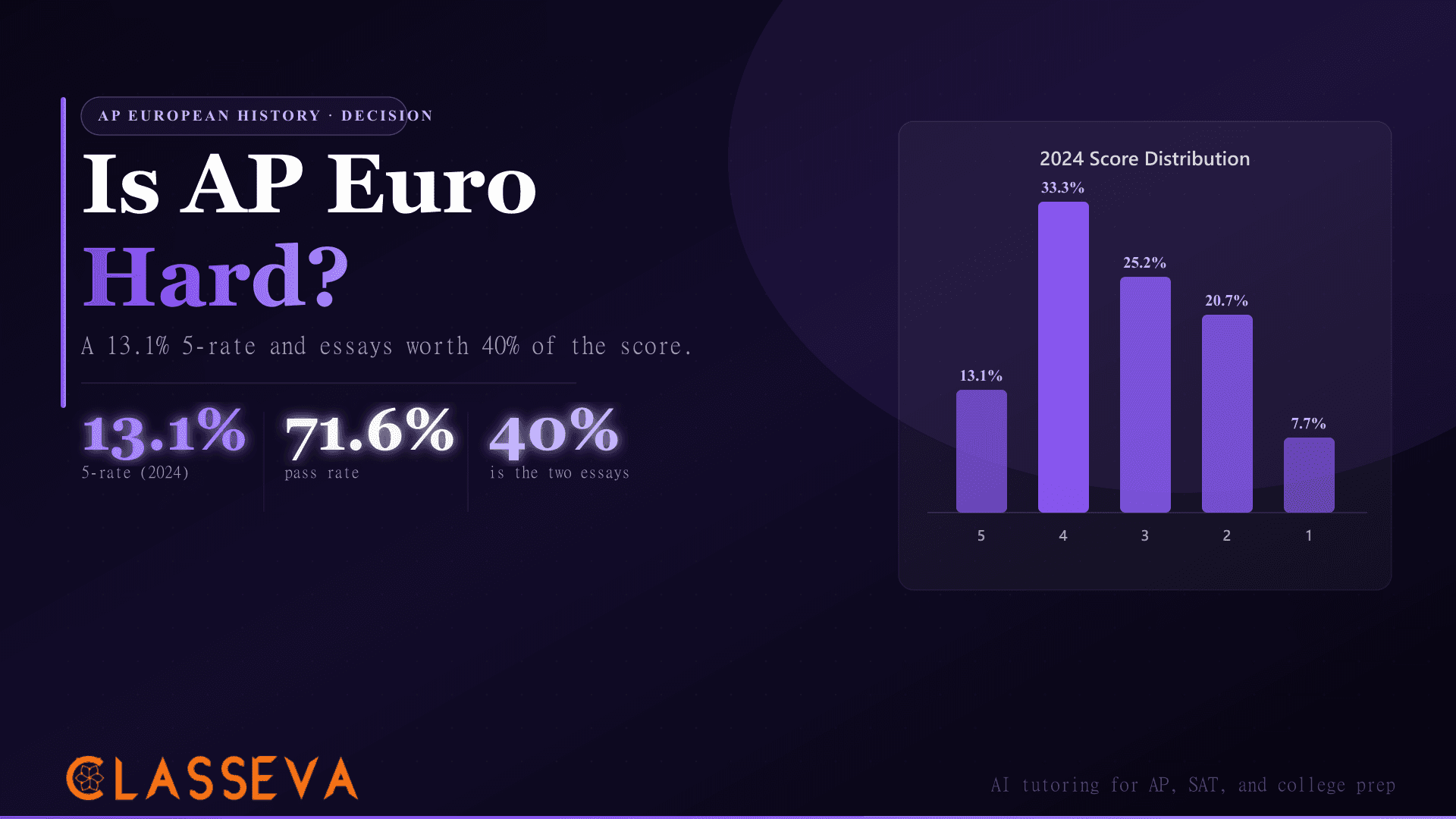
AP European History ranks among the harder history APs, mostly because of unfamiliar content rather than a brutal exam design. Most of the AP Euro difficulty comes from breadth: the 2024 exam produced a 13.1% 5-rate and a 71.6% pass rate, per the College Board's AP European History score distributions. Students with strong writing skills tend to score well; students who try to memorize their way through struggle on the essays.
The AP Euro Score Distribution
AP Euro's 2024 distribution ran 13.1% fives, 33.3% fours, 25.2% threes, 20.7% twos, and 7.7% ones. That gives an AP Euro pass rate (3 or higher) of 71.6% across 83,266 test-takers, with a mean of 3.23. The shape reveals something specific. A large 4-band absorbs most strong students, while the 5-band stays narrow. Reaching a 5 demands more than competence; it requires essays that earn the harder rubric points consistently.
| AP Score | % of Test-Takers (2024) | College Readiness Signal |
|---|---|---|
| 5 | 13.1% | Extremely well qualified |
| 4 | 33.3% | Well qualified |
| 3 | 25.2% | Qualified |
| 2 | 20.7% | Possibly qualified |
| 1 | 7.7% | No recommendation |
2024 AP European History score distribution. Source: College Board AP European History score distributions.
Why the AP Euro 5-Rate Stays Low
The AP Euro 5 rate stays near 13% because the exam rewards specific historical evidence and tight argumentation, two skills that take a full year to build. Students cannot bluff a DBQ. The rubric checks whether you used the documents, sourced them, and supplied outside evidence with real names and dates. Vague essays that gesture at “social tensions” or “economic factors” without naming the Diet of Worms or the Congress of Vienna lose the points that separate a 4 from a 5.
What Is on the AP Euro Exam?
The AP European History exam runs 3 hours and 15 minutes across four parts: 55 multiple-choice questions (40% of the score), 3 short-answer questions (20%), one document-based question (25%), and one long essay (15%). The two essays together decide 40% of the result, per the College Board's AP European History exam page. That weighting tells you where to spend study time.
The MCQ and SAQ Sections
The MCQ section gives you 55 minutes for 55 questions, each tied to a stimulus: a primary source excerpt, a map, a painting, or a data table. You analyze the source, not just recall a fact. The 3 short-answer questions follow in 40 minutes, asking for brief, specific responses (a sentence or two per part) rather than full essays. SAQs reward precision: name the event, state the cause, cite the consequence, and move on without padding.
The DBQ and LEQ Essays
The DBQ hands you 7 documents and 60 minutes (including a 15-minute reading period) to build an argument using at least 4 of them plus outside evidence. The LEQ then gives you 40 minutes and three prompt options covering different time ranges, and you write one essay from memory with no documents to lean on. Many students find the LEQ harder per minute precisely because nothing on the page hands them evidence.
The DBQ alone counts for 25% of your score, more than any other single item on the exam. A strong DBQ writer can pass AP Euro even with a shaky multiple-choice section. The reverse rarely works: a strong MCQ score paired with weak essays usually caps out at a 3.
What Does AP Euro Cover Across 9 Units?
AP European History covers roughly 1450 to the present across 9 units, moving from the Renaissance through the Cold War and contemporary Europe. Each unit carries 10 to 15% of the exam weight, so no single era dominates. The sweep is the challenge: you trace five centuries of dynasties, wars, revolutions, and ideologies, then connect them across units on the essays.
How the Units Are Weighted
Every AP Euro unit carries 10 to 15% of the exam, so the College Board spreads emphasis evenly rather than front-loading any single century. That even spread punishes students who run out of time and skim Units 8 and 9. The 20th century, two world wars, and the Cold War appear on the exam at the same weight as the Renaissance. Skipping the modern units to study the Reformation more deeply trades known points for familiar comfort.
| Unit | Focus | Era |
|---|---|---|
| 1 | Renaissance and Exploration | c. 1450 to 1648 |
| 2 | Age of Reformation | c. 1450 to 1648 |
| 3 | Absolutism and Constitutionalism | c. 1648 to 1815 |
| 4 | Scientific and Political Developments | c. 1648 to 1815 |
| 5 | Conflict and Crisis (Late 18th Century) | c. 1648 to 1815 |
| 6 | Industrialization and Its Effects | c. 1815 to 1914 |
| 7 | 19th-Century Developments and Imperialism | c. 1815 to 1914 |
| 8 | 20th-Century Global Conflicts | c. 1914 to present |
| 9 | Cold War and Contemporary Europe | c. 1914 to present |
The 9 AP European History units, each weighted 10 to 15% of the exam. Source: College Board AP European History course framework.
What Catches Students Off Guard
The content unfamiliarity catches students off guard more than any structural feature. APUSH builds on US history that most students saw in middle and elementary school. AP Euro starts with the Medici, the Habsburgs, and Martin Luther, names many students encounter for the first time in this course. The dynasties tangle: tracing which Habsburg ruled which territory after which treaty becomes a memorization load that US history never demanded.
Students consistently underestimate how many treaties and dynastic successions AP Euro expects them to keep straight. The Peace of Augsburg, the Peace of Westphalia, the Treaty of Utrecht, and the Congress of Vienna each reshaped the map. Build a one-page treaty timeline early, and review it weekly. Cramming five centuries of treaties in April does not work.
AP Euro vs APUSH vs AP World
For most US students, AP Euro feels harder than APUSH because of unfamiliar content, while AP World sits somewhere between the two. The exam formats are nearly identical across all three (MCQ, SAQ, DBQ, LEQ), so the difficulty gap traces to content familiarity, not test design. Take AP Euro if you want a writing-heavy challenge and the European focus interests you.
AP European History
- •13.1% 5-rate, 71.6% pass rate (2024)
- •9 units, c. 1450 to present, Europe only
- •Unfamiliar dynasties, treaties, and religious conflicts
- •Same MCQ/SAQ/DBQ/LEQ structure as APUSH
- •Often taken after APUSH or AP World
APUSH
- •14.2% 5-rate, 73.7% pass rate (2025)
- •9 periods, 1491 to present, US only
- •Builds on US history students already saw in school
- •DBQ and LEQ weight identical to AP Euro
- •Usually the first AP history students take
AP World History: Modern offers a third path. Its 2024 exam produced a 27.4% 5-rate with a 63.7% pass rate and a mean of 3.11 [VERIFY: 2024 College Board AP World History: Modern score distributions], covering global history from c. 1200 forward rather than a single region. Students who want the broadest geographic scope choose AP World; students who want depth in one region's political and intellectual history choose AP Euro. For a fuller comparison of the two history clusters, see the APUSH difficulty breakdown and the AP World History difficulty guide.
All three history APs share the same essay rubrics. The DBQ rubric for AP Euro, APUSH, and AP World awards points for thesis, contextualization, document use, sourcing, and complexity in the same structure. A student who masters the DBQ in one course carries that skill directly into the others.
How Should You Study for AP Euro?
The highest-leverage AP Euro study habit is timed essay practice scored against the official rubrics, not rereading the textbook. The two essays decide 40% of your score, and rubric points are precise enough to drill. Pair essay practice with a running timeline of treaties, rulers, and movements so you always have specific evidence to deploy under pressure.
Why Essay Practice Beats Rereading
Decades of learning-science research show that retrieval practice beats passive review. The 2013 Dunlosky et al. review in Psychological Science in the Public Interest ranked practice testing among the most effective study techniques, while rereading and highlighting ranked among the least. For AP Euro, that means writing full DBQs and LEQs under time, then scoring them against the College Board rubric, teaches more than rereading the chapter a third time. The students who hit 5s have usually written 15 or more practice essays by May.
Pull past prompts and scoring guidelines from AP Central's released AP Euro exam questions, which post the actual documents, sample responses, and point-by-point scoring. Studying how readers awarded each point reveals exactly what separates a 4-level essay from a 5-level essay. If you want techniques that generalize across subjects, the active recall versus passive review breakdown and the spaced practice guide both apply directly to history exams.
Self-grading essays is the skill most students skip. After you write a practice DBQ, set it aside for a day, then score it against the College Board rubric as if it were a stranger's essay. Did you actually source four documents, or did you just summarize them? Honest self-scoring exposes the gap between what you think you wrote and what the rubric rewards.
Should You Take AP European History?
Take AP European History if you write well, enjoy history, and want college credit in a humanities subject. The 71.6% pass rate means most prepared students earn at least a 3, and the writing skills transfer to APUSH, AP World, and college seminars. Skip it if you dislike essay writing or cannot commit to regular practice, because the 40% essay weighting will define your score.
The course also pairs naturally with other writing-heavy APs. Students taking AP English Language in the same year build argumentation skills that feed straight into the DBQ. If you are mapping a full junior or senior schedule, the junior year college planning timeline helps you balance AP Euro against testing and application deadlines.
Project Your AP Euro Score
If you are mid-course, Classeva's AP Score Predictor maps your current MCQ and essay performance to a projected score band, so you know whether to push your essays from a 4-level to a 5-level before May.
AP Score Predictor
Enter your AP European History practice results to project your score band and see whether your essays or your multiple-choice section needs more work before the May exam.
Key Takeaways
- AP European History is among the harder history APs, with a 13.1% 5-rate and a 71.6% pass rate in 2024 across 83,266 test-takers. The difficulty comes from unfamiliar content, not exam design.
- The two essays decide 40% of your score. The DBQ counts for 25% and the LEQ for 15%, so essay practice carries more leverage than memorizing extra content.
- The exam has four parts: 55 MCQs (40%), 3 SAQs (20%), one DBQ (25%), and one LEQ (15%), across 3 hours and 15 minutes.
- The course spans 9 units from c. 1450 to the present, each weighted 10 to 15%. No single era dominates, so skipping the modern units forfeits known points.
- AP Euro feels harder than APUSH for most US students because the dynasties, treaties, and religious conflicts are unfamiliar, while APUSH builds on US history students saw earlier in school.
- Timed essay practice scored against the official rubric beats rereading. Pull past DBQ and LEQ prompts with scoring guidelines from AP Central and write 15 or more practice essays before May.
- Build a treaty and dynasty timeline early. The Peace of Westphalia, Treaty of Utrecht, and Congress of Vienna each reshaped Europe, and cramming five centuries of them in April does not work.