College Likely Letters: What They Are and Who Gets Them
College likely letters land in a small number of inboxes each winter, and they read like a quiet promise: you are almost certainly in, weeks before anyone else finds out. The instinct is to treat them as a tier every strong applicant should chase. That instinct misreads the entire mechanism. Most students admitted to even the most selective colleges in America never receive a likely letter, and the schools that send them aim the practice at two narrow groups rather than the broad pool of excellent applicants.
What Is a College Likely Letter?
A college likely letter is an unofficial written notice from an admissions office telling an applicant they will very probably be admitted on the official decision date. The Ivy League Joint Statement on Admissions permits member schools to advise applicants in writing of their probability of admission (likely, possible, or unlikely) no earlier than October 1 of senior year. A likely letter carries the effect of an admission letter as long as the student sustains the record in the completed application.
A Likely Letter Is Not an Official Acceptance
A likely letter is not a binding contract and not the formal offer itself. The official admission still arrives on the regular notification date, often Ivy Day in late March for Regular Decision applicants. What the letter buys you is certainty, several weeks early, plus a clear signal that the school wants you enough to break its usual silence. The reversal rate is close to zero, but it is not nothing: a student who fails a class or drops a demanding course can lose the commitment.
Ivy League rules state a likely letter has the effect of a letter of admission, provided the applicant maintains the academic and personal record reflected in the completed application. That conditional clause is real. Read any likely letter you receive carefully, because the school is telling you the offer depends on you finishing senior year the way you started it.
Which Schools Send Likely Letters?
A short list of high-yield, highly selective colleges send likely letters, led by the eight Ivy League schools. Peer institutions with strong yield, including Duke, Northwestern, and the University of Chicago, send them too, as do selective liberal arts colleges such as Williams and Amherst. The vast majority of US colleges, including most public flagships and mid-tier privates, never use likely letters at all.
The Ivies and Their Peers
The eight Ivy League schools operate under one shared rulebook, so a Harvard likely letter and a Yale likely letter follow identical timing and effect. Princeton, Brown, Columbia, Dartmouth, Penn, and Cornell behave the same way. Outside the Ivy League, the schools most associated with likely letters compete for the same applicants the Ivies want, which is why high-yield rivals like Duke and the University of Chicago adopted the practice to protect their own enrollment.
Schools That Do Not Send Them
Stanford and MIT do not send academic likely letters, a point worth stating because applicants assume every elite school does. A student rejected from the likely-letter idea at Stanford has lost nothing, because Stanford simply does not play that game. Most large public universities also skip likely letters entirely, relying on rolling or early notification to manage yield instead. The absence of the practice at a school you love is not a verdict on your application.
Who Actually Gets a Likely Letter?
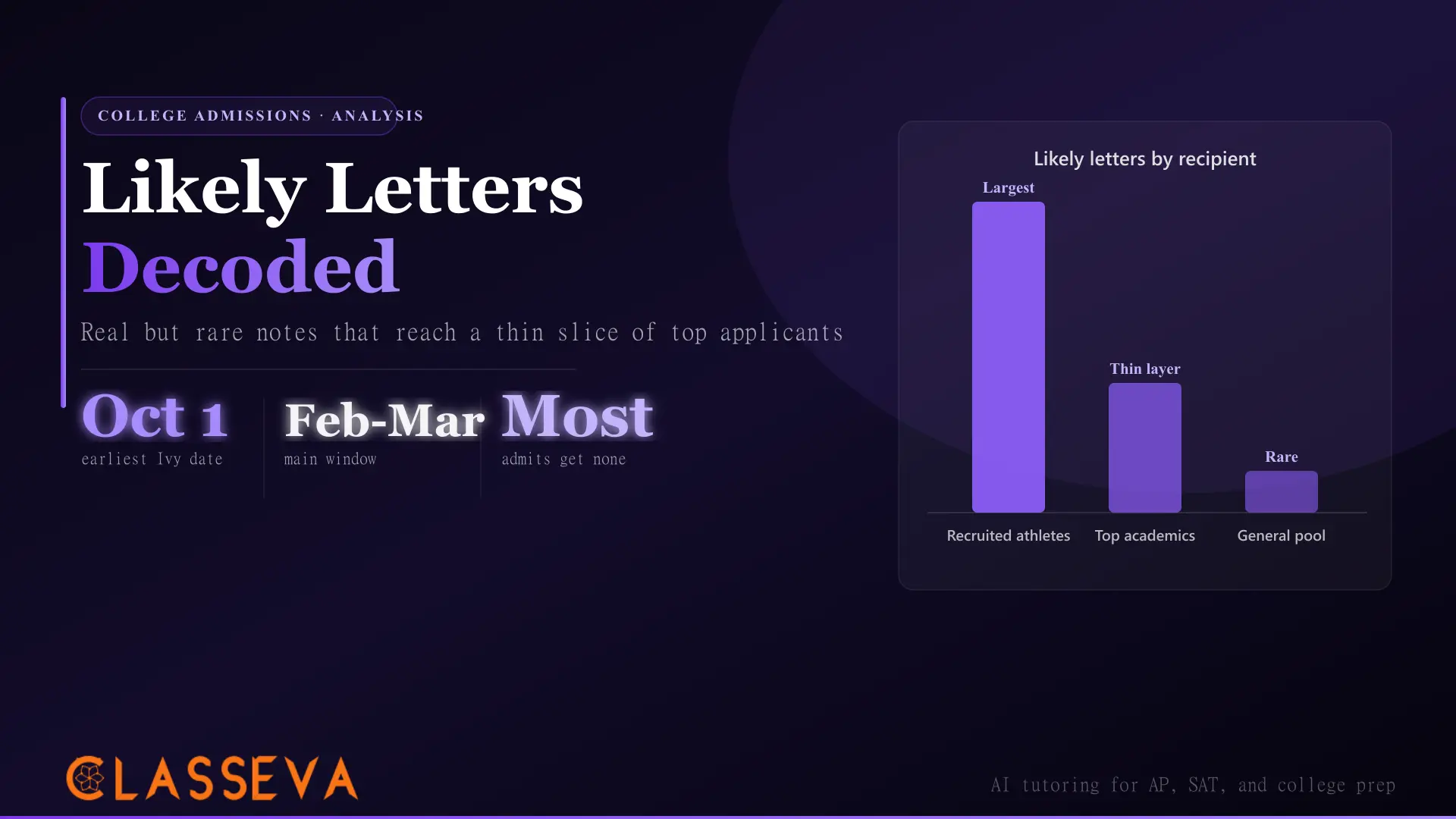
Two groups receive the overwhelming share of college likely letters: recruited athletes and a thin layer of standout academic or scholarship candidates. Both groups share a trait the admissions office cares about, which is a high risk of being lured away by a competitor. A likely letter is a yield-protection tool aimed at students the school expects to have other elite offers.
Recruited Athletes
Recruited athletes are the single most common reason a likely letter gets sent. The Ivy League offers no athletic scholarships and signs no National Letters of Intent, so a likely letter is the strongest commitment a coach and admissions office can extend. A recruited athlete who has submitted a complete application and earned a coach’s backing usually receives a likely letter that confirms the school intends to admit them. Across the Ivy League, recruited athletes account for a large share of all likely letters issued in a given cycle.
Because Ivy League schools cannot sign athletes to National Letters of Intent the way scholarship programs do, the likely letter became the closest equivalent. For a recruited athlete weighing a Division I scholarship offer elsewhere against an Ivy spot, the likely letter is the document that makes the Ivy commitment feel real before any official decision releases.
Top Academic and Scholarship Candidates
The second group is small and hard to predict: applicants whose academic profile sits so far above the admitted median that the school wants to claim them early. Named-scholarship finalists, students with rare research or competition credentials, and candidates flagged by a department all surface here. A non-athlete academic likely letter signals that an office expects you to hold offers from its direct rivals and wants the first word. Unlike recruited-athlete letters, these arrive with no warning and follow no quota.
When Do Likely Letters Come?
Likely letters arrive between early February and mid-March for Regular Decision applicants, weeks before official decisions in late March. Ivy League rules forbid any likely letter before October 1 of senior year. Recruited athletes often hear earliest, sometimes in the fall after they complete their files, while academic likely letters tend to cluster in February and early March as committees finish their reads.
The October to March Window
The clearest rule comes straight from the Ivy League Joint Statement: no member school may signal an applicant’s probability of admission in writing before October 1 of senior year. From that date through the spring, an office may send likely letters at its discretion. Recruited athletes who finish their applications early can receive likely letters in the fall, which is why a coach may tell a recruit to submit by November. For everyone else, the window narrows to a few February and March weeks.
| Applicant Type | Typical Likely Letter Timing | Official Decision |
|---|---|---|
| Recruited athlete (early file) | October to December of senior year | Often via Early Decision/Action |
| Recruited athlete (later file) | January to early March | Late March |
| Top academic candidate | Early February to mid-March | Late March (Ivy Day) |
| General strong applicant | Rarely receives one | Late March, no advance notice |
Approximate likely letter timing by applicant type. Exact dates vary by school and cycle.
What It Means If You Do Not Get One
Not receiving a likely letter tells you almost nothing about your chances. The honest framing here matters more than any tactic. Schools issue likely letters to a tiny, unusual slice of their admitted class, so the typical admitted student learns the news on the official decision date alongside everyone else. Reading rejection into silence is a mistake the timeline does not support.
What a Likely Letter Means
- •The school has decided it wants you and broke its silence early
- •You fall into a recruited or standout category it actively protects
- •Your admission is near-certain if you sustain your record
- •You can plan with more confidence weeks ahead of peers
What No Likely Letter Means
- •Almost nothing: most admitted students never receive one
- •Your file is still under full, normal review
- •You are not an athlete or rare-category candidate the school flags early
- •The official decision date is simply how you will hear
Treat the weeks between submission and decisions as a waiting period you cannot influence by checking your inbox. Refreshing email does not change an outcome already being decided in committee. If you want a productive use of that stretch, build a realistic safety, match, and reach college list and finish strong on the senior coursework that any likely letter would depend on. Students weighing where their odds actually sit should study current admit-rate data rather than likely-letter folklore.
Some applicants email admissions in February to ask whether a likely letter is coming, or read forums comparing who got one. Neither helps. Offices do not predict likely letters on request, and the absence of one is not a signal to decode. The students who get into a Harvard likely letter or a Yale likely letter were flagged by the office, not by anything they did during the wait.
Plan for the Cost of Applying Broadly
Because no student can target a likely letter, the smart move is to apply across a balanced list and plan for the real cost of doing so. Application fees, score sends, and travel for interviews add up fast, especially for students chasing the same selective schools that send likely letters. A focused budget keeps a broad list affordable and stops a single dream school from crowding out matches and safeties.
Map the full price of your list before you submit, then compare it against the application fee waivers you may qualify for. The calculator below totals fees, score reports, and related costs so the application season does not produce a surprise bill.
College Application Cost Calculator
Add up application fees, score sends, and related costs across your full college list so you can budget for a broad, balanced set of schools.
What to Do If You Receive a Likely Letter
If a likely letter arrives, the first job is to verify it, and the second is to keep everything else moving. A genuine likely letter comes from the admissions office and states you are likely to be admitted on the regular date if you sustain your record. Confirm the sender, then resist the urge to coast. The letter’s power depends on a condition you still control.
Keep your senior grades steady and your schedule rigorous, because a likely letter takes effect only if you maintain the academic and personal record reflected in your application. Do not withdraw your other applications or stop submitting, since the letter is not binding and not the official offer. Wait for every official admission and financial aid package before you commit, because a likely letter rarely includes a final aid award. If the letter came through a coach, reply promptly and honestly while you finish weighing your options.
For students mapping their full admissions strategy, the same yield logic that drives likely letters shapes other decisions worth studying: the Harvard admissions breakdown, the Yale admissions guide, and a clear college waitlist strategy for the schools that defer rather than commit early. Athletes weighing service options can compare the service academy admissions path, which runs on an entirely different timeline.
Key Takeaways
- College likely letters are real but rare. They reach a small slice of admitted students at the few schools that send them, and most admitted students never get one.
- The absence of a likely letter predicts almost nothing. Reading rejection into silence misunderstands the timeline; nearly everyone learns their decision on the official date.
- Two groups receive most of them: recruited athletes and a thin layer of standout academic or scholarship candidates the school expects to have rival offers.
- Recruited athletes are the largest group at the Ivies, where likely letters replace athletic scholarships and National Letters of Intent.
- Timing runs February to mid-March for Regular Decision applicants, and Ivy League rules forbid any likely letter before October 1 of senior year.
- A likely letter is not binding, but it carries the effect of an admission offer as long as you sustain the academic and personal record in your application.
- You cannot target one, so apply across a balanced list, budget for the full cost of applying, and finish senior year strong.