College Waitlist Strategy: Improve Your Odds in 2026
A waitlist is not a soft rejection, and it is not a near-acceptance. It is a holding queue a college uses to backfill seats after it counts deposits, which means your odds turn entirely on one number the school publishes every year: how many waitlisted students it actually admitted. That number ranges from zero at some elite colleges to several hundred at large public universities, and almost nobody checks it before deciding how hard to fight. A real college waitlist strategy starts with that number, then layers a focused Letter of Continued Interest on top. This guide pulls the figures from Common Data Set Section C2, walks through a letter you can adapt, and maps the exact window when movement happens.
What Is a College Waitlist?
A college wait list is a pool of qualified applicants a school holds in reserve to fill any seats that open after admitted students decide where to enroll. You were not rejected and you were not admitted. The college parked your file until it knows how many of its accepted students send a deposit by May 1.
Why Schools Build Waitlists
Schools cannot predict yield perfectly. Yield is the share of admitted students who enroll, and a swing of even two points across thousands of offers can leave a class over-enrolled or short by a hundred beds. The waitlist gives admissions offices a precision tool. They admit fewer students up front, watch the deposits land, then pull from the waitlist only if the numbers fall short.
That mechanism explains the volatility. A school that hits its yield target perfectly may go to the waitlist for nobody. The same school a year later, after an unexpected dip in deposits, might admit two hundred. You are competing against a number set by other students' choices, not by your file alone.
What Being Waitlisted Actually Means
Being waitlisted means the college judged you admissible but ran out of guaranteed seats. Most waitlists are unranked, so there is no public position number and no way to know whether you sit near the top. A few schools rank theirs or sort applicants into priority tiers, but they rarely reveal where you stand.
You have to accept your spot on the waitlist, usually within one to two weeks, or the college drops you automatically. If the school is not in your top few choices, declining the waitlist frees you to commit elsewhere with no second-guessing. Joining a waitlist you would not actually attend wastes everyone's time.
What Are Your College Waitlist Odds?
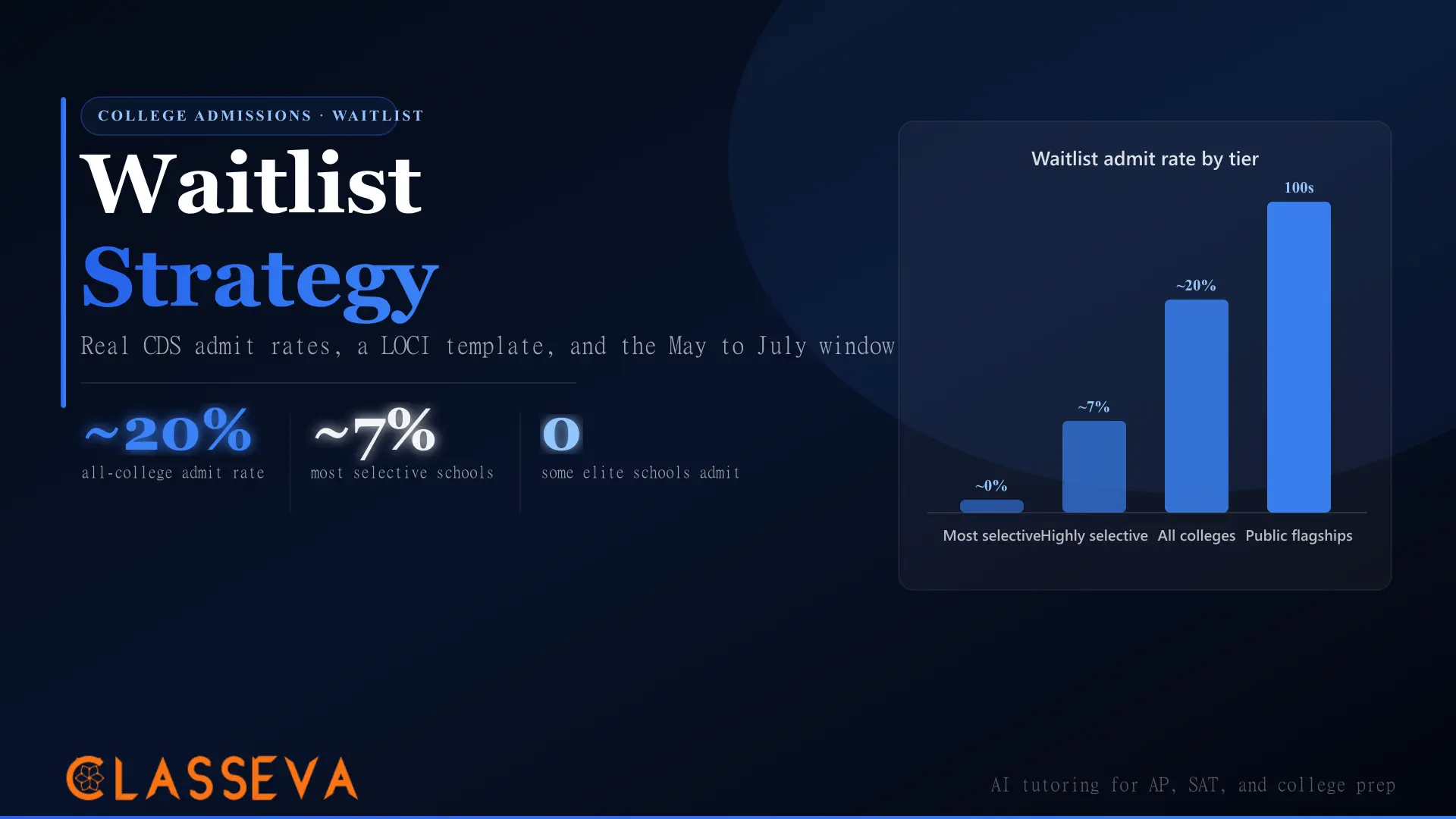
Across all colleges, about 20% of students who accept a waitlist spot are eventually admitted, according to NACAC's State of College Admission report. At the most selective institutions, that average falls to roughly 7%. The honest answer is that one national number tells you little, because the spread between schools dwarfs the average.
Waitlist Admit Rates Vary Wildly by School
Here is the part most guides skip. Princeton has admitted zero students from its waitlist in multiple recent years, while large public flagships like the University of Michigan have pulled hundreds in a single cycle. Same waitlist label, completely different reality. Every school reports these counts in Section C2 of its Common Data Set, and reading them turns a vague hope into a calculated bet.
How to Read CDS Section C2 Yourself
Every accredited college publishes a Common Data Set, and Section C2 reports the waitlist in four plain lines: whether the school uses a waitlist, how many applicants it offered a spot, how many accepted that spot, and how many it ultimately admitted. Divide the last number by the third to get the school's real waitlist admit rate for that year. That single ratio is the most honest forecast you can find.
To locate it, search the school name plus "Common Data Set" and open the most recent PDF, usually hosted on an institutional research page like the University of Michigan Office of Budget and Planning. Scroll to Section C, find line C2, and read the four numbers. A school that offered 4,000 waitlist spots, had 2,000 accept, and admitted 300 ran a 15% waitlist rate. A school showing "0" in the admitted line went to the waitlist for nobody.
| CDS C2 line | What it tells you | How to use it |
|---|---|---|
| Waitlist used? (Yes/No) | Whether the school maintains a waitlist at all | A "No" means there is no queue to join |
| Number offered a place | How large the waitlist pool is | A huge pool usually means thin individual odds |
| Number accepting a place | How many students opted in | This is your real denominator |
| Number admitted | Seats the waitlist actually filled | Divide by the line above for the admit rate |
Source: Common Data Set Section C2 structure, reported by every accredited US college.
A single year can mislead. A school that admitted 0 from the waitlist last spring might admit 250 the next if deposits dip. Read the last three Common Data Sets for each college on your list and look at the range. Consistency across years is a stronger signal than any single number.
When Does Waitlist Movement Happen?
Most waitlist activity happens between early May and late July. The first wave follows the May 1 national enrollment deadline, once colleges count their deposits and see whether they over-enrolled or fell short. Quieter movement continues through summer as admitted students change their minds, and a handful of offers land in August right before orientation.
The May to July Window
The calendar is predictable even when the outcome is not. Schools rarely touch the waitlist before May 1, because they do not yet know how many seats are open. After deposits post, the admissions office models its class and decides whether to pull anyone. Stay reachable. A waitlist offer can arrive by phone or email with a 48-hour deadline, and a missed message is a forfeited seat.
How Do You Write a Letter of Continued Interest?
A Letter of Continued Interest is a short note, 250 to 400 words, that tells a college you remain committed and shares what has changed since you applied. It is the one piece of the waitlist you fully control. Write it only if the school invites updates, reaffirm the college as a top choice, and back the claim with one or two concrete developments.
The Four-Part LOCI Structure
A strong letter of continued interest moves through four beats in order. Lead with commitment, prove momentum, connect to the school, and close cleanly. The structure keeps you from rambling and gives the reader the yield signal they want in the first two sentences.
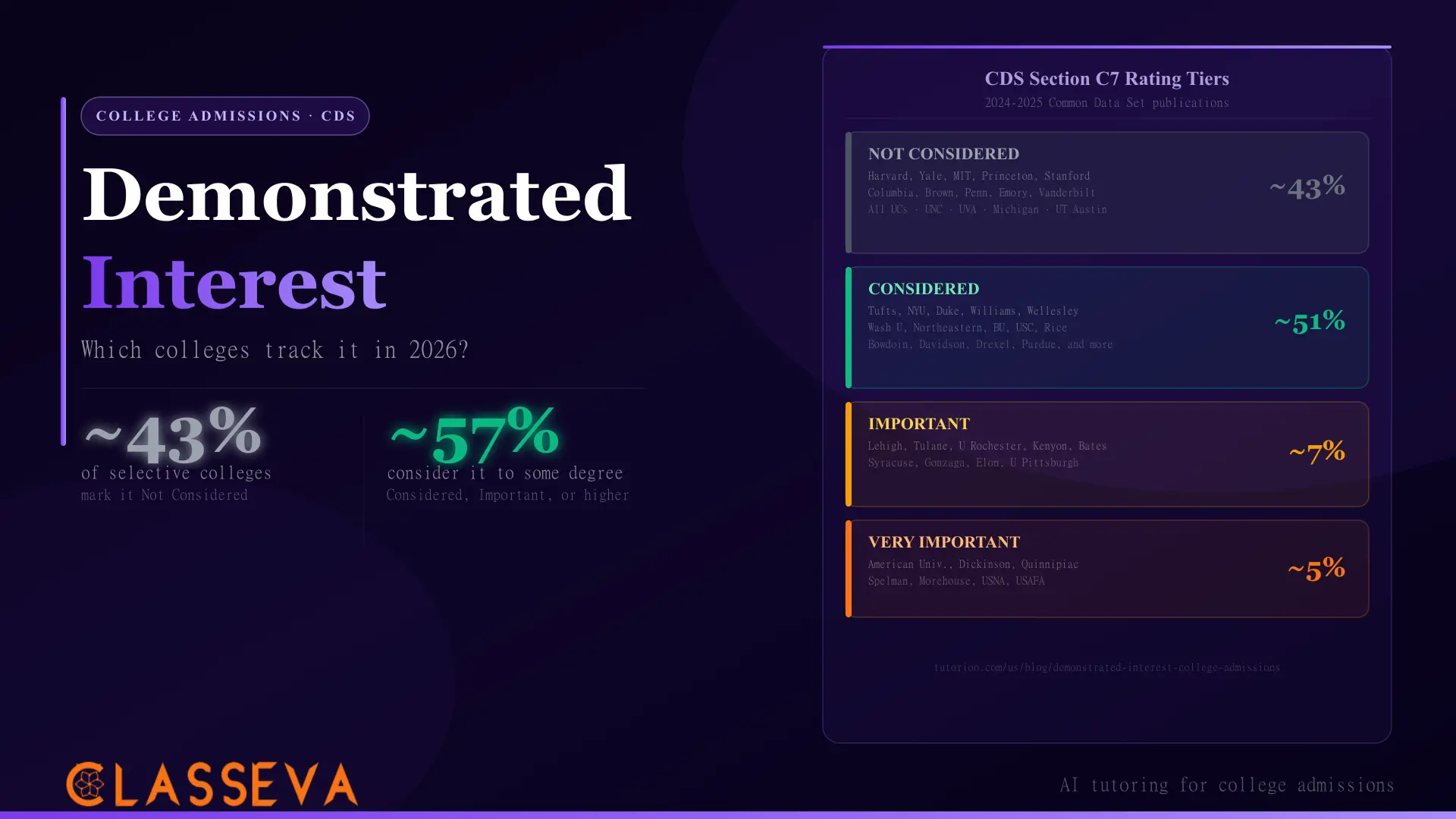
The reaffirmation matters most at schools managing yield. When you write "If admitted, I will enroll," you hand the admissions office a near-certain deposit, which is exactly what they need from a waitlist. A clear first-choice statement on a strong file can tip a close call. For why that signal carries weight, see how demonstrated interest works in college admissions.
A LOCI Sample You Can Adapt
Use the sample below as a frame, not a script. Replace every bracketed phrase with a specific, true detail. The version that works names a real professor, a real course, and a real accomplishment that admissions can verify.
Dear [Regional Admissions Representative],
Thank you for placing me on the waitlist for [University]. It remains my top choice, and I want to confirm that I will enroll if admitted.
Since I applied, I raised my GPA to [4.0 this semester] and was named [captain of the robotics team], where we [qualified for the state finals]. I also completed [an independent research project on water quality] that I started in the fall.
What keeps [University] first on my list is [the Coastal Studies Program] and the chance to work with [Professor Lin's estuary lab]. The [marine policy course sequence] lines up exactly with the work I want to do.
Thank you for considering me. I would be honored to join the Class of [2030].
Sincerely, [Your Name], [Application ID]
A budget conversation belongs in your waitlist plan too. Holding a deposit at one school while you wait on another means you may pay two sets of fees, and a late admit can carry a different aid picture. Model the full spend before you commit anywhere.
College Application Cost Calculator
Waitlists add hidden costs: a held deposit at one school, fees at another, and travel for a late visit. Model your full application and enrollment budget before you commit.
What Should You Avoid on a Waitlist?
The fastest way to sink your college waitlist strategy is to overdo it. Admissions offices read genuine, focused interest as a plus and treat volume, pressure, or rule-breaking as a red flag. The rule is simple: do what the school invites, do it once, and do it well.
Do
- •Accept the waitlist spot before the stated deadline
- •Read the portal instructions and follow them exactly
- •Send one focused LOCI if the school invites updates
- •Report only verifiable, recent accomplishments
- •Keep a deposit at a school that already admitted you
- •Stay reachable by phone and email through August
Avoid
- •Sending weekly emails or repeated letters
- •Mailing gifts, baked goods, or anything theatrical
- •Submitting materials a school asked you not to send
- •Having parents call or email on your behalf
- •Inflating or inventing updates the school can check
- •Letting a 48-hour offer expire because you missed it
One more trap deserves attention. Some students treat the waitlist as a reason to stop everything and wait. Keep your grades up. A college can rescind a regular admission offer for a senior-year collapse, and a waitlist admit reads your final transcript with the same scrutiny. For seniors balancing this, how senior-year course rigor affects admissions explains why the final semester still counts.
A waitlist letter that lists no new information, repeats the original essay, or pressures the reader with a sob story does more harm than no letter at all. Admissions officers process thousands of files. A note that wastes their time signals exactly the judgment they were unsure about. Write once, write well, or do not write.
What Happens to Financial Aid Off the Waitlist?
Being accepted from waitlist status can change your aid. Many institutional grants and outside scholarships are committed by late spring, so a summer admit sometimes receives a thinner package than a March admit would have. Federal aid is not first-come-first-served, but some campus-based funds run low, and the timing works against you.
The fix is to ask directly. Before you accept a waitlist offer, request a financial aid estimate from the school in writing. Federal eligibility flows from the FAFSA, which the step-by-step guide walks through, and that piece does not expire based on your admit date. Federal Student Aid at studentaid.gov confirms that federal grants and loans flow from your verified FAFSA rather than your admit date. Institutional grants are the variable, so get the number before you forfeit a deposit elsewhere.
| Aid type | Affected by late admit? | What to do |
|---|---|---|
| Federal grants and loans (FAFSA) | Mostly no | Keep your FAFSA current and listed for the school |
| Institutional need-based grants | Sometimes thinner | Request a written estimate before committing |
| Merit scholarships | Often already awarded | Ask if any merit funds remain for waitlist admits |
| Campus-based aid (work-study, SEOG) | Can run low | Confirm availability with the aid office |
Late waitlist admits can face reduced institutional aid. Federal aid through studentaid.gov is less time-sensitive.
For the broader picture on how published prices differ from what families actually pay, the net price versus sticker price breakdown shows why a thinner waitlist package can still beat a cheaper-looking school.
How to Build a Realistic Waitlist Plan
A sound college waitlist strategy has two halves: act on the wait list, and protect your future. The mistake students make is pouring energy into a 7% bet while neglecting the school that already wants them. Treat the wait list as a bonus lottery ticket on top of a confirmed plan, never as the plan itself.
Start by depositing at the best school that admitted you, by May 1, with full commitment. Then layer your waitlist effort on top: accept the spot, send one LOCI if invited, and read the school's CDS C2 history so your expectations match reality. If the data shows the school admits nobody from its waitlist most years, your energy is better spent getting excited about where you are headed. The same logic that builds a balanced application list applies here, as holistic review in college admissions makes clear.
If a school's last three Common Data Sets show 0 admitted from the waitlist, accept the spot if you like, but do not anchor your spring to it. If they show 150 to 300 admitted each year, a strong LOCI is worth real effort. The CDS turns a guess into a decision.
One last reframe. A waitlist means a college saw you as admissible, which is itself a signal that your application is competitive. Whether or not this particular door opens, that competitiveness carries to your other choices, including the transfer path. For students set on a different school long-term, the college transfer admissions strategy opens a second route that does not depend on a single waitlist.
Key Takeaways
- Your college waitlist odds depend on the specific school, not a national average. Rates run from 0% at some elite colleges to hundreds admitted at large public flagships. Read CDS Section C2 for each school on your list.
- Across all colleges, about 20% of waitlist-accepters get in; at the most selective schools, roughly 7% do, per NACAC. Divide the "admitted" line by the "accepting a place" line in C2 for the real rate.
- Most movement happens between early May and late July, after the May 1 deposit deadline reveals open seats. Stay reachable; offers can carry a 48-hour deadline.
- A Letter of Continued Interest of 250 to 400 words is the one action you control. Send it only when invited, reaffirm the school as a top choice, and back it with one or two verifiable updates.
- Avoid volume and theatrics. Repeated emails, gifts, parent calls, and inflated updates hurt more than they help. Do what the school invites, once, and well.
- Always deposit at a school that admitted you, and ask about aid before accepting a waitlist offer. Late admits can receive a thinner institutional package even when federal aid holds steady.