Is APUSH Hard? DBQ, LEQ, and the 9-Period Curriculum Decoded
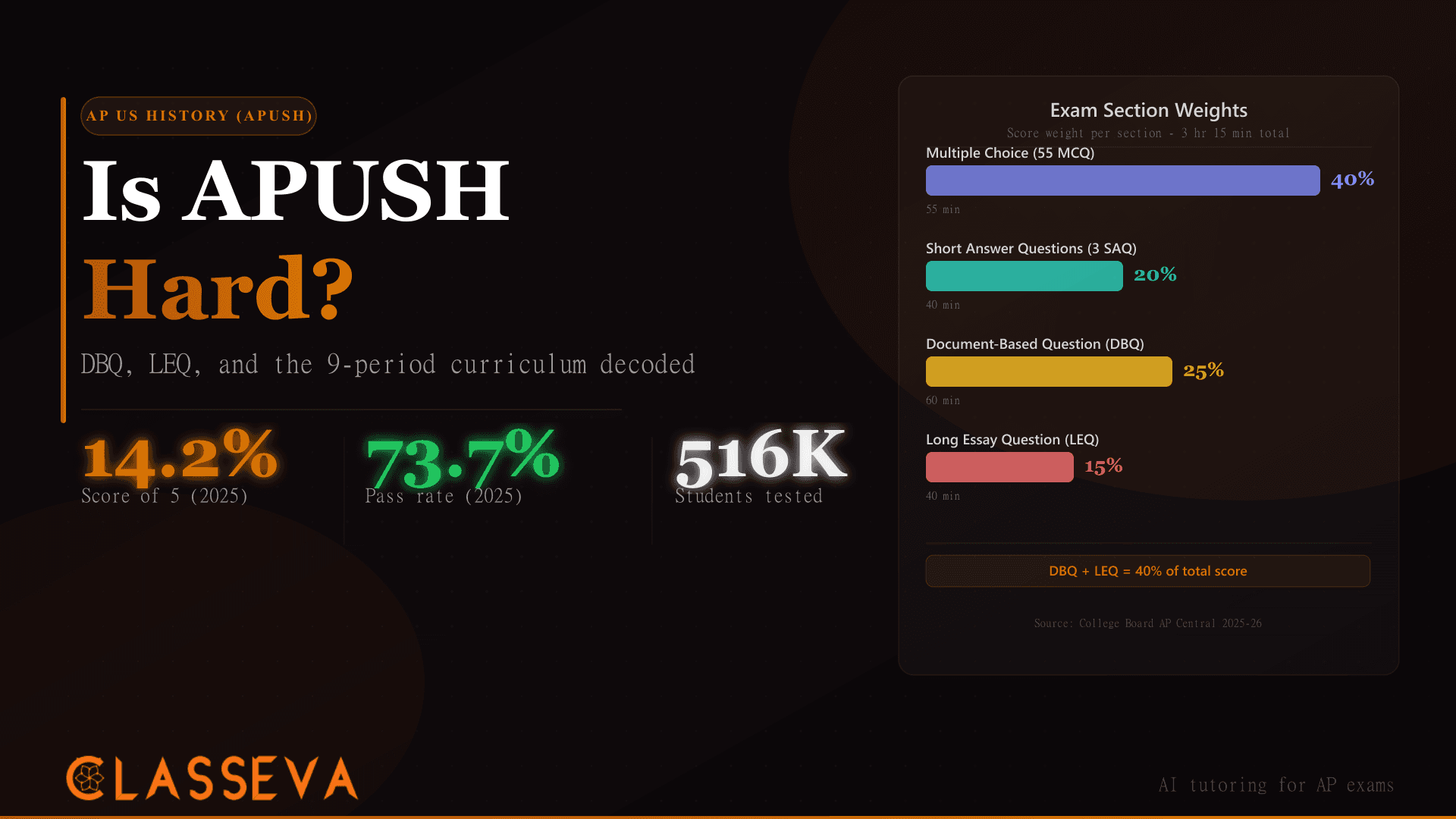
APUSH's 2025 5-rate landed at 14.2% across 516,738 students, placing it in the moderate range of AP difficulty. The 73.7% pass rate looks approachable. The number that tells a sharper story is this: the Document-Based Question and Long Essay Question together account for 40% of your total score. Both demand historical argumentation, not memorization. APUSH rewards the student who can build a thesis and sustain it across seven primary source documents, and punishes the student who spent the year highlighting a textbook.
How Hard Is APUSH?
APUSH earns a pass rate of 73.7% and a 5-rate of 14.2% in 2025, making it moderately challenging by AP standards. It sits above AP Physics 1 (roughly 43% pass rate) and below AP Environmental Science in terms of raw accessibility. The difficulty is concentrated: the multiple-choice section rewards broad content knowledge, but the free-response writing sections require a different skill set that most students underestimate until they sit a timed DBQ for the first time.
Pass Rate and 5-Rate in 2025
In 2025, 516,738 students sat the APUSH exam. Here is the complete score distribution, sourced from College Board's official APUSH score distributions:
| Score | Percentage | What It Means |
|---|---|---|
| 5 | 14.2% | Exceptional: college credit at most schools |
| 4 | 36.2% | Strong: credit at most schools |
| 3 | 23.3% | Pass: credit at some schools |
| 2 | 18.4% | Below passing |
| 1 | 8.0% | No credit |
Source: College Board APUSH Score Distributions, 2025. Mean score: 3.30. Total test-takers: 516,738.
The 2024 5-rate was 12.8%, so the 2025 figure (14.2%) reflects an upward shift. The mean score of 3.30 signals that the majority of students who sit APUSH pass, but passing and scoring a 5 are separated by a wide gulf. The 36.2% who earned a 4 represents the largest single score band, which means a slight improvement in writing quality often separates a 4 from a 5.
How APUSH Compares to Other AP Humanities
APUSH sits near the middle of the AP history difficulty spectrum. Its writing structure is identical to AP World History: Modern and AP European History, so the skills transfer between courses, but the content scope differs significantly. APUSH covers one nation across nine periods; AP World covers global history across roughly 700 years.
APUSH
- •5-rate: 14.2% (2025)
- •Pass rate: 73.7%
- •9 periods, 1491 to present
- •DBQ + LEQ + SAQ writing
- •U.S. national focus
AP World History: Modern
- •5-rate: ~14-16% range
- •Pass rate: ~60-65%
- •6 periods, 1200 CE to present
- •Same DBQ/LEQ/SAQ structure
- •Global comparative scope
AP European History
- •5-rate: ~13-15% range
- •Pass rate: ~55-60%
- •Renaissance to present
- •Same writing structure
- •Smaller test-taker pool
APUSH, AP World History: Modern, and AP European History all use the same DBQ/LEQ/SAQ format and the same Historical Thinking Skills rubric. If you have already taken one of these courses, the skills you developed apply directly to APUSH writing tasks.
What Does the APUSH Exam Actually Test?
The APUSH exam runs 3 hours and 15 minutes and splits into two sections with four distinct question types. The multiple-choice section tests breadth of historical knowledge; the writing sections test whether you can construct historical arguments with evidence and analysis. The College Board's AP Central APUSH exam page confirms the structure below.
Section I: Multiple Choice and Short Answer
Section I carries 60% of your total score and divides into two parts. Part A runs 55 multiple-choice questions in 55 minutes, worth 40% of the exam. Questions typically arrive in sets of three to four, anchored to a stimulus: a primary source excerpt, an image, a map, or a secondary source interpretation. Part B gives you three Short Answer Questions (SAQ) in 40 minutes, worth 20%. Each SAQ contains three lettered parts, and you answer each in a few direct sentences. You choose between questions 3 and 4 based on your period strength.
Section II: DBQ and LEQ
Section II carries the remaining 40% of your score across two essay tasks. The Document-Based Question runs 60 minutes (including a 15-minute reading period) and accounts for 25% of your total score. The Long Essay Question follows, with 40 minutes and 15% of your score. The LEQ offers three time-period options, and you choose the one that suits your content preparation.
Why the DBQ Determines Your Score
The DBQ alone carries 25% of your total APUSH score. No single multiple-choice question comes close to that weight. A student who earns a near-perfect score on 55 multiple-choice questions but writes a weak DBQ essay will not score a 5. Conversely, a student who misses 12 multiple-choice questions but writes a strong DBQ can still reach a 4. The math of the exam rewards writing skill disproportionately.
The 7-Point DBQ Rubric
The DBQ is scored on a 7-point rubric. Each point maps to a specific analytical task, and a rubric scorer can award or deny each point independently of the others. You do not need to earn all 7 to score a 5, but you need most of them. The rubric categories, sourced from AP Central's APUSH exam questions page, break down as follows:
Contextualization and Sourcing in Practice
Contextualization and sourcing are the two rubric points students most commonly miss. Contextualization requires you to describe a broader historical development (one that occurred before, during, or after the time period of the prompt) and explain how it connects to your argument. A single sentence noting that “industrialization was occurring at the time” does not earn the point. The connection must be explained, not just mentioned.
Sourcing requires you to analyze the historical significance of a document's context: the author's point of view, the document's purpose, the audience it targets, or the historical situation in which it was produced. You need to do this for at least three documents. The sourcing point rewards students who treat documents as historical artifacts with perspective and bias, not just as evidence buckets.
Writing “The author says this because they are biased” does not earn the sourcing point. You need to name the specific reason the document's context matters for your argument. “As a plantation owner writing in 1850, the author's economic stake in slavery shapes this document's defense of states' rights” earns the point; a generic bias claim does not.
The 9 Historical Periods: What Is on the Test
The APUSH Course and Exam Description organizes U.S. history into nine chronological periods. Every period can appear in multiple-choice questions and SAQs. The DBQ, however, draws from the period 1754 to 1980 only, which narrows the content range you need to master for the most heavily weighted writing task.
Note that Periods 5 and 6 overlap (1844-1877 and 1865-1898). The AP US History Course and Exam Description acknowledges that certain events bridge period boundaries, and exam questions reflect this overlap. The Civil War and Reconstruction span the transition between Periods 5 and 6, so both periods must be understood in relation to each other.
How Much Should You Study for APUSH?
Most students who score a 4 or 5 on APUSH study between 4 and 7 hours per week during the school year, with the upper end of that range during the final two months before the May exam. The total investment runs roughly 150-200 hours across a 30-week course. What matters more than total hours is how those hours divide between content review and writing practice.
Writing Practice vs. Content Coverage
Most APUSH students spend 90% of their study time on content and 10% on writing. The students who earn 5s reverse that ratio in their final month. By April, you will have covered all nine periods in class. The content gap between a 4 and a 5 is usually small. The writing gap is large.
Weeks 1-20 (September through January): content depth by period
Aim for 4-5 hours per week. For each period, focus on the major themes (political, economic, social) rather than memorizing every name and date. Build your understanding of causation and continuity across periods.
Weeks 21-30 (February and March): writing introduction
Begin timed SAQ practice. Spend at least one session per week writing a complete DBQ response from a past exam. Use the official scoring guidelines from AP Central to evaluate every response you write; the rubric reveals exactly what the grader is looking for.
Weeks 31-36 (April through early May): intensive writing and gap fill
Allocate 7-9 hours per week. Complete at least two full timed practice exams, including the writing sections under real conditions. Focus the last two weeks on the contextualization and sourcing points: they are the most commonly missed and the most efficiently improved.
College Board publishes every past APUSH FRQ with full scoring guidelines and sample scored responses at AP Central, free of charge. Writing one timed DBQ per week against the official rubric teaches you more about the exam than any prep book. The sample responses show exactly how graders apply each rubric point.
How APUSH Compares to Other AP Exams Overall
For students deciding between history AP courses or weighing APUSH against other options, the difficulty comparison below uses 2025 data where available. APUSH's 73.7% pass rate makes it more accessible than several popular AP science courses and on par with AP Language and Composition.
| AP Exam | 5-Rate (2025) | Pass Rate (2025) | Difficulty Factor |
|---|---|---|---|
| AP Physics 1 | ~7% | ~43% | Very high: conceptual reasoning |
| AP Chemistry | ~11-13% | ~56% | High: math and lab reasoning |
| AP Biology | 18.9% | 70.4% | Moderate: content breadth |
| APUSH | 14.2% | 73.7% | Moderate: writing demands |
| AP Lang and Comp | ~12-14% | ~78% | Moderate: rhetorical analysis |
| AP Environmental Science | ~9% | ~53% | Moderate (often underestimated) |
Sources: College Board Score Distributions 2025. AP Chemistry and AP Physics 1 figures are approximate averages.
Reading the College Board's score data across subjects, what stands out about APUSH is how the 5-rate has climbed: 12.8% in 2024 to 14.2% in 2025. The full 2025 AP score distributions show APUSH trending upward while the pass rate remains consistent, suggesting that students are improving their top-end performance without the overall pass rate changing dramatically.
Where Does Your Practice Score Put You?
If you want a sense of where your current preparation maps to the actual APUSH score scale, use Classeva's AP Score Predictor. It takes your practice test results across both sections and projects the likely score range, showing which section most needs improvement to reach the next band. The AP Credit Savings Calculator can also show how much tuition credit you stand to earn from a 4 or 5.
AP Score Predictor
Enter your APUSH practice test results to see your projected score and identify which sections to prioritize in your remaining study time.
For deeper APUSH preparation materials, including past FRQs organized by period and scoring guidelines, visit the APUSH resources hub. Students preparing for multiple AP history exams may also find useful framing in our AP Biology difficulty breakdown, which covers the same score-distribution analysis applied to a different subject.
Key Takeaways
- APUSH is moderately difficult. A 14.2% 5-rate and 73.7% pass rate in 2025 place it in the middle of the AP difficulty spectrum, harder to ace than AP Language but easier than AP Chemistry or AP Physics 1.
- Writing determines your ceiling. The DBQ (25%) and LEQ (15%) together account for 40% of your total score. A student who ignores FRQ practice can score well on multiple choice and still cap at a 3.
- The 9-period framework is the backbone of all content. Periods 1 through 9 cover 1491 to present, but the DBQ draws exclusively from Periods 3 through 8 (1754-1980), narrowing the content range for the highest-stakes task.
- Contextualization and sourcing are the most commonly missed rubric points. Both require explanation, not just mention. A single sentence linking context or bias to your argument earns nothing; a developed connection earns the point.
- Practice with the official rubric, not just with content. Writing one timed DBQ per week against the College Board's actual scoring guidelines teaches you more about the exam than any review book or flashcard deck.
- The 4-rate (36.2%) is the largest single score band. Most prepared students land at a 4. The gap between 4 and 5 is a writing gap, not a knowledge gap.
- APUSH rewards Historical Thinking Skills directly. Contextualization, causation, CCOT, and argumentation appear in rubric language for every writing task. Students who understand what each skill demands score higher than those who write by instinct alone.
Frequently Asked Questions
What percentage of students get a 5 on APUSH?
In 2025, 14.2% of APUSH test-takers earned a 5, up from 12.8% in 2024. That rate has typically ranged between 11% and 15% over the past several years. Earning a 5 requires strong performance on both the multiple-choice section and the writing sections, particularly the DBQ.
Is APUSH the hardest AP exam?
No. APUSH has a 73.7% pass rate and a 14.2% 5-rate in 2025, putting it in the moderate range of AP difficulty. AP Physics 1 has roughly a 43% pass rate and a 7% 5-rate, making it statistically far harder. APUSH is challenging because of its writing demands, not because the content is especially difficult to learn.
Can I self-study APUSH?
Yes. APUSH follows a clear chronological structure and College Board publishes free past DBQs and LEQs with full scoring guidelines at AP Central. The harder part of self-study is the writing: without feedback on your thesis and evidence, you may not realize your arguments are not meeting rubric criteria. Practice writing against the official rubric, then compare your response point by point.
What is the difference between the DBQ and LEQ?
The DBQ provides seven primary source documents and asks you to construct a historical argument using at least six of them. The LEQ provides no documents and relies entirely on your own knowledge. The DBQ is worth 25% of your total score; the LEQ is worth 15%. Both require a thesis and contextualization, but the DBQ adds document-sourcing requirements that do not apply to the LEQ.
How many essays are on the APUSH exam?
Three writing tasks appear on APUSH: three Short Answer Questions (each with three parts answered in a few sentences), one Document-Based Question, and one Long Essay Question. Together these writing tasks account for 60% of your total score. The DBQ and LEQ are full analytical essays that take roughly an hour and 40 minutes combined.
Do I need to memorize specific dates for APUSH?
Not in the way most students assume. The exam rarely asks "what year did X happen?" Instead, it tests whether you can place events in the correct period, explain causation, and trace continuity and change over time. The 9-period framework gives you enough chronological structure to answer most questions accurately without memorizing hundreds of individual dates.
What are the Historical Thinking Skills in APUSH?
College Board identifies six Historical Thinking Skills for APUSH: contextualization, comparison, causation, continuity and change over time (CCOT), periodization, and argumentation. These skills appear directly in the FRQ rubrics. Contextualization and sourcing carry dedicated rubric points in the DBQ, so understanding what each skill requires is as important as knowing content.
How does APUSH compare to AP World History: Modern?
Both exams share the same writing structure (DBQ, LEQ, SAQ) and Historical Thinking Skills framework. AP World History: Modern covers roughly 1200 CE to present across all world regions, while APUSH covers U.S. history across nine periods from 1491 to present. APUSH rewards deeper content knowledge of a single nation; AP World rewards comparative analysis across civilizations. Both have similar 5-rate ranges in recent years.
Score data sourced from College Board APUSH Score Distributions (2025). Exam structure from the AP United States History Exam page on AP Central. Period boundaries from the APUSH Course and Exam Description.