Is AP English Language Hard? Difficulty and FRQ Guide
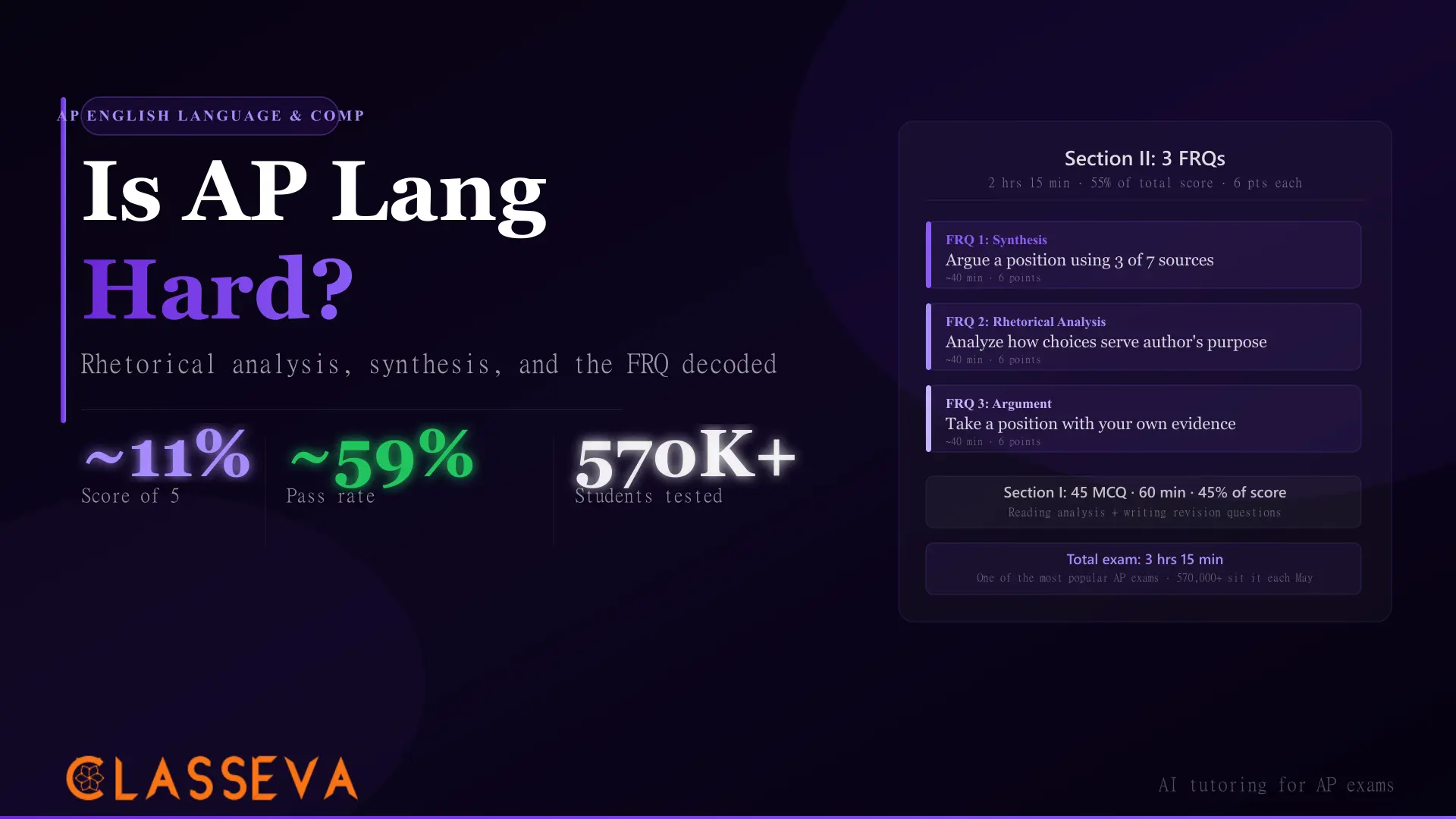
AP English Language's 5-rate hovers around 11%, and the pass rate lands near 59%, placing it in the moderate range of AP difficulty. The multiple-choice section is manageable for any consistent reader. What trips up most students is the writing section, and specifically the rhetorical analysis essay, which demands a skill almost no standard English class explicitly teaches: explaining not just what rhetorical strategy an author uses, but why they chose it and what effect it creates on the specific audience at hand. This breakdown walks through the exam section by section, with the FRQ rubric front and center.
How Hard Is AP English Language?
AP English Language has an ~11% 5-rate and ~59% pass rate across roughly 570,000 students annually, placing it in the moderate range of AP difficulty. [VERIFY: 2025 College Board data] It sits well above AP Physics 1 (roughly 43% pass rate) and below AP Environmental Science in terms of raw pass-rate accessibility. The difficulty concentrates in the writing section: the 3 FRQs carry 55% of the total exam weight, and writing three well-structured analytical arguments under timed conditions is a skill that requires deliberate practice, not just reading ability.
Pass Rate and 5-Rate
AP English Language and Composition is one of the most-taken AP exams, with test-taker counts consistently above 560,000 students per year. Here is the approximate score distribution based on recent College Board data [VERIFY: exact 2025 figures from College Board AP English Language Score Distributions]:
| Score | Approximate % | What It Means |
|---|---|---|
| 5 | ~11% | Exceptional: college credit at most schools |
| 4 | ~20% | Strong: credit at most schools |
| 3 | ~28% | Pass: credit at some schools |
| 2 | ~23% | Below passing |
| 1 | ~18% | No credit |
Source: College Board AP English Language Score Distributions (approximate 2025 figures; verify at apstudents.collegeboard.org). Mean score approximately 2.80-2.95.
How AP Lang Compares to Other Popular APs
AP Lang sits in a cluster of AP humanities and social science courses with similar difficulty profiles. The 5-rate around 11% is lower than AP Calculus AB (20.3% in 2025) but higher than AP Physics 1 (roughly 7%). For students weighing AP Lang against other options, the comparison below uses 2025 data where available.
| AP Exam | 5-Rate | Pass Rate | Core Challenge |
|---|---|---|---|
| AP Physics 1 | ~7% | ~43% | Conceptual physics reasoning |
| AP Chemistry | ~11-13% | ~56% | Math-heavy lab reasoning |
| AP English Language | ~11% | ~59% | Timed rhetorical writing |
| APUSH | 14.2% | 73.7% | Historical argumentation |
| AP Calculus AB | 20.3% | 64.2% | Calculus problem-solving |
| AP Biology | 18.9% | 70.4% | Content breadth + lab design |
Sources: College Board Score Distributions 2025. AP English Language figures approximate (verify at collegeboard.org).
What Does AP Lang Actually Test?
The AP Lang exam runs 3 hours and 15 minutes and covers two distinct competencies: reading nonfiction texts analytically (Section I) and writing analytically under timed conditions (Section II). The College Board AP English Language course pagedescribes the organizing framework as “reading rhetorically” and “writing rhetorically”: students learn to identify how authors construct arguments and then build those same skills in their own writing. Every AP Lang course and exam question sits within one of those two categories.
Section I: Multiple Choice
Section I contains 45 questions across 60 minutes (45% of the total score). The questions divide into two question types. Reading questions give you full nonfiction passages, ranging from historical speeches to contemporary op-eds, and ask you to analyze how rhetorical and stylistic choices contribute to meaning and purpose. Writing questions give you drafts of student essays and ask you to identify revisions that would strengthen the argument, improve evidence use, or sharpen transitions. Neither question type requires prior content knowledge; everything you need to answer is in the passage.
Section I reading questions reward students who can identify why a choice works, not just what it is. A question will rarely ask “what rhetorical device is used here” in isolation. It will ask “how does this phrase contribute to the speaker's purpose?” That is the same distinction that defines the hardest FRQ.
Section II: The Three FRQs
Section II runs 2 hours and 15 minutes and carries 55% of the total score. Three essays, each scored on a 6-point rubric (1 point for thesis, 4 points for evidence and commentary, 1 point for sophistication), spread the writing weight evenly across the section. The AP Central AP Lang exam page publishes the full exam format and past FRQs.
Why the Rhetorical Analysis Essay Is the Hardest FRQ
The synthesis essay gives you 7 source texts to draw from. The argument essay lets you bring your own examples from any domain. The rhetorical analysis gives you one passage and one directive: analyze the rhetorical choices the author makes and explain how those choices contribute to their purpose. Most students can identify a metaphor, a rhetorical question, or an appeal to authority. What separates a 4-point evidence score from a 2-point score is whether the student explains precisely why that choice works for this author, this audience, and this context.
Combing through the AP English Language Chief Reader Reports while building Classeva's writing feedback modules, the comment I saw repeated across every year was some variation of: “The student identified the strategy but did not explain its effect on the audience.” That gap, between naming a device and explaining why it works, costs more AP Lang points than any other single error.
What the Rubric Actually Measures
The AP Lang FRQ rubric applies the same 6-point structure to all three essays. Understanding it for the rhetorical analysis specifically reveals why identification alone earns no points above the baseline.
| Rubric Row | Points | What Earns It |
|---|---|---|
| Thesis / Claim | 0-1 | A defensible claim about the author's rhetorical choices and their effect (not a restatement of the prompt) |
| Evidence: Basic | 1 | Identifies relevant evidence from the passage with minimal commentary |
| Evidence: Developed | 2-4 | Explains how specific evidence supports the thesis; higher scores require sustained, specific commentary connecting evidence to effect |
| Sophistication | 0-1 | Demonstrates complex understanding: nuance, tension, or broader implications of the rhetorical choices |
Source: AP English Language and Composition Scoring Guidelines, College Board. Evidence rows are illustrative tiers within the 0-4 evidence score.
The Most Common Mistake in Rhetorical Analysis
The most expensive error in the rhetorical analysis essay is writing a device catalog instead of an argument. A device catalog looks like this: “The author uses alliteration in line 4 and a rhetorical question in line 9 and an appeal to authority in line 14.” A grader can award this response at most 1 evidence point because it demonstrates awareness of rhetorical vocabulary but no understanding of what the choices accomplish.
An argument answers the “so what?”: “By opening with a series of alliterative phrases, the author creates an almost incantatory rhythm that pulls the reader forward before the central claim arrives; the effect is to secure attention before asking for intellectual assent.” That version earns evidence points because it connects the choice to its effect and ties both to the author's purpose.
Listing rhetorical devices with no explanation of effect earns at most 1 evidence point on the rubric, regardless of how many devices you identify. Every piece of evidence in the rhetorical analysis essay needs a commentary sentence that completes: “this choice works because it [does X] for [this specific audience] in [this context].”
AP Lang vs AP Literature: Which Should You Take?
AP English Language covers nonfiction rhetoric: speeches, editorials, scientific articles, memoirs, essays. AP English Literature covers fiction, poetry, and drama: novels, short stories, poems, plays. Neither is objectively harder, but they demand different instincts. Students who find literary interpretation of poetry frustrating often prefer AP Lang's more argument-grounded framework. Students who find rhetoric dry often prefer the narrative richness of AP Lit.
AP English Language
- •Nonfiction: speeches, essays, editorials
- •Rhetorical analysis of real-world texts
- •Argument and synthesis writing
- •Reading: purpose and audience
- •~11% 5-rate, ~59% pass rate
AP English Literature
- •Fiction, poetry, drama
- •Literary analysis: character, theme, form
- •Poetry explication and novel analysis
- •Reading: meaning and ambiguity
- •~8-10% 5-rate, ~55-60% pass rate
College Board recommends AP Lang for 11th grade and AP Lit for 12th grade. This sequencing works well: AP Lang builds the argumentative writing foundation that makes AP Lit essay writing easier. Students who want both credits often take Lang in junior year and Lit in senior year. Both count separately for AP English credit at most colleges.
How Much Should You Study for AP Lang?
Most students who score a 4 or 5 on AP Lang study between 3 and 5 hours per week during the school year. The total investment runs roughly 100-150 hours across a full-year course. What separates a 3 from a 5 is almost never content knowledge; it is writing fluency. Students who practice timed analytical writing throughout the year improve measurably. Students who focus only on reading comprehension plateau around a 3.
Building Writing Fluency Before May
The three FRQs run under real time pressure. A student who has never written a rhetorical analysis under 40 minutes will spend the first exam attempting the skill for the first time, which rarely produces strong evidence commentary. Consistent low-stakes writing practice throughout the school year is the highest-leverage study activity for AP Lang.
Weeks 1-20 (September-January): read analytically, not just for comprehension
When reading any nonfiction passage for class, practice identifying one rhetorical choice per paragraph and ask why the author made it. This builds the analytical habit the exam demands without requiring separate study sessions.
Weeks 21-28 (February-March): begin timed FRQ practice
Write at least one full timed rhetorical analysis per week using College Board past exam prompts from AP Central. Use the published scoring guidelines to self-assess: check whether you earned the thesis point and whether your evidence commentary would qualify for 2 or 3 evidence points.
Weeks 29-34 (April-early May): intensify writing and add synthesis practice
Increase to 2-3 timed FRQs per week. Prioritize synthesis essays because the 40-minute time allocation (including source reading) is the most compressed. Practice reading the 7 sources in under 8 minutes and selecting 4-5 to use, discarding those that do not support your specific argument.
What If You Are Not a Strong Writer?
“Not a strong writer” usually means one of two things: unclear sentence construction, or weak evidence commentary. The AP Lang rubric does not reward elegant prose style directly. It rewards thesis clarity (can you make a defensible claim?), evidence specificity (can you cite and explain?), and commentary connection (can you explain why the evidence supports your claim?). These are learnable skills, not innate talent.
Students who struggle with sentence construction often improve significantly by studying the structure of scored sample responses published by College Board. The samples show exactly what the rubric rewards, and they range from 1-point responses to 6-point responses, making the gap visible. Students who struggle with commentary often benefit from forcing themselves to write a “because” or “which means” clause after every piece of evidence, drilling the explanatory habit before the exam.
College Board publishes scored student responses at every score level for every past AP Lang FRQ at AP Central's past exam questions page. Reading a 4-point response and a 6-point response on the same prompt and then reading the scoring commentary makes the rubric concrete in a way that no prep book description can replicate.
How to Know If You Are Ready for AP Lang
AP Lang does not have formal prerequisites, but students who enter the course without certain habits in place spend the first semester catching up rather than developing. Use the checklist below to assess readiness before junior year.
You can read a 700-word nonfiction passage in under 10 minutes
AP Lang MCQ passages run 500-900 words, and Section I gives you an average of about 80 seconds per question. Students who read slowly often run out of time before reaching the last passage set.
You can write a complete paragraph in 8-10 minutes
The FRQs require three full essays in 2 hours and 15 minutes. Students who write slowly under pressure consistently underperform. Practice timed paragraph writing before the course begins.
You can explain why a sentence works, not just what it says
If you can look at a sentence and explain the effect of a specific word choice or structural decision on the reader, you already have the core AP Lang skill. If you can only summarize what the sentence means, you need practice with analytical reading.
You are comfortable writing a position you are not entirely sure about
The argument FRQ gives you a debatable claim and asks you to take a side. Students who insist on presenting both sides equally often fail to write a defensible thesis, which is the first rubric point. AP Lang rewards commitment to a position, not perfect hedging.
Where Does Your Practice Score Put You?
If you want to see where your current AP Lang preparation maps on the actual 5-point scale, use Classeva's AP Score Predictor. It takes your practice FRQ scores and multiple-choice percentage and projects the likely composite band. A separate AP Credit Savings Calculator shows the tuition value of a 4 or 5 at your target colleges.
AP Score Predictor
Enter your AP English Language practice results to see your projected score and which section to prioritize in your remaining study time.
For a full archive of AP English Language past FRQs with scoring guidelines, visit the AP English Language resources hub. Students comparing their AP options across subjects may also find useful context in our breakdowns of APUSH difficulty and AP Calculus AB difficulty, which apply the same score-distribution analysis to different subject areas. For students who have already decided on AP Lang and want to understand the scoring mechanics in detail, College Board publishes the full rubrics and sample scored essays at AP Central.
Key Takeaways
- AP Lang is moderately difficult. An ~11% 5-rate and ~59% pass rate place it in the middle of the AP difficulty spectrum, above AP Physics 1 in accessibility and below AP Calculus AB in 5-rate. [VERIFY: 2025 College Board data]
- Three FRQs carry 55% of your score. The multiple-choice section matters, but a student who writes strong essays can outperform a student with better reading comprehension and weaker writing. Practice the writing section more than the MCQ section.
- The rhetorical analysis essay is the hardest FRQ for most students. Its difficulty is not content knowledge but analytical habit: every piece of evidence needs a commentary sentence explaining why the choice serves the author's purpose, not just naming what it is.
- AP Lang and AP Lit test different skills. AP Lang rewards rhetorical analysis of nonfiction; AP Lit rewards literary interpretation of fiction and poetry. Both are rigorous; neither is categorically harder. Many students take both, Lang in junior year and Lit in senior year.
- The rubric rewards explanation, not identification. Every FRQ, including synthesis and argument, applies the same 0-4 evidence and commentary scoring. Students who make claims without connecting evidence to their thesis earn 1-2 evidence points. Students who develop sustained commentary earn 3-4.
- College Board publishes every scored sample response for free. Reading a 4-point and a 6-point response on the same prompt at AP Central shows the evidence-commentary gap more clearly than any textbook explanation.
- Timed writing practice is the highest-leverage preparation. One full timed FRQ per week from October through April, self-graded against the official rubric, produces more score improvement than any amount of re-reading class notes.
Frequently Asked Questions
What percentage of students get a 5 on AP English Language?
Roughly 10-12% of AP English Language test-takers earn a 5 in any given year, based on College Board score distribution data. [VERIFY: 2025 College Board AP Score Distributions] The 5-rate has remained relatively stable, putting AP Lang in the moderate-difficulty range alongside APUSH and AP Psychology. Earning a 5 requires strong performance on all three FRQs, not just the multiple-choice section.
Is AP Lang harder than AP Literature?
Neither course is categorically harder; they test different skills. AP Lang focuses on nonfiction rhetoric and argumentation; AP Lit focuses on literary analysis of fiction, poetry, and drama. Students who struggle with close reading of unfamiliar nonfiction passages often find AP Lang more demanding. Students who find abstract literary interpretation difficult tend to prefer AP Lang's more concrete rhetorical analysis framework.
Can I take both AP Lang and AP Literature?
Yes. Many students take AP English Language junior year and AP English Literature senior year. The courses complement each other: AP Lang builds the rhetorical and argumentative writing skills that strengthen your AP Lit essays. College Board offers credit for both exams separately at most schools that award AP credit for English courses.
What is the synthesis essay in AP Lang?
The synthesis essay is FRQ 1 on the AP Lang exam. You receive 7 source texts on a debatable topic and must write an argument that references at least 3 of those sources as evidence. The task is not to summarize what the sources say but to develop your own position and use the sources selectively to support it. The exam allows about 40 minutes total for reading and writing.
How many sources do I need to cite in the synthesis essay?
You must cite at least 3 of the 7 provided sources to earn any evidence points on the synthesis essay. High-scoring responses typically integrate 4-5 sources, selecting evidence that supports the specific argument the writer is making rather than cataloging all perspectives. Sources must be cited with attribution, not just quoted.
Do I need to memorize specific rhetorical devices for AP Lang?
No. The AP Lang exam does not ask you to define terms or list devices from memory. The multiple-choice questions provide full passages for analysis. The rhetorical analysis FRQ asks you to identify strategies the author uses and explain their effect, but it does not require labeling every device with its classical name. What matters is whether you can explain why a rhetorical choice serves the author's purpose.
Is AP English Language worth taking if I am not planning to major in English?
Yes, and arguably more so than for English majors. AP Lang teaches analytical writing, evidence-based argumentation, and rhetoric recognition, all of which transfer directly to college coursework in any major, particularly the college writing requirements most schools impose in the first year. A score of 4 or 5 typically earns credit that exempts students from one or two required writing courses.
How does the AP Lang exam differ from a standard 11th-grade English class?
Standard 11th-grade English typically blends literary analysis, grammar, and writing. AP Lang is organized entirely around the College Board's rhetorical framework: how authors construct arguments using evidence, appeals (ethos, pathos, logos), and stylistic choices. The exam tests whether students can read nonfiction passages analytically and write under timed conditions at a college freshman level, which is a higher bar than most standard-level English courses require.
Score data sourced from College Board AP English Language Score Distributions (approximate 2025 figures). Exam structure from the AP English Language Exam page on AP Central. FRQ rubrics from AP Central past exam questions. [VERIFY all figures against the July 2025 College Board annual score report.]