Is AP Comparative Government Hard? 6-Country Guide
AP Comparative Government and Politics earned a 5-rate of 16.3% in 2025, higher than the all-subject AP average and higher than AP US Government in the same cycle. The headline tempts students into reading the course as easy. It is not. The number rides on a tiny, self-selected pool of about 27,000 students who chose a niche elective, and the real challenge sits in a place the 5-rate cannot show: holding six different political systems in your head and comparing them under exam pressure.
Is AP Comparative Government Hard?
AP Comparative Government rates as moderately hard, with a difficulty profile unlike any other AP social science. The content load stays finite: six countries, five units, a fixed concept list. The difficulty hides in synthesis. You will not memorize 15 court cases the way AP US Government students do, but you will track how China, Iran, Mexico, Nigeria, Russia, and the United Kingdom each handle elections, parties, and policy, then compare them on demand.
Score Distribution and Pass Rate
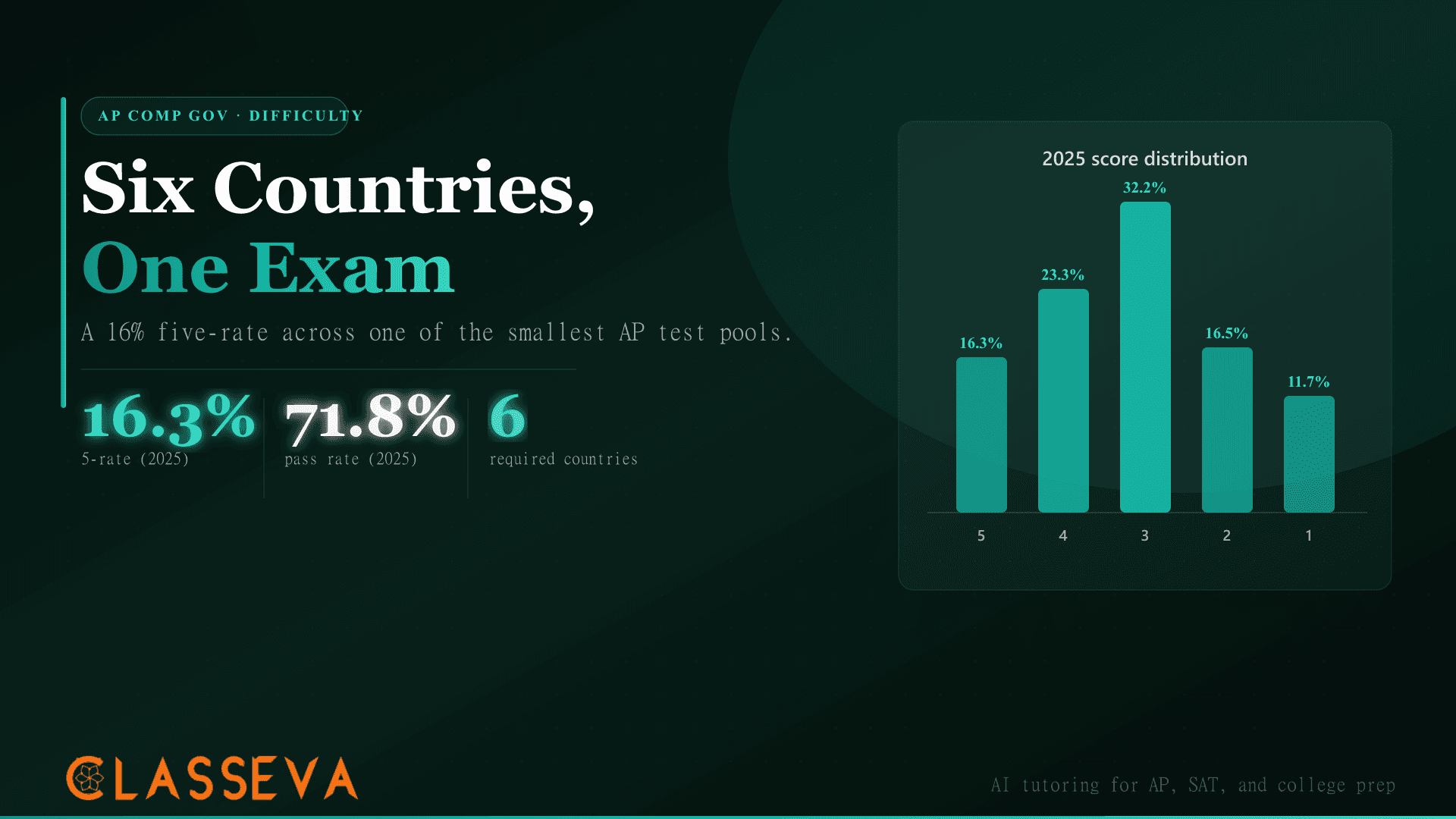
In 2025, AP Comparative Government scores broke down as 16.3% fives, 23.3% fours, 32.2% threes, 16.5% twos, and 11.7% ones, for a pass rate of 71.8% and a mean of 3.16. The 2024 cycle landed almost identically: a 16.0% 5-rate and a 3.18 mean across 25,436 students, per the College Board AP score distributions. The distribution clusters at 3, which tells you the exam separates a confident core from a long tail of students who never locked down country-specific detail.
| AP Score | 2025 % of Test-Takers | College Readiness Signal |
|---|---|---|
| 5 | 16.3% | Extremely well qualified |
| 4 | 23.3% | Well qualified |
| 3 | 32.2% | Qualified |
| 2 | 16.5% | Possibly qualified |
| 1 | 11.7% | No recommendation |
2025 AP Comparative Government and Politics score distribution. Source: College Board.
Why a Small Test Pool Inflates the 5-Rate
AP Comparative Government drew about 27,150 test-takers in 2025, one of the smallest AP populations of any exam. Compare that with AP US Government, which runs past 300,000 students a year, or AP Human Geography, which clears 200,000. No high school funnels its entire junior class into Comp Gov. Students choose it deliberately, often after enjoying another government or history course, and that voluntary filter trims the bottom of the curve. The 16% 5-rate measures a motivated minority, not the difficulty of the material.
What Are the 6 Countries in AP Comp Gov?
AP Comparative Government covers six required countries: China, Iran, Mexico, Nigeria, Russia, and the United Kingdom. The College Board chose them to span a range of regime types, from the United Kingdom’s consolidated democracy to China’s authoritarian one-party state, with Iran, Mexico, Nigeria, and Russia spread across the spectrum between. Every exam question draws from these six and no others.
The Country-Specific Memorization Load
The memorization load defines the course. For each of the six countries you carry its regime type, legislature, executive structure, party system, electoral rules, and signature policy debates. That is six parallel data sets, not one. A student who masters the United Kingdom but blanks on Nigeria’s federalism cannot answer a prompt that pairs them. The trap is studying each country in a silo. Comp Gov rewards students who build the comparison while they learn, not after.
Treating the six countries as six separate units you review one at a time. The exam almost never asks about a country in isolation; it asks you to compare. A student who can recite Russia’s political system but cannot place it next to China’s on federalism, party control, or elite recruitment will lose points on every comparative item. Build side-by-side charts from week one.
How Is the AP Comp Gov Exam Structured?
The AP Comparative Government exam runs about 2 hours and 40 minutes and splits evenly between two sections. Section I gives you 60 minutes for 55 multiple-choice questions, worth 50% of the score. Section II gives you 100 minutes for 4 free-response questions, the other 50%. The 2026 exam falls on Wednesday, May 6.
The 55-Question MCQ Section
Section I packs 55 questions into 60 minutes, just over a minute each. Some are stand-alone concept checks; others attach to a stimulus such as a data table, a passage, a map, or an infographic that you read and interpret. The quantitative and visual items reward students who practice reading charts under time pressure. Most students who miss their target here run out of time on the stimulus sets, not the plain recall questions.
The 4 Free-Response Questions
Section II contains four distinct FRQ types, each testing a different skill. You write all four in 100 minutes, so pacing matters as much as knowledge. The comparative analysis question carries the most risk because vague, country-light answers earn nothing.
| FRQ Type | What It Asks | Approx. Points |
|---|---|---|
| Conceptual Analysis | Define and apply a concept using course countries | ~5 points |
| Quantitative Analysis | Interpret a data set and connect it to course concepts | ~8 points |
| Comparative Analysis | Compare institutions or policies across 2+ countries | ~8 points |
| Argument Essay | Build a thesis with evidence from course countries | ~5 points |
The four AP Comp Gov FRQ types. Point values are approximate; confirm against the current scoring guidelines on AP Central.
The comparative analysis and quantitative FRQs reward specificity over polish. A clean paragraph that names no country institution scores below a rough one that cites Nigeria’s federal structure or China’s National People’s Congress by name. The rubric awards points for accurate, country-specific evidence. Write the proper noun, not the generic description.
The 5-Unit Framework Explained
AP Comparative Government organizes content into five units, and public policy threads through all of them rather than standing alone. Each unit carries a weight band on the multiple-choice section, so you can target study time toward the heaviest units. The framework matters because the exam pulls concepts across units inside a single comparative question.
College Board publishes the full unit weighting and skill breakdown in its AP Comparative Government course page on AP Central. Reading the CED before you start tells you which units the multiple-choice section leans on, so you do not over-invest in lighter material. Students who plan study time around the weight bands tend to outperform students who give every unit equal hours.
AP Comp Gov vs AP US Government
AP Comparative Government and AP US Government share a name and almost nothing else. AP US Gov drills one political system with two fixed content lists: 15 required Supreme Court cases and 9 foundational documents. AP Comp Gov drops the case-and-document lists entirely and asks you to compare six systems. The skill shifts from recall to structured comparison.
AP Comparative Government
- •Six required countries: China, Iran, Mexico, Nigeria, Russia, UK
- •Five units organized around comparison across systems
- •No required case or document list to memorize
- •4 FRQs including a comparison-across-countries question
- •Roughly 27,000 test-takers; one of the smallest AP exams
- •16.3% 5-rate, 71.8% pass rate (2025)
AP US Government
- •One political system: the United States
- •15 required SCOTUS cases and 9 foundational documents
- •Heavy fixed-content memorization load
- •4 FRQs including a SCOTUS comparison and an argument essay
- •Past 300,000 test-takers; a mainstream AP course
- •Lower 5-rate in most cycles than Comp Gov
Choose by how you learn. If you absorb fixed lists well and prefer one deep system, AP US Government plays to that strength. If you think in structures and enjoy contrasting how different countries solve the same governing problem, Comp Gov fits better. Students mapping a full social science track often pair this decision with the AP World History difficulty breakdown, since the comparison skill from one course reinforces the institutional knowledge in the other.
How Much Should You Study for AP Comp Gov?
Most students need 3 to 5 hours of study per week during the year to reach a 4 or 5 on AP Comparative Government. The figure stays lower than lab sciences or AP Calculus BC because the content is finite. The hours convert poorly, though, if you spend them re-reading rather than building comparisons and drilling FRQs. Active comparison work beats passive review at a rate few students appreciate until their first practice FRQ.
A Country-by-Country Study Approach
Build one master comparison chart and add to it as the course moves through each unit. Columns for the six countries, rows for regime type, legislature, executive, judiciary, party system, electoral rules, and major policy debates. By April, that single chart holds most of what the comparative FRQ tests.
Then drill released FRQs. College Board posts past free-response questions with scoring guidelines on its AP Comparative Government exam page, which show exactly how points are awarded and which weak answers earned zero. Students who time themselves on real FRQs surface their pacing problems early, while there is still room to fix them. For broader scheduling context across electives, the AP Macroeconomics difficulty breakdown covers another social science with a heavy data-interpretation component.
Project Your AP Comp Gov Score
If you are mid-course, mapping your current practice results to a projected score band tells you which units and countries need more work before May. Classeva’s AP Score Predictor turns your practice performance into a target band so you can prioritize.
AP Score Predictor
Enter your AP Comparative Government practice results to project your score band and see which units and countries to prioritize before the May exam.
Students weighing whether the score will translate into tuition savings can also compare credit policies before committing. The AP credit and college tuition guide walks through how a 4 or 5 maps to placement or credit at different schools, which varies widely by institution.
Key Takeaways
- AP Comparative Government posted a 16.3% 5-rate and 71.8% pass rate in 2025, both above the all-subject AP average, with a 3.16 mean across roughly 27,150 students.
- The high 5-rate reflects a small, self-selected pool. Comp Gov is one of the smallest AP exams, with under 30,000 students versus more than 300,000 for AP US Government.
- The course covers six required countries (China, Iran, Mexico, Nigeria, Russia, United Kingdom) across five units. Every question draws from those six.
- The exam runs 55 MCQs in 60 minutes plus 4 FRQs in 100 minutes, split 50/50, on Wednesday, May 6, 2026.
- The comparative analysis FRQ is the highest-risk section. Country-light answers earn zero; specific institutions and proper nouns earn points.
- AP Comp Gov differs fundamentally from AP US Government. Instead of memorizing 15 cases and 9 documents in one system, you compare six systems at once.
- Build a six-country comparison chart from week one and drill released FRQs from AP Central. Active comparison beats passive re-reading for this exam.