Is AP Macroeconomics Hard? AD/AS, FRQ, and Score Data
Reading the AP Macroeconomics CED alongside the AP Microeconomics CED while developing Classeva's economics content, the detail that crystallizes is the graph catalog. AP Macro students must master four distinct market diagrams: the AD/AS model, the money market, the loanable funds market, and the foreign exchange market. Each responds to policy shifts differently. A student who conflates the money market and the loanable funds market (both display supply-and-demand curves for financial resources) will drop FRQ points in ways that add up fast. The score distribution reflects that precision gap: the pass rate sits around 57%, and most students who do not pass trace their errors back to the same two or three graph-drawing mistakes.
Is AP Macroeconomics Hard?
AP Macroeconomics is moderately difficult. The pass rate sits around 55-60% and the 5-rate near 16-18%, placing it alongside AP Statistics and AP Chemistry in the middle tier of AP difficulty. [VERIFY: 2025 College Board AP Score Distributions at reports.collegeboard.org] The exam draws a wide mix of students, from those who took a full economics course in middle school to those meeting the subject for the first time. The 5-rate holds near 17% because the FRQ section tests graph construction and policy analysis under time pressure, not just whether students recall definitions.
The AP Macro Score Distribution
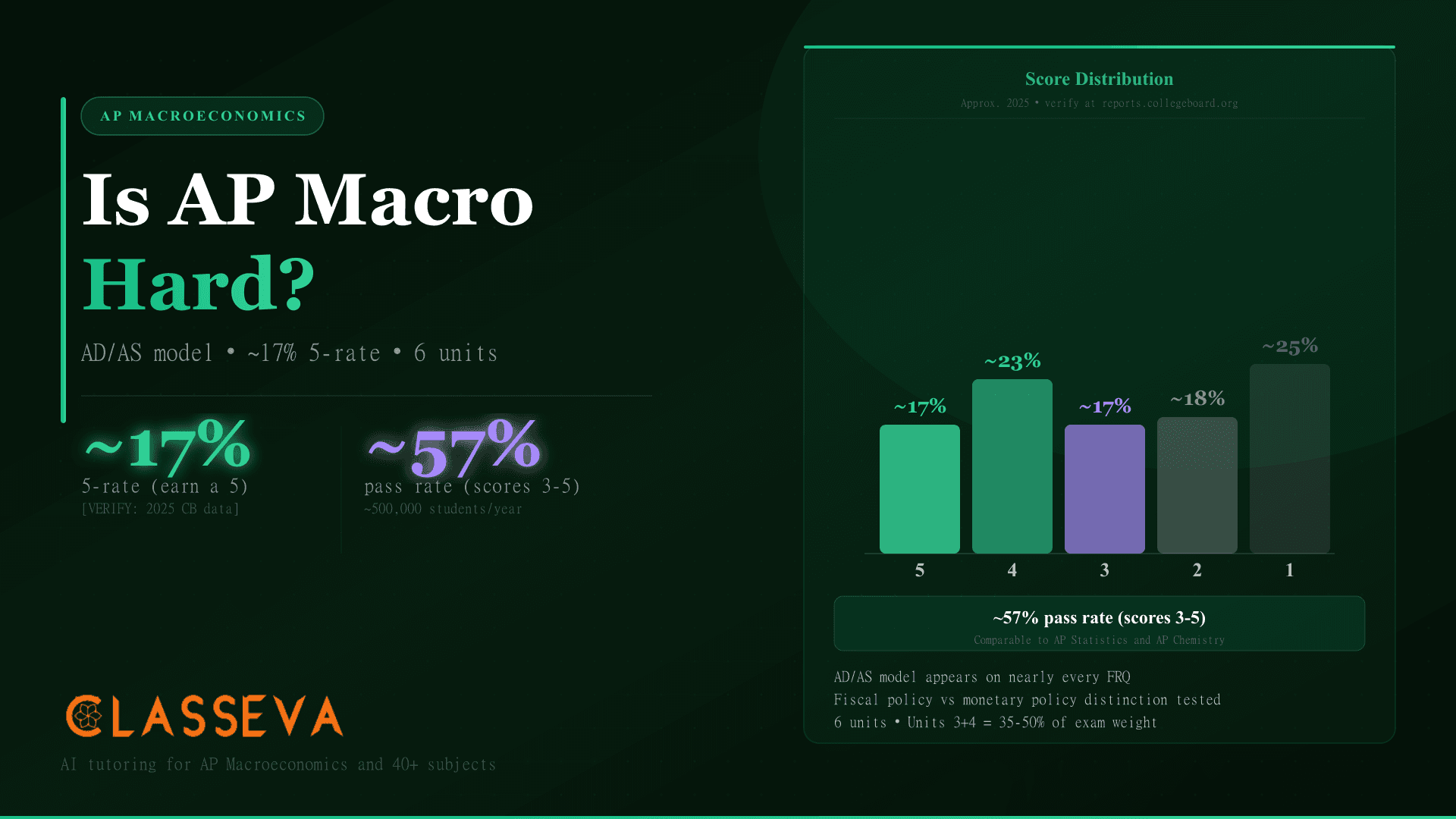
Here is the approximate score distribution for AP Macroeconomics based on recent College Board data. [VERIFY: exact 2025 figures from reports.collegeboard.org]
| Score | Approximate % | What It Means |
|---|---|---|
| 5 | ~17% | Exceptional: college credit at most schools |
| 4 | ~23% | Strong: credit at most schools |
| 3 | ~17% | Pass: credit at some schools |
| 2 | ~18% | Below passing |
| 1 | ~25% | No credit |
Source: College Board AP Macroeconomics Score Distributions (approximate figures; verify at reports.collegeboard.org). Mean score approximately 2.8-3.0.
How AP Macro Compares to Other AP Exams
AP Macro sits in the moderate tier of AP difficulty, with a higher pass rate than AP Physics 1 but lower than AP Calculus AB. The score distribution pattern mirrors AP Micro closely, which makes sense given the overlap in content and the shared student population. [VERIFY: 2025 College Board score distributions]
| AP Exam | 5-Rate | Pass Rate | Core Challenge |
|---|---|---|---|
| AP Physics 1 | ~7% | ~43% | Conceptual physics reasoning without calculus |
| AP Chemistry | ~14% | ~56% | Lab reasoning and multi-step calculations |
| AP Macroeconomics | ~17% | ~57% | AD/AS graph mastery and policy tracing |
| AP Microeconomics | ~17% | ~58% | Market structure analysis and graph precision |
| AP Calculus AB | 20.3% | 64.2% | Derivatives, integrals, and rates of change |
Sources: College Board Score Distributions 2025. AP Macro and AP Micro figures approximate. [VERIFY at reports.collegeboard.org]
What Does AP Macroeconomics Actually Test?
The AP Macroeconomics exam runs 2 hours 10 minutes. Section I has 60 multiple-choice questions in 70 minutes, worth 66.7% of the total score. Section II has 3 FRQs in 50 minutes, worth 33.3% of the score: one long FRQ worth 10 points, and two short FRQs worth 5 points each. [VERIFY: current exam format at AP Central] The College Board's CED organizes the course into 6 units. Units 3 and 4 together carry roughly 35-50% of the exam weight, making the AD/AS model and the financial sector the two areas that most determine the final score.
The 6 Units and Their Exam Weights
Here are the 6 units with their approximate exam weight ranges from the College Board CED. [VERIFY: current CED unit weights at AP Central]
The FRQ Section: Long FRQ Plus Two Short FRQs
The FRQ section is where most students either gain or lose ground. The long FRQ typically asks students to draw one or two graphs, label all curves and axes, identify the equilibrium, and then trace a policy shock through at least two markets. Each graph label earns a separate point. A curve drawn in the right direction but labeled incorrectly scores zero for that label.
The two short FRQs follow the same pattern on a smaller scale. Both can require graphs, but more often they test a specific policy scenario: what happens to real GDP, price level, interest rates, and exchange rates when the Fed raises the reserve requirement? Every answer must trace the chain of effects in the correct sequence. Skipping a step in the chain costs the point for that step, even if the final conclusion is correct.
Each FRQ part is scored as all-or-nothing. There is no partial credit within a single bullet point on the AP Macro rubric. Drawing the AD curve in the correct direction earns the point. Drawing it with an ambiguous slope, or correct slope but missing arrow, does not.
Why the AD/AS Model Is the Central Concept
The AD/AS (Aggregate Demand/Aggregate Supply) model appears on nearly every AP Macro FRQ because it is the framework that links every major topic in the course. Fiscal policy, monetary policy, inflation, unemployment, and economic growth all express themselves as shifts in the AD or AS curves. A student who cannot draw and shift the AD/AS model fluently within 60 seconds will spend too much time on that step and run out of time completing the rest of the FRQ.
Reading AD/AS Shifts Correctly
The FRQ rubric awards points for identifying the correct direction of each shift. The two most common mistakes are shifting SRAS when a fiscal policy question intends an AD shift, and shifting AD when a supply shock question intends an SRAS shift. Here are the shift rules the CED tests most often:
AD shifts right (expansionary): government spending increases, taxes decrease, money supply expands, consumer confidence rises, exports increase. AD shifts left (contractionary): the mirror of each.
SRAS shifts right: input costs fall (e.g., oil price drops), productivity rises, subsidies reduce production costs, positive supply shock. SRAS shifts left: input costs rise, negative supply shock, wages increase due to labor market tightening.
LRAS shifts right: long-run growth only (new technology, larger labor force, more capital stock, better institutions). LRAS does not shift in response to short-run policy tools.
Fiscal Policy vs Monetary Policy
The AP Macro FRQ tests both policy types in almost every exam cycle. Students must know which institution controls each tool, how each tool shifts the AD curve, and which secondary markets each policy affects.
Fiscal Policy
- •Controlled by Congress and the President
- •Tools: government spending (G) and taxes (T)
- •Expansionary: raise G or cut T → AD shifts right
- •Contractionary: cut G or raise T → AD shifts left
- •Affects the loanable funds market (government borrowing)
- •Slower to implement; requires legislative process
Monetary Policy
- •Controlled by the Federal Reserve (the Fed)
- •Tools: open market operations, reserve requirement, discount rate
- •Expansionary: buy bonds, lower reserve ratio, lower discount rate → money supply up → interest rates down → AD shifts right
- •Contractionary: sell bonds, raise reserve ratio → money supply down → interest rates up → AD shifts left
- •Operates through the money market
- •Faster to implement than fiscal policy
How Does AP Macro Compare to AP Micro?
AP Macro and AP Micro carry nearly identical 5-rates (~17%) and pass rates (~57-58%), but they test different mental frameworks. Micro analyzes individual decision-making: how a single firm prices output, how a labor market reaches equilibrium, how a monopoly restricts production to raise prices. Macro analyzes the whole economy: how total spending determines GDP, how the central bank controls inflation, how exchange rates affect trade balances.
The students who struggle most in Macro are those who try to apply Micro intuition to Macro graphs. When the money supply increases in Macro, interest rates fall. In Micro, a supply increase in a standard goods market causes prices to fall, which is superficially similar. But the interest rate in the money market is not the same variable as the price of a good. Keeping these frameworks separate requires deliberate practice, not just reading comprehension.
One practical consequence of taking both courses: the AD/AS graph and a standard Micro supply/demand graph look nearly identical on paper. Both have a downward-sloping demand curve and an upward-sloping supply curve. On the AP Macro FRQ, the axes read "Price Level" and "Real GDP." On the AP Micro FRQ, the axes read "Price" and "Quantity." A student who draws the wrong axis labels under exam pressure loses points on both exams.
When practicing for AP Macro, always write axis labels before drawing any curves. Writing "Price Level" and "Real GDP" first forces your brain to stay in the Macro framework. It takes 5 seconds and prevents the most common cross-course error.
What About the Foreign Exchange Section?
The foreign exchange (FX) section, covered in Unit 6 of the CED, appears on roughly 60-70% of AP Macro FRQs. [VERIFY: review of recent AP Macro FRQs at AP Central] It trips up students who did not review it carefully, because the FX market graph uses the same visual structure as a standard supply/demand diagram but with a different variable on the horizontal axis (quantity of the domestic currency) and a different price (the exchange rate).
The most commonly tested FX scenario on the FRQ: the Fed raises interest rates. Higher US rates attract foreign investment, increasing demand for US dollars in the FX market. Dollar demand shifts right. The dollar appreciates (exchange rate rises). US exports become more expensive, imports become cheaper. The trade balance shifts toward deficit. Each arrow in that chain earns a separate FRQ point.
How Much Should You Study for AP Macroeconomics?
Most students who earn a 4 or 5 on AP Macro study 3-5 hours per week during the school year and add 20-30 hours of focused practice in the 6 weeks before the May exam. The school-year hours go toward understanding the concepts. The pre-exam hours go toward graph fluency and FRQ practice under timed conditions.
Graph fluency is the bottleneck. A student can understand perfectly well that an open market purchase of bonds by the Fed increases the money supply and lowers interest rates. But if it takes 3 minutes to draw and label the money market graph, the 50-minute FRQ section runs out of time before the third question. The target is drawing any of the five common Macro graphs (AD/AS, money market, loanable funds, Phillips curve, FX) labeled correctly in under 90 seconds.
A Study Timeline for AP Macro
Fall semester: Build the conceptual foundation
Work through Units 1-3 (Basic Economics, Economic Indicators, and AD/AS) with your class. Draw the AD/AS model at least three times per week on scratch paper. Label every axis and curve without looking at notes.
December through February: Master the financial sector
Unit 4 (Financial Sector) introduces the money market, banking, and monetary policy tools. This is where most students fall behind. Drill the distinction between the money market and the loanable funds market until you can draw both from memory and name which policy tools affect each one.
March through April: Add Units 5 and 6
Cover long-run stabilization (Unit 5) and the open economy (Unit 6). Practice the FX graph separately until you can trace the full chain: interest rate change → FX demand shift → currency appreciation/depreciation → export/import effect → trade balance effect.
May: FRQ practice under timed conditions
Complete at least 5-7 full past FRQs under exam conditions (50 minutes for 3 questions). Check your answers against the official College Board scoring guidelines, available at no cost at AP Central. Focus on every point you missed due to a missing label or a skipped causal step, not just wrong conclusions.
Past AP Macro FRQs and scoring guidelines go back over 20 years on the College Board AP Central page. Using the official rubrics to grade your own work is the most efficient study technique available for this exam; the rubric language tells you exactly what earns each point. Students who skip this step consistently underestimate what the exam expects.
If you want to estimate your likely score based on your current preparation level, Classeva's AP Score Predictor can help you identify which areas to prioritize. Students who invest 30-50 hours of deliberate, rubric-focused practice before the exam move up approximately one score band from their mid-year practice scores. That means a 3 becomes a 4, and a 4 becomes a 5, more reliably than any other AP subject I track.
Classeva's AP Credit Savings Calculator can also show you exactly how much tuition a score of 4 or 5 saves at your target colleges. AP Macro credit frequently satisfies a required Principles of Economics course that costs $3,000-$6,000 at most universities.
AP Score Predictor
Use the AP Score Predictor to estimate your likely AP Macroeconomics score based on your current practice performance. The tool maps your self-reported confidence on each unit to predicted score bands using College Board score distribution data.
AP Score Predictor
Enter your current practice confidence across each AP Macro unit and get a predicted score band based on College Board score distribution data.
Key Takeaways
- AP Macroeconomics has a ~17% 5-rate and ~57% pass rate. It sits in the moderate range of AP difficulty, comparable to AP Statistics and AP Chemistry. [VERIFY: 2025 College Board data]
- The exam runs 2 hours 10 minutes: 60 MCQ questions (66.7% of score) and 3 FRQs (33.3%): one 10-point long FRQ and two 5-point short FRQs.
- The AD/AS model is the central concept. Students who cannot draw, label, and shift the AD/AS graph fluently within 60 seconds will struggle across the FRQ section regardless of content knowledge.
- Fiscal policy (Congress) and monetary policy (the Federal Reserve) operate through different markets: the loanable funds market and the money market, respectively. Confusing them is the most common FRQ error.
- Unit 6 (foreign exchange) appears on roughly 60-70% of FRQs and requires tracing a full causal chain from interest rate change to trade balance effect.
- Students taking both AP Macro and AP Micro must keep two separate graph catalogs straight. The AD/AS model (Macro) and a standard supply/demand model (Micro) look similar but use completely different axis variables.
- Past FRQs and official scoring rubrics at AP Central are the most efficient study resource available. Grading your own work against the official rubric reveals exactly which FRQ steps the exam rewards.