Is AP US Government Hard? Documents and FRQs Decoded
AP US Government and Politics earns a 5-rate of roughly 13-15%, landing in the accessible middle tier of AP exams. The part that surprises students is not the conceptual depth but the specificity of the required content: the College Board names exactly which Supreme Court cases and exactly which foundational texts you must know, and those documents show up in the FRQs by name. General civics knowledge won't earn a 5. Knowing precisely what Marbury v. Madison established and what argument Federalist No. 51 makes will.
How Hard Is AP US Government?
AP US Government has a pass rate around 55-60% and a 5-rate of 13-15%, placing it in the middle of the AP social science family. [VERIFY: 2025 College Board AP Score Distributions at apstudents.collegeboard.org/courses/ap-united-states-government-and-politics] That 5-rate sits above AP Physics 1 (roughly 7-8%) and close to AP World History (roughly 15%). It also sits well below AP Macroeconomics (roughly 20%), where the more focused subject matter and slightly smaller test-taker pool push the top-score percentage higher.
The pass rate at 55-60% reflects a large, varied student population. AP Gov attracts students from strong AP Government courses alongside self-studiers who underestimate how much specific memorization the exam demands. Students who walk in knowing all 15 required cases and all 9 foundational documents consistently outperform those who studied general government concepts without knowing those specific texts.
Pass Rate and 5-Rate
The score distribution below reflects recent College Board data. Verify exact 2025 figures at AP Central's AP Government page or the College Board score distribution reports.
| Score | Approximate % | What It Means |
|---|---|---|
| 5 | ~14% | Exceptional: college credit at most schools |
| 4 | ~21% | Strong: credit at most schools |
| 3 | ~25% | Pass: credit at some schools |
| 2 | ~22% | Below passing |
| 1 | ~18% | No credit |
Source: College Board AP US Government Score Distributions (approximate; verify at reports.collegeboard.org). Mean score approximately 2.8-3.0.
How AP Gov Compares to Other AP Exams
Among social science APs, AP Gov sits comfortably in the middle: accessible enough that targeted prep reliably produces a 4, demanding enough that unprepared students cluster at 2s and 3s. The table below places AP Gov among comparable exams by 5-rate. [VERIFY: all figures against 2025 College Board data]
| AP Exam | Approx. 5-Rate | Approx. Pass Rate |
|---|---|---|
| AP Macroeconomics | ~20% | ~70% |
| AP Psychology | ~17% | ~62% |
| AP World History: Modern | ~15% | ~60% |
| AP US Government | ~14% | ~60% |
| APUSH | ~12% | ~65% |
Approximate figures; verify at reports.collegeboard.org. AP US Government highlighted for reference.
What Does AP Gov Actually Test?
The AP US Government exam runs 3 hours 15 minutes. Section 1 consists of 55 multiple-choice questions answered in 80 minutes, drawing from all five content areas of the CED: constitutional underpinnings, interactions among branches of government, civil liberties and civil rights, American political ideologies and beliefs, and political participation. Section 2 consists of four free-response questions answered in 100 minutes.
The five CED content areas weight the exam roughly evenly across the MCQ section, but the FRQs layer additional skill demands on top of content knowledge. A student who knows every civics fact but cannot construct a coherent argument citing foundational documents will cap at a 3 or 4. The FRQ section is where AP Gov separates itself from a general knowledge test.
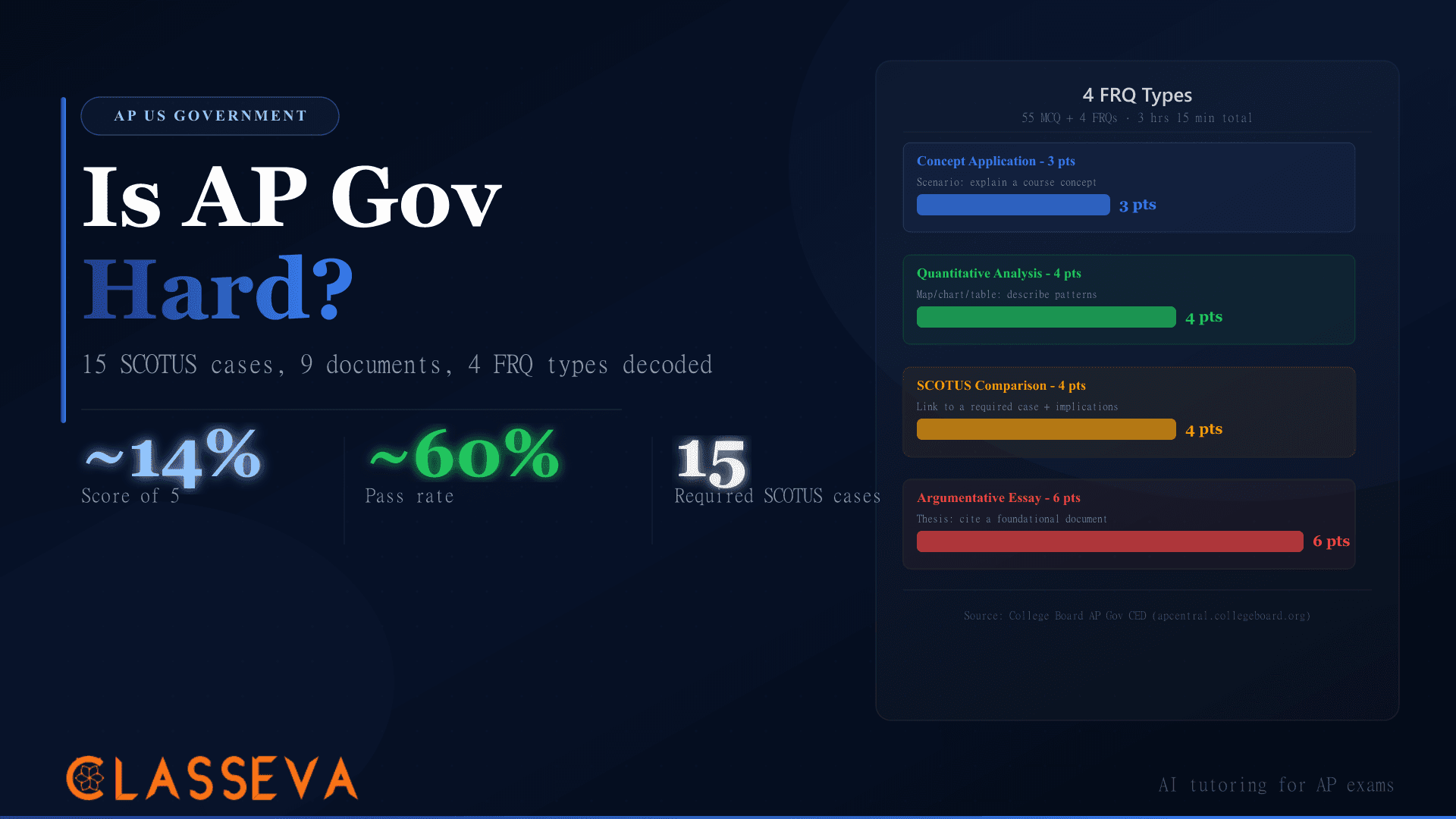
The Four FRQ Types
Every AP Gov exam includes exactly one of each FRQ type. Knowing each format before exam day is worth at least 30 minutes of saved time because students who encounter the format for the first time during the exam waste their first minutes figuring out what is being asked.
How the FRQ Section Scores
The four FRQs total 17 raw points: 3 for concept application, 4 for quantitative analysis, 4 for SCOTUS comparison, and 6 for the argumentative essay. Those 17 points combine with the 55-question MCQ score through a College Board composite formula to produce the final scaled score of 1-5. The MCQ section carries roughly 50% of total exam weight; the FRQ section carries the other 50% divided among all four question types.
At 6 of 17 FRQ points, the argumentative essay represents more than one-third of the FRQ score. Students who treat it as an afterthought consistently cap at a 4. Practicing timed argumentative essays that cite foundational documents by name, not just by general topic, is the fastest path from a 4 to a 5.
Why Required Documents and Cases Dominate the Exam
The College Board publishes an explicit required content list in the AP Gov CED: 15 Supreme Court cases and 9 foundational documents that every student must know by exam day. This specificity is what separates AP Gov from every other social science AP. APUSH rewards broad historical reasoning. AP Macro rewards economic analysis. AP Gov rewards precise knowledge of named texts.
The required content shows up across three distinct assessment touchpoints on every exam. The SCOTUS Comparison FRQ directly tests one of the 15 required cases. The argumentative essay rubric specifically rewards citing one of the 9 foundational documents by name, not by vague reference. And MCQ questions routinely present excerpts from foundational documents and ask you to identify the author, the argument, or the constitutional implication. Missing the required content costs points in three places simultaneously.
Summary cards that tell you "Federalist No. 51 argues for checks and balances" earn partial credit on the argumentative essay. Full credit comes from knowing the specific language: Madison's "ambition must be made to counteract ambition" and what problem he was solving with that design. Read each original document at least once before exam day.
The 15 Required SCOTUS Cases
The College Board lists the following required Supreme Court cases in the current AP Gov CED. [VERIFY: exact list and count against the current CED at apcentral.collegeboard.org/courses/ap-united-states-government-and-politics] Each case connects to a specific constitutional principle that appears across both the MCQ and FRQ sections.
| Case | Year | Constitutional Principle |
|---|---|---|
| Marbury v. Madison | 1803 | Judicial review established |
| McCulloch v. Maryland | 1819 | Implied powers; federal supremacy |
| Schenck v. United States | 1919 | Clear and present danger test |
| Brown v. Board of Education | 1954 | Equal protection; school desegregation |
| Baker v. Carr | 1962 | Legislative apportionment is justiciable |
| Engel v. Vitale | 1962 | Establishment Clause; school prayer |
| Gideon v. Wainwright | 1963 | Right to counsel (6th Amendment) |
| Tinker v. Des Moines | 1969 | Student free speech rights |
| New York Times Co. v. United States | 1971 | Prior restraint; free press |
| Wisconsin v. Yoder | 1972 | Free exercise of religion |
| Roe v. Wade | 1973 | Privacy rights; Due Process (overturned 2022) |
| Shaw v. Reno | 1993 | Racial gerrymandering; Equal Protection Clause |
| United States v. Lopez | 1995 | Commerce Clause has limits |
| McDonald v. Chicago | 2010 | 2nd Amendment incorporated against states |
| Citizens United v. FEC | 2010 | Political spending as protected free speech |
Source: AP US Government and Politics CED (College Board). Verify the exact list at apcentral.collegeboard.org. Roe v. Wade remains a required case despite being overturned in Dobbs v. Jackson Women's Health Organization (2022).
The 9 Foundational Documents
The nine foundational documents listed below appear in MCQ stimulus passages and directly in the argumentative essay rubric. Knowing the author, the date, the central argument, and one specific quotation from each document represents the minimum standard for a score of 5. [VERIFY: exact list against the current CED]
Declaration of Independence (Jefferson, 1776)
The foundational argument for natural rights (life, liberty, pursuit of happiness) and the social contract. AP Gov uses it to illustrate the philosophical basis of American government and the relationship between government power and popular consent.
Articles of Confederation (1781)
The first US constitution, creating a weak central government with no direct taxing power and no executive branch. AP Gov uses it to frame the problems of decentralized government that the Constitution later addressed.
U.S. Constitution (1789)
The foundational legal document of American government. AP Gov expects familiarity with all seven Articles and the most frequently tested amendments: 1st, 2nd, 4th, 5th, 6th, and 14th.
Federalist No. 10 (Madison, 1787)
Madison argues that a large republic controls the violence of factions more effectively than a small one. Frequently cited in argumentative essays about representation, interest groups, and pluralism.
Brutus No. 1 (1787)
The leading Anti-Federalist response to the proposed Constitution, arguing that a large republic dangerously centralizes power and that the necessary and proper clause gives Congress unlimited authority. The direct counterpart to Federalist No. 10 on every prompt about federal power.
Federalist No. 51 (Madison, 1787)
"Ambition must be made to counteract ambition." Madison's defense of separation of powers and checks and balances as the structural safeguard against tyranny. The most cited foundational document in AP Gov argumentative essays.
Federalist No. 70 (Hamilton, 1788)
Hamilton's argument for a single, energetic executive rather than a committee. Supports the unitary presidency as more accountable and decisive. Cited on FRQs about executive power and presidential authority.
Federalist No. 78 (Hamilton, 1788)
Hamilton's defense of an independent federal judiciary with lifetime tenure. Argues for judicial review as the courts' power to strike down laws violating the Constitution — the philosophical foundation for Marbury v. Madison.
Letter from Birmingham Jail (Martin Luther King Jr., 1963)
King's argument for civil disobedience against unjust laws, written during his imprisonment. The only foundational document from the 20th century on the required list. Tested frequently in prompts about civil rights, moral law versus legal law, and the obligations of citizenship.
Is AP Gov Harder Than APUSH?
By 5-rate, AP Gov (13-15%) runs slightly above APUSH (roughly 11-14%), suggesting AP Gov is somewhat more accessible at the top end. But that comparison understates a real structural difference between the two exams. APUSH tests breadth across eight historical periods from pre-Columbian America through contemporary US history, drawing on DBQs, LEQs, and SAQs that reward contextual synthesis. AP Gov tests depth within a focused content area where 15 specific cases and 9 specific documents define a significant chunk of what is assessed.
Students who struggle with AP Gov usually do so for one of two reasons: they underestimated the required memorization, or they practiced general essay writing without ever citing a foundational document by name. Students who struggle with APUSH typically hit trouble with historical breadth and the DBQ's document-sourcing requirements. The two exams demand genuinely different cognitive profiles. Precise textual recall suits AP Gov; broad historical synthesis suits APUSH.
Both exams differ structurally from AP World History: Modern, which leans harder on global periodization and cross-cultural comparison. AP Gov's focus on American political institutions keeps it narrower in scope, even if the specific content requirements run deep.
How Much Should You Study for AP Gov?
Most AP Gov students study 3-4 hours per week during the school year and add 15-20 hours of focused review in the final four weeks before the May exam. That amounts to roughly 80-110 total hours over a 30-week course. Compared to AP Chemistry (which typically demands 5-7 hours per week and heavy lab work), AP Gov is a lighter weekly lift. The challenge lies in sequencing the prep correctly: students who try to memorize all 15 required cases in the final week consistently score below those who spaced the memorization across the semester.
Research on spaced retrieval practice, including the widely cited Roediger and Karpicke (2006) study, consistently shows that spacing memorization across multiple sessions produces 30-40% stronger retention than massed review. For AP Gov, that means adding two required SCOTUS cases per week starting in week one rather than reviewing all 15 the night before the exam.
Building the Study Schedule
A realistic 3.75-hour weekly schedule for AP Gov during the school year spaces content review and FRQ practice across four sessions. The chart below shows one way to structure a typical week.
How to Know If You Are Ready
Three weeks before the AP Gov exam, run through this self-assessment. Clearing all three checks puts you on track for a 4 or 5.
Name every required SCOTUS case and its constitutional principle without notes
Cover the "Constitutional Principle" column in the table above and read only the case name. State the principle aloud. If you hesitate on more than three cases, spend the next two weeks filling those gaps before moving on to argumentative essay practice.
Write a timed argumentative essay from a blank prompt in 40 minutes
Pull a past AP Gov argumentative FRQ prompt from College Board's released materials at apcentral.collegeboard.org. Set a 40-minute timer. Write a full essay that includes a thesis, an explicitly named foundational document (not just a vague reference), and a counter-argument. If you cannot complete a full essay with a named document citation in 40 minutes, you need more timed practice before exam day.
Score 40 or more correct on a 55-question MCQ practice set
A score of 40 or above out of 55 MCQs (roughly 73% accuracy) correlates with a 4 or 5 on the full exam when combined with solid FRQ performance. College Board releases full practice exams. If you land below 35 on timed practice, the MCQ section is the bottleneck, and content review time should prioritize the CED's five content areas rather than FRQ practice.
AP Score Predictor
Once you have a practice MCQ score and a sense of your FRQ performance, you can estimate your AP Gov scaled score before exam day. The AP Score Predictor at Classeva combines your practice section results to project your 1-5 score.
Predict Your AP Gov Score
Enter your practice MCQ accuracy and FRQ point estimates to see your projected AP US Government score before the exam.
If the exam yields a score that earns college credit, the savings can be meaningful. Use the AP Credit Savings Calculator to see how a 4 or 5 on AP Gov translates to tuition dollars at specific colleges. For broader context on how those credit calculations work, the AP credit savings guide walks through how colleges weigh AP scores differently.
Key Takeaways
- AP US Government earns a 5-rate of roughly 13-15% and a pass rate around 55-60%, placing it in the accessible middle tier of AP social science exams, above APUSH and close to AP World History.
- The College Board specifies 15 required SCOTUS cases and 9 foundational documents in the CED; these appear directly in at least two of the four FRQ types on every exam.
- The argumentative essay, worth 6 of 17 FRQ points, specifically rewards students who cite required foundational documents by name — not by general concept, and not by paraphrase.
- AP Gov demands less breadth than APUSH but more precise textual knowledge; students who prefer depth over breadth and can cite specific documents tend to find AP Gov more manageable.
- Three to four hours of study per week, front-loaded with the required cases and documents in the first weeks, produces the best outcomes; last-minute cramming rarely closes the gap on the argumentative essay.
- Timed argumentative essay practice, starting at least six weeks before exam day, is the single highest-return preparation activity for students already scoring 3s or 4s on practice exams.