Is AP Spanish Language Hard? The Native-Speaker Curve
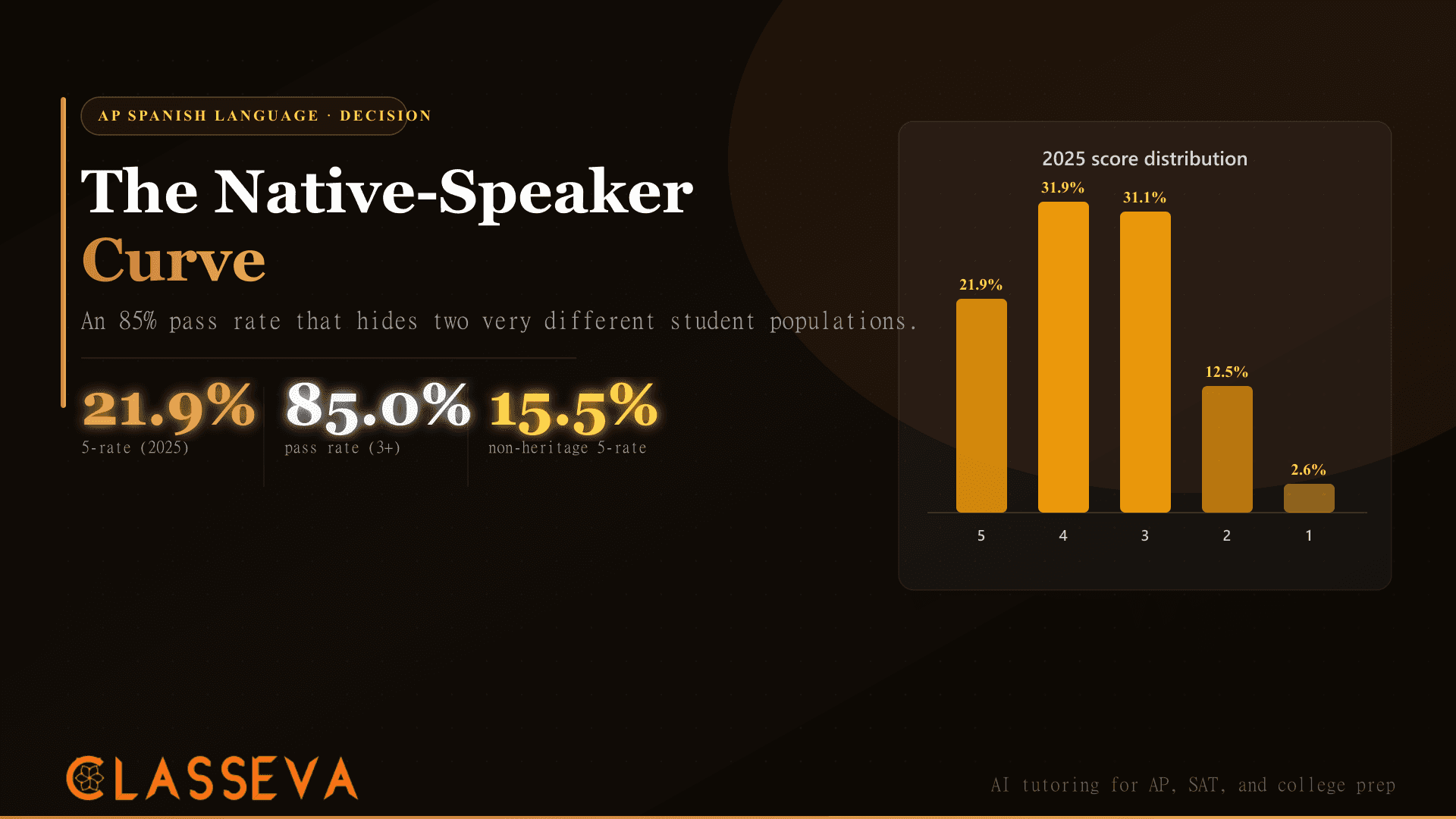
AP Spanish Language and Culture earns an 85.0% pass rate and a 21.9% 5-rate, which makes it look like one of the easiest AP exams on paper. The reality splits sharply along one line: did you grow up hearing Spanish, or did you learn it from a textbook? Building tutoring tools that adapt to a student's starting fluency forced me to look closely at this exam, and the score data tells two stories at once. This post separates them so you can predict your own outcome honestly instead of trusting an average that does not describe you.
Is AP Spanish Language Hard?
AP Spanish Language is easy for fluent bilingual students and hard for everyone else. The exam tests real-world communication, not memorized vocabulary lists, so students who already think in Spanish breeze through the interpretive and speaking tasks. Students who translate from English in their heads run out of time and stumble on the recorded speaking section. The honest read on AP Spanish Language difficulty is that it depends almost entirely on your starting fluency, which predicts your score better than any study plan you build in junior year.
Pass Rate vs 5-Rate
The 2025 numbers from the College Board score distributions set the AP Spanish 5 rate at 21.9%, with 31.9% fours, 31.1% threes, 12.5% twos, and 2.6% ones, for an 85.0% pass rate and a mean of 3.58. Compare that to the broader AP slate, where the average 5-rate across all subjects sits near 14%. AP Spanish Language clears the bar on volume of high scores. But the pass rate flatters the exam, because the pool that takes it is not a random cross-section of Spanish learners.
| AP Score | % of Test-Takers (2025) | Readiness Signal |
|---|---|---|
| 5 | 21.9% | Extremely well qualified |
| 4 | 31.9% | Well qualified |
| 3 | 31.1% | Qualified |
| 2 | 12.5% | Possibly qualified |
| 1 | 2.6% | No recommendation |
2025 AP Spanish Language and Culture Total Group distribution. Source: College Board (182,670 test-takers, mean 3.58).
The Native-Speaker Curve
College Board reports two slices of this exam: the Total Group and the Standard Group. Standard students learned Spanish mostly in US schools and do not regularly speak or hear it at home, and did not live a month or more in a Spanish-speaking country. In 2022, the Total Group earned a 5 about 23.6% of the time with a mean of 3.54, while the Standard Group earned a 5 only 15.5% of the time with a mean of 3.33. That gap is the native-speaker curve, and it reshapes how you should read the headline rate.
If you grew up speaking Spanish at home, your realistic target is a 5, and a 4 should worry you. If you started Spanish in 7th or 9th grade in a US classroom, a 3 or 4 is a strong outcome and a 5 takes a year of deliberate fluency work. The 85% pass rate applies to neither student cleanly. It is the math of two curves averaged together.
What Does the AP Spanish Exam Test?
The AP Spanish Language exam tests communication, not grammar trivia. It runs about 3 hours and 5 minutes and never asks you to conjugate a verb in isolation. Instead, every task drops you into a real situation: read an article, listen to a podcast, reply to an email, argue a position, hold a conversation, compare two cultures. The exam measures whether you can use Spanish, not whether you can describe its rules.
The 4 AP Spanish Exam Sections
Four scored components split across two halves carry equal weight: multiple choice is 50% and free response is 50%. Within free response, written tasks count 25% and spoken tasks count 25%. The structure rewards balance, so a student who reads well but freezes when speaking loses a quarter of the exam to a single weak skill.
| Section | Tasks | Time | % of Score |
|---|---|---|---|
| I-A Multiple Choice | Interpretive reading: 30 print-text questions | 40 min | 23% |
| I-B Multiple Choice | Interpretive listening: 35 audio questions | 55 min | 27% |
| II-A Written FRQ | Email reply + argumentative essay | 70 min | 25% |
| II-B Spoken FRQ | Simulated conversation + cultural comparison | 18 min | 25% |
AP Spanish Language and Culture exam format. Source: College Board AP Central exam page.
The 3 Modes of Communication
Every task on the exam maps to one of three modes. Interpretive communication is one-way input: you read or listen and answer. Interpersonal communication is two-way exchange: you reply to an email or respond inside a conversation. Presentational communication is one-way output to an audience: you write an essay or deliver a spoken comparison. Students who know which mode a task demands waste less time guessing what the rubric wants.
The 6 Course Themes
The course organizes everything around six themes that supply the content for reading passages, audio clips, and prompts. They are families and communities, personal and public identities, beauty and aesthetics, science and technology, contemporary life, and global challenges. You will not be quizzed on a theme by name, but knowing them helps you predict the topic range and build relevant vocabulary instead of memorizing random word lists. The full assessment breakdown lives on the AP Students assessment page.
The audio in Section I-B plays twice, which surprises students who expect a single pass. Use the first listen for the gist and the second for the specific detail the question targets. College Board publishes the full format on the AP Spanish Language exam page, including how many audio sets pair with print and how many are audio-only.
Why Is AP Spanish Hard for Non-Native Speakers?
AP Spanish Language is hard for non-native speakers because the exam rewards spontaneous production, and classroom learning builds recognition faster than production. AP Spanish for native speakers tilts toward fluency you already own; for everyone else, you can recognize a word you cannot summon on command. The speaking section gives you seconds to respond with no script, and the essay demands a structured argument in a second language under a clock. Both expose the gap between understanding Spanish and producing it.
The Speaking Tasks Punish Hesitation
The simulated conversation gives you five chances to respond, 20 seconds each, with no preview of where the conversation goes. The cultural comparison gives you 4 minutes to prepare and 2 minutes to speak. Non-native students lose points to long pauses, English-style sentence structure, and translating mid-sentence. Heritage speakers fill the time naturally because they are not assembling sentences from rules, they are talking. That difference shows up directly in the spoken-section scores.
The Argumentative Essay Catches Students
The argumentative essay gives you three sources (an article, a chart or infographic, and an audio clip) and asks you to take a position and defend it using all three. You get 55 minutes total, including 15 minutes to read and listen. Students who only describe the sources instead of building an argument cap out at a middling score. The rubric rewards a clear thesis, integrated evidence from every source, and accurate connectors and transitions. Practicing released prompts from AP Central teaches the structure faster than any vocabulary list.
Many non-native students treat the argumentative essay as a summary of the three sources. Summarizing earns partial credit at best. The rubric wants a defended position with evidence pulled from all three sources and woven together, not a paragraph about each source in turn. Write your thesis first, then mine the sources for support.
Students mapping their full AP slate often compare this exam to the English-language exams they take the same year. The AP English Language difficulty breakdown is a useful companion, because both exams reward argument construction over memorization, and the AP French Language post shows the same heritage-speaker dynamic in a different language.
AP Spanish Language vs Spanish Literature
AP Spanish Language tests real-world communication; AP Spanish Literature tests literary analysis of a fixed reading list. Language is the better choice for fluency-focused students and anyone chasing an intermediate-language college credit. Literature suits students who want to analyze poetry, prose, and drama in Spanish and earn literary-analysis credit. Most schools offer Language first because it builds the foundation Literature assumes.
AP Spanish Language and Culture
- •Tests interpretive, interpersonal, and presentational communication
- •No required reading list; content drawn from six cultural themes
- •Four tasks: reading, listening, writing, speaking
- •85.0% pass rate, 21.9% 5-rate in 2025 (182,670 test-takers)
- •Credit usually maps to intermediate college Spanish
- •Typical entry point for the AP Spanish sequence
AP Spanish Literature and Culture
- •Adds literary analysis to language fluency
- •Fixed reading list of 38 required works across genres
- •Essays interpret theme, structure, and literary devices
- •Lower 5-rate; pool skews toward students who cleared Language
- •Credit often maps to a literature or advanced Spanish course
- •Usually taken after AP Spanish Language
The honest read on AP Spanish vs Spanish Literature: Language is more attainable, Literature is more specialized. Strong bilingual students who plan to keep studying Spanish often take both, Language in junior year and Literature in senior year. Students taking Spanish to satisfy a requirement and move on should stop at Language. For a parallel decision in another subject, the AP English Literature difficulty post walks through the same language-versus-literature tradeoff in English.
How Should You Study for AP Spanish?
Study AP Spanish by producing the language daily, not by drilling grammar in isolation. Speak it, write it, and consume native audio and text every day, because the exam scores production and comprehension, not rule recall. The single highest-leverage habit is daily output: a short spoken recording or a paragraph of writing, reviewed for accuracy. Vocabulary follows naturally from the six themes once you read and listen within them.
Study Plans by Starting Point
Your starting fluency determines your plan. A heritage speaker needs format practice, not language practice. A classroom learner needs daily production reps across a full year. Matching the plan to the gap is what separates a 3 from a 5 for non-native students, and a 4 from a 5 for fluent ones.
| Starting Point | Main Gap | Where to Spend Study Time |
|---|---|---|
| Heritage / bilingual | Exam format and written accents | Released FRQs, essay structure, accent and spelling precision |
| Strong classroom learner | Spontaneous speaking | Daily timed speaking reps, audio immersion, essay drills |
| Building fluency | Production under time pressure | Year-long daily output, theme vocabulary, conversation practice |
Match your study time to the gap your starting point creates.
Record yourself answering one released spoken prompt every day for the two months before May. Play it back and mark every pause longer than two seconds and every place you reached for an English structure. Non-native students who do this close the spoken-section gap faster than students who only study vocabulary, because the exam tests talking, not knowing.
Project Your AP Spanish Score
If you are mid-course, the fastest way to know where you stand is to score released practice tasks and map them to a projected band. Classeva's AP Score Predictor turns your practice results into a likely score so you can target the section dragging you down, whether that is listening, the essay, or the recorded speaking tasks.
AP Score Predictor
Enter your AP Spanish Language practice results to project your score band and pinpoint which of the four sections to prioritize before the May exam.
Students weighing how AP credit translates into tuition savings can pair this with the broader AP slate. The AP Precalculus difficulty post and the decision framework in AP Spanish Literature help you build a schedule where each AP earns credit without overloading a single semester.
Key Takeaways
- The 85% pass rate is real but misleading. AP Spanish Language posted a 21.9% 5-rate and 85.0% pass rate in 2025, but the pool blends heritage and non-heritage students into one average.
- The native-speaker curve splits the exam in two. Heritage and bilingual students concentrate in the 5s; the Standard Group (US-classroom learners) earned a 5 only 15.5% of the time in 2022.
- The exam has four equally weighted skill areas. Reading and listening make up 50% as multiple choice; writing and speaking split the other 50% as free response.
- Speaking and the argumentative essay catch non-native students. Both reward spontaneous production, which classroom learning builds slower than recognition.
- Language is more attainable than Literature. AP Spanish Literature adds analysis of a 38-work reading list and posts a lower 5-rate; most students take Language first.
- Study by producing, not by memorizing. Daily spoken and written output across a full year moves non-native scores more than any vocabulary list.
- Predict your score from your curve. A 5 is the realistic target for fluent students and a stretch goal for classroom learners; plan your time accordingly.