College Interview Preparation: What to Expect
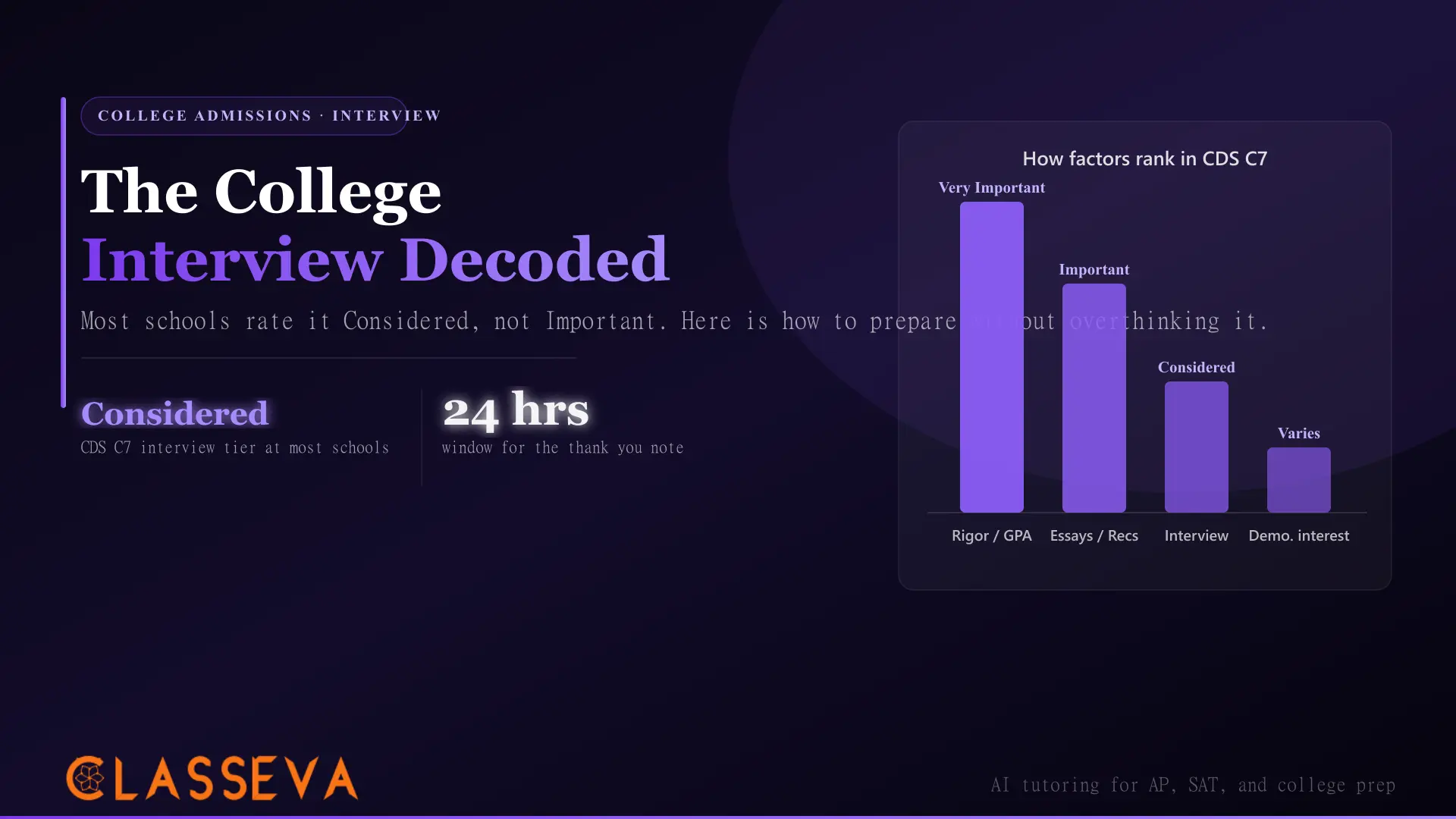
A college interview rarely decides your admission, and treating it like a high-stakes exam is the most common way students sabotage it. The numbers back this up. Across the Common Data Sets that selective universities publish, the interview lands in the Considered tier far more often than in Important or Very Important, which means it functions as a tiebreaker, not a gatekeeper. The goal here is calibration: stop stressing, but do not squander the one human conversation in an otherwise paper application.
How Much Does the College Interview Actually Matter?
At most colleges, the interview matters at the margin. Common Data Set Section C7 asks every school to rate 19 admissions factors, and the interview almost always shows up as Considered rather than Important or Very Important. That tier sits below rigor of curriculum, GPA, essays, and recommendations, the factors that NACAC research consistently identifies as the heaviest weights in selective admissions. A good interview helps you win a close call; it does not rewrite a transcript.
Yale Admissions states plainly that interviews are not required and that many admitted students never interview at all. Harvard and Dartmouth frame the alumni conversation as a chance to learn about the school and add your voice, not a screening test. Read alongside the CDS data, the message is consistent: the interview adds color to a file that academics and essays have already shaped.
What “Considered” Means in Practice
Considered is the CDS rating just above Not Considered. It signals that admissions officers read the interview report and let it nudge a decision, but they do not anchor an outcome on it. Picture two applicants with near-identical transcripts, test scores, and essays. A vivid, specific interview report can tip the borderline candidate toward admit. A flat report rarely pulls a strong candidate toward deny.
Evaluative vs Informational Interviews
Not every interview gets scored. An evaluative interview produces a written report that goes into your file. An informational interview exists mainly so you can ask questions and learn about the school, and it carries little or no weight in the decision. Before you prepare, ask the admissions office or your interviewer which type you are doing, because the answer changes how much polish the conversation needs.
What Are the Types of College Interview?
Three formats cover almost every college admissions interview: the alumni interview, the on-campus interview, and the virtual interview. They differ in who runs them, where they happen, and how the school uses them. Knowing which one you are walking into removes most of the anxiety.
Alumni Interview
- •Run by a volunteer graduate, not an admissions officer
- •Usually 30 to 60 minutes, often over coffee or video
- •The alumnus writes a report; they do not make the decision
- •You get matched after you apply, by region where possible
- •Optional at most schools; standard at a few like Georgetown
On-Campus / Office Interview
- •Booked directly through the admissions office
- •Often shorter (around 30 minutes) and back to back
- •Conducted by staff, seniors, or trained student interviewers
- •Doubles as a campus visit, which can signal interest
- •Limited slots; book early in the application cycle
The Alumni Interview
The alumni interview is the format most applicants encounter. After you apply, the school passes your contact information to a volunteer graduate in your area, who emails you to schedule a conversation. Duke, Dartmouth, and Princeton all run large alumni interviewer networks built on this model. The interviewer is enthusiastic about their school and curious about you, not a gatekeeper trying to catch you out.
Because alumni volunteer their time, capacity is uneven. In some regions, every applicant gets contacted; in others, no interviewer is available, and you simply will not be offered one. Georgetown is the notable outlier where the alumni interview is a standard step for first-year applicants. If a school cannot reach you, that absence does not count against you, a point Harvard makes explicitly on its admissions pages.
The On-Campus Interview
The on-campus interview runs through the admissions office and often pairs with a tour. You book a slot, show up, and talk with a staff member or a trained student interviewer for roughly half an hour. These slots fill fast, so reserve early in the fall if a school you love offers them. A campus interview also reads as a form of demonstrated interest at schools that track it, which compounds its value.
At schools that track engagement, showing up for an on-campus interview can register as demonstrated interest, which the Common Data Set lists as a separate C7 factor. Ivies and major research universities generally mark demonstrated interest as Not Considered, so the campus interview there is about the conversation, not attendance credit. Check each school’s C7 before assuming a visit moves the needle.
The Virtual Interview
The virtual college interview became the default after 2020 and has stayed common because it removes geography from the equation. An alumnus in Chicago can interview a student in rural Montana over a video call with zero travel. The substance matches an in-person conversation, but the medium adds technical risks: a frozen screen, an echoing room, or a glaring backlight can undercut an otherwise strong showing. Treat the setup as part of the preparation, not an afterthought.
What Questions Should You Expect?
Expect open, conversational interview questions for college, not trivia. Interviewers want to understand who you are beyond the transcript, so most prompts invite you to expand on your interests, your reasons for applying, and how you spend your time. Harvard and Yale both tell interviewers to have a genuine conversation rather than quiz applicants on facts.
| Question Type | Example Prompt | What They Are Really Asking |
|---|---|---|
| Fit | Why are you interested in this school? | Have you done specific research, or is this a name on a list? |
| Academic | What subject could you talk about for an hour? | Where is your genuine intellectual energy? |
| Activities | Which activity means the most to you and why? | Can you show depth instead of a long resume? |
| Reflection | Tell me about a book or idea that changed your thinking. | Do you reflect, or just accumulate accomplishments? |
| Forward | What do you hope to explore in college? | Are you curious and self-aware about the next four years? |
Common college interview question types and the intent behind each. Interviewers are listening for genuine, specific answers.
The Questions You Ask Back
The strongest applicants treat the interview as two-way. When the interviewer asks whether you have questions, do not say no. Ask something only that person could answer: what surprised them most as a student, what they wish they had done differently, or which professor changed how they thought. Generic questions you could Google (class size, deadlines) waste the moment. Specific, personal questions show you see the interviewer as a human, not a hurdle.
How Do You Prepare for a College Interview?
Solid college interview preparation takes about an hour, not a week. Reread your own application, name three concrete reasons you want this school, prepare two or three questions to ask back, and run a five-minute mock answer to “tell me about yourself.” Over-rehearsing backfires, because scripted answers sound scripted. Aim for prepared, not memorized.
Specific Tips for the Virtual Format
A virtual college interview rewards quiet logistics as much as good answers. Cornell and Duke career advisors give the same core checklist for video conversations, and it maps directly onto an admissions setting.
- Test the tech an hour early. Open the meeting link, check your camera and microphone, and confirm a stable connection before the interviewer joins.
- Fake eye contact on purpose. Drag the interviewer's video window to sit just under your webcam, then look at the lens. Looking at their face on screen reads as looking away.
- Control the room. Choose a quiet, private space with a plain background and light in front of you, not behind. Put pets and roommates on notice.
- Silence every device. Phone on do not disturb, notifications off, and out of reach so a buzz does not pull your eyes mid-sentence.
- Have a plan B. If the call drops, rejoin calmly or switch to a phone call. Composure under a glitch is itself a small signal.
The single biggest virtual-interview upgrade is moving the interviewer's video window directly below your webcam and looking at the camera, not the screen. To the interviewer, you appear to make steady eye contact instead of glancing down and to the side. Practice it once on a test call so it feels natural before the real conversation.
What Should You Never Do in a College Interview?
The fastest way to hurt yourself is to perform instead of converse. Reciting a memorized speech, name-dropping rankings, or treating the interviewer like a stepping stone all read as inauthentic. Interviewers write reports for the admissions office, and a forced or arrogant tone lands in that report.
- Do not read scripted answers. A glance at bullet points is fine; reading paragraphs aloud kills the conversation.
- Do not bash other schools. Comparing this college favorably against a rival sounds insecure, not enthusiastic.
- Do not let a parent attend or hover. The interview tests your voice, not your family's. Show up alone.
- Do not ask what you could Google. Deadlines and tuition are public; spend the questions on something only the interviewer knows.
- Do not exaggerate or invent achievements. Interviewers probe gently, and a story that unravels does more damage than a modest, true one.
Students who rehearse every answer word for word often interview worse than students who prepared lightly and stayed present. A memorized monologue cannot adapt when the interviewer follows up, and the seams show immediately. Prepare your stories and your reasons for applying, then let the actual conversation breathe. Interviewers consistently report that the candidates they remember most warmly sounded relaxed, not rehearsed.
How Do You Follow Up After a College Interview?
Follow up with a short thank you note within 24 hours, and you put yourself ahead of most applicants. University career offices, including Penn and Yale, note that a large share of interviewees never send one. The note is brief and specific: thank the interviewer, reference one concrete moment from the conversation, and restate your interest. That is the entire job.
Writing the Thank You Note
A college interview thank you note runs three to five sentences over email. Open by thanking the interviewer for their time. Add one detail that proves you were present, such as a book they mentioned or a class they recommended. Close by restating, briefly, why the conversation reinforced your interest in the school. Skip the flattery and the length; interviewers value sincerity and brevity over polish.
Where the Interview Fits in Application Costs
The interview costs nothing, which is one more reason its weight stays modest: every applicant can do it, so it cannot separate the wealthy from everyone else. The expensive parts of applying are the application fees, score reports, and travel. Mapping those out early keeps the free, high-leverage steps like the interview from getting lost in the budget noise.
Before you spend on visits or fee-heavy application rounds, total the real cost of your list with the calculator below, then decide which schools earn an in-person trip and which interviews can stay virtual.
College Application Cost Calculator
Add up application fees, score-report charges, and visit costs across your full college list so you can decide where to spend on travel and where a virtual interview does the job.
Once your list and budget are set, the interview slots into your broader timeline. Students mapping the full sequence find the junior year college planning timeline and the safety, match, and reach college list guide useful for deciding which schools justify the effort of scheduling and preparing for an interview at all.
The interview also rewards the same self-knowledge that strong essays demand. The work you do to articulate why a school fits you in your supplemental essays doubles as interview preparation, and understanding how schools weigh the whole file through holistic review tells you exactly where the interview sits in the bigger picture. For schools that track engagement, pairing the interview with other demonstrated interest signals can compound a borderline advantage.
Key Takeaways
- The interview is Considered, not decisive. Common Data Set Section C7 ranks it below rigor, GPA, essays, and recommendations at most colleges. Treat it as a tiebreaker, and let go of the pressure.
- Three formats cover almost everything: the alumni interview (a volunteer graduate), the on-campus interview (booked through admissions), and the virtual interview (video), which has been the default since 2020.
- Interviews are usually optional. Yale and others fill admitted classes with students who never interviewed, so a missed or imperfect interview will not sink a strong application. Georgetown is a rare exception where it is standard.
- Expect a conversation, not a quiz. Common interview questions for college are open-ended: why this school, what you love studying, which activity matters most. Specific, genuine answers beat rehearsed ones.
- The virtual format needs setup. Test your tech, fake eye contact by placing the interviewer's window under your webcam, control the room, and silence every device.
- Never read a script or bring a parent. Over-preparation and performance hurt more than light preparation and presence. Interviewers remember candidates who sounded relaxed.
- Send a thank you note within 24 hours. Three to five sentences, one specific reference, restated interest. Most applicants skip it, so it is free differentiation.