College Supplemental Essays: 4 Types, How to Approach Each
Pulling together admissions guidance from Stanford, Yale, U Chicago, and MIT side by side, I noticed something that most supplement strategy articles miss: the majority of prompts across hundreds of schools are variations on four questions. The schools phrase them differently, set different word limits, and emphasize different dimensions. But the underlying question type stays consistent. A student who understands the four types and has a strategy for each will approach 30 prompts with a plan instead of 30 separate puzzles.
This post breaks down each type, gives you a concrete approach, and ends with a practical workflow for managing the full volume. Before you write a single supplement, you need to understand why they matter more than most students assume.
Why Supplemental Essays Matter More Than Students Think
Supplemental essays receive less strategic attention than the Common App personal statement, but they carry at least as much weight at selective schools. Admissions officers read the personal statement to understand who you are. They read supplements to assess fit: does this student actually know what we offer, and do their goals connect to what we do well?
How Many Supplemental Essays Will You Write?
The Common App personal statement is one essay. Supplements are everything else. A balanced college list of 12 schools generates, on average, 25-35 individual supplement prompts. Stanford alone requires five short essays plus three additional questions. Yale requires a Why Yale response plus several 35-word short takes. MIT requests five essays alongside its activities section.
Budget 30-50 hours for supplement writing across a full application season. Students who begin supplement research in August rather than October consistently produce stronger Why This College essays because they have time to read about specific programs, follow faculty research, and visit or attend virtual info sessions before writing.
Why Supplements Separate Students With Similar Profiles
At highly selective schools, the applicant pool at the top contains thousands of students with near-identical academic profiles: GPA above 3.9, strong test scores if submitted, several AP 5s, leadership in one or two activities. Supplements are where admissions officers distinguish between those students. A generic Why This College essay tells an officer the school is a safety or a prestige pick. A specific, researched Why This College essay signals genuine interest and fit.
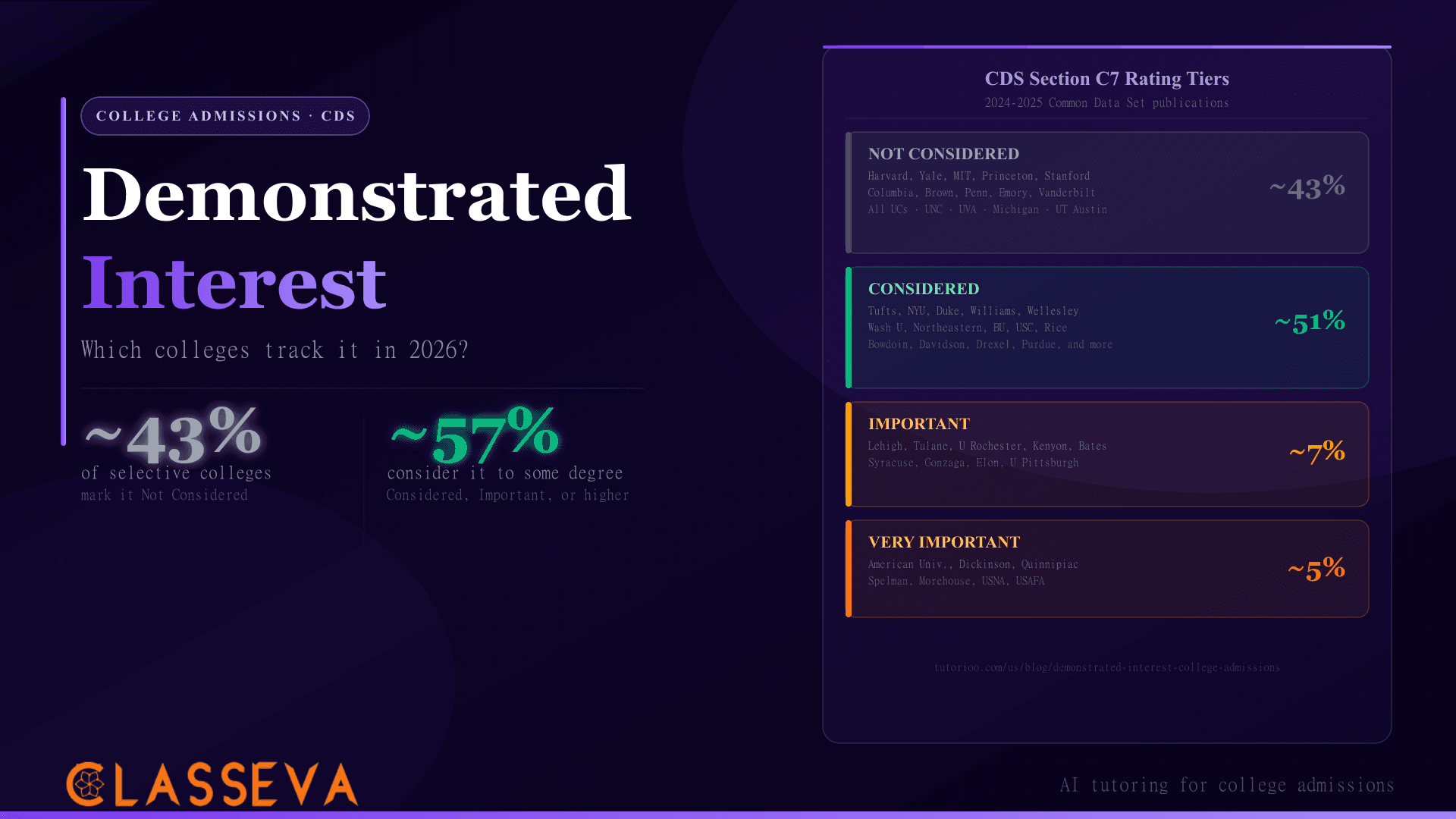
Demonstrated interest also matters at many schools. Colleges track whether students engage with admissions events, contact admissions officers, and visit campus. A well-researched supplement is the strongest written form of demonstrated interest. Our post on demonstrated interest in college admissions covers how schools weight it and which schools track it most closely.
The 4 Types of College Supplemental Essays
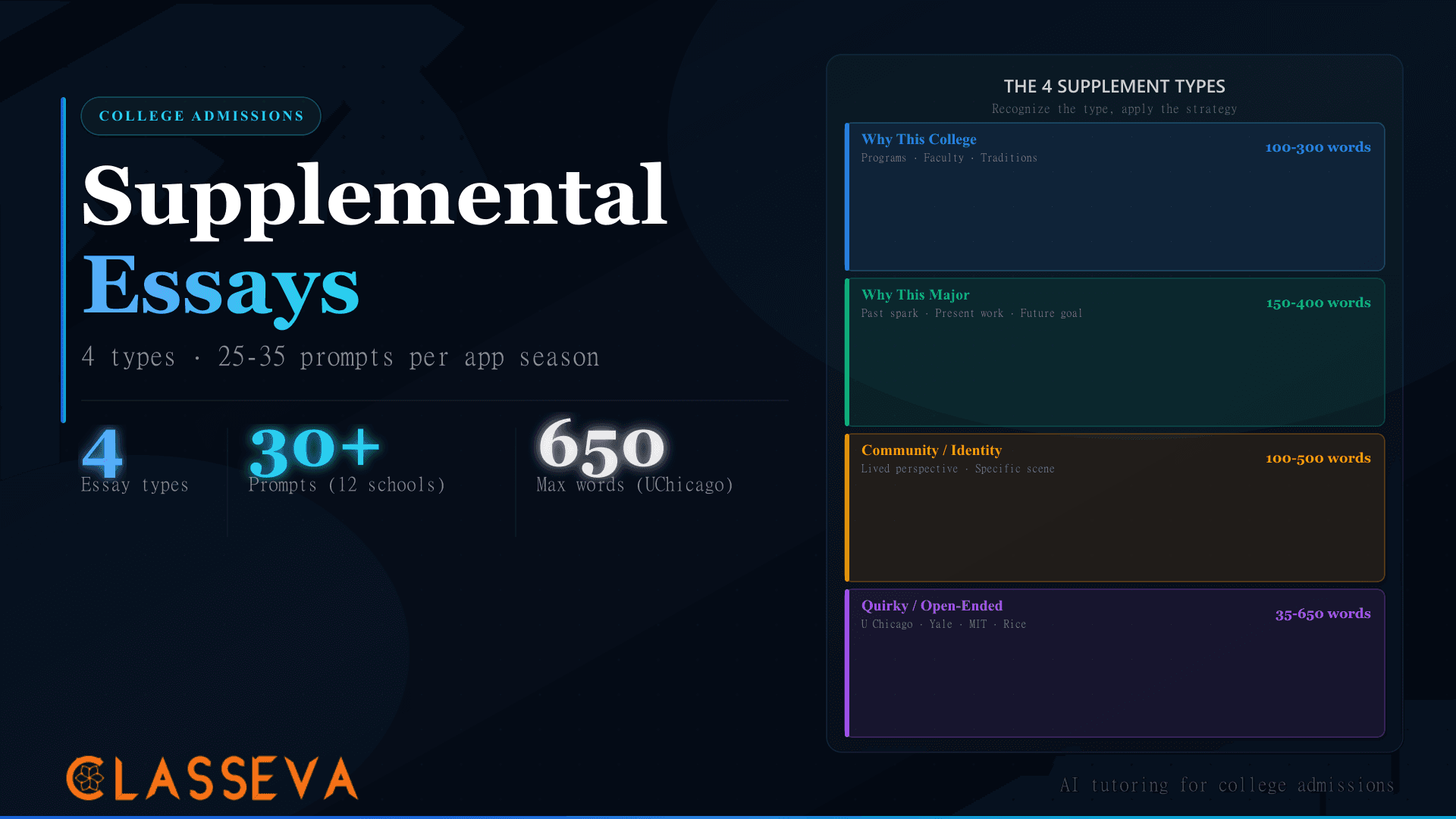
Almost every supplement prompt fits into one of four categories. Recognizing the type immediately clarifies your strategy.
| Type | Core Question | Most Common At | Word Range |
|---|---|---|---|
| Why This College | Why are you applying here specifically? | Most selective schools | 100-300 |
| Why This Major | What draws you to this field of study? | Schools requiring major declaration | 150-400 |
| Community / Identity | What perspective do you bring to campus? | Most top-25 schools | 100-500 |
| Quirky / Open-Ended | Show us who you are in an unusual way | U Chicago, Yale, MIT, Rice | 35-650 |
Categorizing your prompts into these four types before writing saves hours of strategic confusion.
How to Write a “Why This College” Essay That Works
The Why This College essay has one job: convince the reader that this school appeared on your list for substantive reasons, not prestige or geography. A strong answer names something specific enough that the same sentence could not appear in an essay for a different school.
The Specificity Rule: Programs, Faculty, and Traditions
Generic answers fail at every word count. “Northwestern has an incredible journalism program” tells an admissions reader nothing they do not already know about their own school. A strong Why This College answer names a specific dimension of that program: a particular sequence, a faculty member by name, a research center, a student publication, or a course from the actual catalog.
The research required is not onerous. Thirty to forty minutes on a school’s website and course catalog produces enough material for a 200-word essay. Check the department pages for faculty research interests. Search the school’s name alongside terms like “research center,” “undergraduate program,” or “honors thesis.” Read recent news from the department. If you attended a virtual info session or spoke with a current student, reference what you learned.
What “Specific” Actually Looks Like in Practice
Stanford’s essay guidanceis instructive here. Stanford asks “How will you contribute to the students you will live with, be educated with, and potentially graduate with?” rather than a standard Why Stanford prompt. The underlying expectation remains: show genuine self-knowledge and genuine engagement with what Stanford offers. The same principle applies across all Why This College variations. Schools want evidence that the match is real, not aspirational.
Before drafting any Why This College essay, open a document and write down: (1) two programs or research centers by name, (2) one faculty member and their current research focus, and (3) one course from the catalog that connects to your goals. Then write the essay from those notes. This 30-minute research step eliminates the blank-page problem and produces a draft that admissions officers remember.
How to Write a “Why This Major” Essay
Why This Major essays test whether your stated academic interest holds up under scrutiny. A student applying to study economics who writes “I have always found money and markets interesting” raises questions. A student who traces a specific intellectual thread from a high school event through a summer project through a book or paper they read independently produces a credible portrait.
The Past-Present-Future Framework
Structure Why This Major essays in three movements:
Past: the specific moment that sparked the interest
Not "I always loved science." Name a specific moment, course, experiment, person, or piece of reading that first surfaced the question you now want to pursue. Precision here signals authentic interest rather than stated interest.
Present: what you are actively doing with that interest now
Research, coursework, projects, competitions, independent reading, an internship, or a relevant job. The present tense element proves the interest survived the moment that sparked it. This section differentiates students who claim interest from students who demonstrate it.
Future: what you want to build, solve, or contribute
Connect your declared major to something beyond graduation. It does not need to be a specific career plan — a research question, a problem you want to work on, or a field you want to contribute to all work. This signals that the major serves a purpose, not just a requirement.
The past-present-future framework adapts across disciplines. A pre-med student, an economics student, and a comparative literature student all use the same three movements with entirely different content. Once you have written the core version, adapting it for different schools requires only swapping in specific faculty names, programs, or courses from each school’s catalog.
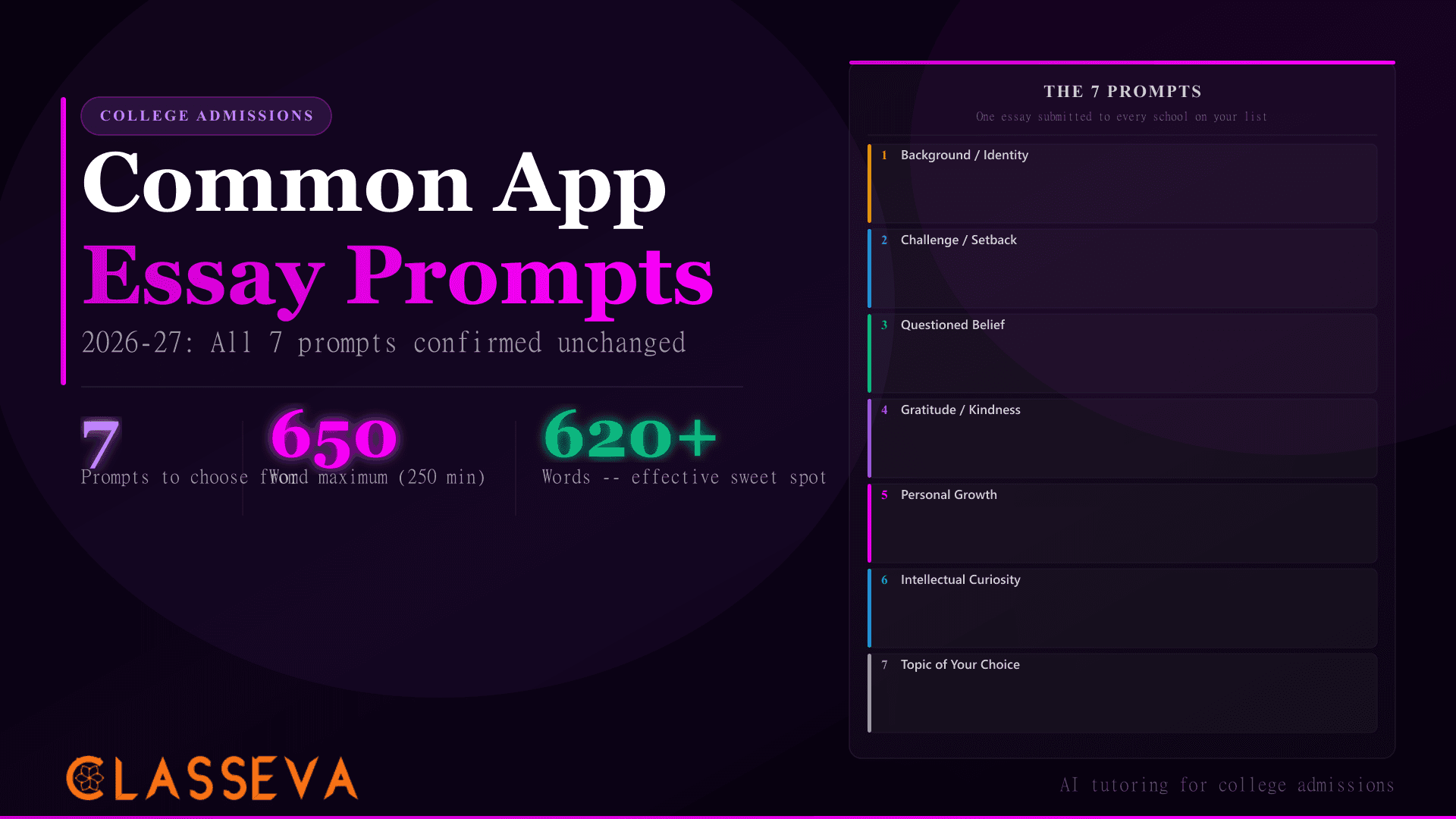
See our guide to Common App essay prompts for how to coordinate your Why This Major essay with your personal statement so the two pieces show different dimensions of the same interest, rather than repeating each other.
Community and Identity Supplemental Essays
Community and identity supplements ask how your background, experiences, or identity will contribute to campus life. At Yale, the 2024-25 cycle included: “Reflect on a time when you have not felt included. How did that affect your understanding of the community?” At Harvard, applicants respond to questions about community and belonging in the additional information section and supplements.
What “Diverse Perspective” Actually Means to Admissions Officers
Admissions officers are not looking for demographic representation as the essay’s subject. They are looking for the intellectual and interpersonal consequences of your lived experience. Two students can share the same background and write completely different essays depending on what they noticed, how they processed it, and how that shaped their thinking.
Lists Identity Labels
- •Leads with demographic characteristics
- •Tells rather than shows the experience
- •Generic summary of what the group "faces"
- •No specific scene or moment
- •Could have been written by anyone with the same background
Shows Lived Perspective
- •Opens with a specific scene or moment
- •Shows how the experience shaped a particular way of thinking
- •Reveals something about intellectual or interpersonal approach
- •Connects experience to what the student brings to campus
- •Could only have been written by this specific person
The test for a community essay is: does this show me something about how this person thinks, solves problems, or relates to others that I would not learn from the rest of the application? If the answer is no, the essay is repeating application information rather than adding dimension.
Yale’s essay guidance states that supplements should reflect “what matters to you and what you want Yale to know about you.” That open framing is a deliberate signal: Yale rewards self-awareness and intellectual engagement, not formula. A student who writes a memorized structure for Yale will produce a forgettable essay regardless of how polished it reads.
Quirky and Open-Ended Essays
Quirky and open-ended supplements exist at a small number of schools, but the schools that use them are among the most selective in the country. U Chicago, Yale, MIT, and Rice all include unusual prompts designed to surface intellectual personality and genuine voice.
U Chicago, Yale, and MIT: What They Actually Reward
The University of Chicago Uncommon Essay (up to 650 words) uses prompts that have included philosophical paradoxes, invented words, and unlikely alliances between historical figures. Past prompts have asked students to find a word in the dictionary that does not exist and define it. The essay rewards students who take genuine intellectual risks on the page, not students who write the most refined essay they can.
Yale’s short takes ask for 35-word responses on topics like favorite books, websites, and intellectual inspirations. The constraint forces economy of language and genuine preference. “My favorite book is [widely praised literary novel] because it taught me about the human condition” wastes the 35 words. A student who names an unusual book or a textbook or a graphic novel and gives one specific reason tells an admissions officer something real.
MIT’s essay promptsinclude “Tell us about a few of your quirks” and questions about what you do for fun that reveal habits and personality. MIT rewards students who engage honestly with the prompts rather than students who answer what they imagine MIT wants to hear. An applicant who writes that they spend weekends reading about obscure railway history, or who has an unusual system for cataloging their music collection, produces a more memorable MIT essay than one who writes about their love of problem-solving.
Common Supplemental Essay Mistakes
The most damaging supplement mistakes share one root cause: students apply a template rather than engaging with the specific prompt.
| Mistake | Why It Fails | Fix |
|---|---|---|
| Praising school reputation or rankings | Signals low effort; every school hears this | Name specific programs, faculty, or resources instead |
| Copying a Why This College essay with the school name swapped | Admissions officers recognize the generic structure immediately | Build a specificity file per school before writing |
| Answering a different question than what was asked | Reveals that student did not read the prompt carefully | Restate the prompt in your own words before drafting |
| Writing a Why This Major essay that lists interests without evidence | Interest without evidence reads as claimed, not demonstrated | Include one concrete activity, project, or piece of reading |
| Identity essay that catalogs demographics | Shows the label, not the person | Open with a specific scene that reveals your perspective |
| Quirky essay that tries to be impressive rather than genuine | U Chicago and Yale readers recognize manufactured quirkiness | Write toward what genuinely interests you, not what sounds smart |
These mistakes appear across thousands of supplements each cycle. Recognizing the pattern before writing is the fastest path to avoiding it.
One underappreciated source of mistakes: students writing while tired or rushed toward a deadline. The Common App deadline pressure produces a cluster of low-effort Why This College essays each November. Starting supplement research in August and drafting in September leaves time to revise. A well-researched Why This College essay written in September consistently outperforms a polished but generic one finished the night before the deadline.
A Practical Workflow for 8-15 Supplements
The volume of supplement writing only becomes manageable when you stop treating each prompt as a standalone task and start treating it as an instance of one of four types.
The sequence matters. Start with the Why This Major draft because it contains the most transferable material. Once you have articulated your intellectual interests with specificity, the identity and Why This College essays draw from the same self-knowledge. Quirky essays come last because genuine voice develops across the writing process, not before it.
Plan your application budget alongside your essay timeline. Our college admissions resource hub covers the full application process, from building your list through final submissions.
College Application Cost Calculator
A 12-school application list adds up fast. Calculate total application fees, test score sending costs, and optional extras across your specific college list before you finalize it.
If scholarship essays also appear on your timeline, our scholarship probability estimator can help you identify which scholarship applications are worth the additional writing investment, so you are not producing 40 essays while also juggling supplements.
For context on how supplement strategy intersects with application timing, see our guide on early decision vs early action. EA deadlines at many schools land in November, which compresses supplement timelines for students who also apply ED somewhere else.
Key Takeaways
- College supplemental essays fall into four recurring types: Why This College, Why This Major, Community or Identity, and Quirky or Open-Ended. Identifying the type determines the strategy.
- A 12-school application list typically produces 25-35 supplement prompts. Budget 30-50 hours for supplement writing across the full application season.
- Specificity is the non-negotiable standard for Why This College essays. Name actual programs, faculty, courses, or traditions. Generic praise for rankings or campus culture will not help any application.
- Why This Major essays perform best with a past-present-future structure: the specific moment that sparked your interest, what you are actively doing with that interest now, and what you want to contribute.
- Community and identity essays should open with a scene that reveals lived perspective, not a catalog of demographic characteristics. The intellectual and interpersonal consequence of experience is what admissions officers are reading for.
- Write supplements in order: Why This Major first (most adaptable), then community essays, then quirky prompts last when your voice has fully developed across the writing process.
- Specificity requires research. Thirty minutes on a school’s course catalog and faculty pages produces enough material for a strong 200-word Why This College essay. Do the research before you write, not during.
For strategy on the Common App activities list, which shapes the context that your supplements extend, see our dedicated guide. Together, the activities list and the supplements give admissions officers two complementary views of the same student.