Common App Activities List: What Counts and How to Frame It
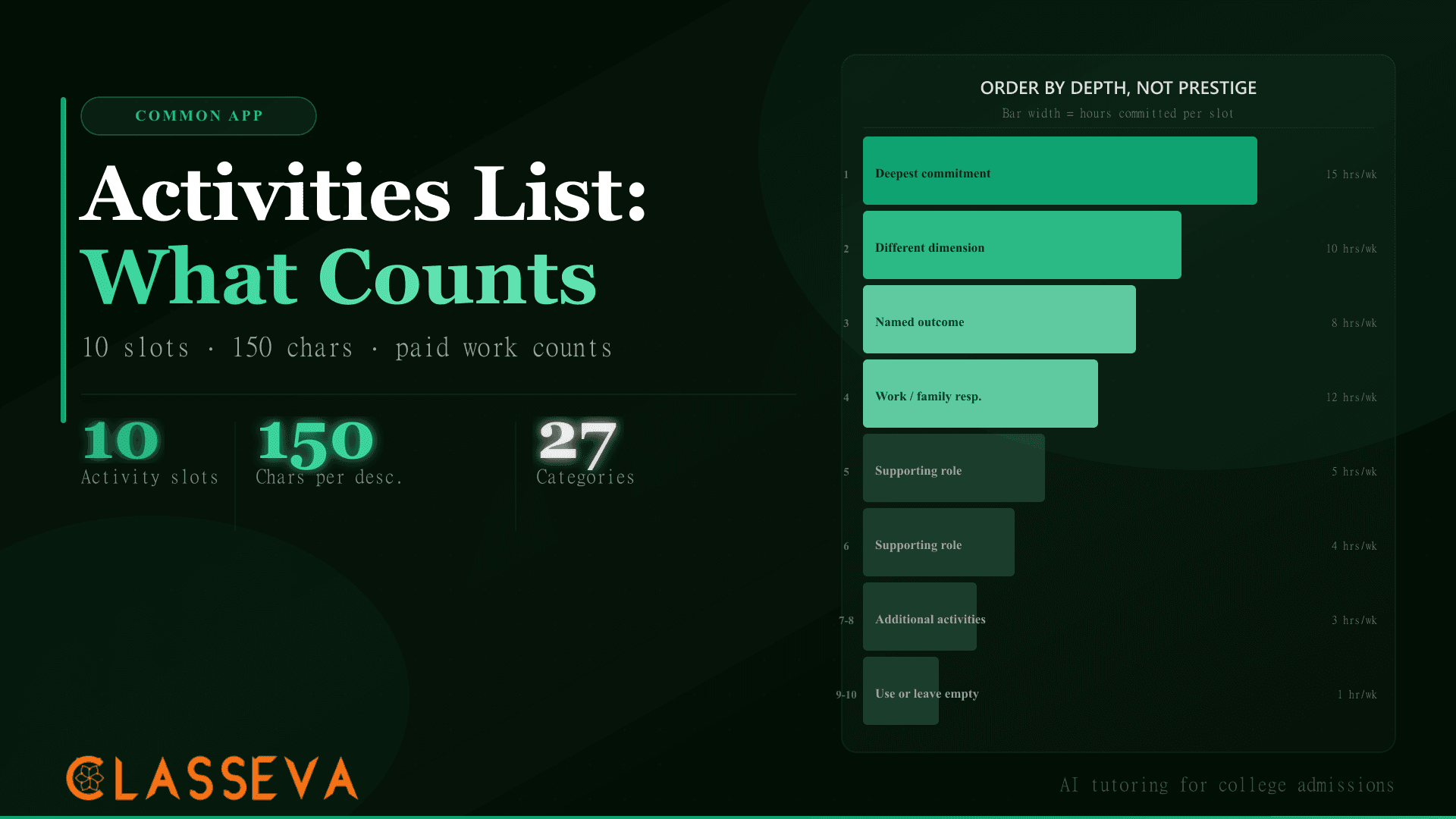
The Common App activities section runs 10 slots deep, gives you 150 characters per description and 50 for your position title, and asks for hours per week, weeks per year, and grade levels for each entry. Those are tight constraints. Most students respond to tight constraints by playing it safe: listing only formal clubs, writing descriptions that restate their job titles, and sorting activities by how impressive they sound on paper rather than how much they actually reveal.
The result is a section that looks like every other application. Admissions officers at selective colleges read thousands of these. They notice when the first entry is "student council president" with a generic description and nothing to distinguish it from the previous 400 they read. They also notice when a student uses the family responsibilities category to describe translating for non-English-speaking parents at medical appointments, or lists a 15-hour-per-week restaurant job with a description that names exactly what that schedule demanded of them.
This walkthrough covers the format in full, what actually qualifies as an activity, how to order and write your entries, and how admissions officers process this section during review.
How the Common App Activities List Works
The activities section sits inside the Common Application itself, available to all applicants after they create an account at commonapp.org. It covers extracurricular activities, work experience, family responsibilities, community involvement, and independent projects, all in a single structured form.
The 10 Slots, 150 Characters, and 50-Character Title
Each of the 10 activity slots contains five distinct fields. The position/leadership title field caps at 50 characters. The description field caps at 150 characters. You also indicate the organization name, the grade levels during which you participated (9 through 12, plus post-graduate if applicable), and whether you plan to continue the activity in college.
150 characters is roughly the length of two short sentences. That forces specificity by default. Students who try to write a full paragraph discover quickly that they need to cut. Students who embrace the constraint from the start write stronger entries than those who edit down from something longer, because they lead with what matters most.
Activity Categories the Common App Recognizes
The Common App provides a dropdown of categories for each activity. Selecting the right one matters because admissions officers scan by category when they want to understand a student's profile quickly. The full list includes: Academic, Art, Athletic: Club, Athletic: JV/Varsity, Career-Oriented, Community Service (Volunteer), Cultural, Debate/ Speech, Environmental, Family Responsibilities, Foreign Language, Journalism/Publication, Junior R.O.T.C., LGBT, Religious, Research, Robotics, School Spirit, Science/Math, Social Justice, Sports: Club, Student Govt/Politics, Technology, Theater/Drama, Work (Paid), and Other.
"Other" is a legitimate category for genuinely unusual activities that do not fit the list. A student who runs a monetized Etsy shop, manages a local podcast, or coordinates neighborhood mutual aid without formal nonprofit status can use it. Do not default to "Other" for activities that fit an existing category simply because the category sounds less prestigious.
Hours, Weeks, and Grade Levels
The hours-per-week and weeks-per-year fields are self-reported numbers. Admissions officers read them as context for how much of your time this activity actually consumed, not as validation criteria. A student who worked 20 hours per week at a restaurant for 35 weeks of the year demonstrates a level of commitment that a once-monthly club meeting does not, regardless of which activity sounds more impressive.
Report in-season or active-period hours. If you played a school sport that ran for 14 weeks and consumed 15 hours per week during that window, report 15 and 14, not an averaged annual figure. The grade level checkboxes let you indicate which years you participated, which gives context without requiring explanation in the description field.
What Counts as an Activity?
The short answer: almost anything that consumed meaningful time and produced a result you can describe. The Common App's official guidance does not restrict activities to school-sponsored programs, formal organizations, or supervised experiences. Students who interpret the section narrowly almost always underreport what they actually did.
Paid Work and Family Responsibilities
Paid employment belongs in the activities list. The "Work (Paid)" category exists specifically for this. A student who worked 15 hours per week bagging groceries while carrying a full course load demonstrated time management and financial responsibility that matters to admissions offices. Write the description as an accomplishment statement, not a job listing.
The "Family Responsibilities" category covers caring for siblings or elderly relatives, running a household when parents are unavailable, managing family finances, translating for non-English-speaking family members, and contributing to a family business. First-generation and immigrant students disproportionately hold these responsibilities and underreport them. An admissions officer reading this category understands immediately that the student balanced obligations most applicants never faced.
Online and Independent Activities
Online activities have been explicitly recognized since the 2020-21 cycle, when Common App updated its guidance in response to school closures. Remote internships, virtual research programs, online clubs, self-directed coding projects, content creation with a real audience, and independent study programs all qualify.
The honest test for any activity, online or otherwise: can you report real hours per week, name your role, and describe a specific outcome? If yes, it belongs. A student who spent 8 hours per week building a mobile app for three years has a more compelling entry than one who attended a well-known club twice a month. The platform is irrelevant. The commitment and the outcome are what the field asks for.
How to Order Your 10 Activities
Order activities by depth of personal meaning and commitment, not by name recognition or perceived prestige. The activity you list first is the one you are implicitly telling admissions officers represents you most. A student who spent 500 hours coaching youth soccer should put that first, even if it sounds less impressive than a school club they attended sporadically.
Research on how admissions officers process high-volume reading consistently shows that early entries carry disproportionate weight. By the time a reader reaches entry 8 or 9, they have already formed a working impression. That impression comes from the top of the list.
A common mistake is listing varsity sports first because "varsity" sounds impressive, even when the student played limited minutes for two months and spent the other ten months of the year running an after-school tutoring program that served 40 students. The tutoring program belongs first. Depth of commitment and specificity of outcome outweigh label prestige.
How to Write a Strong 150-Character Activity Description
The 150-character description is not a place for your job title again. You have already put your title in the 50-character position field. The description field exists for one thing: what did you actually do, and what resulted from it?
The Lead-Verb Formula
Start every description with a strong action verb in the past tense (for completed activities) or present tense (for ongoing ones). The verb is the signal that you are describing action, not restating a title. After the verb, add the scope (how many, how much, how large, how often) and the outcome (what changed, what was produced, what was achieved).
Three words to avoid at the start of a description: "I," "Was," and "Helped." Starting with "I" wastes two characters and reads passively. "Was responsible for" describes a job posting, not an accomplishment. "Helped" dilutes your role and signals you are giving someone else the credit.
Specific Results Over Generic Roles
Admissions officers read thousands of descriptions that say "participated in community service" and "volunteered at local organizations." The descriptions that stand out name the number of hours, the number of people served, the dollar amount raised, the product built, or the specific outcome delivered. If your description could apply to any student in any club at any school, it needs to be rewritten.
Weak Description Patterns
- •"Helped with" / "Assisted in" / "Participated in"
- •Restates the organization name or club type
- •No numbers, no scope, no outcome
- •"Responsible for various duties"
- •Generic enough to fit any student in the same club
Strong Description Patterns
- •Starts with a specific action verb
- •Names a number: people, hours, dollars, units, events
- •States a specific outcome or product
- •Fits in 150 characters with room to spare
- •Could only have been written by this specific student
How Admissions Officers Actually Read This Section
Admissions officers at selective colleges review each application file in 12-20 minutes on average. The activities section gets a fast scan: top to bottom, category and title first, then the description if something catches attention. A 2023 survey by the National Association for College Admission Counseling (NACAC) confirmed that extracurricular activities rank among the top factors considered in admissions decisions at selective institutions, sitting below academic performance but above many other application components.
What officers look for in the activities section is not a checklist of prestigious clubs. They want to understand how you spent your time outside class and whether those choices reveal something about your values, capabilities, or potential. A student who committed 600 hours to one activity over four years reveals something the student who listed 10 clubs at one hour each per week does not.
| What AOs Notice | Why It Matters |
|---|---|
| Hours per week × weeks per year | Reveals genuine commitment vs. resume padding |
| Consistency across grade levels | Four-year involvement signals sustained interest |
| Leadership or increased responsibility | Shows growth and initiative over time |
| Unusual categories (Family, Work) | Signals context about the student's life circumstances |
| Specific outcomes in descriptions | Distinguishes action from passive attendance |
| Coherence across all 10 entries | A narrative emerges: who is this student? |
What admissions officers actually look for when reviewing the Common App activities section
The activities section also provides context for the rest of the application. An admissions officer who reads about your tutoring work, then encounters your Common App essay about the moment you realized you wanted to study education policy, reads both with more depth. Your Common App essay and your activities section should reinforce each other, not tell two separate stories.
What If You Have Fewer Than 10 Activities?
Leave slots empty. The Common App does not flag unused activity slots, and admissions officers do not penalize students for having fewer entries. What they do notice is an activities list padded with one-off volunteering events, clubs the student attended twice, or vague independent projects with no concrete hours or outcomes.
A student who lists 6 genuine activities, each with honest hours and a specific description, presents a more coherent profile than one who lists 10 and pads the bottom with filler. If you are genuinely concerned about the depth of your extracurricular profile, the right response is not to pad the list but to address it honestly in the additional information section of the Common App, where you can provide context about constraints on your time.
The Common App's Additional Information section (650 characters) gives you space to explain any circumstances that affected your activity participation: a health condition, a family situation, a school that cancelled all clubs during a particular year. Use it to provide context rather than to apologize. An admissions officer who understands why your list is shorter will read it differently than one who sees empty slots with no explanation.
How to Finalize Your Activities List
Building the activities list is not a one-session task. The students who submit the strongest entries typically draft in the summer, revise in September, and review again after they finish their essays, because the essay process often surfaces activities they had undervalued or described too weakly.
Inventory everything you have done since 9th grade
Include jobs, sports, clubs, family responsibilities, online projects, summer programs, independent study, and anything else that consumed real time. Do not self-edit at this stage.
Select your top 10 by hours and depth
Drop anything you cannot describe with a specific role, outcome, or number. One-off volunteering events and casual attendance do not belong unless you can show sustained participation.
Write a first draft of each 150-character description
Lead with an action verb. Name a number. State an outcome. Read it without the context of the rest of your application: does it convey something specific?
Order by importance, then read all entries together
Check for redundancy: do two entries tell the same story? Does your first entry match what you would say if someone asked "what is the most important thing you do outside school?"
Fill in hours, weeks, and grade levels accurately
Report in-season or peak-period hours. Accuracy matters more than impressive numbers. Admissions officers ask about activities in interviews, and inflated hours surface quickly.
Have someone unfamiliar with your activities read the full list
If a reader who does not know you cannot understand what you did and what you accomplished from the description alone, the description needs another pass.
Review your essays and activities together
Your Common App essay and your activities section should reinforce each other. If your essay is about leadership but your activities section does not show it, one of them needs revision.
The application process carries real costs beyond the Common App fee: standardized testing, score sends, campus visits, and supplemental applications add up quickly across a school list of 10 or more colleges. The College Application Cost Calculator breaks down the full expense picture so you can plan your school list and application timeline with a clear budget in view.
College Application Cost Calculator
Enter your full college list to calculate total application fees, score-sending costs, and campus visit estimates. Useful when deciding how many schools to apply to and where to prioritize demonstrated interest investments.
For students exploring scholarship opportunities to offset costs, the Scholarship Probability Estimator factors in your GPA, test scores, and extracurricular profile to show which scholarships align with your application. Students who use the activities list strategically often find their extracurricular profile opens scholarship doors that GPA alone would not.
For the broader admissions picture, including how colleges weigh extracurriculars alongside test scores, essays, and grades, the Classeva college admissions resource hub covers holistic review factors with data from Common Data Sets at selective colleges.
Key Takeaways
- The Common App activities section gives you 10 slots with 150 characters per description and 50 characters for your position title. Use every character that conveys something specific.
- Paid work, family responsibilities, and online activities are fully recognized categories. Students who assume only formal school clubs qualify underreport years of genuine commitment.
- Order activities by depth of commitment and personal meaning, not by name recognition. Admissions officers read top to bottom and form impressions from the first three entries.
- Lead every description with a strong action verb. Follow it with a specific number, scope, or outcome. Never restate your title or write generically enough to fit any student in any similar role.
- Unused slots signal focus. A clean list of 6 meaningful entries beats 10 padded ones with thin descriptions and low hours.
- The activities section and your essays should tell a coherent story. If they diverge, revise until they reinforce each other.
- Use the Common App's Additional Information field to explain any circumstances that reduced your activity participation, rather than leaving gaps without context.
For context on how the activities section fits into the broader application strategy at specific schools, see how selective institutions weigh extracurriculars in their holistic review: Harvard admissions, Yale admissions, and the ED vs EA timing decision all touch on how extracurricular depth interacts with application strategy. Students who demonstrate genuine commitment in the activities section also tend to score higher on demonstrated interest metrics, because the same student who commits to one activity consistently tends to engage with colleges consistently too.