Is AP Spanish Literature Hard? The Iberian Canon Decoded
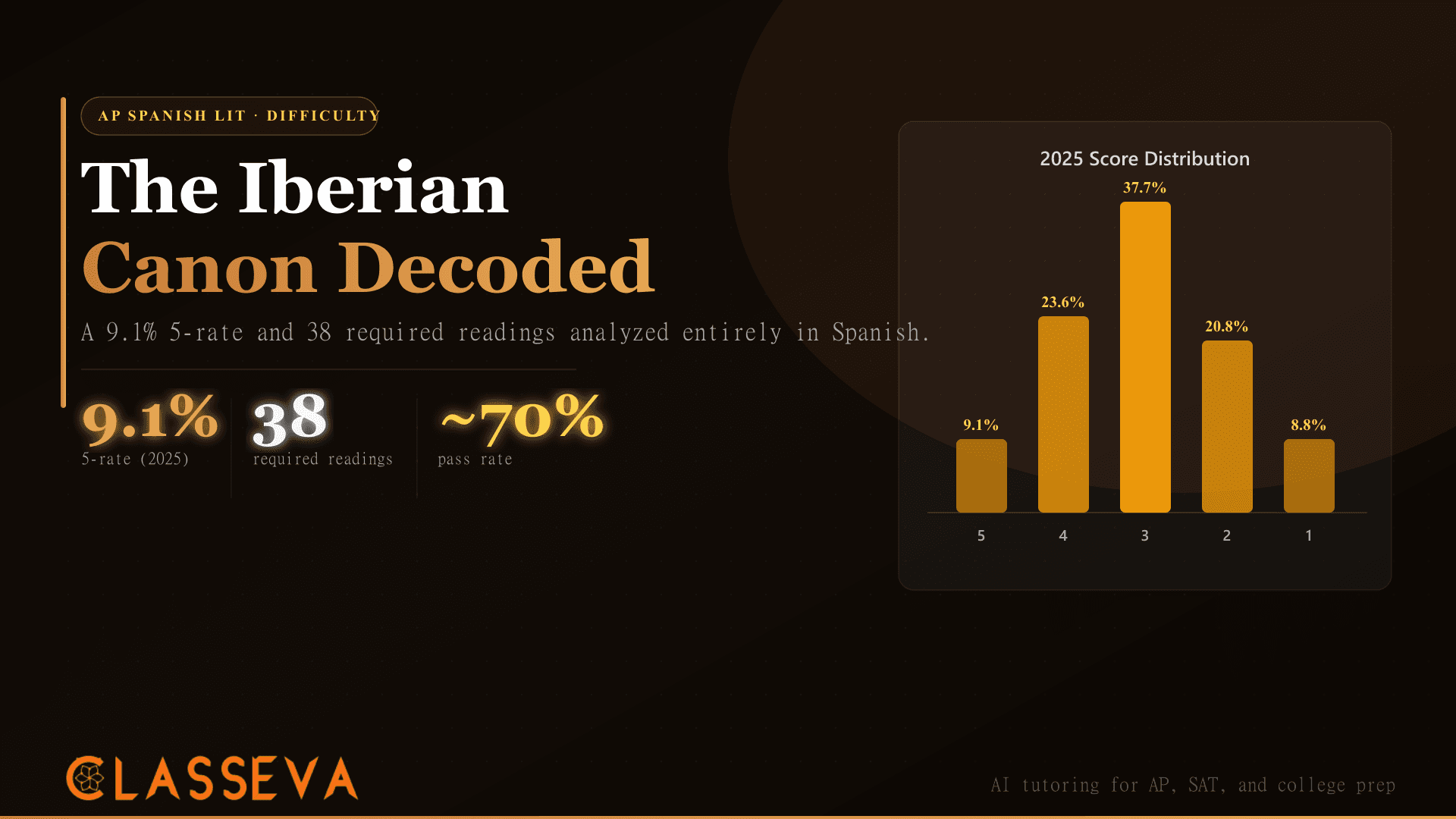
AP Spanish Literature is hard in a way the score data hides: a 9.1% 5-rate sounds brutal, yet roughly 70% of students still pass. The reason both numbers can be true is that the exam rewards a narrow band of skill. Speaking Spanish fluently gets you nowhere near a 5 if you cannot name the period of a Garcilaso sonnet or trace a theme across a Borges story in formal written Spanish. The wall is literary analysis, not the language.
Is AP Spanish Literature Hard?
AP Spanish Literature ranks among the harder AP language exams for non-heritage students, with a 2025 5-rate of 9.1% per College Board score distribution data. AP Spanish Lit difficulty hinges on one thing: you analyze 38 literary works in Spanish, write essays in Spanish, and identify authors and periods from short excerpts. Fluency helps you read faster. It does not teach you to dissect a villancico.
Score Distribution and 5-Rate
The 2025 AP Spanish Literature score distribution broke down as 9.1% fives, 23.6% fours, 37.7% threes, 20.8% twos, and 8.8% ones, for a pass rate near 70% and a mean score of 3.03. That pass rate marked the highest share of 3-or-better scores since the pandemic, a 4-point jump from 2024 per College Board. The fat middle is the story: most students land on a 3, the qualifying score, but breaking into 4 and 5 territory takes analytical writing that few master.
| AP Score | % of Test-Takers (2025) | College Readiness Signal |
|---|---|---|
| 5 | 9.1% | Extremely well qualified |
| 4 | 23.6% | Well qualified |
| 3 | 37.7% | Qualified |
| 2 | 20.8% | Possibly qualified |
| 1 | 8.8% | No recommendation |
Source: College Board 2025 AP Spanish Literature and Culture Score Distributions. Mean score 3.03.
Who Actually Takes the Exam
AP Spanish Literature draws a small, self-selected pool, roughly 27,000 students in 2025, a fraction of the 180,000-plus who sit for AP Spanish Language. [VERIFY: 2025 College Board participation counts] Most enrollees are upperclassmen who already cleared AP Spanish Language or grew up speaking Spanish at home. That filtering should push the 5-rate up, the way it does for AP Calculus BC. It does not, which tells you the exam tests a skill the pool does not arrive already holding.
What Is on the AP Spanish Literature Reading List?
The official AP Spanish Literature reading list contains 38 required works spanning eight centuries, from medieval Iberian texts to 21st-century Latin American and US Latino writing. The list mixes poetry, short stories, essays, drama, and novel excerpts. Students must know the author, the literary period, the genre, and the central themes of every text, because the exam quotes short excerpts and asks you to place and analyze them on sight.
The Four Literary Periods
College Board organizes the 38 readings across roughly four historical bands. Each carries its own vocabulary, syntax, and set of literary conventions, which is why the list resists cramming. The medieval and Golden Age texts use Spanish that no longer matches modern speech.
The Don Quijote Vocabulary Problem
Don Quijote is where fluency stops helping. Cervantes wrote in early-1600s Castilian, with verb forms, vocabulary, and sentence structures that a native Spanish speaker today does not use and often cannot parse on first read. A heritage speaker fluent in conversational Mexican or Caribbean Spanish meets words like “fazer,” “agora,” and “vuestra merced” and has to learn them like any other student. The required excerpts include the windmills episode from Part One and a chapter from Part Two, both written in a register that feels foreign even to fluent readers.
College Board recommends students complete AP Spanish Language or its equivalent before AP Spanish Literature, but even that preparation leaves a gap. The course assumes you can read 17th-century verse and 19th-century essays, then write formal analysis using terms like soneto, verso libre, and narrador omnisciente. That is a literature skill layered on top of language, and it is the part most students underestimate.
How Is the AP Spanish Lit Exam Structured?
The AP Spanish Lit exam runs about 3 hours and 5 minutes across two sections of equal weight. Section I holds 65 multiple-choice questions split between listening and reading. Section II holds four free-response tasks, all written in Spanish. Each section counts for half the score, so a student cannot coast on strong reading comprehension and skip the analytical writing.
| Section | Format | Time | % of Score |
|---|---|---|---|
| I-A Listening | 15 multiple-choice questions | ~20 min | 10% |
| I-B Reading | 50 multiple-choice questions | ~1 hr 20 min | 40% |
| II Free Response | 4 written tasks (in Spanish) | ~1 hr 40 min | 50% |
Source: College Board AP Spanish Literature and Culture exam format. Total testing time is about 3 hours 5 minutes.
The Multiple-Choice Section
The 65 multiple-choice questions test interpretation, not recall. Reading questions present excerpts and ask about theme, tone, figurative language, and historical context. One reading set pairs two thematically linked passages, one from the required list and one from outside it. Listening questions play audio of poems and prose, then ask comprehension and analysis questions, which catches students who rely on reading print at their own pace.
The Four Free-Response Tasks
Section II is where the score separates. Four written tasks, each in Spanish, each demanding a different analytical move. The College Board publishes scoring rubrics and past prompts on AP Central, and the four task types repeat every year with fresh texts.
The free-response rubrics reward a clear thesis, specific textual evidence, and correct literary terminology over flawless grammar. A student who names the device, quotes the line, and explains the effect outscores one who writes elegant but vague Spanish. Identify the author and period first; the rest of the response builds on getting that anchor right.
AP Spanish Lit vs AP Spanish Language: Which Is Harder?
For most students, AP Spanish Literature is the harder exam. AP Spanish Language tests communication: reading, listening, speaking, and writing in everyday and academic contexts. AP Spanish Literature tests analysis of 38 set works across eight centuries, with no speaking section but heavy demands on formal written interpretation. The skills barely overlap, which is why a 5 on one predicts little about the other.
AP Spanish Literature and Culture
- •38 required literary works across four periods
- •Tests literary analysis, author and period ID
- •Four written free-response tasks, all in Spanish
- •No speaking section; heavy on formal essay writing
- •9.1% 5-rate in 2025; smaller, advanced test pool
- •Suits Spanish, comparative literature, humanities majors
AP Spanish Language and Culture
- •No fixed literary canon to memorize
- •Tests communication: read, write, listen, speak
- •Includes a graded speaking section
- •Broad real-world and academic topics
- •Higher 5-rate; large pool with many heritage speakers
- •Broadest appeal; most students take it first
The takeaway: take AP Spanish Language first if you want one Spanish AP, since it carries broader appeal and a friendlier 5-rate. Add AP Spanish Literature if you plan to study Spanish or the humanities in college, or if you want to show a multi-year language commitment. Students mapping out the broader humanities load often pair this decision with the AP English Literature difficulty breakdown, since both exams test close reading and timed analytical essays.
Why Fluent Speakers Still Struggle
Heritage and fluent speakers carry a real edge on reading speed and listening, but fluency does not transfer to literary analysis. Speaking Spanish at home teaches conversational registers, not the skill of dissecting a Golden Age sonnet's meter or tracing magical realism through a García Márquez passage. Add the archaic vocabulary in medieval and 17th-century texts, and a fluent speaker can find the reading as slow as a classmate who learned Spanish in school. The exam measures what you can do with a text, not how naturally you speak.
How Should You Study for AP Spanish Literature?
Study AP Spanish Literature by mastering the 38 works early, then drilling the four free-response formats with feedback on your writing. Passive rereading of plot summaries produces a 3 at best. The students who reach 4 and 5 build active recall of author-period-genre for every text and write timed analytical responses against the published rubrics. Front-load the reading; back-load the writing practice.
A Year-Long Study System
The course rewards spacing the 38 readings over the full year rather than cramming them in spring. Evidence-based study research backs this directly: spaced retrieval beats massed practice for durable memory, a finding documented across decades of work in cognitive psychology. Classeva's breakdown of spaced practice versus cramming and the case for active recall over passive review both apply cleanly to a fixed-canon exam like this one.
Reading English summaries of the works to save time backfires. The exam quotes Spanish excerpts and tests close reading of the actual language, so a student who knows the plot of El burlador de Sevilla but never wrestled with its verse cannot answer device-level questions. Read the required texts in unabridged Spanish, the way College Board specifies, even when it is slow.
For broader scheduling context, students stacking several language-heavy APs often weigh this course against the AP French Language difficulty and the demands of AP Latin, which shares the same on-sight translation and analysis pressure. Mapping the full senior-year load early keeps any single course from blindsiding your schedule.
Project Your AP Score
If you are mid-year in AP Spanish Literature, mapping your practice results to a projected score band shows which periods and task types to prioritize before May. Classeva's AP Score Predictor turns your practice performance into a target score so you can aim your remaining study time where it moves the needle.
AP Score Predictor
Enter your AP Spanish Literature practice results to project your score band and pinpoint which literary periods and free-response tasks to prioritize before the May exam.
Key Takeaways
- AP Spanish Literature posted a 9.1% 5-rate in 2025 with a pass rate near 70%, its strongest since the pandemic. Most students land on a 3; the top scores demand analytical writing.
- The reading list holds 38 required works across four periods: medieval Iberian, the Spanish Golden Age, 19th-century Latin American, and 20th to 21st-century writing. Know author, period, and genre for each.
- The exam runs about 3 hours 5 minutes: 65 multiple-choice questions (listening plus reading) and four free-response tasks worth 50% combined, all written in Spanish.
- AP Spanish Lit is harder than AP Spanish Language for most students because it tests literary analysis in Spanish, not communication. The two skill sets barely overlap.
- Fluent and heritage speakers still struggle with the archaic vocabulary in Don Quijote and the dense syntax of Golden Age poetry, which differ sharply from conversational Spanish.
- The four free-response tasks repeat every year with new texts: Text Explanation, Text and Art Comparison, Analysis of a Single Text, and Text Comparison. Drilling them against the rubric is the highest-leverage prep.
- Space the 38 readings across the year and get your essays scored on the official rubric. Active recall of author-period-genre plus timed writing practice separates a 3 from a 5.