Is AP Latin Hard? Vergil, Caesar, and Translation Decoded
AP Latin earned an 11.9% 5 rate in 2024, and that single number hides almost everything that makes the exam hard. [VERIFY: 2024 College Board AP Latin score distribution] The course is not a language sampler. It demands that you read Vergil and Caesar in the original Latin, translate fixed passages word for word, and decode unseen Latin at sight under a clock. What follows breaks down the reading list, the section structure, the memorization load, and the honest answer to whether you are ready.
Is AP Latin Hard?
AP Latin is hard for students new to Latin and manageable for students with three or more years of study. The course assumes you already read connected Latin prose and poetry. AP Latin difficulty hinges on prior preparation, not raw intelligence: a strong third-year Latin student typically clears a 3 or 4, while a one-year student rarely passes. Translation precision, not vocabulary breadth, separates the scores.
Score Distribution and the Small Population
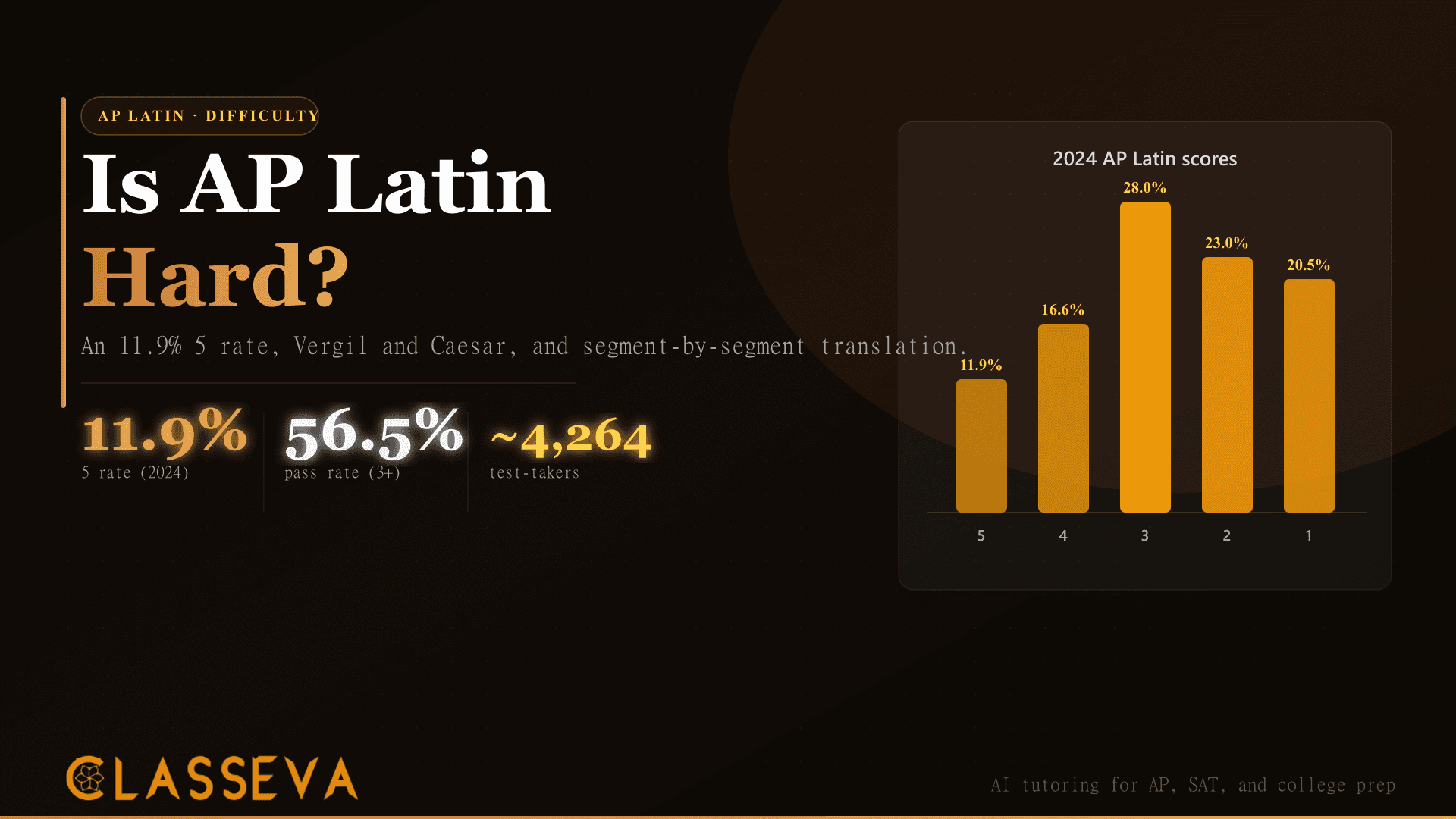
The 2024 AP Latin distribution ran: 11.9% fives, 16.6% fours, 28.0% threes, 23.0% twos, and 20.5% ones, for a 56.5% pass rate and a mean of 2.77. [VERIFY: 2024 College Board AP Latin score distributions] Compare that with the high-volume history exams: AP European History posted a similar 5 rate but across more than 100,000 students. AP Latin reaches that distribution with roughly 4,264 test-takers, which makes its percentages far more sensitive to who shows up in a given year.
| AP Score | 2024 % of Test-Takers | Approx. Count | Readiness Signal |
|---|---|---|---|
| 5 | 11.9% | ~508 | Extremely well qualified |
| 4 | 16.6% | ~709 | Well qualified |
| 3 | 28.0% | ~1,194 | Qualified |
| 2 | 23.0% | ~980 | Possibly qualified |
| 1 | 20.5% | ~873 | No recommendation |
2024 AP Latin score distribution. [VERIFY: 2024 College Board AP Latin score distributions]
Why Years of Latin Decide Your Score
AP Latin sits at the end of a multi-year sequence. Most students who reach the course have studied Latin since freshman or sophomore year, building from declensions and conjugations to reading Cicero or Ovid before they ever open Vergil. The students scoring 5 are not casual electives shoppers. They chose a four-year language path and arrived able to parse a subjunctive clause without flinching.
When I dug into the AP Latin numbers while building Classeva, the pattern that stood out was the gap between the headline 5 rate and the lived difficulty. An 11.9% 5 rate on an exam this small does not mean the content is gentle. It means the cohort already filtered itself across three or four years of study before exam day. The students who would have pulled the average down dropped Latin in year two, so the distribution you see reflects survivors, not the full range of students who ever started the language.
What Does AP Latin Actually Test?
AP Latin tests four skills: reading and comprehending Latin, translating it literally, placing passages in context, and analyzing the text with specific Latin evidence. The exam runs 3 hours and splits evenly between a multiple-choice section and a free-response section. There is no speaking or listening component, which sets it apart from every modern AP language.
The Multiple-Choice Section and Sight Reading
The multiple-choice section weighs 50% of the score and mixes two passage types. Some questions draw on the required Vergil and Caesar syllabus passages you studied all year. Others present sight passages: unseen Latin you have never read, chosen for relatively common vocabulary and clean grammar. [VERIFY: exact 2024 multiple-choice question count and section timing] The sight passages separate students who memorized translations from students who actually read Latin, because no memorized crib helps when the text is new.
The Translation and Essay FRQs
The free-response section also weighs 50% and centers on two demands. First, a literal translation question scored segment by segment, where graders check whether you rendered each word and grammatical form correctly. Second, analytical essays that require you to quote and cite specific Latin, not paraphrase. A vague essay about themes earns little; an essay anchored in exact Latin words and their forms earns the points.
The AP Latin translation question does not reward elegant English. Graders divide the passage into segments and award points for rendering each word and grammatical form accurately. Skip an ablative absolute or mistranslate a deponent verb, and you lose the point even if the rest of the sentence reads beautifully. Drill the exact required passages until the forms are automatic.
What Is on the AP Latin Reading List?
AP Latin reads two authors in the original Latin: Vergil for poetry and Caesar for prose. The College Board fixes exact lines and chapters in the Course and Exam Description, and only those required Latin passages can appear as syllabus-based questions. Students also read large stretches of both works in English translation to grasp the full narrative and themes. The required Latin is finite, which makes targeted memorization possible.
Vergil Aeneid and Caesar Gallic Wars
The poetry half is Vergil’s Aeneid, the epic of Aeneas fleeing Troy to found Rome. Required Latin selections come from across the first six books, including the famous opening and the Dido tragedy. [VERIFY: exact 2024-2026 Aeneid line selections in the current CED] The prose half is Caesar’s Gallic Wars (Bellum Gallicum), his firsthand account of conquering Gaul. Required Latin selections come from several books of the campaign narrative. [VERIFY: exact 2024-2026 Gallic Wars chapter selections in the current CED]
The full reading list, with exact line numbers, lives in the official Course and Exam Description at apstudents.collegeboard.org. Studying directly from the required-reading list, rather than a general Latin reader, keeps your effort aimed at the passages that can actually appear on the syllabus questions.
How Much Memorization Does AP Latin Demand?
AP Latin demands heavy, targeted memorization of specific Vergil and Caesar passages, not open-ended vocabulary cramming. Because the required Latin is fixed, top scorers internalize the exact passages: the vocabulary, the grammatical forms, and the context of each line. That investment pays off on the syllabus questions and the translation FRQ, where the passage you memorized appears verbatim.
Why Literal Translation Trips Students Up
Literal translation punishes students who learned the gist instead of the grammar. A student who knows the Dido episode’s story may still botch the translation by missing a deponent verb, a result clause, or a tricky case ending. The rubric does not care that you know what the passage means. It checks whether you rendered each segment with the correct word and form, which is why students who only read English summaries collapse on this question.
Reading the Aeneid and Gallic Wars only in English translation feels productive and builds context, but it does not prepare you for the Latin questions. Many students arrive at the exam fluent in the plot and unable to parse the Latin sentence in front of them. Read the required passages in the original Latin, line by line, and parse every form. The English translation is context, not preparation.
How Hard Is AP Latin Sight Reading?
AP Latin sight reading is the hardest section to fake, because no memorization helps with text you have never seen. The exam includes unseen Latin passages chosen for relatively common vocabulary and clean grammar, but you still must parse them cold. Students who genuinely read Latin handle sight passages; students who memorized translations of the syllabus passages stall the moment the text is new.
Sight reading rewards a habit most students skip: reading large amounts of unfamiliar Latin all year, not just the required passages. The more connected Latin you read outside the syllabus, the faster you process the case endings and clause structures that sight passages throw at you. Build the habit early. By spring it is hard to manufacture.
The sight passages also reward speed. You are decoding text you have never seen while a clock runs, so the skill that matters is recognizing forms instantly, not deriving them from a chart. A student who pauses to reconstruct every ending burns minutes the exam does not give back. Strong readers chunk Latin into phrases the way a fluent reader of English chunks words, and that fluency only comes from volume. Reading one extra unseen passage a week across a school year compounds into the automatic recognition the section demands.
AP Latin
- •Classical language: no speaking or listening section
- •Literal translation of fixed Vergil and Caesar passages
- •Heavy memorization of specific required passages
- •Sight reading of unseen Latin under time pressure
- •11.9% 5 rate in 2024 across roughly 4,264 students
- •Capstone of a three to four year Latin sequence
AP Spanish Language
- •Modern language: listening and speaking are tested
- •Interpretive and presentational communication tasks
- •Vocabulary and fluency built through conversation
- •No fixed literary translation requirement
- •Far larger test-taker population each year
- •Often taken after two to four years of Spanish
For a sense of how the modern languages compare, see the AP Spanish Literature difficulty breakdown, which shares AP Latin’s focus on literary analysis but adds listening and a living-language component. Students mapping out a language-heavy schedule may also find the AP French Language post useful for comparison.
How Should You Prepare for AP Latin?
Preparation depends almost entirely on how many years of Latin you bring to the course. The path for a fourth-year student differs sharply from the path for a newcomer, and pretending otherwise sets students up to fail. Both groups should drill the required passages in the original Latin and practice sight reading weekly.
If You Have Three or More Years of Latin
You are the target student for AP Latin, and a 3, 4, or 5 is within reach. Focus your effort on three things: memorizing the exact required Vergil and Caesar passages for the translation question, drilling past free-response questions from AP Central with their scoring guidelines, and reading unseen Latin weekly to sharpen sight reading. Trace every missed multiple-choice question back to the specific grammatical rule before moving on.
If You Are New to Latin
AP Latin is not an entry point, and attempting it with one year of Latin usually ends in a 1 or 2. The course assumes you already read connected Latin prose and poetry, so a beginner spends class time learning forms while classmates analyze meter and rhetoric. If you are new to Latin and want the AP, build a multi-year sequence first: Latin I and II, then a literature year, then AP Latin as the capstone. There is no shortcut through the grammar.
Whichever path fits you, working through the full curriculum scope helps. Students weighing AP Latin against another multi-year language commitment often compare it with the AP Spanish Language difficulty breakdown, since both reward years of cumulative skill rather than a single semester of cramming.
Project Your AP Latin Score
If you are mid-course, Classeva’s AP Score Predictor maps your current practice performance to a projected score band, so you know whether to pour more time into translation precision, sight reading, or essay analysis before May.
AP Score Predictor
Enter your AP Latin practice results to project your score band and see whether translation, sight reading, or analytical essays need the most work before the May exam.
Key Takeaways
- AP Latin’s 11.9% 5 rate (2024) sits low, and the population is tiny. Roughly 4,264 students sat the exam, with a 56.5% pass rate and a mean of 2.77, so percentages swing more than on high-volume APs. [VERIFY: 2024 College Board data]
- The reading list is fixed: Vergil’s Aeneid for poetry and Caesar’s Gallic Wars for prose. Only the required Latin passages can appear as syllabus questions, which makes targeted study possible.
- The exam splits 50/50 between multiple choice and free response. Multiple choice mixes syllabus and sight passages; free response centers on literal translation and analytical essays.
- Memorization is heavy but targeted. Top scorers internalize the exact required passages: vocabulary, grammatical forms, and context, then drill the translation question until forms are automatic.
- Literal translation is graded segment by segment. Knowing the plot in English earns nothing; rendering each word and form correctly earns the points.
- Sight reading cannot be faked. Reading large amounts of unseen Latin all year is the only way to handle the unseen passages on exam day.
- Years of Latin decide readiness. Students with three or more years handle AP Latin; students new to Latin should build a multi-year sequence first rather than attempt the capstone cold.