AP Biology Unit 1: Chemistry of Life Walkthrough 2026
Combing through the AP Biology Course and Exam Description with an eye toward exam strategy, the thing that jumps out about Unit 1 is how rarely students treat it as a foundation and how often they treat it as a checklist. Unit 1 covers 8-11% of the exam. That slice accounts for roughly 5 MCQ questions but shows up embedded in FRQ questions targeting Units 2, 3, 6, and beyond. An ap biology unit 1 review done well cuts study time across the entire course because you stop re-learning the same chemistry in every subsequent unit.
What Does AP Biology Unit 1 Actually Cover?
AP Biology Unit 1 covers the chemical foundations that every subsequent unit depends on. The College Board's AP Biology curriculumorganizes Unit 1 as seven numbered topics (1.1 through 1.7), spanning water's structure, the elements of life, and the four classes of biological macromolecules.
How Much Does Unit 1 Count on the Exam?
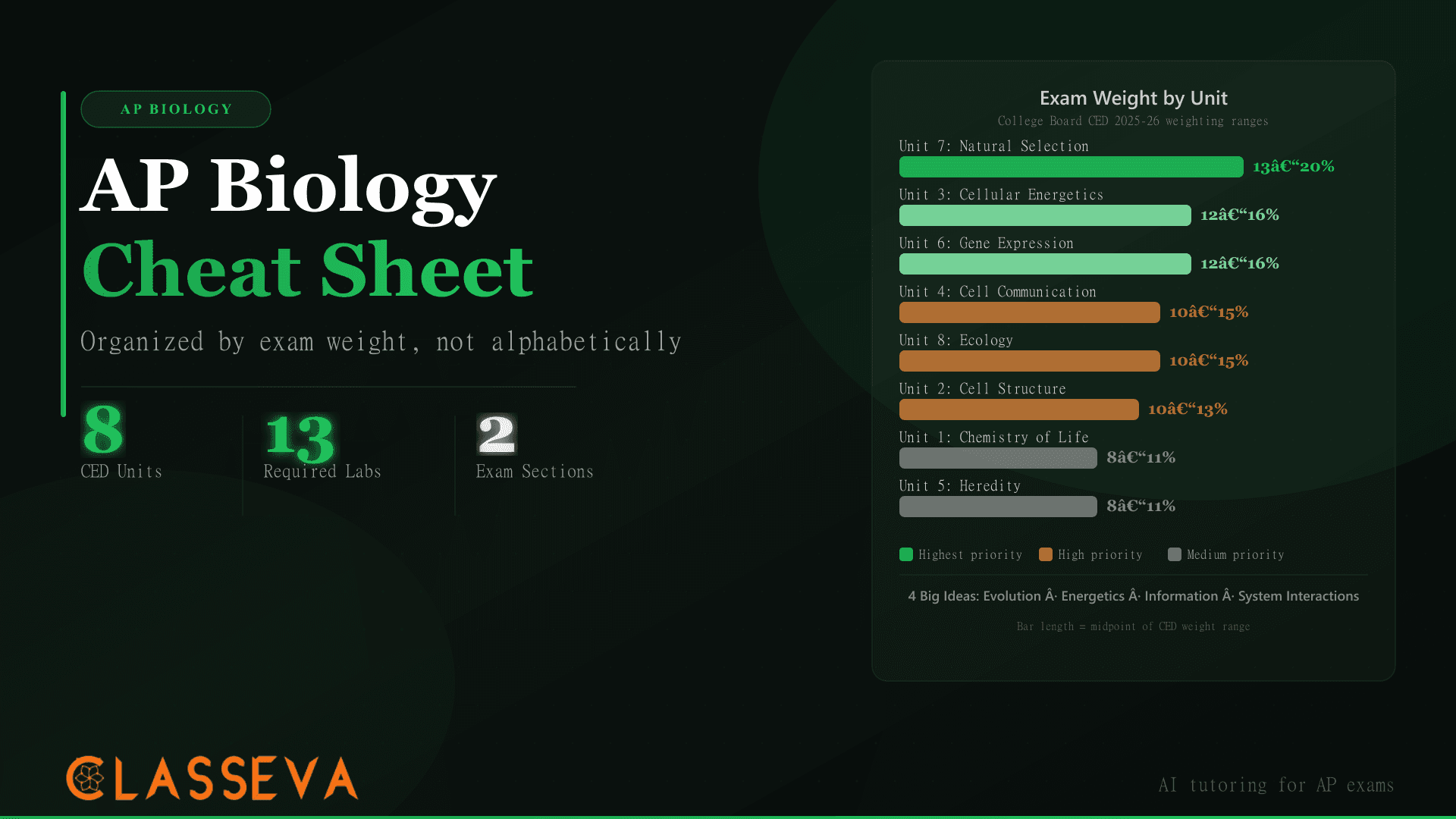
Unit 1 carries 8-11% of the AP Biology exam score, per the current CED. That puts it among the lower-weight units alongside Unit 5 (Heredity, also 8-11%). The higher-weight units pull 12-20%: Unit 7 (Natural Selection) sits at 13-20%, while Units 3 and 6 each claim 12-16%. Still, underestimating Unit 1 costs you on two levels: the direct MCQ questions it generates and the conceptual scaffolding it provides for every unit that follows.
If you're tracking where to invest study hours, Unit 1 delivers a higher return than the raw percentage suggests. See the AP Biology cheat sheet for a full breakdown of all eight unit weights side by side.
The Seven Topics: 1.1 Through 1.7
The CED assigns Unit 1 roughly 5-7 class periods. Each numbered topic corresponds to a testable concept cluster:
| Topic | Title | What It Tests |
|---|---|---|
| 1.1 | Structure of Water and Hydrogen Bonding | Polarity, partial charges, H-bond formation between water molecules |
| 1.2 | Elements of Life | CHONPS elements, carbon's four bonds, functional groups |
| 1.3 | Introduction to Biological Macromolecules | Monomers, polymers, dehydration synthesis, hydrolysis |
| 1.4 | Carbohydrates | Monosaccharides, glycosidic bonds, polysaccharide functions |
| 1.5 | Lipids | Triglycerides, phospholipids, steroids, ester bonds |
| 1.6 | Nucleic Acids | Nucleotide structure, DNA vs. RNA, phosphodiester bonds |
| 1.7 | Proteins | Amino acids, peptide bonds, four levels of protein structure |
Source: AP Biology Course and Exam Description, College Board (effective Fall 2025)
Why Do Water's Properties Matter for AP Biology?
Water covers the properties that students most often memorize without connecting them to a single root cause. Every property the AP exam tests traces back to one thing: water's polarity. Oxygen pulls shared electrons toward itself more strongly than hydrogen does, creating a molecule with a partial negative charge on oxygen and partial positive charges on the two hydrogen atoms. That charge distribution drives hydrogen bonding, and hydrogen bonding explains everything else.
Hydrogen Bonding: The Mechanism Behind Water's Behavior
A hydrogen bond forms when a hydrogen atom covalently bonded to a highly electronegative atom (oxygen or nitrogen) is attracted to another electronegative atom nearby. In water, each molecule can form up to four hydrogen bonds with its neighbors: two through its hydrogen atoms and two through the lone pairs on oxygen. These bonds are weak individually but strong collectively, because billions of them form and break simultaneously in liquid water.
If the AP exam shows you a diagram with two molecules and asks where hydrogen bonds form, look for a hydrogen atom bonded to N or O that is positioned near another N or O atom on a different molecule (or a different part of the same large molecule). The bond forms between the slightly positive H and the slightly negative N or O. In DNA, for instance, adenine's N-H group hydrogen bonds to thymine's C=O group. The bond is between H and O, not between the bases themselves.
The Four Properties That Appear on Exam Questions
The AP Biology CED specifically lists four water properties students must be able to explain in biological contexts:
- Cohesion: hydrogen bonds between water molecules give liquid water high surface tension and allow water columns to move upward through plant xylem without breaking, a process called transpiration pull.
- Adhesion: water's polar molecules attract other polar surfaces (like cellulose in plant cell walls), enabling capillary action and helping water climb narrow tubes against gravity.
- High specific heat: breaking hydrogen bonds requires significant energy input before the temperature of water rises, making water an effective temperature buffer for cells and for bodies of water in ecosystems.
- Solvent capacity: water surrounds polar molecules and ions with a hydration shell, dissolving them and enabling the aqueous chemical environment that cells require. Nonpolar molecules cannot form hydrogen bonds with water, which is why lipids cluster away from water.
The AP exam might describe a coastal ecosystem that stays warmer than the surrounding land in winter and cooler in summer. Ask yourself which water property explains this. The answer is high specific heat: coastal water absorbs and releases large amounts of energy with minimal temperature change, moderating the local climate. If a question instead describes water moving up a tree trunk, that's cohesion (water pulling on water) combined with adhesion (water sticking to xylem walls).
What Are the Four Macromolecules?
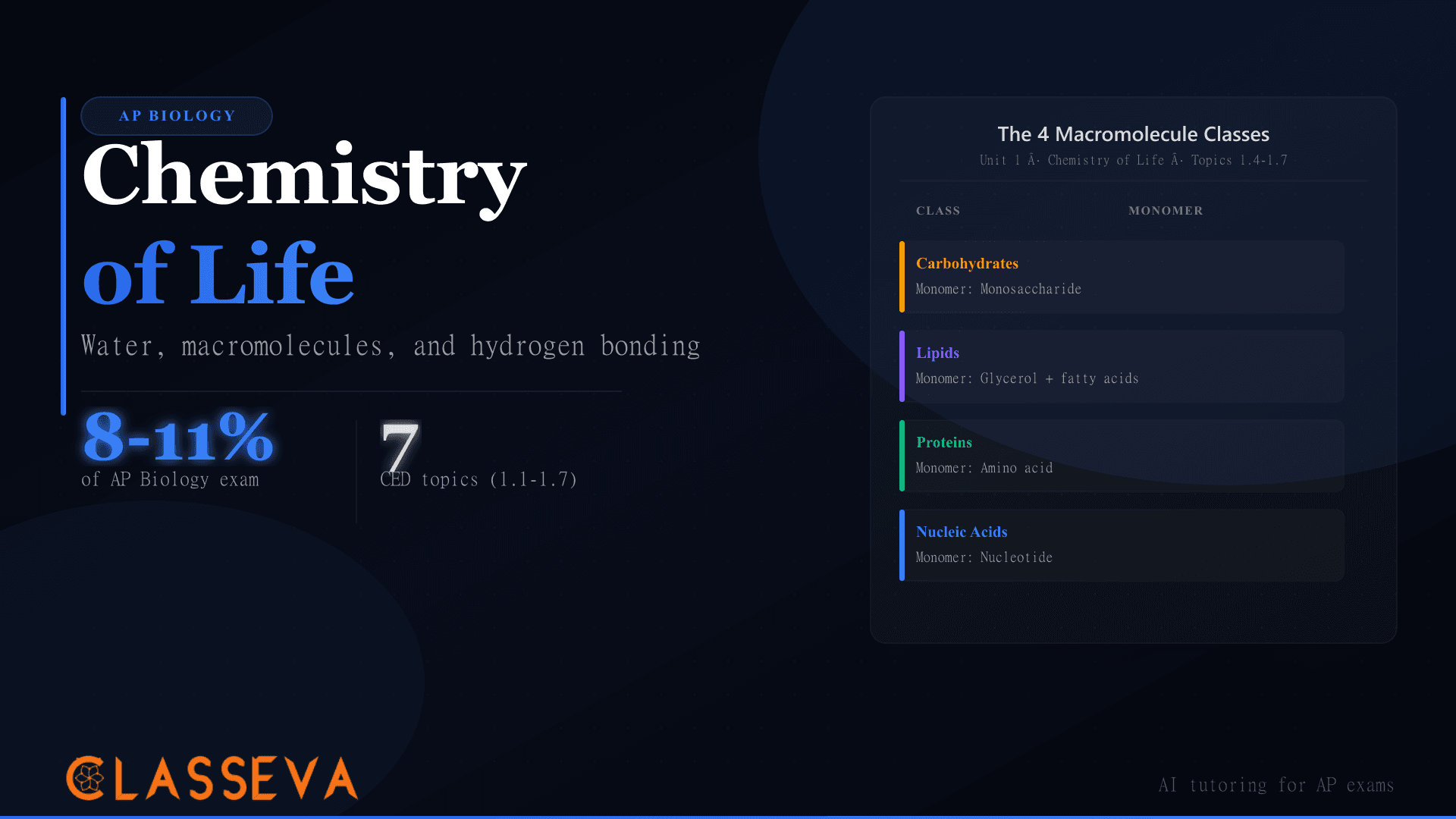
The four macromolecule classes are carbohydrates, lipids, proteins, and nucleic acids. Three of them (carbohydrates, proteins, and nucleic acids) follow the monomer-polymer model: small repeating units join through specific chemical bonds to build large polymers. Lipids do not follow this model in the same way. Each class has a distinct monomer, a distinct bond, and a set of functions the AP exam expects you to map correctly.
Carbohydrates: From Glucose to Glycogen
Carbohydrate monomers are monosaccharides, with glucose as the most common example. Monosaccharides share the general formula (CH₂O)n. Two monosaccharides join through a glycosidic bond (formed via dehydration synthesis) to produce a disaccharide: glucose + glucose yields maltose, glucose + galactose yields lactose, glucose + fructose yields sucrose. Chains of monosaccharides form polysaccharides: starch and glycogen store energy; cellulose provides structural support in plant cell walls; chitin forms the exoskeletons of arthropods and the cell walls of fungi.
Lipids: Why They Break the Polymer Rule
Lipids do not qualify as true polymers because they are not built from repeating identical monomers joined by the same bond type. A triglyceride (the most common lipid) consists of one glycerol molecule attached to three fatty acids through ester bonds. Phospholipids substitute one fatty acid chain for a phosphate group, creating the amphipathic molecule that forms cell membranes. Steroids (like cholesterol) have a completely different structure: four fused carbon rings, no fatty acid chains.
If the AP exam gives you a molecule with a glycerol backbone bonded to three long hydrocarbon chains, it is a triglyceride. If one of those chains is replaced by a phosphate group with an attached charged head, it is a phospholipid. If you see four fused carbon rings, you are looking at a steroid. Lipids have no single monomer definition, but you can identify the class by the glycerol or ring backbone, not by the presence of a peptide or glycosidic bond.
The hydrophobic nature of fatty acid tails directly connects to water's properties from Topic 1.1. Because fatty acid chains are nonpolar, they cannot form hydrogen bonds with water and cluster together. This property explains why phospholipid bilayers form spontaneously in water: the polar heads face the aqueous environment while the nonpolar tails face inward.
Proteins: Amino Acids and Peptide Bonds
Proteins have 20 different monomers (amino acids), all sharing the same backbone structure: a central carbon bonded to an amino group (NH₂), a carboxyl group (COOH), a hydrogen, and a variable side chain called the R-group. The R-group determines each amino acid's properties: polar, nonpolar, charged, or uncharged. Two amino acids join through a peptide bond between the carboxyl group of one and the amino group of the next, releasing water. A chain of amino acids is a polypeptide.
The AP exam tests four levels of protein structure. The primary structure is the linear sequence of amino acids. Secondary structure forms when the polypeptide backbone folds into alpha helices or beta pleated sheets, held together by hydrogen bonds between backbone atoms. Tertiary structure is the overall 3D shape of a single polypeptide, determined by R-group interactions (including disulfide bonds, hydrophobic clustering, ionic bonds, and hydrogen bonds). Quaternary structure describes proteins made of two or more polypeptide subunits joined together, like hemoglobin.
Nucleic Acids: The Nucleotide Blueprint
Nucleic acid monomers are nucleotides. Every nucleotide contains three components: a phosphate group, a five-carbon sugar (deoxyribose in DNA, ribose in RNA), and a nitrogenous base. Nucleotides join through phosphodiester bondsbetween the phosphate of one nucleotide and the sugar of the next, building a nucleic acid chain with a directional 5'-to-3' orientation.
The 2026 AP Biology exam asked students to describe the three structural components of a nucleotide. The expected answer names each component specifically: (1) a phosphate group, (2) a five-carbon (pentose) sugar, and (3) a nitrogenous base. Partial credit on FRQs typically requires naming all three. Saying “sugar” without specifying the type (deoxyribose or ribose) may not earn full credit on questions that distinguish DNA from RNA.
How Do Monomers Become Polymers on the AP Exam?
Dehydration synthesis and hydrolysis appear together in one CED topic (1.3) because they are reverse reactions. The AP exam tests both directions, and students who understand only one of them lose points on questions that ask about digestion, absorption, or polymer degradation.
Dehydration Synthesis: Building by Removing Water
Dehydration synthesis (also called a condensation reaction) joins two monomers by removing a water molecule. One monomer contributes a hydroxyl group (OH) while the other contributes a hydrogen (H). Those two pieces combine into H₂O, and the remaining oxygen atom links the two monomers with a new covalent bond. The specific bond name depends on the macromolecule: glycosidic bond for carbohydrates, peptide bond for proteins, ester bond for lipids, phosphodiester bond for nucleic acids.
Two glucose molecules (each C₆H₁₂O₆) undergo dehydration synthesis. The OH group from carbon 1 of one glucose and the H from carbon 4 of the other combine to form H₂O. The oxygen bridges the two sugars, forming a glycosidic bond. The product is the disaccharide maltose (C₁₂H₂₂O₁₁), which has one fewer water molecule than the sum of the two glucose molecules. On the AP exam, this reaction is the starting point for understanding how polysaccharides like starch (long chains of glucose via glycosidic bonds) form and break down during digestion.
Hydrolysis: Breaking Bonds by Adding Water
Hydrolysis reverses dehydration synthesis. A water molecule is added across a covalent bond, breaking it apart: the H from water goes to one product, the OH goes to the other. Digestion depends entirely on hydrolysis: enzymes in your digestive system (amylase for starch, proteases for proteins, lipases for triglycerides) catalyze hydrolysis reactions that break polymers into absorbable monomers.
Dehydration Synthesis
- •Joins two monomers into a polymer
- •Releases one water molecule per bond formed
- •Requires energy input
- •Builds starch, proteins, DNA, triglycerides
- •Also called: condensation reaction
Hydrolysis
- •Breaks a polymer bond into two pieces
- •Consumes one water molecule per bond broken
- •Releases energy (can be exergonic)
- •Drives digestion and polymer recycling
- •Reverse of dehydration synthesis
Which Unit 1 Concepts Show Up Most on the Exam?
Hydrogen bonding and macromolecule structure appear most often on AP Biology exam questions, both as standalone MCQ and embedded within FRQs targeting other units. The table below maps each major Unit 1 concept to how the exam typically tests it.
| Unit 1 Concept | MCQ Frequency | FRQ Context |
|---|---|---|
| Hydrogen bonding in water | Moderate (1-2 per exam) | DNA base pairing (Unit 6), enzyme active site (Unit 3), osmosis (Unit 2) |
| Water properties (cohesion/adhesion/specific heat) | Moderate (1-2 per exam) | Plant transport (Unit 2), ecosystem energy flow (Unit 8) |
| Four macromolecule classes | High (2-3 per exam) | Membrane structure (Unit 2), nucleic acid structure (Unit 6), enzyme structure (Unit 3) |
| Monomer and bond types | High (2-3 per exam) | Any FRQ requiring molecular identification |
| Dehydration synthesis / hydrolysis | Moderate (1-2 per exam) | Digestion questions, biosynthesis pathways |
| Elements of life (CHONPS) | Low (0-1 per exam) | Occasionally embedded in chemical analysis FRQs |
Frequency estimates based on College Board released FRQs and AP Biology exam format documentation
The past AP Biology FRQs on AP Central confirm this pattern. Questions about membrane structure (Unit 2) almost always require naming the phospholipid as a lipid and explaining why its hydrophobic tails face inward. Questions about DNA replication (Unit 6) require explaining that hydrogen bonds between complementary bases break during strand separation. Unit 1 vocabulary shows up constantly in answers to questions nominally about other units.
For a full breakdown of how Unit 1 fits within the AP Biology exam format, the AP Biology Exam 2026 guide covers section lengths, point values, and what each FRQ type expects. The difficulty decoded postexplains how the exam's 5-rate of 18.9% in 2025 connects to the depth of conceptual understanding the College Board expects, including Unit 1 cross-connections.
How to Study AP Biology Unit 1 Without Wasting Time
Most students study Unit 1 in isolation: they read the chapter, take notes, and move on. That approach produces declarative knowledge (they can define cohesion) but not applied knowledge (they freeze when asked why water moves from cell to cell during osmosis). The AP Biology resources hub links to additional practice, but the method matters more than the materials.
Why Retrieval Practice Works for Unit 1
Roediger and Karpicke's 2006 study on the testing effect demonstrated that recalling information from memory produces stronger long-term retention than re-reading notes for the same amount of time. For Unit 1, retrieval practice means covering your notes and writing out from memory which bond type joins each macromolecule class, then checking. Not re-reading the answer and recognizing it as correct, but generating the answer cold.
Three specific retrieval loops pay off for Unit 1. First: for each macromolecule class, name the monomer, the bond, two examples of polymers, and one function. Second: for each water property, describe the mechanism (why hydrogen bonds cause it) and name a biological consequence. Third: write the sequence of a dehydration synthesis reaction and then reverse it into hydrolysis, naming what happens to the atoms in each step. Thirty minutes of this practice produces more exam-ready knowledge than two hours of passive review.
Connect Unit 1 forward to the units it feeds. After studying phospholipid structure, immediately link it to the fluid mosaic model (Unit 2). After studying protein structure levels, link tertiary structure to enzyme active sites (Unit 3). After learning hydrogen bonding in DNA base pairs, link it to the energy required to separate strands during replication (Unit 6). Students who build these cross-unit connections during their ap biology unit 1 review cut their total study time across the course. The score distribution post shows that students scoring 4 and 5 consistently outperform on cross-unit FRQ questions, which is exactly where this integrated approach pays off.
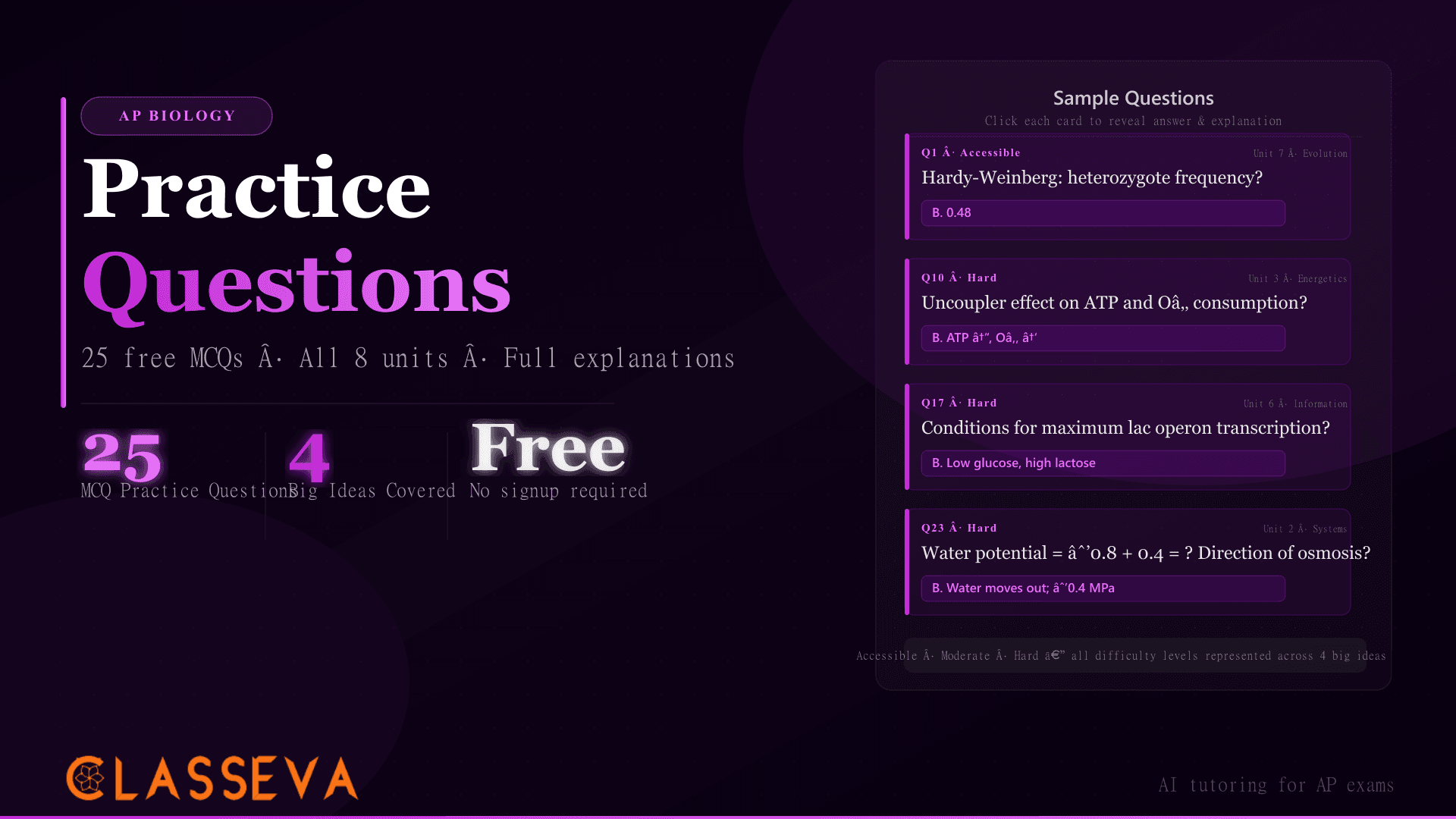
The AP Biology practice questions post includes worked problems on hydrogen bonding and macromolecule identification that follow the actual AP format. Use those after your retrieval practice loops to verify you can apply Unit 1 concepts under exam conditions.
After working through Unit 1 with this method, the AP Score Predictor estimates where your full-exam score would land based on your practice performance across all units.
AP Score Predictor
Enter your practice performance across AP Biology units to see where your composite score lands and which units offer the highest return on additional study time.
Key Takeaways
- AP Biology Unit 1 covers 8-11% of the exam across seven CED topics (1.1-1.7), from water structure through protein organization.
- All four water properties (cohesion, adhesion, high specific heat, solvent capacity) trace back to hydrogen bonding between polar water molecules. Understanding the mechanism means you can answer any property question without memorizing each property separately.
- The four macromolecule classes differ by monomer type and bond: monosaccharide/glycosidic for carbohydrates, amino acid/peptide for proteins, nucleotide/phosphodiester for nucleic acids. Lipids are the exception: no single repeating monomer, ester bonds.
- Dehydration synthesis builds polymers (removes H₂O per bond formed); hydrolysis breaks polymers (adds H₂O per bond broken). These are reverse reactions and the AP exam tests both directions.
- Unit 1 vocabulary appears embedded in FRQ questions targeting every other unit. Hydrogen bonding, macromolecule structure, and the monomer-polymer relationship show up in questions about membranes (Unit 2), enzymes (Unit 3), DNA (Unit 6), and evolution (Unit 7).
- Retrieval practice outperforms re-reading for Unit 1 mastery. Generate answers cold: name monomers and bonds for each class, explain each water property from mechanism to consequence, and walk through both directions of the dehydration synthesis-hydrolysis cycle without looking at notes.