AP Physics 1 Unit 1 Review: Kinematics in 90 Minutes
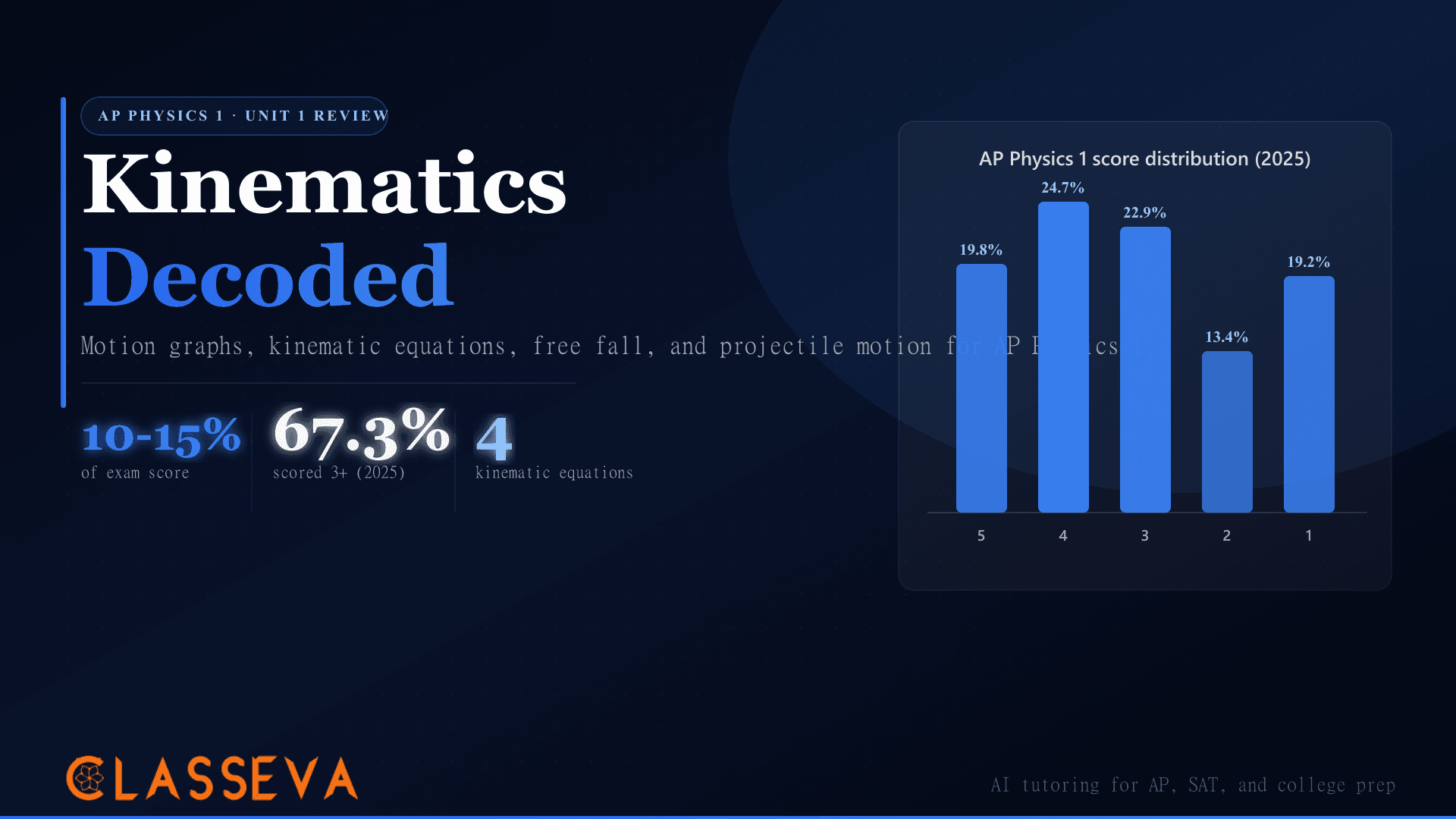
AP Physics 1 Unit 1 covers kinematics, the math of how objects move, and it carries 10 to 15 percent of the multiple-choice score under the Fall 2024 CED. That weighting undersells its real value. Kinematics is the language every later unit speaks, so a shaky Unit 1 quietly drags down forces, energy, and momentum scores too.
Studying how the College Board built the redesigned 2024 exam, one pattern stands out: the graders care less about whether you can plug numbers into a formula and more about whether you can move between a graph, an equation, and a sentence describing the same motion. The 2025 exam, the first full run of the new format, lifted the pass rate to 67.3 percent from 47.3 percent the year before, yet the reasoning demand never dropped. This review builds kinematics around that representation skill, starting with the motion graphs that show up on more questions than any single equation. For the full difficulty picture, see whether AP Physics 1 is hard before you commit to the course.
What Does AP Physics 1 Unit 1 Cover?
Unit 1 covers kinematics in one and two dimensions: position, displacement, velocity, and acceleration, plus the graphs and equations that connect them. It introduces scalars versus vectors, reference frames and relative motion, free fall, and projectile motion. The College Board allots 12 to 17 class periods to the unit in the official AP Physics 1 exam framework.
Topics 1.1 Through 1.4
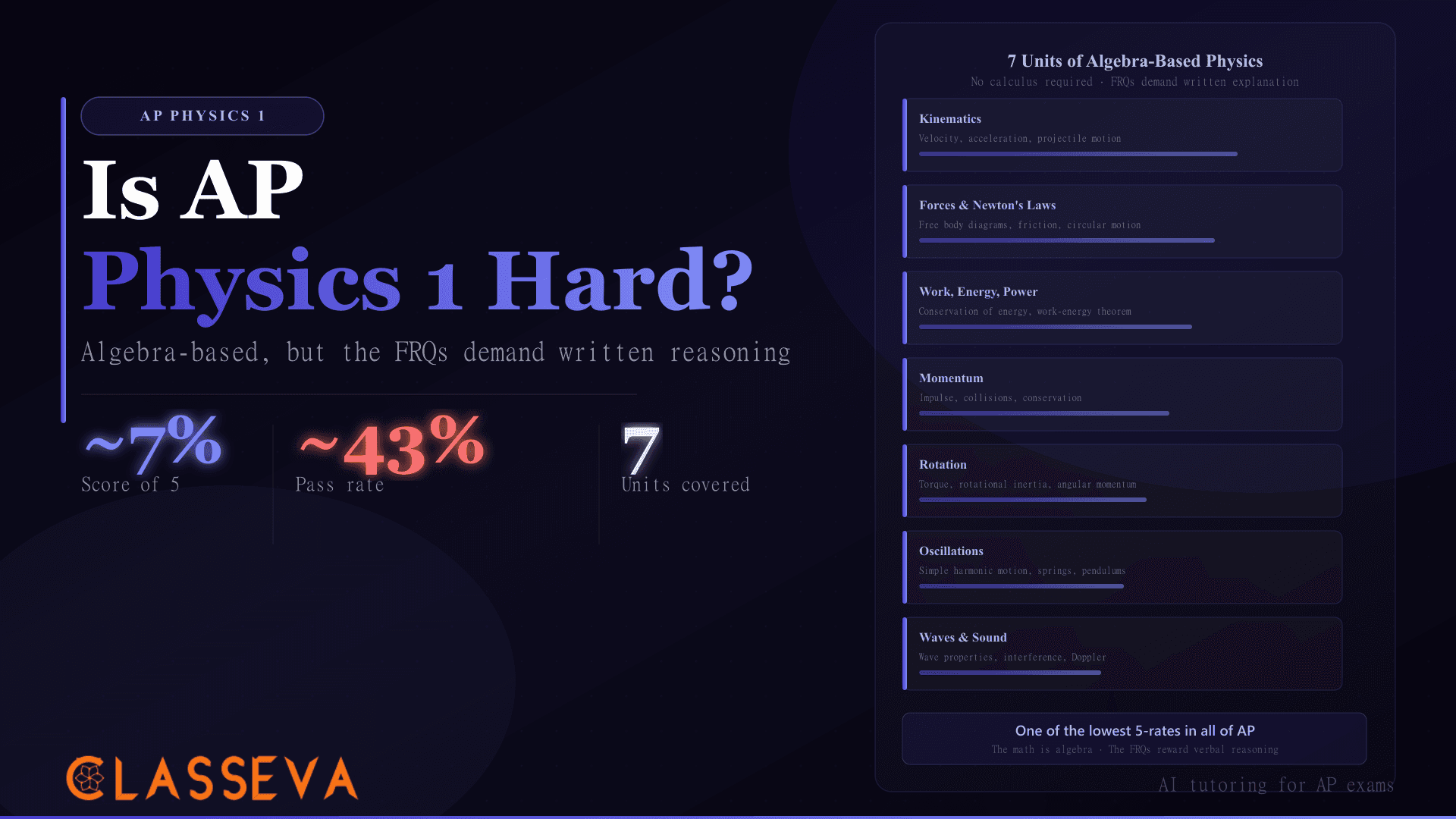
The Fall 2024 redesign reorganized AP Physics 1 into eight units and folded fluids back in. Unit 1 itself splits into four topic areas that build in order.
| Topic | Content Area | What You Must Be Able to Do |
|---|---|---|
| 1.1 | Scalars and Vectors in One Dimension | Distinguish distance from displacement and speed from velocity; assign signs to direction |
| 1.2 | Displacement, Velocity, and Acceleration | Define each quantity, relate them through slopes and areas, and read them off graphs |
| 1.3 | Representing Motion | Translate between position-time, velocity-time, and acceleration-time graphs and the kinematic equations |
| 1.4 | Reference Frames and Relative Motion | Add and subtract velocity vectors to find motion measured from a different observer |
Source: AP Physics 1 Course and Exam Description, College Board (Effective Fall 2024).
Position, Velocity, and Acceleration
Three quantities run the whole unit. Position tells you where an object sits relative to an origin. Velocity is the rate position changes, a vector that carries both speed and direction. Acceleration is the rate velocity changes. Each one derives from the previous through a slope, which is exactly why graphs dominate the unit.
Sign conventions trip students before the physics does. A negative velocity does not mean slowing down; it means moving in the direction you labeled negative. An object can have negative velocity and positive acceleration at the same time, which means it moves backward while speeding up toward the forward direction. Nail the signs in Unit 1 and the later units inherit a clean foundation.
Displacement: change in position, a vector, not the same as total distance traveled. Velocity: rate of change of position, the slope of a position-time graph. Acceleration: rate of change of velocity, the slope of a velocity-time graph. Use these exact relationships on free-response answers; writing “it goes faster” instead of “velocity increases because acceleration is positive” earns no credit.
How Do You Read Motion Graphs on AP Physics 1?
To read AP Physics 1 motion graphs, use slopes to move down the chain and areas to move up it. The slope of a position-time graph gives velocity. The slope of a velocity-time graph gives acceleration. Reverse direction with area: the area under an acceleration-time graph gives change in velocity, and the area under a velocity-time graph gives displacement.
Position, Velocity, and Acceleration Graphs Linked
The single highest-leverage skill in Unit 1 is deriving all three graphs from any one of them. Given a position-time curve, you can sketch the matching velocity-time and acceleration-time graphs without a single calculation. A car that starts at rest and speeds up smoothly traces a curving position graph, a straight rising velocity graph, and a flat positive acceleration graph. The figure below builds all three from the same motion so you can see the slope chain connect them.
Slopes Move Down, Areas Move Up
Memorize the direction of travel and you stop second-guessing every graph question. Going from position to velocity to acceleration, you read slopes. Going from acceleration to velocity to position, you read areas. The College Board loves a velocity-time graph that dips below the axis, because the area below counts as negative displacement and the two pieces can cancel to a net displacement of zero even when the object never stopped moving.
On a velocity-time graph, total distance traveled sums the absolute value of every area piece, while displacement keeps the signs. An object that moves forward then backward to its start has positive distance but zero displacement. FRQ graders deduct when students report distance where the prompt asks for displacement, so reread which one the question wants before you compute the area.
How Motion Graphs Show Up on the FRQ
Free-response kinematics almost always involves a graph, either reading one or sketching one. A typical prompt gives a velocity-time graph and asks for the displacement over an interval, then asks you to sketch the matching acceleration-time graph. The high-scoring move is to label the area you used for displacement and to state that acceleration equals the slope of the velocity line. Two sentences, two score points, no heavy algebra.
Sketching answers fail when students draw a smooth curve where a straight line belongs. If velocity changes linearly, acceleration is a flat horizontal line, not a slanted one. Match the shape to the slope: constant slope produces a flat derivative graph, and a changing slope produces a sloped one. For more on how the exam structures these prompts, the AP Physics 2 difficulty breakdown shows how the same representation skills carry into the second-year course.
What Are the Kinematic Equations and When Do You Use Them?
The kinematic equations are four formulas that relate displacement, initial and final velocity, acceleration, and time for motion with constant acceleration. They only work when acceleration stays constant, which covers free fall, projectiles, and most Unit 1 scenarios. The College Board prints them on the equation sheet, so the graded skill is selecting the right one, not recalling it.
| Equation | Variables It Uses | Use It When |
|---|---|---|
| v = v0 + at | velocity, time, acceleration | Displacement is not given and not asked for |
| x = x0 + v0t + (1/2)at^2 | position, time, acceleration | You know time and want displacement |
| v^2 = v0^2 + 2a(x - x0) | velocity, displacement, acceleration | Time is missing from the problem |
| x - x0 = (1/2)(v0 + v)t | position, both velocities, time | Acceleration is unknown but velocities are given |
The four constant-acceleration kinematic equations. Each one omits a different variable; pick the equation that leaves out the quantity you neither know nor need.
Picking the Right Equation Fast
Equation choice is a sorting problem, not a memory test. List the five kinematic variables for the problem: initial velocity, final velocity, acceleration, displacement, and time. Mark which three you know and which one the question wants. The equation that contains your three knowns plus the unknown, and omits the fifth variable, is the one to use. Students who skip this step grab the first equation they remember and stall when it carries a variable they cannot fill.
Problem: A sprinter accelerates uniformly from rest to 9 meters per second over a distance of 20 meters. Find the acceleration.
Sort the variables: initial velocity is 0, final velocity is 9, displacement is 20, acceleration is the unknown, and time is neither known nor asked for. The equation that drops time is v squared equals v-initial squared plus 2 times a times displacement. Solve: 81 equals 0 plus 2 times a times 20, so a equals 81 divided by 40, about 2.0 meters per second squared. Picking the time-free equation first avoided a needless second step.
The figure below turns that sorting routine into a one-glance map. Each kinematic equation sits next to the single variable it leaves out, so once you know which quantity the problem ignores, the equation picks itself.
How Does Free Fall Work in AP Physics 1?
Free fall is motion under gravity alone, with a constant downward acceleration of 9.8 meters per second squared near Earth's surface. The kinematic equations apply directly, with acceleration set to negative g if you call up the positive direction. Mass does not appear, so a feather and a bowling ball fall identically when air resistance is ignored.
The defining feature of free fall is that the object slows, stops for an instant at its peak, then speeds up downward, all while acceleration never changes. At the highest point the velocity equals zero but the acceleration still equals 9.8 meters per second squared downward. The figure below compares a dropped ball with one thrown straight up to make that constant acceleration visible.
How Do You Solve AP Physics 1 Projectile Motion?
You solve AP Physics 1 projectile motion by splitting it into two separate one-dimensional problems that share only the time variable. Horizontal velocity stays constant because no force acts horizontally after launch. Vertical motion is free fall, accelerating at 9.8 meters per second squared downward. Solve one direction for the time of flight, then carry that time into the other direction.
Separating Horizontal and Vertical Components
Independence of horizontal and vertical motion is the concept the College Board tests hardest in this section. A bullet fired horizontally and a bullet dropped from the same height hit the ground at the same instant, because the horizontal launch does nothing to the vertical free fall. Students who try to solve a projectile as one tilted motion get tangled; students who build two clean columns, one for x and one for y, finish faster and lose fewer points.
Horizontal Direction (x)
- •Velocity stays constant after launch
- •Acceleration is zero, no horizontal force
- •Use x equals v-x times t
- •Range depends on launch speed and time of flight
Vertical Direction (y)
- •Acceleration is g downward the whole flight
- •Velocity changes sign at the peak
- •Use the constant-acceleration equations
- •Time of flight comes from the vertical motion
A Worked Projectile FRQ
A standard free-response projectile prompt launches a ball horizontally off a table and asks for the horizontal distance it lands from the base. The vertical direction gives the time: the ball falls the table height under gravity, so time comes from the height-and-acceleration equation. That same time then feeds the horizontal equation, where constant horizontal velocity multiplied by time gives the range.
Graders award separate points for setting up the vertical equation correctly, solving for time of flight, and using that time in the horizontal equation. State that horizontal acceleration is zero and that vertical acceleration is g. Carry units through every line. A correct final number with no shown reasoning earns only a fraction of the available credit on an ap physics 1 kinematics frq.
Estimate Your AP Physics 1 Score
Kinematics sets your baseline, but your projected exam score depends on how Unit 1 reasoning carries across forces, energy, and momentum. The 2025 AP Physics 1 score distribution pushed roughly 67 percent of students to a 3 or higher, a sharp jump from 2024. The predictor below turns your practice performance into a likely 1 to 5 so you can see whether your current work earns the score you want.
AP Score Predictor
Enter your practice exam results to estimate your likely AP Physics 1 score on the 1 to 5 scale and see how far you are from a passing 3 or a college-credit 4 or 5.
For a wider view of where physics fits in a course schedule, the junior year college planning timeline shows when to load rigorous AP science, and the active recall study method explains why redrawing motion graphs from memory beats rereading your notes. If you are still weighing the course, compare the workload against the calculus-based Physics C Mechanics path.
Key Takeaways
- Unit 1 is 10 to 15 percent of the multiple-choice score under the Fall 2024 CED, but it underpins every later unit, so weak kinematics drags down forces, energy, and momentum too.
- Motion graphs are the most-tested skill. Slope moves you down the chain from position to velocity to acceleration; area moves you back up from acceleration to velocity to displacement.
- The four kinematic equations are provided. Sort the five variables, mark three knowns and one unknown, and pick the equation that omits the fifth variable.
- Free fall keeps acceleration at g the whole time. At the peak of an upward throw, velocity is zero but acceleration is still 9.8 meters per second squared downward.
- Projectile motion is two problems sharing time. Horizontal velocity stays constant; vertical motion is free fall. Solve one direction for time, then use it in the other.
- Free-response credit rewards reasoning. Label graph areas, derive symbolically before plugging in numbers, carry units, and reference the data or graph in every answer.