Is AP Physics 2 Hard? Fluids, Thermo, E&M, and the 5-Rate Reality
AP Physics 2 shows a ~14-16% 5-rate, and the first reaction most students have is: “That is easy compared to Physics 1.” That reaction misreads what the number actually measures. The students who show up for AP Physics 2 are not a random sample of high schoolers. They are, in almost every case, students who already passed AP Physics 1. The pool filters itself, and the score distributions reflect the pool, not the difficulty of the content. This breakdown covers what Physics 2 actually tests, who takes it, and whether it belongs in your schedule.
Is AP Physics 2 Hard?
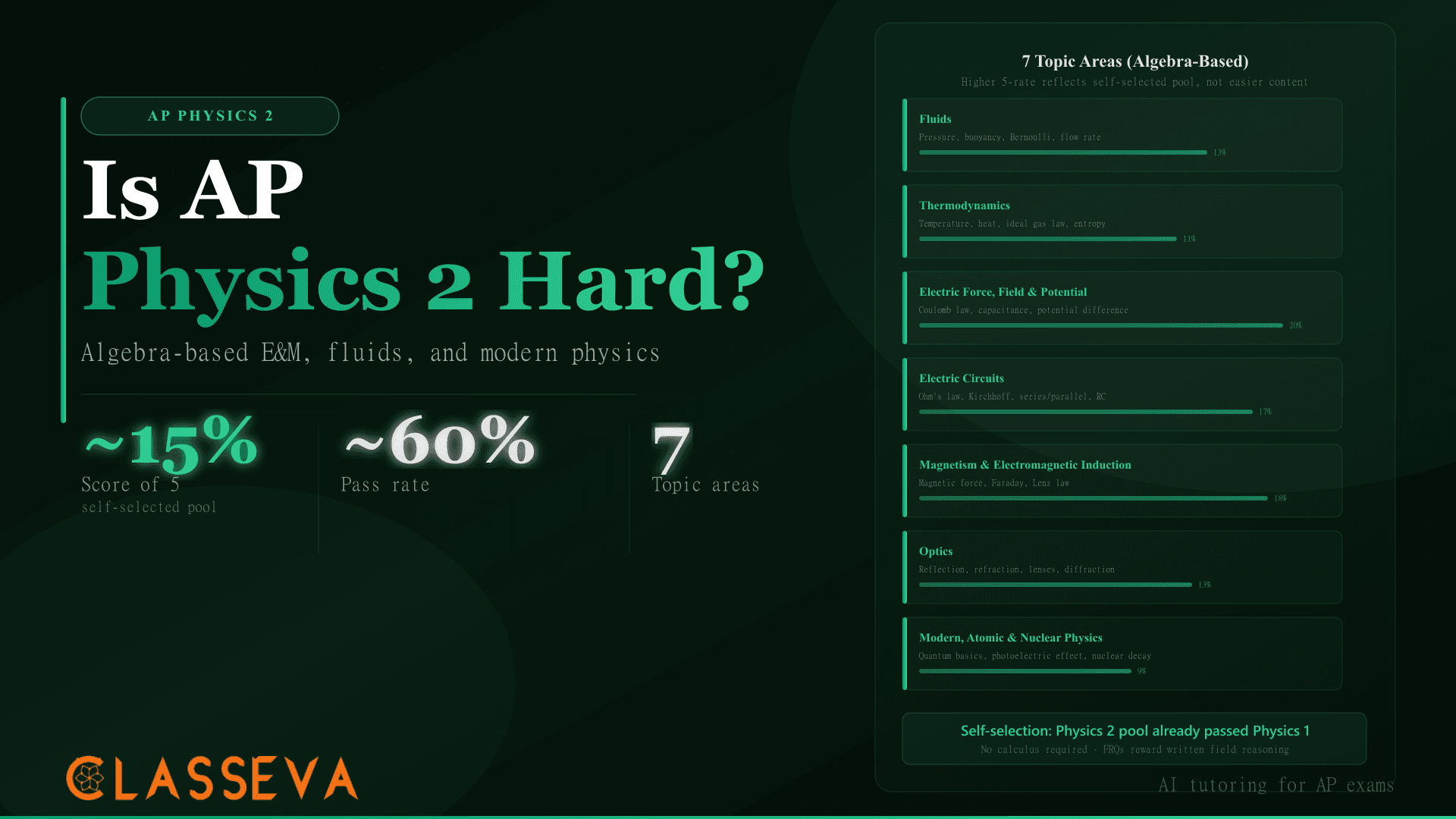
AP Physics 2 ranks in the moderate range of AP exam difficulty when judged by its 5-rate of approximately 14-16% and pass rate of roughly 60%. [VERIFY: 2025 College Board AP Score Distributions at College Board AP Physics 2 page] Both figures look comfortable compared to AP Chemistry (~11-13% 5-rate, ~56% pass rate) and AP Physics 1 (~7% 5-rate, ~43% pass rate). But the comparison requires a caveat. The student population taking AP Physics 2 is substantially different from the population taking those other exams.
Score Distribution and Pass Rate
AP Physics 2 draws approximately 25,000-35,000 test-takers annually, compared to over 135,000 for AP Physics 1. Here is the approximate score distribution based on recent College Board data [VERIFY: exact 2025 figures]:
| Score | Approximate % | What It Means |
|---|---|---|
| 5 | ~14-16% | Exceptional: college credit at most schools |
| 4 | ~22-25% | Strong: credit at many schools |
| 3 | ~20-22% | Pass: credit at some schools |
| 2 | ~22-24% | Below passing |
| 1 | ~15-18% | No credit |
Source: College Board AP Physics 2 Score Distributions (approximate figures; verify at apstudents.collegeboard.org). [VERIFY: 2025 data] Mean score approximately 2.8-3.0.
Why the 5-Rate Looks So High
AP Physics 2 carries roughly double the 5-rate of AP Physics 1. That gap is not a statement about the relative difficulty of the content. It is a statement about who takes each exam. AP Physics 1 draws over 135,000 students per year, including many who take it as a required science course regardless of their physics interest or aptitude. AP Physics 2 draws a pool one-quarter that size, made up predominantly of students who already demonstrated they can handle AP-level physics by passing Physics 1.
Reading the College Board score data carefully, what stands out is how consistent this pattern is. In years when Physics 2's test-taker count rises, the score distributions shift slightly downward. In years when enrollment contracts, they shift up. The 5-rate tracks cohort composition more than exam difficulty. Any comparison between Physics 1 and Physics 2 difficulty needs to account for this structural difference.
What Does AP Physics 2 Actually Cover?
AP Physics 2 covers the topics that Physics 1 does not: electricity, magnetism, fluid mechanics, thermodynamics, optics, and modern physics. All content uses algebra-based math. The course runs at the pace of a second-semester college introductory physics course. Access the official curriculum at AP Central's AP Physics 2 page.
The 7 Units and Exam Weighting
The AP Physics 2 CED organizes content into seven topic areas with specific exam weighting. [VERIFY: exact unit weights from the current AP Physics 2 CED at College Board, especially given 2025-26 course lineup changes]
The electricity and magnetism units (Units 3, 4, and 5) collectively carry the largest portion of the exam. Students who arrive from AP Physics 1 with strong mechanics intuition often find the shift to field-based reasoning (where forces act at a distance through invisible fields rather than through direct contact) conceptually unfamiliar. That shift is the main adjustment, not the mathematical complexity.
The FRQ Section Explained
AP Physics 2 includes four free-response questions. Like AP Physics 1, the FRQs reward written physics reasoning, not just numerical computation. The rubric awards points for identifying the correct physical principle, applying it correctly to the specific scenario, and justifying the reasoning in writing. Students who prepare only for the multiple-choice section regularly score lower than their practice suggests, because the FRQ explanation standard surprises them on exam day.
AP Physics 2 FRQs consistently penalize responses that state a correct formula but do not explain why that formula applies to the specific physical situation. Writing “V = IR” earns less than writing “V = IR applies here because the resistor and battery form a complete loop where the potential difference drives current proportional to resistance.” The rubric rewards physics reasoning, not algebra.
How Does AP Physics 2 Compare to AP Physics 1?
AP Physics 1 and AP Physics 2 are designed as a two-course sequence covering distinct territory. They share the same mathematical level (algebra-based) and the same FRQ philosophy (explanation over computation). They cover entirely different content. The AP Physics 1 difficulty breakdown covers the mechanics side in detail; this section focuses on what changes in Physics 2.
AP Physics 1
- •Covers mechanics: kinematics, forces, energy, momentum, rotation, oscillations, waves
- •~7% 5-rate, ~43% pass rate
- •135,000+ students annually (large, mixed-ability pool)
- •FRQ focus: written explanation of mechanical reasoning
- •Most students take it in 10th or 11th grade
AP Physics 2
- •Covers fluids, thermodynamics, electricity, magnetism, optics, modern physics
- •~14-16% 5-rate, ~60% pass rate
- •25,000-35,000 students annually (smaller, self-selected pool)
- •FRQ focus: written explanation of field, circuit, and wave reasoning
- •Taken after Physics 1, usually 11th or 12th grade
The higher Physics 2 score distributions do not mean the course content is simpler. Electric field concepts and electromagnetic induction challenge students differently than mechanics, because the intuition built through daily experience (pushing objects, throwing balls, riding bikes) does not transfer. Students who rely on physical intuition from Physics 1 find that intuition works less reliably in Physics 2, particularly for circuits and magnetism.
What About AP Physics C?
AP Physics C: Electricity and Magnetism covers similar content to AP Physics 2's electricity and magnetism units, but with calculus as the mathematical foundation. Integrals appear in derivations of Gauss's law, Faraday's law, and field calculations. The 5-rate for Physics C: E&M runs around 35-40%, but that number reflects an even more self-selected population: students taking Physics C are almost always juniors and seniors who have completed Calculus BC and plan to study engineering or physics. A direct comparison between Physics 2 and Physics C scores misrepresents both courses.
| AP Physics Course | 5-Rate | Pass Rate | Math Level | Typical Student |
|---|---|---|---|---|
| AP Physics 1 | ~7% | ~43% | Algebra | 10th-11th, any science track |
| AP Physics 2 | ~14-16% | ~60% | Algebra | 11th-12th, post-Physics 1 |
| AP Physics C: Mechanics | ~35-40% | ~70% | Calculus | 11th-12th, engineering track |
| AP Physics C: E&M | ~30-35% | ~65% | Calculus | 12th, post-Physics C: Mech |
Sources: College Board Score Distributions (approximate 2025 data; verify at collegeboard.org). Physics C figures reflect smaller, calculus-enrolled populations. [VERIFY: 2025 data]
Should You Take Physics 1 Then Physics 2, or Jump to Physics C?
The right sequence depends on your intended college major and your math timeline. This is the decision that most students get wrong by not asking it early enough in high school.
Who Should Take AP Physics 2?
AP Physics 2 fits students who completed Physics 1, want to continue with physics at the algebra level, and plan to pursue a major outside engineering or physics. Pre-med, biology, and environmental science majors often benefit most: many medical and graduate programs require two semesters of physics, and Physics 2 covers the electromagnetic and thermodynamic content those programs value.
Check your math timeline
If you are taking Calculus AB or BC concurrently in 11th grade and plan to study engineering, AP Physics C is the better investment. Physics C credit earns engineering placement that Physics 2 does not.
Check your major prerequisites
Pre-med students should verify which physics sequence (algebra-based or calculus-based) their target medical schools prefer. Physics 2 satisfies the physics prerequisite at most, but some programs specify calculus-based physics.
Check your school's Physics 2 availability
College Board reorganized the AP Physics lineup for 2025-26. Verify with your school counselor that AP Physics 2 is available and running before planning your sequence. [VERIFY: AP Physics 2 availability for 2025-26 at AP Central]
Plan for the self-study gap if Physics 1 is not offered
If your school does not offer AP Physics 1, taking Physics 2 without a mechanics foundation is challenging. The CED assumes familiarity with kinematics, Newton's laws, and energy conservation. A summer of Physics 1 self-study before taking Physics 2 is a reasonable bridge.
AP Physics 2 for Pre-Med Students
Pre-med students represent a large share of AP Physics 2 enrollment. Medical school admissions committees at most institutions require two semesters of physics, and Physics 2 covers the electricity, magnetism, thermodynamics, and optics content that the MCAT tests directly. A score of 4 or 5 on Physics 2 earns credit for the second physics requirement at roughly 70-80% of colleges that accept AP credit. [VERIFY: AP credit policy at your specific target schools, as policies vary widely]
The MCAT Physics section draws on both semester 1 (mechanics) and semester 2 (E&M, thermodynamics, optics) physics. Students who take both AP Physics 1 and AP Physics 2 and earn credit for both typically arrive at MCAT preparation with stronger physics foundations than students who took only one semester. The AP Credit Savings Calculator shows the tuition value of that double credit at your target school.
How Much Should You Study for AP Physics 2?
Most students preparing for AP Physics 2 while enrolled in the course spend 4-6 hours per week during the school year, consistent with AP Physics 1 and AP Chemistry time commitments. Students who self-study or accelerate their preparation typically add 30-50 hours of focused practice in the eight weeks before the May exam.
Study Approach by Topic Area
The conceptual shift from mechanics (Physics 1) to field-based physics (Physics 2) takes most students 3-5 weeks to internalize. The following sequencing reflects what the CED weights most heavily on the exam:
| Phase | Topic Focus | Why It Matters |
|---|---|---|
| First 4-6 weeks | Electric force, field, and potential (Unit 3) | Highest exam weighting; foundational for circuits and magnetism |
| Weeks 7-10 | Electric circuits (Unit 4) | Builds directly on Unit 3; FRQ questions appear here every year |
| Weeks 11-14 | Magnetism and electromagnetic induction (Unit 5) | Conceptually challenging; requires daily practice of field visualizations |
| Parallel track | Fluids and thermodynamics (Units 1-2) | Start early; conceptually distinct from E&M and can be studied in parallel |
| Final 4 weeks | Optics and modern physics (Units 6-7) + full-length practice exams | Lower individual weighting but always appear; released FRQs available at AP Central |
Study sequencing based on AP Physics 2 CED exam weighting. Adjust based on class pace and individual strengths. Released FRQs at AP Central are the highest-leverage practice resource.
College Board publishes complete AP Physics 2 free-response questions and scoring guidelines at AP Central. Read a scored sample response that earned full marks on an E&M question, then write your own response to the same question without looking. Compare them sentence by sentence. That process directly builds the explanation skill the rubric rewards, and no prep book replaces it.
How to Know If You Are Ready for AP Physics 2
The clearest readiness signal is performance in AP Physics 1. Students who earned a 4 or 5 on AP Physics 1 typically have the algebra fluency, FRQ explanation habit, and physics reasoning foundation that Physics 2 requires. Students who earned a 3 on Physics 1 can succeed in Physics 2, but should expect the first unit (electric force and field) to feel unfamiliar while they adjust to field-based reasoning.
Students considering AP Physics 2 without prior physics exposure face a steeper ramp. The CED assumes comfort with vectors, trigonometric ratios, algebraic manipulation, and the general framework of applying physical laws to specific scenarios. Those skills develop through Physics 1, not through a single summer review. If your school does not offer Physics 1, a structured self-study of the Physics 1 CED content is the preparation that actually matters.
AP Score Predictor
If you want to project where your current AP Physics 2 preparation sits on the 5-point scale, Classeva's AP Score Predictor maps your practice results to expected score bands. The AP Credit Savings Calculator shows exactly what a 4 or 5 earns in tuition credit at your target schools.
AP Score Predictor
Enter your AP Physics 2 practice results to see your projected score band and which topic areas to prioritize before the May exam.
For the full AP Physics 2 resource archive, including past FRQs with scoring guidelines, visit the AP Physics 2 resources hub. Students also weighing the rest of the AP science catalog may find the difficulty breakdowns for AP Chemistry, AP Biology, and AP Environmental Science useful for scheduling decisions. College Board maintains official course information, past exam materials, and the current CED at AP Central.
Key Takeaways
- AP Physics 2 carries a ~14-16% 5-rate and ~60% pass rate. Both figures look favorable compared to AP Physics 1, but the comparison misses the critical variable: Physics 2's test-takers are a filtered group who already passed Physics 1. [VERIFY: 2025 College Board data]
- The course is algebra-based throughout. No calculus appears. Derivatives and integrals belong to AP Physics C: E&M. Physics 2 uses Coulomb's law, Ohm's law, and Faraday's law at the algebraic level.
- Seven topic areas cover the second semester of algebra-based physics. Electric force, field, and potential (Unit 3) and magnetism and electromagnetic induction (Unit 5) carry the largest exam weighting. Start studying those units first.
- The FRQ explanation standard is the same as Physics 1. The rubric awards points for identifying the correct principle, applying it correctly, and justifying the reasoning in writing. Students who prepare only for the multiple-choice section consistently underperform on the FRQs.
- Pre-med students should verify credit policies before relying on Physics 2. Physics 2 satisfies the second physics prerequisite at most colleges and covers MCAT-relevant content, but some medical schools specify calculus-based physics. Check each target program directly.
- Students planning engineering should evaluate AP Physics C: E&M instead. Engineering programs rarely award placement credit for AP Physics 2 toward their calculus-based physics sequence. Physics C: E&M earns the placement that engineering tracks require.
- Released FRQs at AP Central are the highest-leverage study resource. College Board publishes complete scoring guidelines for every year. Reading the full-credit sample responses directly before attempting the same question yourself is the preparation method that builds the explanation skill the rubric tests.
Frequently Asked Questions
What percentage of students get a 5 on AP Physics 2?
Approximately 14-16% of AP Physics 2 test-takers earn a 5 in most years, based on College Board score distribution data. [VERIFY: 2025 College Board AP Score Distributions] This is roughly double AP Physics 1's 5-rate of ~7-9%. The gap reflects self-selection: Physics 2 draws a smaller, more experienced pool of around 25,000-35,000 students who predominantly already passed Physics 1.
Is AP Physics 2 harder than AP Physics 1?
AP Physics 2 is not inherently harder or easier than Physics 1 in terms of content complexity. Both are algebra-based and both require written physics reasoning on the FRQs. The score distributions look more favorable for Physics 2, but only because students who take it already filtered through Physics 1. When comparing same-ability students, the two courses present similar challenge levels. Physics 2's topics (electromagnetism, fluid dynamics, modern physics) are conceptually distinct from Physics 1's mechanics foundation.
Do I need to take AP Physics 1 before AP Physics 2?
Most high schools require AP Physics 1 (or an equivalent introductory physics course) as a prerequisite for AP Physics 2. College Board does not mandate Physics 1 as a prerequisite, but the CED assumes familiarity with kinematics, forces, energy, and waves. Students who skip Physics 1 and start with Physics 2 typically need additional review of mechanics fundamentals to follow the course effectively.
Does AP Physics 2 require calculus?
No. AP Physics 2 is algebra-based and requires no calculus. The official title is "AP Physics 2: Algebra-Based," and all problems use algebraic and trigonometric reasoning rather than derivatives or integrals. The calculus-based alternative covering electricity and magnetism is AP Physics C: Electricity and Magnetism, which requires concurrent or prior calculus.
Should I take AP Physics 2 or AP Physics C: E&M?
Take AP Physics 2 if you are in 10th or 11th grade, have not yet taken Calculus AB or BC, or plan to pursue a major that needs one physics course beyond mechanics (pre-med, biology, environmental science). Take AP Physics C: E&M if you have completed or are concurrently enrolled in calculus and plan to study engineering, physics, or computer engineering. Most engineering programs prefer Physics C credit over Physics 2 credit for placement purposes.
Is AP Physics 2 required for pre-med?
Many medical schools require two semesters of physics as a prerequisite for admission. AP Physics 2 can satisfy one or both semesters depending on the school's credit policy and your AP score. A score of 4 or 5 earns credit at roughly 70-80% of colleges that award AP credit. However, some medical schools prefer calculus-based physics. Check the specific prerequisite policies of your target medical schools before relying on AP Physics 2 credit to satisfy physics requirements.
How many students take AP Physics 2 each year?
AP Physics 2 draws approximately 25,000-35,000 students annually, compared to roughly 135,000+ for AP Physics 1. [VERIFY: 2025 College Board participation data] This smaller, more selective pool is the primary reason Physics 2's score distributions look more favorable than Physics 1's. College Board reorganized the AP Physics course lineup for 2025-26; verify current course availability and enrollment at AP Central before planning your sequence.
What topics does AP Physics 2 cover?
AP Physics 2 covers seven topic areas: fluid statics and dynamics (including pressure, buoyancy, and flow rate), thermodynamics (temperature, heat, and ideal gas laws), electric force and field, electric potential and energy, electric circuits, magnetism and electromagnetic induction, geometric optics, physical optics, and modern physics including quantum mechanics fundamentals and atomic/nuclear physics. All content uses algebra-based math rather than calculus.