Is AP Environmental Science Hard? Math, FRQs Decoded
Combing through the College Board's score distribution data while building Classeva's AP Environmental Science content, the number that keeps surfacing is the 5-rate: roughly 6-9% of APES test-takers earn the top score in a typical year. [VERIFY: 2025 data at reports.collegeboard.org] That figure places APES among the lowest 5-rates of any AP exam, yet the course circulates in high school hallways as the science AP you take when you want something manageable. The gap between that reputation and the score data is real, and it matters for how students prepare.
Is AP Environmental Science Hard?
AP Environmental Science is harder than its reputation suggests. The pass rate sits around 45-55% and the 5-rate near 6-9%, placing APES in the same difficulty tier as AP Chemistry and well below easier APs like AP Human Geography or AP Psychology by 5-rate. [VERIFY: 2025 College Board AP Score Distributions at reports.collegeboard.org] The content itself is accessible. But “accessible content” and “easy 5” are different things, and APES students who conflate them tend to underprepare for the FRQ section.
The APES Score Distribution
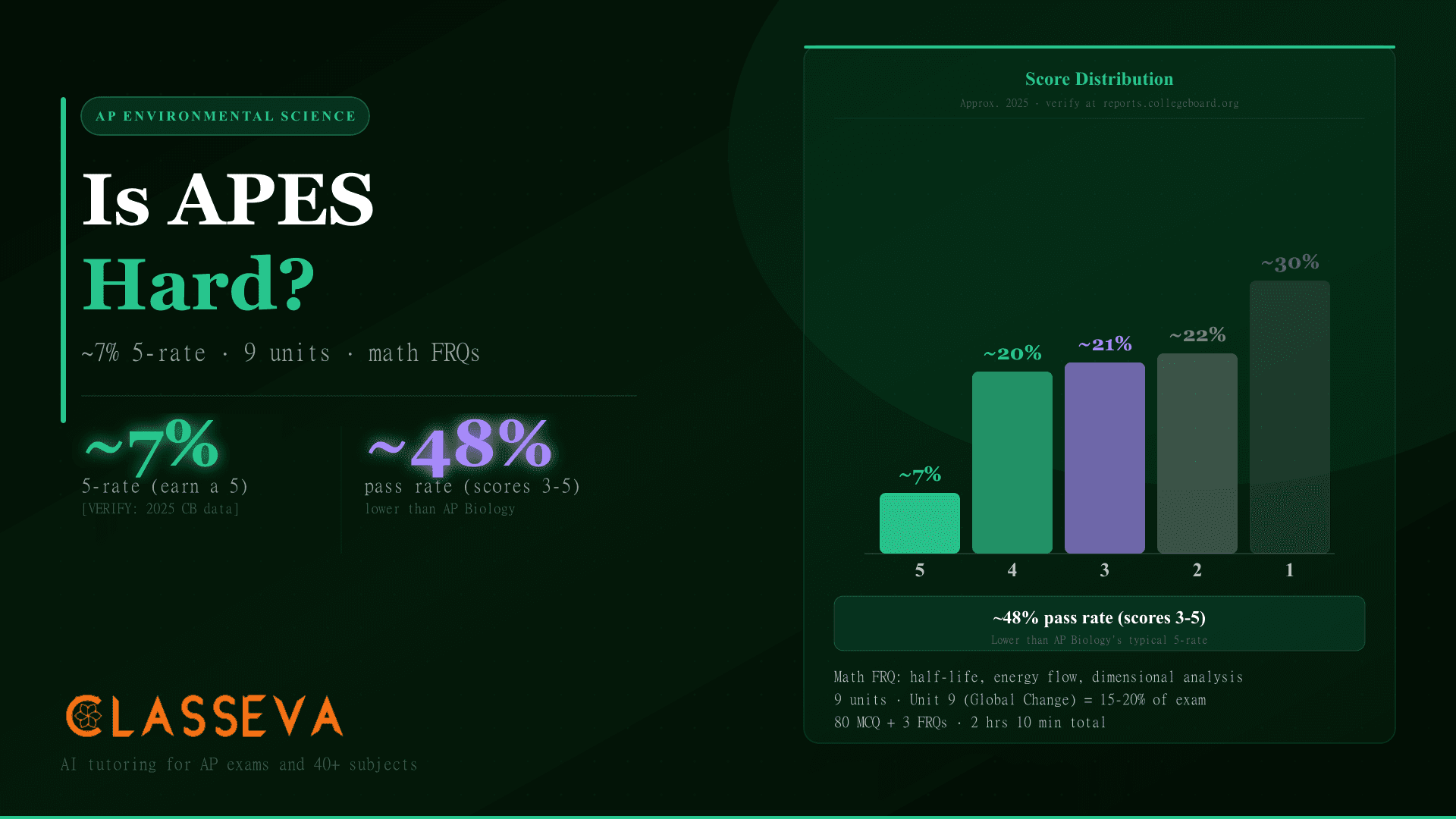
Here is the approximate score distribution for AP Environmental Science based on recent College Board data. [VERIFY: exact 2025 figures from reports.collegeboard.org]
| Score | Approximate % | What It Means |
|---|---|---|
| 5 | ~7% | Exceptional: college credit at most schools |
| 4 | ~20% | Strong: credit at most schools |
| 3 | ~21% | Pass: credit at some schools |
| 2 | ~22% | Below passing |
| 1 | ~30% | No credit |
Source: College Board AP Environmental Science Score Distributions (approximate figures; verify at reports.collegeboard.org). Mean score approximately 2.7-2.9.
Why the “Easy AP” Reputation Misleads
The reputation has a foundation. APES content is genuinely more conceptually accessible than AP Chemistry or AP Physics 1. You do not need calculus. You do not need organic chemistry. The course covers topics like ecosystems, biodiversity, and pollution that connect naturally to news students already follow. None of that is wrong.
But the 5-rate does not care about accessible content. It measures whether students can execute under timed exam conditions on the specific question types College Board writes. The FRQ section includes a calculation question every year, and students who chose APES to stay light on math consistently lose points there. The result is a course where “I understand the material” translates to a 3 far more often than it translates to a 5.
APES being “conceptually accessible” does not mean it is easy to score a 5. The calculation FRQ, the breadth of 9 content units, and the environmental-problem-analysis FRQ all require dedicated practice. Students who treat APES as a lower-stakes course consistently underprepare for the exam and underperform on their target score.
What Does AP Environmental Science Actually Test?
The APES exam runs 2 hours 10 minutes. Section I has 80 multiple-choice questions in 90 minutes, worth 60% of the total score. Section II has 3 free-response questions in 70 minutes, worth 40% of the score. [VERIFY: current exam format at AP Central] The College Board's CED organizes the course into 9 units spanning physical, biological, and social dimensions of environmental science. No single unit dominates the exam the way the AD/AS model dominates AP Macro, but Units 3 through 6 and Unit 9 together carry roughly 65-75% of the exam weight.
The 9 Units and Their Exam Weights
Here are the 9 APES units with their approximate College Board CED exam weight ranges. [VERIFY: current CED at AP Central]
MCQ and FRQ: What the Exam Looks Like
The 80 MCQ questions test conceptual understanding across all 9 units. Individual questions pull from ecology, earth science, energy policy, and pollution chemistry. No unit is safe to skip. The 3 FRQs break down as follows: one asks students to design a scientific investigation to test an environmental hypothesis; one asks students to analyze an environmental problem and evaluate solutions; and one requires quantitative calculations using data provided in the prompt.
That third FRQ, the calculation question, is where the score gap opens. Students who have rehearsed only content knowledge hit it cold. Students who have practiced the math types that appear on APES FRQs can earn full points in 10-15 minutes and bank time for the other two FRQs. The difference between those two preparation strategies shows up in the 5-rate.
The Math-Heavy FRQs That Catch Students Off Guard
The APES calculation FRQ appears on every exam. College Board writes a new scenario each year, but the underlying math types rotate through a predictable set. Students who have seen each type once before the exam can solve them in 10 minutes. Students who encounter them for the first time during the FRQ section typically run out of time or make unit-conversion errors that cascade across multiple parts.
What Calculations Appear on the APES Exam
Five calculation types dominate the APES FRQ math section, based on a review of released FRQs from AP Central:
| Math Type | What It Tests | Common Trap |
|---|---|---|
| Dimensional analysis | Unit conversions: grams to tons, kWh to BTUs, liters to gallons | Forgetting to cancel units; setting up the fraction inverted |
| Percent change | Population growth or pollution reduction over time | Confusing (new-old)/old with (new-old)/new |
| Energy flow (10% rule) | How much energy transfers between trophic levels | Applying the 10% rule in the wrong direction (up vs. down the food chain) |
| Half-life | Radioactive decay and pollutant persistence over time | Using the wrong formula; forgetting that each half-life halves the remaining amount |
| Exponential population growth | PERT formula for population projections | Confusing growth rate r with doubling time; mis-setting up the exponent |
Five primary calculation types on APES FRQs, based on released exam questions at AP Central. [VERIFY: review recent APES FRQ sets]
Each of these types appears with a scenario baked in: you will not see a bare formula problem. College Board embeds the numbers in a story about a salmon fishery, a solar farm, or a nuclear waste site. The calculation itself is straightforward once you identify what type it is. Practice means learning to identify type quickly from scenario language, not memorizing the formulas in isolation.
The Design-an-Investigation FRQ
The design-an-investigation FRQ rewards a different skill set. Students propose a study to test an environmental hypothesis, identifying variables (independent, dependent, and at least one controlled) and describing the experimental procedure with enough specificity to replicate. Points go to methodological precision, not to content knowledge alone.
Download 5 years of released APES FRQs from AP Central (free, no login required). Score each using the published rubric before checking the scoring guidelines. The rubric language for the design-an-investigation FRQ is nearly identical year to year, so 5 repetitions teaches the exact vocabulary College Board rewards. For the calculation FRQ, one set per week for 8 weeks before the exam builds the fluency that classroom instruction rarely provides.
How Does APES Compare to AP Biology?
The most common comparison students make is APES vs. AP Biology. The conventional wisdom is that APES is easier. The 5-rate data does not consistently support that claim. AP Biology's 5-rate sits in the 7-9% range, which is comparable to or higher than APES depending on the year. [VERIFY: 2025 College Board Score Distributions] The two courses test different skills entirely, and choosing one over the other on the assumption that APES is automatically easier is a mistake that costs students on the exam.
AP Sciences 5-Rate Comparison
Which Science Should You Take?
AP Environmental Science
- •Content is more accessible: no calculus, no organic chemistry
- •Strong fit for students interested in sustainability, ecology, or policy
- •The calculation FRQ requires dedicated math practice regardless
- •9 content units covering physical, biological, and social topics
- •Lower 5-rate than AP Chemistry; comparable to AP Biology
- •Counts toward science distribution at most colleges (check specific policies)
AP Biology
- •Higher 5-rate in most years, though both sit near 7-9%
- •Stronger preparation for pre-med, pre-vet, or bio-adjacent majors
- •8 units with heavier lab investigation component
- •Difficulty comes from breadth and conceptual depth, not math
- •Credit accepted at more colleges for core science requirements
- •Stronger signal for science-intensive admissions tracks
Choose APES if your interest genuinely aligns with environmental topics and you are willing to practice the calculation FRQ seriously. Choose AP Biology if you are on a pre-health or science-intensive track and want a course that signals stronger science preparation. For students wondering how APES fits against the physical sciences: AP Physics 1 sits at roughly 6% (the lowest 5-rate among AP sciences), while AP Chemistry sits around 14%. APES lands between those two. Do not choose APES because you want to avoid a hard AP science: all four AP sciences earn sub-15% 5-rates, and APES adds a math FRQ that AP Bio does not.
How Much Should You Study for APES?
A realistic APES study commitment runs 3-5 hours per week during the school year. That puts students at roughly 90-150 total hours over a 30-week course. Students who do less than 3 hours per week consistently miss the calculation FRQ details. The course rewards consistent practice across all 9 units more than cramming in a single unit, because no single unit dominates the exam the way some other AP exams weight specific topics.
A Study Timeline for APES
Download the CED and map your school's calendar
Get the official AP Environmental Science Course and Exam Description from College Board. Match each of the 9 units to your class schedule. Identify the weeks where your course covers Units 3-6 and Unit 9 (the high-weight zones) and block extra review time there.
Work the calculation FRQ types from week one
Do not wait until April to practice math. Pick one calculation type per week starting in the fall: dimensional analysis in week 1, percent change in week 2, energy flow in week 3, and so on. A single worked FRQ per week builds fluency faster than reading about the math in a prep book.
Use AP Central released FRQs as your primary practice tool
College Board posts released APES FRQs with scoring rubrics at AP Central. For each year's FRQ set, attempt all three questions before reading the rubric. Score yourself honestly. Released FRQs are the most reliable signal of what earns points, because they are written by the same team that writes the exam.
Run a full-unit review pass in March and April
Spend the 8 weeks before the May exam cycling through all 9 units using the CED exam weight as your guide. Unit 9 (Global Change) and Units 3-6 together carry 65-75% of the exam, so give them proportionally more time. For each unit, write out the core concepts in your own words, then test yourself with released MCQ questions.
Take a full timed practice exam two weeks out
Simulate exam conditions: 90 minutes for 80 MCQ, then a short break, then 70 minutes for 3 FRQs. Grade your MCQ against the answer key. Score your FRQs using the released rubrics. The practice exam reveals which units still have gaps and which calculation types still feel uncertain, leaving two weeks for targeted review.
The High-Yield Topics to Prioritize
Unit 9 (Global Change) carries 15-20% of the exam, making it the single highest-weighted unit. It covers climate change mechanisms, sea level rise, ocean acidification, ozone depletion, and biodiversity loss under human pressure. Students who treat Unit 9 as just another content block and give it equal time to Units 1-2 consistently leave points on the table.
Units 3 through 6 together represent another 40-60% of the exam weight, spanning population dynamics, earth systems, land and water use, and energy resources. The energy unit (Unit 6) is where the calculation FRQ most frequently draws its scenarios: students need to know how solar, wind, nuclear, and fossil fuel energy systems work quantitatively, not just conceptually. A student who can calculate the energy output of a solar array given panel efficiency and surface area has prepared for this unit the way the exam actually tests it.
Unit 9 (Global Change, 15-20%), plus Units 3-6 together (40-60% combined), cover roughly 55-80% of the APES exam. Study these units first, return to them last, and spend the most time on calculation types that arise from Unit 6 (Energy Resources) and the population math in Unit 3. Units 1, 2, 7, and 8 need coverage, but they carry the lowest exam weights.
The Classeva APES resource page organizes practice by unit and FRQ type, making it easier to target the high-yield zones without losing coverage of the rest of the course. For students tracking whether their preparation is on pace, the AP Credit Savings Calculator shows what a qualifying score would be worth at specific colleges, which can be a motivating data point during the long stretch of the school year.
AP Score Predictor
Before committing to a final review strategy, use the AP Score Predictor to estimate where your current preparation puts you on the 1-5 scale. The predictor factors in your practice test performance and the typical score distribution for APES to give you a realistic target range and show which improvements would move you from a 3 to a 4 or from a 4 to a 5.
AP Score Predictor
Enter your APES practice test scores to see a realistic estimate of your exam score on the 1-5 scale, and find out which improvements would move you into the next score band.
Key Takeaways
- AP Environmental Science earns roughly 6-9% of test-takers a 5, one of the lowest 5-rates of any AP exam, directly contradicting its easy-AP reputation. [VERIFY: 2025 College Board data]
- The exam has 80 MCQ questions (60% of score) and 3 FRQs (40% of score): design-an-investigation, environmental problem analysis, and a math-heavy calculation question.
- The calculation FRQ tests five recurring math types: dimensional analysis, percent change, energy flow using the 10% rule, half-life, and exponential population growth. None require calculus.
- AP Biology shows a comparable or higher 5-rate than APES in most years. Choosing APES to avoid a difficult AP science is a strategy that does not match the score data.
- Unit 9 (Global Change) carries the highest single-unit exam weight at 15-20%. Units 3-6 together carry another 40-60%. These five units are where most of the exam score comes from.
- A realistic study commitment is 3-5 hours per week across the school year. Students should practice calculation FRQ types starting in the fall, not in April.
- Released FRQs from AP Central are the most reliable preparation tool for both the calculation FRQ and the design-an-investigation FRQ. Five years of practice with rubric scoring builds the fluency that content review alone does not.