Is AP 2-D Art and Design Hard? The Portfolio AP Decoded
AP 2-D Art and Design is hard in a way no other AP exam is hard, because there is no exam to study for. The College Board grades a portfolio of 20 pieces you build across an entire school year, and the deadline in early May is an upload button, not a testing room. I have spent years mapping how AP courses convert effort into scores, and this one breaks the usual rules: cramming does nothing, a single brilliant piece cannot rescue you, and a year of steady studio practice is the only path to a 4 or 5.
Is AP 2-D Art and Design Hard?
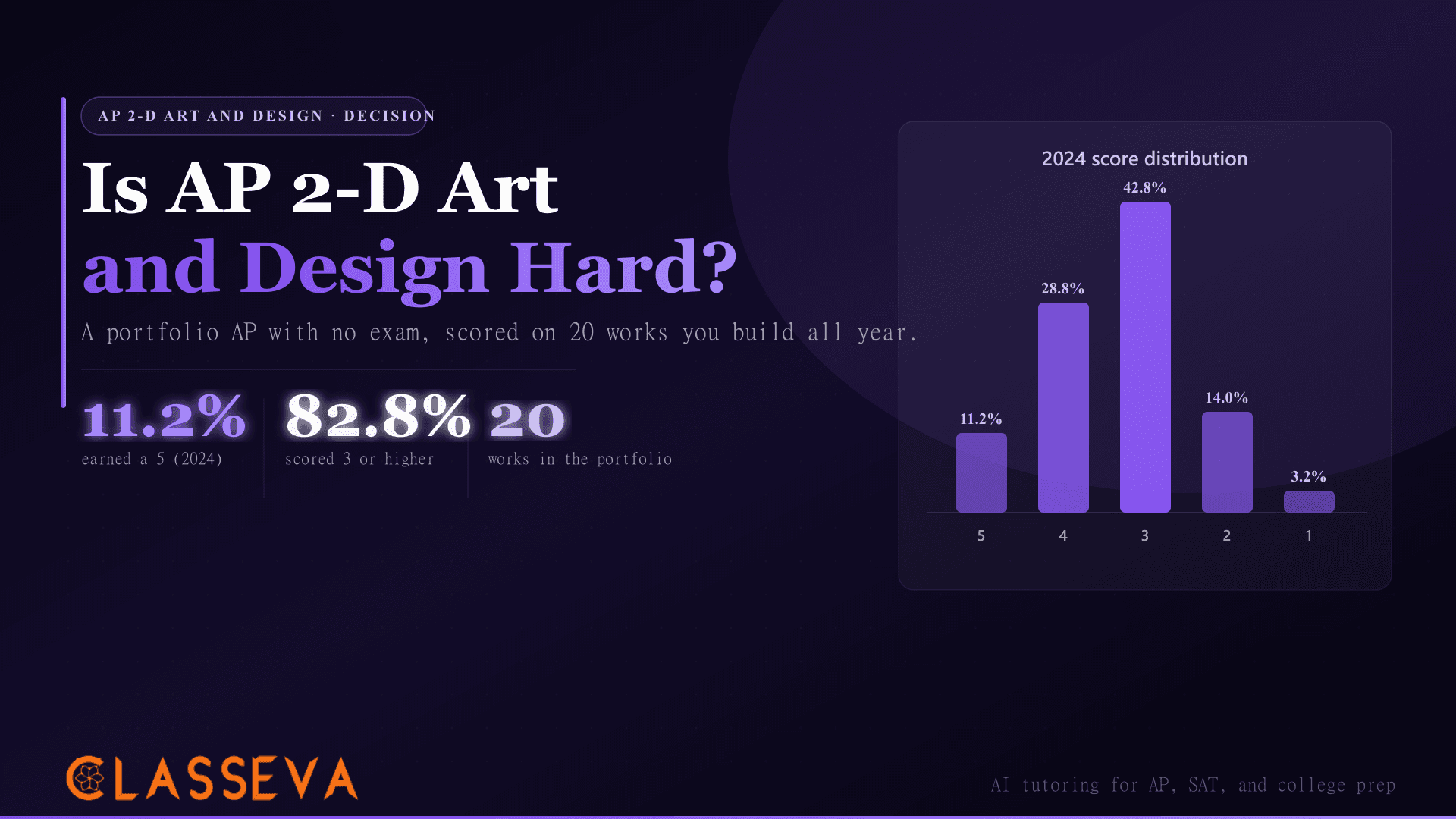
AP 2-D Art and Design is moderately hard, but the difficulty lives in consistency rather than peak skill. In 2024, 82.8% of students scored a 3 or higher and the mean landed at 3.31, yet only about 11% earned a 5. [VERIFY: 2024 College Board AP Score Distributions] The course demands a year of sustained creative output, written reflection, and revision, which trips up strong artists who treat it like a portfolio they can assemble in April.
There Is No Exam, Only a Portfolio Deadline
AP 2-D Art and Design replaces the May exam with a digital portfolio submission. You upload your work through the AP Digital Portfolio, and the 2026 deadline falls on May 8 at 8 PM ET. There is no multiple-choice section, no free-response booklet, and no proctor. Your teacher sets earlier internal deadlines because the College Board upload window closes hard, and a missed upload means no score at all.
For AP 2-D Art and Design, “exam day” is a file-upload deadline, not a sit-down test. By May 8, 2026 at 8 PM ET, you must have all 20 images, titles, dimensions, and written evidence uploaded and submitted in the AP Digital Portfolio. Nothing you do after that moment counts. Treat the date as a hard production deadline from September, not a study target for spring.
Score Distribution and Pass Rate
AP 2-D Art and Design posted one of the friendlier score distributions among AP subjects in 2024: 11.2% earned a 5, 28.8% earned a 4, and 42.8% earned a 3, for an 82.8% rate of 3-or-higher across 47,902 students. [VERIFY: 2024 College Board AP Score Distributions] The mean of 3.31 sits above many STEM AP exams. But the 5-rate stays modest because a 5 demands a portfolio where all 20 works hang together as one coherent investigation.
| AP Score | 2024 % of Test-Takers | What It Signals |
|---|---|---|
| 5 | 11.2% | A fully resolved, coherent investigation |
| 4 | 28.8% | Strong work with clear inquiry |
| 3 | 42.8% | Qualified; passing at most colleges |
| 2 | 14.0% | Uneven or incomplete investigation |
| 1 | 3.2% | Minimal evidence of sustained inquiry |
AP 2-D Art and Design 2024 score distribution; mean 3.31 across 47,902 students. [VERIFY: 2024 College Board AP Score Distributions]
What Do You Submit for AP 2-D Art and Design?
You submit 20 digital images split into two sections: a 15-work Sustained Investigation worth 60% and a 5-work Selected Works worth 40%. There is no separate sketchbook review and no in-person critique by the readers. Everything the College Board scores arrives as image files plus short written evidence inside the AP Digital Portfolio, with the full requirements published on the official AP 2-D Art and Design assessment page.
The Sustained Investigation (15 Works)
The Sustained Investigation is 15 images that document one inquiry developed through practice, experimentation, and revision. Not all 15 need to be finished pieces. Some images can show details, process work, sketches, or earlier versions that prove how the inquiry evolved. You also write two short responses, each capped at 600 characters including spaces, explaining the question that drove your investigation and how it changed over time.
A “theme” like “nature” produces 15 disconnected pretty pictures. An “inquiry” like “How can torn paper edges convey decay versus growth?” gives you something to test, fail at, and revise across 15 works. Readers reward visible experimentation. Choose a question narrow enough to investigate but open enough to sustain from September to May.
The Selected Works (5 Works)
Selected Works asks for your 5 strongest pieces that show skillful synthesis of materials, processes, and ideas. These do not have to come from the Sustained Investigation, and they do not need to share its inquiry. Each work carries a short written description covering the idea, the materials, and the processes used, plus a citation if you referenced any source imagery. This section rewards polish and command of your medium, where the Sustained Investigation rewards inquiry and growth.
How Is the AP 2-D Art Portfolio Scored?
Trained AP readers score the portfolio holistically each June against published rubrics, assigning the Sustained Investigation and Selected Works separate scores that combine 60-40 into your 1-to-5. Readers never see your name, your school, or your grades. They evaluate only the images and your written evidence, so the work has to communicate without you in the room. The College Board posts scored sample portfolios and scoring information on AP Central so you can study what each score level looks like.
What the Readers Look For
For the Sustained Investigation, readers weigh whether your inquiry is clear, whether the works show genuine practice and revision, and whether your written evidence connects to the images. For Selected Works, they judge technical command and how well materials, processes, and ideas synthesize. A common failure is a portfolio of skilled but unrelated pieces: high craft, no investigation, capped score.
The most common way to lose points is treating AP 2-D Art and Design like an exam you prep for in spring. Because the Sustained Investigation has to show development across many works, a portfolio built in the final six weeks reads as flat and unexamined. Readers can tell when 15 images were produced in a rush. Start your inquiry in the first month of class.
AP 2-D Art vs AP Drawing vs AP 3-D
The three AP Art and Design portfolios share an identical structure but reward different skills. AP Drawing centers on mark-making and observational rendering. AP 2-D Art and Design centers on two-dimensional design principles across media like photography, graphic design, and collage. AP 3-D Art and Design covers sculpture, ceramics, and physical form. You can take more than one in a year, but each portfolio must use completely different artwork.
AP 2-D Art and Design
- •Two-dimensional design: photography, graphic design, collage, printmaking, digital
- •Judged on elements and principles of 2-D design
- •15 Sustained Investigation + 5 Selected Works
- •Strong fit if you work in flat or screen-based media
- •Drawing skill helps but is not required
AP Drawing
- •Mark-making, line, observational rendering, painting
- •Judged on drawing-based image-making
- •Same 15 + 5 portfolio structure
- •Strong fit if your work leads with drawing or painting
- •Best for illustrators and traditional rendering
AP 3-D Art and Design
- •Sculpture, ceramics, fashion, physical and spatial form
- •Judged on three-dimensional design principles
- •Same 15 + 5 portfolio structure, photographed for upload
- •Strong fit if you build, mold, or construct objects
- •Lowest enrollment of the three portfolios
Which Portfolio Fits Your Work?
Choose the portfolio that matches what you already make, not the one that sounds easiest. A photographer or graphic designer belongs in 2-D. A figure illustrator belongs in Drawing. A ceramicist belongs in 3-D. Students who pick a portfolio that fights their natural medium spend the year forcing work and submit a weaker investigation. If you genuinely span media, you can submit two portfolios with two entirely separate bodies of work.
If you are weighing AP 2-D Art and Design against other expression-heavy APs, the AP Art History difficulty breakdown and the AP Music Theory difficulty guide show how those exam-based courses compare to a portfolio course. Both reward different strengths than a studio portfolio does.
What Is the Real Workload?
The real workload is steady production, not exam cramming. Most students spend 4 to 8 hours per week making and revising work outside class, with the hours climbing sharply in the final weeks before the May 8 deadline. The portfolio is cumulative, so falling behind in October cannot be recovered with a strong April. There is no shortcut: a 5-rated portfolio represents months of consistent studio practice.
A Realistic Time Budget
For broader scheduling context, students often pair this course with reading-heavy APs and want to balance the load. The AP Seminar difficulty guide covers another project-based AP with no traditional final exam, and the AP Latin breakdown shows how a content-dense exam course compares. Pairing a portfolio course with a memorization-heavy course can spread your effort across the year more evenly.
Is AP 2-D Art and Design Right for You?
AP 2-D Art and Design fits you if you already make two-dimensional work and can commit to producing and revising it across nine months. It does not fit students who want a low-effort GPA boost or who expect to assemble a portfolio in spring. The course rewards curiosity and persistence far more than raw talent, and the students who struggle are usually the ones who treat it as easy.
Run a quick self-check. Do you have a question about your own work you could explore for a year? Can you photograph or scan your pieces at high quality? Will you keep a steady weekly studio habit without a looming test to force it? If yes, this course suits you. If the idea of self-directed production with no exam structure feels unmoored, a content-driven AP like the AP Research course or a standard exam AP may serve you better, and the wider AP 2-D Art and Design resource hub lays out the full requirements.
AP Score Predictor
Because there is no practice exam to score yourself against, gauging a portfolio AP is harder than gauging a multiple-choice one. If you also sit traditional AP exams this year, Classeva's AP Score Predictor maps your practice results to a projected score band so you know where to focus before May.
AP Score Predictor
Enter your AP practice results to project your score band and see which areas to prioritize before the May exam window.
Key Takeaways
- There is no exam. AP 2-D Art and Design is scored entirely on a 20-image digital portfolio uploaded by May 8, 2026 at 8 PM ET. Exam day is a file-upload deadline.
- The portfolio splits 60-40. The 15-work Sustained Investigation counts for 60% of the score; the 5-work Selected Works counts for 40%.
- The 2024 numbers are friendly but the 5-rate is not. About 82.8% scored 3 or higher with a 3.31 mean, yet only 11.2% earned a 5. [VERIFY: 2024 College Board data]
- Inquiry beats individual pieces. Readers reward a coherent, revised investigation over a set of skilled but unrelated works. A single brilliant piece cannot carry the portfolio.
- It is a year-long commitment. Plan 4 to 8 hours per week of studio work all year. A portfolio built in spring reads as flat and loses points.
- Pick the portfolio that fits your medium. 2-D for design and photography, Drawing for rendering, 3-D for sculpture. Each portfolio you submit must use entirely different artwork.
- Drawing skill is optional. AP 2-D Art and Design judges two-dimensional design principles, so photographers, designers, and collage artists can thrive without traditional rendering ability.