Is AP Music Theory Hard? Ear Training and Sight-Singing
Is AP Music Theory hard? Yes, but not in the way the scores suggest. The 5-rate of 18.8% in 2025 ranks among the highest of any AP exam, yet plenty of trained musicians walk out shaken by a section no other AP touches: you sing two melodies, alone, into a recording device. The written theory rewards study. The aural skills reward years of listening, and that gap is the whole story of this exam.
Is AP Music Theory Hard?
AP Music Theory is hard in a way the scores hide. The content itself, chords, intervals, part-writing, follows learnable rules. The difficulty lives in the aural subscore: melodic dictation, harmonic dictation, and sight-singing all demand a trained ear that takes months to build. A student who reads music fluently and has sung in choir for years finds it manageable; a beginner finds the listening sections close to impossible.
Score Distribution and 5-Rate
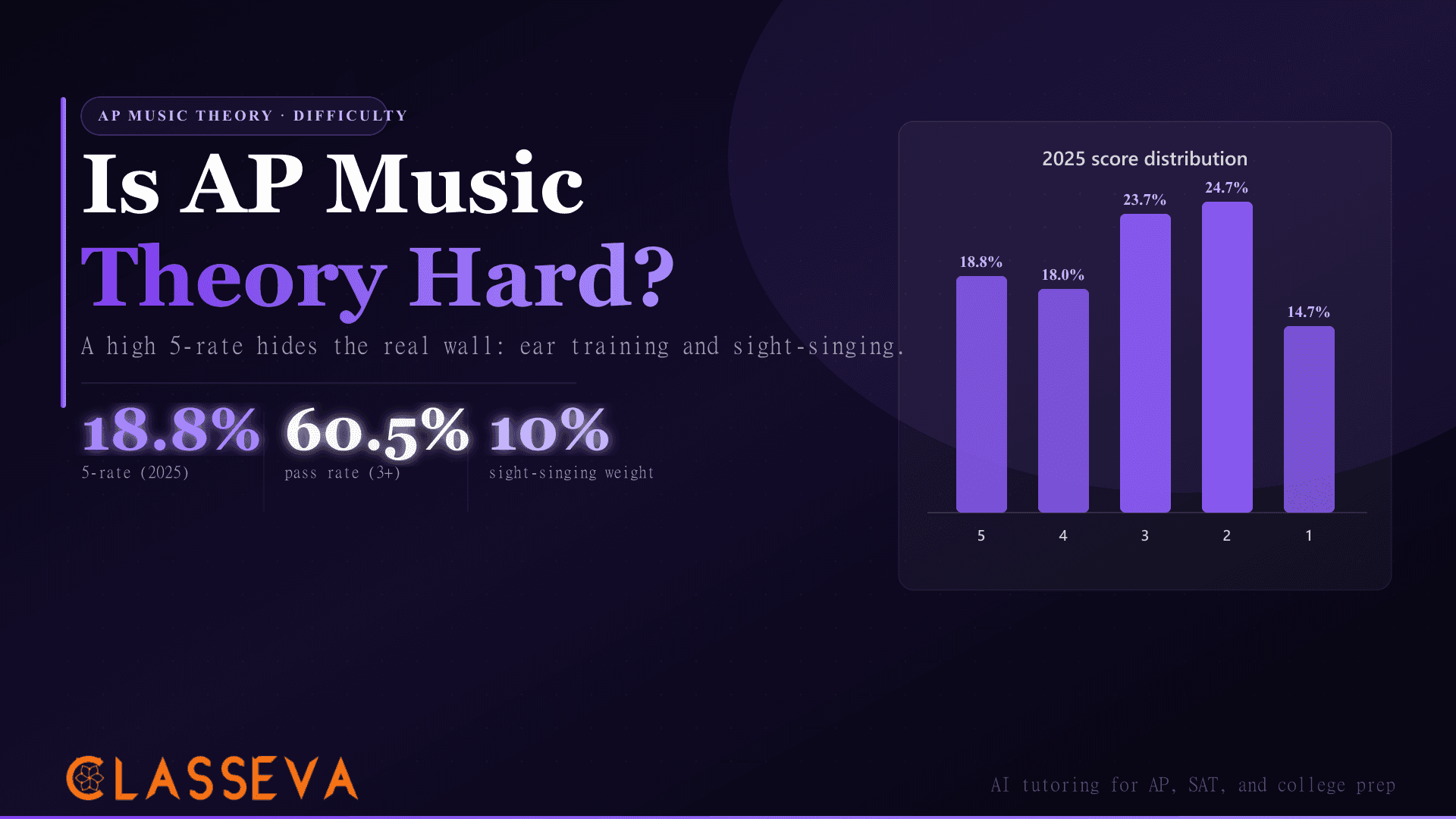
AP Music Theory's 2025 distribution ran 18.8% fives, 18.0% fours, 23.7% threes, 24.7% twos, and 14.7% ones, for a 60.5% pass rate and a mean score of 3.01 across 17,799 students, per College Board's 2025 score distributions. The 5-rate beats most AP exams. The middle of the curve tells the real story: nearly half of all test-takers landed at a 2 or 1, the steepest lower tail you will find among the high-5-rate exams.
| AP Score | 2025 % of Test-Takers | College Readiness Signal |
|---|---|---|
| 5 | 18.8% | Extremely well qualified |
| 4 | 18.0% | Well qualified |
| 3 | 23.7% | Qualified |
| 2 | 24.7% | Possibly qualified |
| 1 | 14.7% | No recommendation |
2025 AP Music Theory score distribution. Source: College Board, 17,799 test-takers, mean 3.01.
Why the 5-Rate Misleads You
AP Music Theory drew 17,799 test-takers in 2025, a fraction of AP English Language's half-million-plus. Almost nobody enrolls by accident. Students arrive because they already sing in choir, march in band, or take private lessons, and they can read music before the first class. That filter lifts the 5-rate without making the exam easy. Strip out the self-selection and you would see a far lower pass rate, because the skills the exam tests take years to build.
College Board lists no prerequisite course for AP Music Theory, but it recommends that students read and write notation fluently and have basic performance skill on voice or an instrument before enrolling. That recommendation does most of the filtering: the students who follow it are the ones already in choir, band, or orchestra.
What Is on the AP Music Theory Exam?
The AP Music Theory exam runs about 2 hours and 40 minutes and splits into three scored parts: 75 multiple-choice questions worth 45%, seven written free-response questions worth 45%, and two sight-singing melodies worth 10%. College Board also reports an aural subscore and a nonaural subscore, each from 1 to 5, so a college can place you separately in written theory and ear training.
The 75 Multiple-Choice Questions
Section I packs 75 questions into roughly 80 minutes, split into two kinds. About 41 to 43 questions play recorded audio and ask you to identify intervals, chords, rhythms, or errors by ear. The remaining 32 to 34 questions show printed scores and test analysis you can do on the page. The audio questions feed the aural subscore; the score-analysis questions feed the nonaural subscore. You hear each recording a fixed number of times, then the audio moves on whether you are ready or not.
The 7 Written Free-Response Questions
The written free-response section contains seven items: two melodic dictation questions, two harmonic dictation questions, one part-writing from figured bass, one part-writing from Roman numerals, and one melody harmonization. Dictation means you notate music you hear. Part-writing means you compose four voices that obey voice-leading rules. The part-writing and harmonization questions reward study and pattern recognition; the dictation questions, like the audio multiple choice, lean on a trained ear.
How Hard Are the AP Music Theory Aural Sections?
The aural sections are the hardest part of AP Music Theory because they test perception, not memorization. You hear a melody and must write it down. You hear a four-voice progression and must notate the bass line and label the chords. No formula produces the answer. A student who has spent years matching pitches in choir hears the notes; a student who has not hears noise, no matter how many chord charts they memorized.
Ear Training and Dictation
AP Music Theory ear training centers on dictation, which appears in two flavors on the written section. Melodic dictation gives you a short tune played a fixed number of times, and you notate its pitches and rhythm on staff paper. Harmonic dictation plays a chord progression, and you write the soprano line, the bass line, and the Roman numeral of each chord. Both reward students who practice daily for months. Cramming the week before does almost nothing, because the brain needs repeated exposure to internalize intervals and chord qualities.
The aural subscore, melodic dictation, harmonic dictation, and sight-singing, is where AP Music Theory separates trained ears from everyone else. You can memorize part-writing rules in a semester. You cannot fake a trained ear. This is why students with substantial choir, band, orchestra, or private-lesson backgrounds succeed and why beginners stall regardless of how hard they study the written theory.
Why AP Music Theory Sight-Singing Terrifies Students
AP Music Theory sight-singing terrifies students because you perform alone, on the record, with no instrument to lean on. You see a melody you have never heard, get just over a minute to study it, then sing it into a device while it records. There is no second take and no accompaniment to hide behind. A student who reads notation perfectly on paper can still freeze the moment they have to produce those pitches with their own voice.
The Sight-Singing Format and Timing
The sight-singing section gives you two short melodies, each about four to eight bars and mostly diatonic. For each one you get 75 seconds to examine and practice quietly, then 30 seconds to perform it aloud while your school's recording device captures your voice. The section counts for 10% of the composite and feeds the aural subscore. You may sing on any syllable system or even a neutral syllable, but you must hit accurate pitches and rhythm to earn points.
Many students treat sight-singing as an afterthought because it is only 10% of the score. That backfires. The same skill that wins sight-singing points, hearing a pitch before you produce it, also drives melodic dictation and the audio multiple choice. Neglecting your voice does not just cost you the 10%; it quietly drags down the whole aural subscore.
Who Succeeds in AP Music Theory?
Students with substantial music background succeed in AP Music Theory; students without it usually do not. The dividing line is years of trained listening, not raw intelligence or work ethic. A National Merit-caliber student with no choir or instrumental experience often scores a 2, while an average student who has sung in choir since elementary school clears a 4. The exam measures a skill that grows over years, and the score distribution reflects exactly that.
If You Have a Music Background
If you have sung in choir, played in band or orchestra, or taken private lessons for several years, AP Music Theory rewards what you already have. Your ear recognizes intervals and chord qualities, your sight-reading transfers to sight-singing, and the written theory codifies patterns you have felt for years. The course often clicks fast for these students. Pair that foundation with consistent dictation practice and a 4 or 5 is within reach. Many of these students also weigh it against a quantitative AP like AP Statistics when balancing their schedule.
If You Have No Choir or Instrumental Training
If you have never sung in a group or played an instrument, AP Music Theory will fight you on the aural sections no matter how hard you study. You can learn to read notation and apply part-writing rules in a year, which lifts your nonaural subscore. The aural subscore is the wall. Melodic dictation and sight-singing demand a trained ear that takes far longer than one school year to build. Consider a year of choir, lessons, or a fundamentals course first, the same way a beginner coder should take AP Computer Science Principles before AP CSA rather than starting cold.
Strong Music Background
- •Reads notation fluently before day one
- •Ear already recognizes intervals and chord qualities
- •Sight-reading transfers directly to sight-singing
- •Aural subscore is a strength, not a liability
- •Realistic target: 4 or 5 with steady dictation practice
No Choir or Instrumental Training
- •Must learn notation and theory from scratch
- •Ear training lags months behind the written work
- •Sight-singing feels exposing and unnatural
- •Aural subscore caps the composite no matter the effort
- •Realistic first step: a year of choir, lessons, or fundamentals
This split is why AP Music Theory is one of the most self-selected AP exams. The students who enroll have usually already crossed the music-background line, which lifts the 5-rate while masking how hard the aural skills are for true beginners. If you are deciding where the course fits among your other choices, the AP 2-D Art and Design difficulty breakdown and the AP Art History difficulty guide cover the two other arts APs students often consider alongside it.
How Should You Prepare for AP Music Theory?
Prepare for AP Music Theory by splitting your effort along the two subscores and front-loading the aural work. The written theory, part-writing and harmonic analysis, follows rules you can drill in focused sessions. The aural skills need daily, distributed practice over months because the brain builds pitch perception slowly. Treat ear training like learning a language, not like memorizing a chapter.
| Skill Area | Subscore | How to Build It |
|---|---|---|
| Part-writing and harmony | Nonaural | Drill voice-leading rules and Roman numeral analysis in focused weekly sessions |
| Score analysis | Nonaural | Analyze printed excerpts; label chords, cadences, and non-chord tones |
| Melodic and harmonic dictation | Aural | Practice short dictations daily; review every miss against the played example |
| Sight-singing | Aural | Sing a new melody aloud every day; record yourself and check pitch accuracy |
A two-track prep plan. The aural row demands daily repetition; the nonaural row rewards focused weekly study.
Lean on College Board's own materials. The official AP Music Theory past exam questions include real free-response prompts with scoring guidelines, and the AP Music Theory assessment overview spells out the exact section weights and timing. Studying from the Course and Exam Description keeps you on the material the May exam actually tests, the same discipline that helps students preparing for AP Latin and other small, specialized AP exams.
Record your sight-singing practice on your phone every single day, even for two minutes. Hearing yourself back is uncomfortable, which is exactly why it works: you catch the pitch drift and rhythm slips you do not notice while singing. Students who do this for a semester walk into the recording booth without the panic that sinks first-timers.
Project Your AP Music Theory Score
If you are mid-course and want to know where you stand, Classeva's AP Score Predictor maps your current practice performance to a projected score band so you can see whether the aural or nonaural side is dragging you down before May.
AP Score Predictor
Enter your AP Music Theory practice results to project your score band and see whether your aural or nonaural skills need the most work before the May exam.
Key Takeaways
- The 18.8% 5-rate reflects self-selection, not easy content. AP Music Theory drew only 17,799 test-takers in 2025, and almost all of them already read music and play or sing.
- The exam splits three ways: multiple choice (45%), written free response (45%), and a sight-singing recording (10%), with separate aural and nonaural subscores reported from 1 to 5.
- The aural subscore is the real difficulty. Melodic dictation, harmonic dictation, and sight-singing test a trained ear that takes months to build and cannot be crammed.
- Sight-singing means singing alone into a recording device, 75 seconds to study each melody and 30 seconds to perform it, with no accompaniment and no second take.
- Music background decides outcomes more than effort. Students with years of choir, band, orchestra, or lessons succeed; beginners stall on the listening sections regardless of study time.
- The written theory is the studyable half. Part-writing and harmonic analysis follow rules you can master in one school year, which lifts the nonaural subscore.
- Prepare on two tracks and front-load the ear training. Drill written theory weekly, but practice dictation and sight-singing daily, because pitch perception builds slowly over time.