Duke Admissions Decoded: What the Common Data Set Reveals
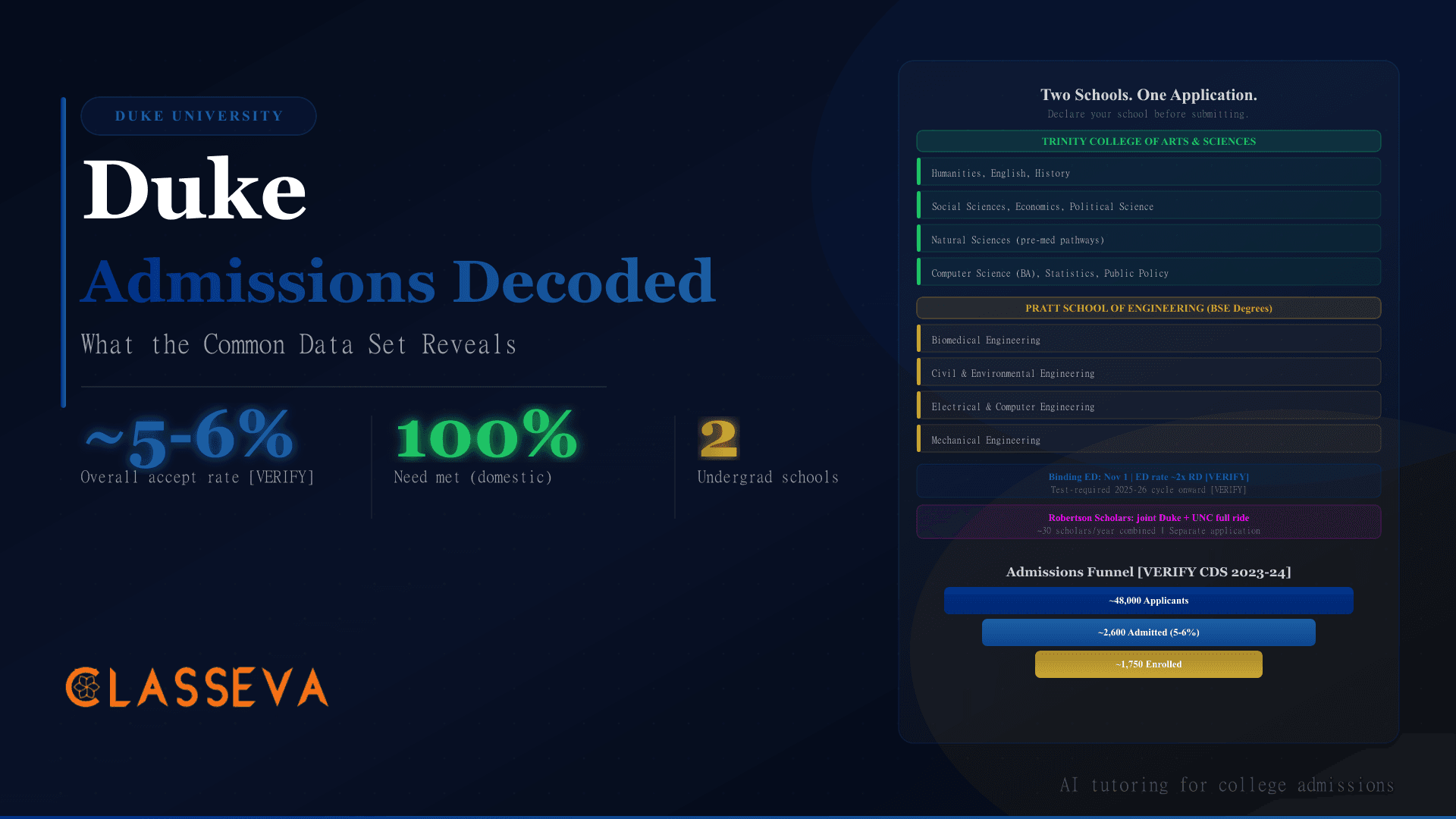
Most families research Duke as a single institution. What the Duke admissions office actually runs is two separate review processes: one for Trinity College of Arts and Sciences and one for the Pratt School of Engineering. You declare which school you are applying to before submitting, and your application lands in front of a reviewer evaluating fit with that specific school. The overall acceptance rate says very little about your individual odds without knowing which school you chose.
The other number most resources miss is the Robertson Scholarship. Duke and the University of North Carolina at Chapel Hill jointly award roughly 30 full scholarships per year to students selected through a separate competitive process. Among named merit scholarships at selective universities, few match the Robertson's combination of financial coverage and cross-campus academic access. This breakdown covers both the admissions numbers and the scholarship landscape that sits alongside them.
What Does It Take to Get Into Duke?
Getting into Duke requires academic credentials near the top of any national applicant pool, a clear reason for choosing Trinity or Pratt specifically, and evidence of engagement outside the classroom. The two-school structure means Duke's reviewers are reading your application against a defined academic context from the first page.
The Two-School Structure
When you apply to Duke, you choose a school before submitting the Common App. Trinity College of Arts and Sciences covers humanities, social sciences, natural sciences, quantitative social science, and non-engineering STEM programs. Pratt School of Engineering covers four disciplines: Biomedical Engineering, Civil Engineering, Electrical and Computer Engineering, and Mechanical Engineering. The two schools share a campus but run separate admissions reviews, and the curricular expectations built into each review differ in ways that matter to how your application reads.
Roughly 75-80% of Duke's undergraduate class enters through Trinity. [VERIFY: Trinity vs Pratt enrollment split from Duke CDS or institutional research] Pratt's smaller size means the engineering applicant pool is tighter and more uniformly competitive. Applying to Pratt with weak math and science preparation sends a signal the application cannot walk back.
Applying to Pratt with arts and humanities interests (or Trinity with an engineering passion) does not improve your chances. Duke's reviewers read for fit with the school you declared. Mismatched applications raise questions about why you did not apply to the school matching your stated goals.
The Academic Bar
The mid-50% SAT range for enrolled Duke students sits approximately 1500-1560. [VERIFY: Duke CDS 2023-24, Section C9] The mid-50% ACT composite runs approximately 34-35. [VERIFY] Most admitted students rank among the top 3-5% of their high school class, with course loads that include multiple AP or IB courses in disciplines relevant to their intended school.
Below-range scores are not automatically disqualifying, but Duke's holistic review gives significant weight to academic preparation as one factor among many. A breakdown of how holistic review works at selective universities covers how these factors interact in practice.
The Latest Duke Admissions Data
Acceptance Rate and Class Size
Duke's overall acceptance rate has compressed consistently over the past decade, settling in the 5-6% range in recent cycles. [VERIFY: exact Class of 2028 acceptance rate from Duke Common Data Set 2023-24] Duke receives approximately 45,000-50,000 applications per year [VERIFY] and enrolls roughly 1,750 students per incoming class. [VERIFY] The declining rate mirrors the broader trend across highly selective private universities as application volume has grown while class size has stayed roughly constant.
Class Profile by the Numbers
The test score ranges below come from Duke's Common Data Set, which Duke publishes annually. [VERIFY: confirm CDS URL and most recent publication year] These figures represent the middle 50% of enrolled students, not the full admitted pool, so the 25th percentile represents the realistic floor for competitive applicants.
| Test | 25th Percentile | 75th Percentile |
|---|---|---|
| SAT Composite | 1500 | 1560 |
| SAT Evidence-Based Reading and Writing | 720 | 790 |
| SAT Math | 780 | 800 |
| ACT Composite | 34 | 35 |
[VERIFY: Source Duke Common Data Set 2023-24, Section C9. Figures represent enrolled students.]
Trinity vs Pratt: Which School Should You Apply To?
This question matters more than most applicants realize. At Duke, the choice of school is not cosmetic. Admissions officers in each school review applications for fit with that school's academic expectations. A student writing about a passion for economics, public policy, or biology applies to Trinity. A student drawn to biomedical devices, circuits, or structural analysis applies to Pratt.
What Each School Actually Is
Trinity College of Arts and Sciences is Duke's flagship college, offering programs across the full breadth of liberal arts and sciences. Pre-med, pre-law, economics, political science, computer science (BA track), and environmental science students all enter through Trinity. Trinity graduates represent the majority of Duke's undergraduate class.
Pratt School of Engineering offers four undergraduate degree programs: Biomedical Engineering, Civil and Environmental Engineering, Electrical and Computer Engineering, and Mechanical Engineering. All lead to a Bachelor of Science in Engineering (BSE). The Duke admissions page on choosing between Trinity and Pratt frames the decision as a question of academic identity, not strategy.
Switching Schools After Admission
Internal school transfers at Duke are possible after enrollment. A Trinity student who wants to transfer to Pratt must complete specific prerequisite courses, maintain a competitive GPA, and pass an internal review. The process is more stringent than at schools with porous boundaries between colleges. Pratt-to-Trinity transfers are generally more straightforward because Trinity's breadth requirements overlap well with Pratt's first-year curriculum.
Students considering a school switch should begin the prerequisite coursework in the first year rather than waiting. The internal transfer window is narrower in the sophomore year once specialized coursework has locked in credit structures on one side.
Duke's Binding Early Decision
Duke offers a single binding Early Decision round, with a November 1 deadline and decisions released in mid-December. Duke does not offer a second ED round or Early Action. The Regular Decision deadline typically falls on January 2. If you are confident Duke is your first choice, binding ED is the most direct path to improving your odds.
The ED Admit Rate Advantage
Duke's ED admit rate historically runs approximately twice the Regular Decision rate, sometimes higher. [VERIFY: Duke CDS Section C21 ED figures for Class of 2028] When the overall admit rate sits around 5-6%, an ED applicant pool with a 15-20% admit rate represents a substantial statistical advantage, not a marginal one. The advantage reflects a combination of factors: the pool self-selects for students with strong demonstrated interest and well-prepared applications, and Duke benefits from locking in students who would otherwise be competing decisions with peer schools.
Early Decision
- •Binding: must enroll if admitted
- •November 1 deadline
- •Mid-December decisions
- •Admit rate roughly 2x Regular Decision [VERIFY]
- •Must withdraw all other applications upon admission
- •Financial appeal possible if aid is insufficient
Regular Decision
- •Non-binding: compare offers in April
- •January 2 deadline (typically)
- •Late March decisions
- •Overall accept rate ~5-6% [VERIFY]
- •Can hold multiple offers until May 1
- •Better for families needing to compare aid packages
What You Commit to in November
Binding ED at Duke means exactly what it says. An accepted ED applicant must submit a deposit, withdraw all other applications, and enroll at Duke for the following fall. The only recognized exception is financial: if Duke's aid package does not adequately meet your demonstrated need, you may appeal the aid decision or, in some circumstances, withdraw from the binding commitment after documenting the financial hardship.
Run Duke's net price calculator before submitting an ED application. Binding ED forfeits your ability to compare aid packages across peer schools. If Duke's aid estimate does not align with your family's budget, RD preserves your options. The College Net Cost Estimator can help model realistic costs before November.
Does Duke Require the SAT or ACT?
Duke reinstated standardized testing requirements for the 2025-26 application cycle, affecting students entering fall 2026 and beyond. [VERIFY: confirm current Duke test policy at admissions.duke.edu/apply] Both SAT and ACT are accepted. Duke's Common Data Set indicates the school considers test scores "very important" alongside GPA and course rigor in its holistic review. [VERIFY: CDS Section C7 factor weightings]
The test-optional window that operated during the COVID years has closed. Applicants without scores are at a structural disadvantage given the reinstated requirement. Duke does not publicly confirm whether it superscores the SAT or ACT, so checking the Duke apply page directly for the most current guidance before submitting scores matters.
For a broader look at how test score ranges compare across peer schools and what the Digital SAT's adaptive structure means for preparation, the college admissions resources hub covers score target-setting in detail.
The Robertson Scholarship and Other Named Programs
The Robertson Scholars Leadership Program is the most visible named scholarship at Duke, but it operates differently from most merit awards. Robertson is a joint program between Duke and the University of North Carolina at Chapel Hill: scholars spend their four undergraduate years affiliated with one institution but have full cross-enrollment access to both. The scholarship covers tuition, room, board, and a budget for summer programs, which Robertson scholars use for research, community service work, or international experiences.
Studying how Duke's scholarship infrastructure differs from peer institutions, what stands out about Robertson is the cross-campus design. Most merit scholarships tie students to a single institution. Robertson explicitly structures the experience around building relationships between Duke and UNC communities, which creates a different kind of network than a conventional full ride. The broader landscape of merit-based scholarships at selective colleges covers how Robertson fits relative to other named awards like the Morehead-Cain at UNC and the Davidson Fellows.
What Robertson Selection Looks Like
Robertson selection runs parallel to, not inside, regular admissions. Students apply for Robertson consideration either through a direct application or through nomination by their high school. The program selects roughly 30 scholars per year combined across Duke and UNC. Both schools conduct independent final selection processes, so a Robertson applicant is effectively competing within a pool of finalists for a single institution's scholarship seats.
Robertson scholars spend four years building connections across both Duke and UNC, with formal academic and social programming designed to integrate the two campuses. The scholarship makes attendance at either school financially cost-free while adding a structured leadership development component that runs throughout all four years.
Financial Aid and What Duke Actually Costs
Duke's financial aid commitmentcovers 100% of demonstrated need for all admitted domestic students. Duke does not include loans in aid packages for families below a certain income threshold, replacing them with grants and work-study. [VERIFY: exact income threshold from Duke financial aid publications] The result is that Duke's effective cost for middle-income families looks significantly different from the sticker price.
Net Price by Income Bracket
Duke's sticker price runs approximately $82,000-$86,000 per year including tuition, room, board, and fees. [VERIFY: current Duke cost of attendance from Duke admissions or financial aid site] What a family actually pays depends on the financial aid calculation. The figures below represent approximate averages from Duke's published net price data by income range. [VERIFY all from Duke financial aid publications or IPEDS net price calculator]
How to Estimate Your Costs
Duke's published income brackets provide directional guidance, but individual aid packages depend on family-specific financial circumstances that the brackets cannot capture. The CSS Profile, which Duke requires alongside the FAFSA, collects more detailed information than the FAFSA alone and produces a more accurate need estimate for most families.
Running Duke's official net price calculator before submitting an ED application is worth doing. The estimate is not binding, but it prevents the scenario where a family commits to binding ED only to discover the aid package misses their budget by a significant margin. Use the calculator below to build your full application cost picture across your school list before committing to any application strategy.
College Application Cost Calculator
Duke's application fee is one line on a longer list. Model your full application budget across reach, match, and safety schools before deciding which rounds to apply to.
How Duke Compares to Ivies and Peer Schools
Duke sits in the same selectivity tier as Brown, Dartmouth, and Cornell but is not officially an Ivy League school. The Ivy League designation is an athletic conference membership from 1954, not an academic ranking. Duke's research output, faculty-to-student ratio, and graduate placement rates sit at or above several Ivy League institutions by conventional measures.
The most meaningful differences between Duke and Ivy peers are structural. Duke has a dedicated engineering school (Pratt) rather than a joint engineering program inside a general college, which matters for engineering applicants. Duke's pre-med pipeline is among the strongest in the country by medical school acceptance rates. Duke's location in Durham, North Carolina, within the Research Triangle (alongside UNC and NC State), gives undergraduates access to a research and startup ecosystem that few peer campuses match.
What Duke offers that Ivy peers do not
A standalone engineering school (Pratt BSE degrees), the Robertson Scholarship joint program with UNC, and Research Triangle proximity that connects undergrads directly to Duke Medicine, NC State engineering programs, and a dense network of biotech and pharmaceutical companies.
Where Ivy peers offer advantages
Schools like Harvard, Yale, and Princeton carry centuries of alumni network density in finance, law, and government that Duke has not yet matched at the very top of those fields. For students targeting those specific pipelines, the school-to-outcome connection at Ivy League institutions is real.
What the selectivity data actually shows
Duke, Harvard, Yale, Princeton, Columbia, and Stanford all admit fewer than 7% of applicants. At these acceptance rates, no single school is meaningfully more or less reachable than any other. For competitive applicants, applying to Duke with strong Trinity or Pratt fit produces odds comparable to any peer institution.
For a comparison of ED and EA policies across Duke and peer schools (and how binding ED affects aid negotiation leverage), the early decision vs early action breakdown covers the strategic tradeoffs.
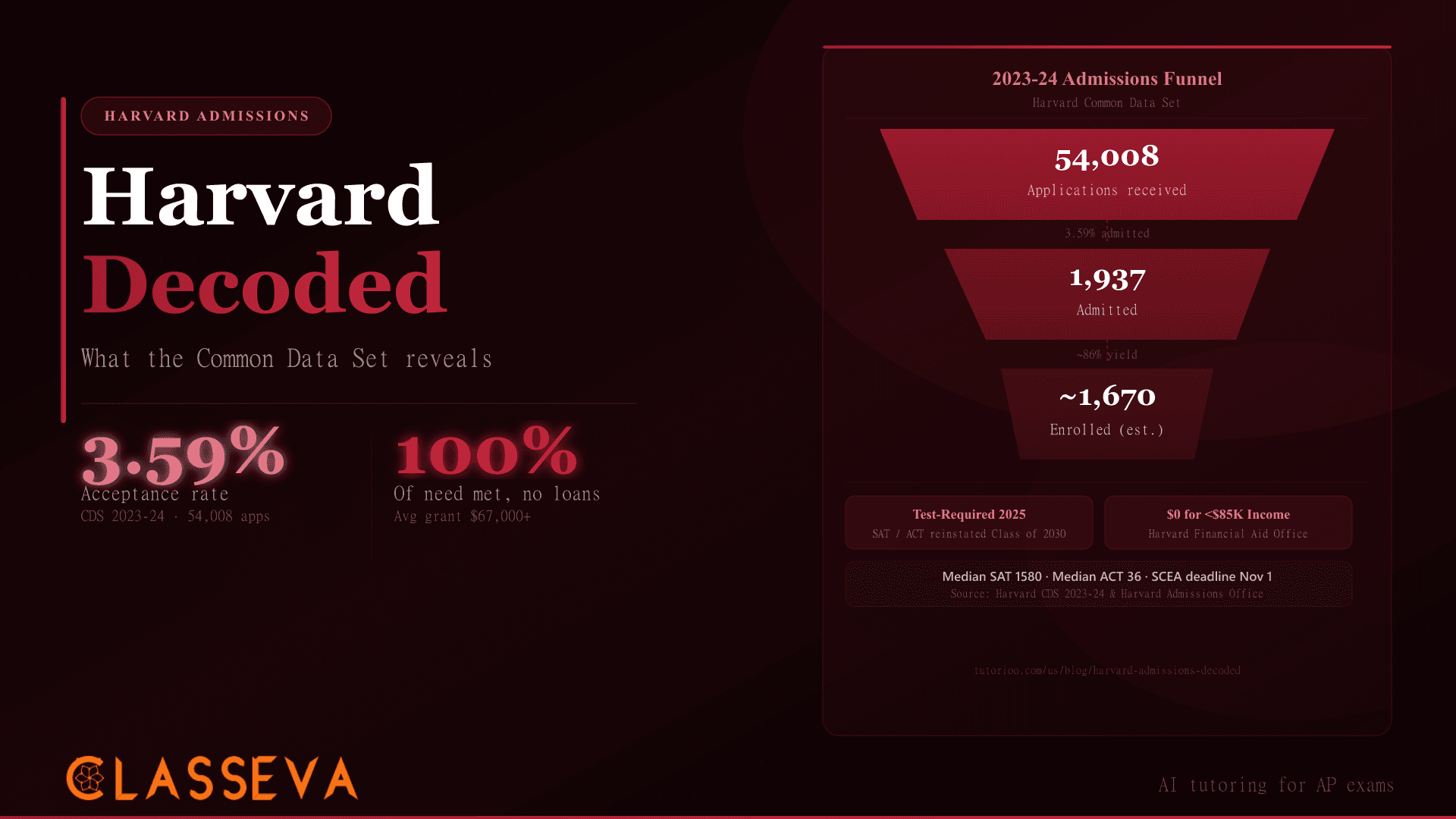
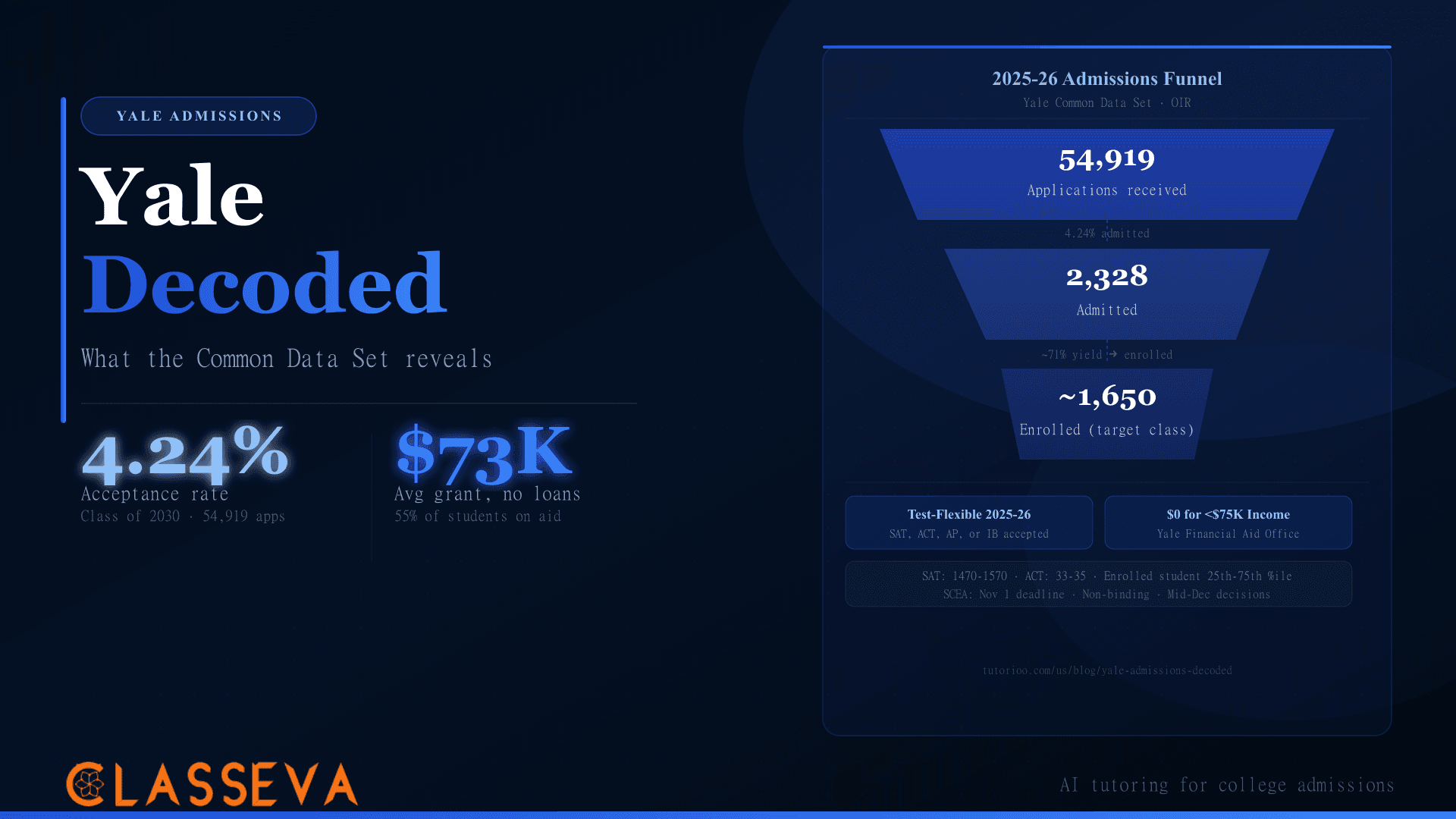
If you are evaluating Duke alongside the Ivies in detail, the breakdown of how Harvard admissions and Yale admissionswork at the CDS level provides a direct comparison of factors, score ranges, and aid policies. The structure of Duke's review is meaningfully distinct from both: the two-school declaration creates a tighter fit requirement than schools with a single undergraduate college.
Key Takeaways
- Duke admissions routes your application based on which undergraduate school you declare: Trinity College of Arts and Sciences or Pratt School of Engineering. This is not a cosmetic choice. Pick the school that matches your academic direction.
- The overall acceptance rate of ~5-6% [VERIFY] obscures the school-specific rates. Pratt applicants face a tighter and more uniformly engineering-focused pool. Trinity admits the majority of Duke's class across a broader range of fields.
- Binding Early Decision produces admit rates roughly double the RD rate at Duke. [VERIFY] If Duke is your clear first choice and the aid estimate works for your family, ED is the highest-leverage strategic move available.
- Duke reinstated test requirements for the 2025-26 cycle. [VERIFY] Submitting strong SAT or ACT scores is a stated requirement, not a bonus. The mid-50% SAT range of approximately 1500-1560 and ACT range of 34-35 [VERIFY] represent the realistic competitive floor.
- The Robertson Scholarship is entirely separate from regular admissions. It awards roughly 30 full scholarships per year across Duke and UNC combined. The application process requires a separate submission and involves campus interview rounds.
- Duke meets 100% of demonstrated financial need for domestic admits. The sticker price of approximately $82,000-$86,000 per year [VERIFY] does not reflect what most families actually pay. Running the net price calculator before applying ED prevents binding yourself to an unworkable financial commitment.
- Internal school transfers (Trinity to Pratt or Pratt to Trinity) are possible but not automatic. Students who realize they declared the wrong school should initiate the internal transfer process in the first year rather than waiting.