Northwestern Admissions Decoded: What the CDS Reveals
One distinction separates Northwestern from most other highly selective universities: you are not applying to Northwestern in the abstract. You apply to Weinberg, McCormick, Medill, Communication, Bienen, or SESP, and that school's admissions committee reads your file. The structure forces a level of intentionality that trips up applicants who build a generic top-school application and paste Northwestern into the list.
What Does It Take to Get Into Northwestern?
Getting into Northwestern requires academic performance near the top of the national distribution, genuine interest in a specific Northwestern school, and a compelling case for why that school fits your goals. The same file reads differently to Medill's committee versus McCormick's committee. A student with no documented journalism interest applying to Medill signals something the committee notices immediately.
The Academic Bar
The mid-50% SAT score range for enrolled Northwestern students runs approximately 1490-1570. The mid-50% ACT composite sits around 34-35. Both figures come from recent Northwestern Common Data Set filings and should be verified against the current CDS for the class entering fall 2026. Most admitted students rank in the top 5-7% of their high school class, and almost all come from students who loaded their schedules with the most challenging courses their school offered.
| Test | 25th Percentile | 75th Percentile |
|---|---|---|
| SAT Composite | 1490 | 1570 |
| SAT Reading and Writing | 730 | 770 |
| SAT Math | 760 | 800 |
| ACT Composite | 34 | 35 |
Source: Northwestern University Common Data Set. Approximate enrolled class percentiles. Verify exact current figures at northwestern.edu/about/facts/cds-archive/ [VERIFY]
Scoring within or above these ranges earns a full read. Below-range scores do not automatically disqualify, but they shift the burden onto the rest of the file. Northwestern reviews test scores in the context of academic rigor, meaning a 1490 from a student who took the most demanding courses available carries more weight than a 1540 from a student who avoided challenge.
The Six-School Structure Changes the Equation
Most applicants research Northwestern's overall acceptance rate without recognizing that the rate aggregates six distinct admission pools. Medill's journalism applicant pool differs from Weinberg's social sciences pool. McCormick draws heavily from students with documented engineering backgrounds. Applying to Weinberg because it seems "more flexible" while every signal in your application points toward engineering is a strategic error the separated structure makes visible to readers.
Northwestern's supplemental essays include a school-specific component asking why you want to attend that particular school. A vague answer about Northwestern's "interdisciplinary opportunities" does not satisfy this requirement. Explain which programs, faculty, or unique offerings drew you to Weinberg versus McCormick versus Medill specifically. Generic answers read as generic.
The Latest Northwestern Admissions Data
Acceptance Rate and Application Volume
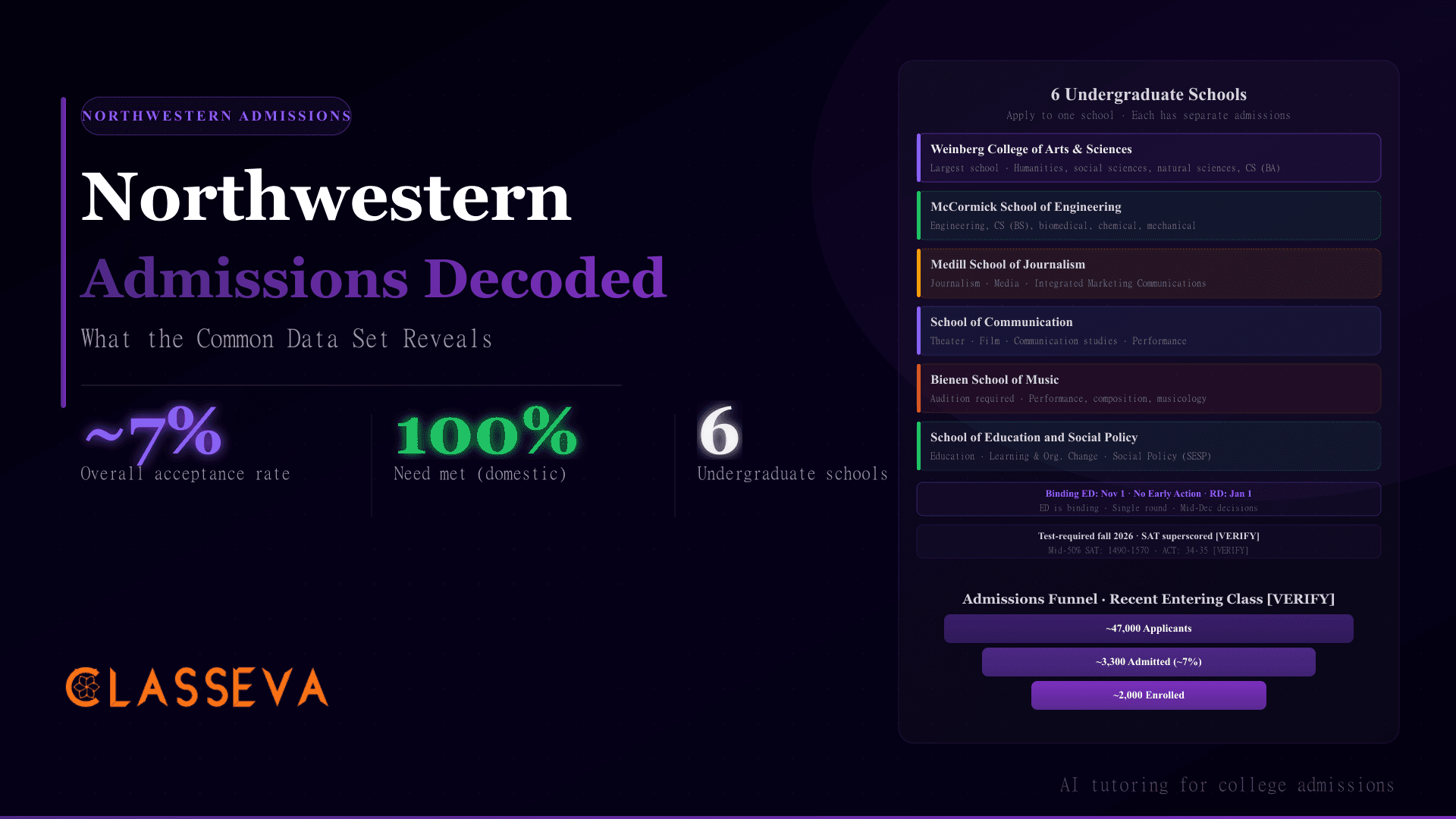
Northwestern received approximately 47,000 applications for recent entering classes and admitted around 7%, based on publicly available admissions data [VERIFY against current Northwestern CDS]. That translates to roughly 3,000-3,300 admitted students from a pool where most applicants arrive academically qualified. The compression of the acceptance rate over the past decade reflects application volume growth, not a shrinking class: Northwestern enrolls approximately 2,000 undergraduates per year.
Class Profile by the Numbers
Northwestern's CDS provides a snapshot of the enrolled class. Academic performance concentrates in the top 1-3% of the national distribution. The university draws students from all fifty states, and geographic diversity is a stated institutional priority.
| Metric | Recent Entering Class |
|---|---|
| Total applicants | ~47,000 [VERIFY] |
| Students admitted | ~3,300 (~7%) [VERIFY] |
| Enrolled | ~2,000 [VERIFY] |
| Mid-50% SAT composite | 1490-1570 [VERIFY] |
| Mid-50% ACT composite | 34-35 [VERIFY] |
| Students from top 10% of HS class | Approximately 95% [VERIFY] |
| States represented | All 50 |
Source: Northwestern University Common Data Set. Verify all figures against the current CDS at northwestern.edu/about/facts/cds-archive/
Northwestern's 6 Undergraduate Schools
Choosing the right school matters before the first word of your application gets written. Northwestern's six schools each have distinct cultures, curricula, and application requirements. Weinberg and McCormick are the largest by enrollment. Medill and Bienen are the most specialized, with audition or journalism-specific requirements. School of Communication and SESP sit between: purposeful, smaller, and demanding a clear statement of intent.
Weinberg, McCormick, and Medill
Weinberg College of Arts and Sciencesis Northwestern's largest school and the default choice for students who are not yet certain about a single discipline. It covers humanities, social sciences, natural sciences, and mathematics. Weinberg requires a Distribution System rather than a core curriculum, giving students flexibility to explore across divisions. Pre-med students typically enroll in Weinberg; so do students heading toward law, social sciences, and the humanities.
McCormick School of Engineering and Applied Science admits students directly into engineering majors. CS students at Northwestern have two distinct paths: a CS degree through McCormick (BS) or a CS degree through Weinberg (BA). The two degrees carry different requirements and slightly different focuses. McCormick applicants should signal engineering or applied science interest throughout the application, not just in the supplemental essays.
Medill School of Journalismis one of the most competitive schools to enter at Northwestern because the applicant pool skews toward students who have already been writing, reporting, or building media projects. Medill's undergrad curriculum combines journalism fundamentals with IMC (Integrated Marketing Communications) tracks. The school requires additional essays and often asks applicants to demonstrate active interest in the field before applying.
Communication, Bienen, and SESP
School of Communicationcovers theater, film, radio/television/film, and communication studies. Students interested in performance, directing, or media production apply here. BFA-track applicants often submit audition materials. The school sits distinctly between Medill's journalism orientation and Weinberg's broad arts focus.
Bienen School of Musicis Northwestern's conservatory-level music program. Most students apply to Bienen for performance or music education, and an audition is required for almost all programs. Bienen also offers dual-degree options in partnership with Weinberg, allowing students to pursue a music degree alongside a liberal arts degree over five years. The admission pool for Bienen is separately assessed from any other school.
SESP (School of Education and Social Policy)draws students interested in education, social policy, learning sciences, and organizational change. It is one of the smaller schools and one of the less well-known externally, which means the applicant pool does not swell the way Weinberg and McCormick do. Students who genuinely want to work in education policy, human development, or learning-oriented nonprofits should consider SESP seriously, both for fit and for the fact that the competition in its specific pool differs from Weinberg's.
Northwestern's Binding Early Decision
Northwestern offers one binding Early Decision round and no Early Action option. The November 1 deadline produces mid-December decisions. ED is binding: if Northwestern admits you and the financial aid package adequately covers your demonstrated need, you commit to enrolling and withdraw all other applications immediately.
Northwestern's ED commitment means withdrawing all other college applications upon admission. The one exception: if the financial aid package falls short of demonstrated need, you may be released from the binding commitment. Submit the CSS Profile as early as possible so Northwestern can provide a preliminary aid estimate before the ED deadline. Understand the full ED vs EA difference before committing.
Early Decision applicants benefit from two effects: a higher admit rate and a smaller competing pool. ED applicants who are stronger fits for their chosen Northwestern school and whose financial situation is compatible with binding commitment should consider ED seriously. Students who need to compare financial aid packages across multiple schools, or whose top choice might change after fall grades, should apply Regular Decision.
Does Northwestern Require the SAT or ACT?
Yes. Northwestern reinstated standardized testing requirements for students entering fall 2026 onward [VERIFY], ending the temporary test-optional policy it maintained for several admissions cycles. Both the SAT and ACT are accepted. Northwestern applies superscore policy for the SAT, combining the highest Evidence-Based Reading and Writing and Math scores across multiple test sittings. No superscore policy applies to the ACT.
Submitting scores in the mid-50% range or above strengthens the academic component of a file. Scores below the 25th percentile place additional pressure on grades, course rigor, and the rest of the application to compensate. Northwestern does not publish a stated minimum score cutoff, and the holistic review process at Northwestern evaluates test scores alongside every other element of the file.
Check the current Northwestern test policy
Northwestern reinstated test requirements beginning with fall 2026 applicants. Verify this applies to your entry year at admissions.northwestern.edu before assuming any test-optional flexibility remains.
Prepare both SAT and ACT if possible
Some students score significantly higher on one than the other. Take both in sophomore and junior year to identify which instrument suits you better.
Superscore SAT across multiple sittings
Northwestern superscores the SAT. A strong Math section on one date combined with a strong Reading/Writing section on another date produces a higher composite than either single sitting.
Submit scores even if at the lower bound
Northwestern requires test scores beginning with fall 2026 applicants. Not submitting leaves an obvious gap in the file. If scores are at the low end of the range, address academic rigor and other strengths to compensate.
Northwestern Supplemental Essays for 2026
Northwestern's supplement requires applicants to explain why they are applying to that specific school and why Northwestern fits their goals. The Why Northwestern essay is not a formality. Readers at Medill distinguish immediately between applicants who know Medill's curriculum and those who have lifted language from a Northwestern website overview. The same applies at McCormick: a generic statement about Northwestern's "collaborative engineering culture" does not substitute for referencing a specific lab, program, or faculty member.
Each school may have additional prompts. Bienen applicants submit an arts supplement tied to their audition preparation. Medill applicants address journalism-specific questions about their background in the field. Review the current Common App prompts for your chosen school in August of senior year, as prompt language changes annually [VERIFY]. For an overview of how supplemental essay strategy applies across highly selective schools, see the supplemental essay strategy guide.
The most effective Why Northwestern essays name specific programs, courses, research groups, professors, or unique Northwestern opportunities unavailable at peer institutions. General praise about "innovative thinking" or "global perspective" appears in thousands of Northwestern essays. Specificity is the differentiator.
The Quarter System and What It Means for You
Northwestern runs on a quarter calendar: Fall, Winter, and Spring quarters, each approximately ten weeks long. An optional summer term exists for students who want additional coursework or to fulfill internships for academic credit. Most students take three courses per quarter, moving through material significantly faster than a 15-week semester system.
The quarter calendar produces a measurable difference in how coursework feels. A topic covered over ten weeks moves at a pace that many students find more energizing than a semester; others find it stressful because there is no mid-semester catch-up period. Students who thrive with deadlines close together, who prefer breadth over depth within a single term, and who want to try more courses per year tend to prefer the quarter system. Students who need time to process complex material and who prefer deep engagement with fewer subjects at a time should factor this into their fit assessment.
Students at quarter-system schools typically complete more course credits per year than semester-system students, but each course covers a smaller total window. For subjects that build sequentially (like organic chemistry or proof-based math), the pace can feel compressed. For liberal arts exploration, three terms per year means three more chances to try something new.
Financial Aid and Northwestern's Actual Cost
Northwestern's sticker price sits above $83,000 per year when tuition, room, board, and fees are combined [VERIFY against current published figures at Northwestern Financial Aid]. The sticker price tells almost nothing about what a family actually pays. Northwestern meets 100% of demonstrated financial need for all admitted domestic students, meaning the net cost for families with demonstrated need drops substantially below sticker.
What Your Family Pays by Income
Northwestern operates a no-loan financial aid policy for families below approximately $65,000 in annual income, substituting grants for loans in aid packages [VERIFY against current Northwestern financial aid policy]. Families above that threshold still receive grants but may see loans in their packages at higher income levels. The following brackets are approximate and derived from Northwestern's published aid information; individual packages depend on assets, household size, and other factors.
| Family Income Range | Approximate Net Cost | Aid Type |
|---|---|---|
| Under $65,000/yr | Near $0 (grants cover cost) | Need-based grants, no loans [VERIFY] |
| $65,001-$100,000/yr | Roughly $10,000-$20,000/yr | Substantial grants, minimal loans |
| $100,001-$150,000/yr | Roughly $25,000-$40,000/yr | Partial grants |
| $150,001-$200,000/yr | Roughly $45,000-$60,000/yr | Smaller grants |
| $200,001+/yr | Near sticker price | Limited or no need-based aid |
Approximate figures based on Northwestern published aid data. Individual packages depend on assets, number in household, and other factors. Verify current figures at northwestern.edu/financialaid/ [VERIFY]
These figures make Northwestern affordable for many middle-income families who assume the sticker price reflects their actual cost. A family earning $90,000 per year may pay less at Northwestern than at a state flagship, once merit aid at the flagship is factored out. Families who dismiss Northwestern on sticker price without using the net cost estimator are making a financial decision on incomplete data.
How to Estimate Your Net Price
Northwestern publishes a net price calculator at its financial aid website. Use it in junior year, not after submitting applications. The CSS Profile is required for Northwestern aid consideration in addition to the FAFSA. Submit both forms as early as October 1 of senior year, before the ED deadline if you are applying ED.
The College Application Cost Calculator below helps families plan for the application process itself, including testing fees, Common App fees, and CSS Profile submission costs across multiple schools.
College Application Cost Calculator
Map out the full cost of applying to Northwestern and your other schools: Common App fees, CSS Profile, test registration, and score reporting.
What to Do If You're Below the Typical Range
Scores below Northwestern's mid-50% range do not automatically close the door, but they require the rest of the file to carry the academic signal. Northwestern's holistic review evaluates rigor of coursework alongside test scores, meaning a student who took the hardest available courses and earned straight As in a challenging program reads differently from a student who achieved the same GPA in easier classes.
Non-academic factors carry real weight at Northwestern in ways the Common Data Set documents. Northwestern's CDS lists character and personal qualities, extracurricular activities, and talent/ability as factors the admissions office weighs [VERIFY against CDS Section C7]. Students with strong leadership trajectories, sustained commitments, or distinctive creative or athletic records have been admitted below the test score ranges. Applying below range to a reach school is rational; applying below range without a compelling non-academic case is not.
For students who cannot reach Northwestern's ranges and want to improve, the clearest path runs through consistent preparation in junior year. For students who are at or near the range, Northwestern's policy on demonstrated interest and its binding ED opportunity offer strategic levers worth understanding before the application cycle starts.
Key Takeaways
- Northwestern runs six separate undergraduate schools, each with its own admissions committee. You apply to one school, and your application is evaluated by that school specifically.
- The overall acceptance rate sits near 7%. Verify the current figure against Northwestern's published Common Data Set at northwestern.edu/about/facts/cds-archive/.
- Northwestern reinstated test requirements for fall 2026 applicants onward. Both SAT and ACT are accepted; Northwestern superscores the SAT.
- Northwestern offers one binding Early Decision round (November 1 deadline). There is no Early Action option. ED produces a meaningfully higher admit rate.
- The supplemental essays are school-specific. Generic Why Northwestern essays do not satisfy readers who spend their year reviewing essays tailored to their school's programs.
- The quarter system runs three 10-week terms per year, moving faster than a semester system and requiring students to adapt to compressed course timelines.
- Northwestern meets 100% of demonstrated need for admitted domestic students. Use the net price calculator at Northwestern's financial aid website before dismissing Northwestern on sticker price.