AI and Homework: Is Using AI Cheating?
Your child almost certainly knows about ChatGPT, Claude, Gemini, and Copilot. There is a good chance they have already used one of these tools for schoolwork. The question is not whether AI homework cheating is happening; it is whether your child understands the difference between using AI to cheat and using AI to learn.
From speaking to hundreds of families while building Classeva, the pattern I see most often is not students deliberately trying to cheat. It is students genuinely unsure where the line is. They ask an AI to explain a concept, then ask it to write a paragraph, then submit that paragraph. At no point did anyone tell them where “help” ended and “cheating” began.
This post gives you a clear, practical framework for thinking about AI and homework: when it crosses the line, when it genuinely supports learning, and exactly what to say to your child about it.
The Question Every Parent Should Ask
If your child is in secondary school, the question is not “Is my child using AI?” but “How is my child using AI?” The tools are free, accessible from any phone or laptop, and capable of writing essays, solving maths problems, explaining science concepts, and generating code in seconds. Pretending they do not exist is not a strategy.
Students Are Already Using AI
A 2024 survey by the National Education Union found that the majority of secondary school teachers were aware of students using AI for homework, with many reporting difficulty detecting it. This matches what I hear from parents: most know their child has access to AI tools, but few have had a direct conversation about how to use them responsibly.
Schools are responding in wildly different ways. Some have banned AI entirely. Others actively encourage it with guidelines. Many have not yet established any clear policy at all. This means the responsibility currently falls on parents to set expectations at home.
The UK Department for Education published guidance on generative AI in education in 2023, updated in 2024, acknowledging that AI tools are here to stay and recommending schools develop clear usage policies rather than blanket bans.
When Using AI for Homework Is Cheating
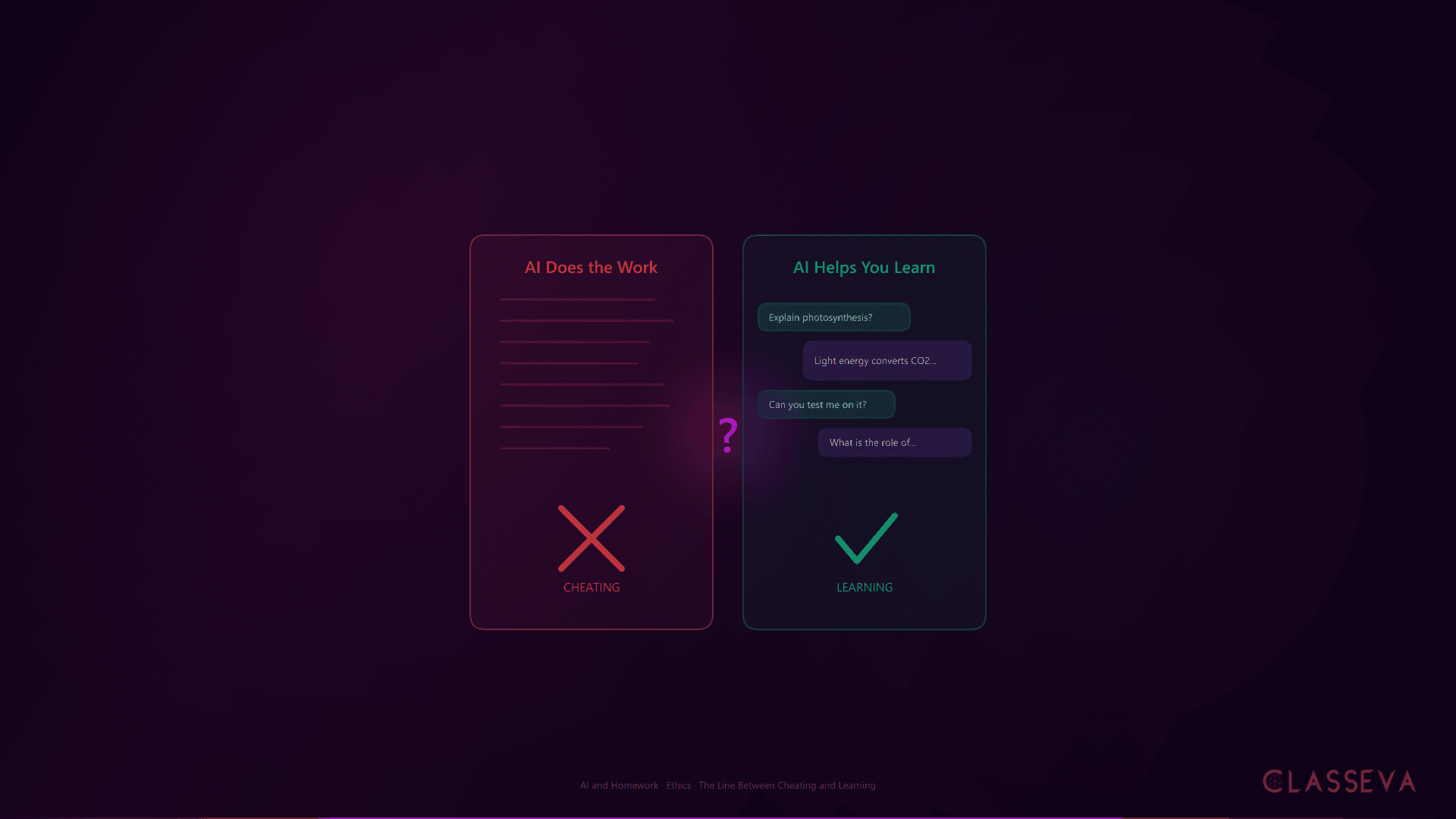
Let's be direct. Using AI for homework is cheating when the student submits AI-generated work as their own without disclosure. This applies whether they use ChatGPT to write an English essay, solve a set of maths equations, produce a science report, or generate code for a computing project.
This is no different in principle from copying from a textbook, paying someone else to write an essay, or using a friend's completed homework. The student has not done the work. They have not learned anything. The homework submission misrepresents what they know and can do.
Clearly Cheating
- •Pasting a homework question into ChatGPT and submitting the response
- •Getting AI to write an essay, then putting your name on it
- •Using AI to solve problem sets you were meant to work through
- •Generating coursework content without disclosure
- •Using AI during a task designed to test YOUR knowledge
Clearly Legitimate
- •Asking AI to explain a concept you do not understand
- •Writing your own essay, then asking AI for feedback
- •Generating practice questions to test yourself
- •Getting alternative explanations when textbook is unclear
- •Using AI to quiz you before a test
There is also a critical context factor: if your child's school has a policy that says “no AI tools for homework,” then any AI use is a violation regardless of how it was used. Even legitimate learning uses would breach the school's rules.
The Coursework and NEA Line
For coursework and Non-Exam Assessment (NEA), the line is drawn even more firmly. All major UK exam boards have explicitly stated that AI-generated content in coursework constitutes malpractice. This is not a grey area.
Some students assume that using AI for coursework is fine as long as they “edit it a bit” or “put it in their own words.” It is not. AQA, Edexcel, and OCR all classify AI-generated coursework as malpractice, which can result in disqualification from that subject or, in serious cases, all subjects.
AI detection tools like Turnitin's AI writing detector exist, but they are imperfect. They produce false positives (flagging genuinely human-written work) and can be bypassed by sophisticated users. Schools and exam boards know this, which is why they increasingly rely on teachers' professional judgement: does this piece of work match what this student can produce in class?
When AI Genuinely Helps Learning
Here is where the conversation gets more nuanced, and more important. AI homework help is not inherently bad. Used correctly, AI tools can be genuinely powerful learning aids. The key principle is simple: AI should help the student learn, not replace the learning.
Five Legitimate Uses of AI for Students
| Use | Example Prompt | Why It Works |
|---|---|---|
| AI as Tutor | "Explain photosynthesis in simple terms" | Builds understanding; student could then explain it themselves |
| AI for Feedback | "Here is my essay. What are the weakest arguments?" | Student did the work; AI helps improve it |
| AI for Practice | "Give me 10 GCSE-style questions on quadratic equations" | Active recall practice, the most effective revision technique |
| AI for Research | "Give me an overview of the causes of WW1" | Starting point for deeper research with proper sources |
| AI as Study Buddy | "Test me on the key quotes from Macbeth" | Interactive revision that forces retrieval from memory |
Five legitimate ways students can use AI tools for learning.
Notice the pattern: in every legitimate use, the student is doing the thinking. The AI provides explanations, feedback, questions, or structure, but the student processes, understands, and produces the final work themselves. Having worked with parents navigating the best AI learning tools available in 2026, I have seen first-hand how transformative these tools can be when used this way.
AI as Tutor, Not Answer Machine
The distinction between AI as a tutor and AI as an answer machine is at the heart of this entire debate. A good human tutor does not give students the answers. They ask guiding questions, provide hints, explain concepts from different angles, and let the student work through problems themselves. AI can do exactly the same thing, if the student uses it that way.
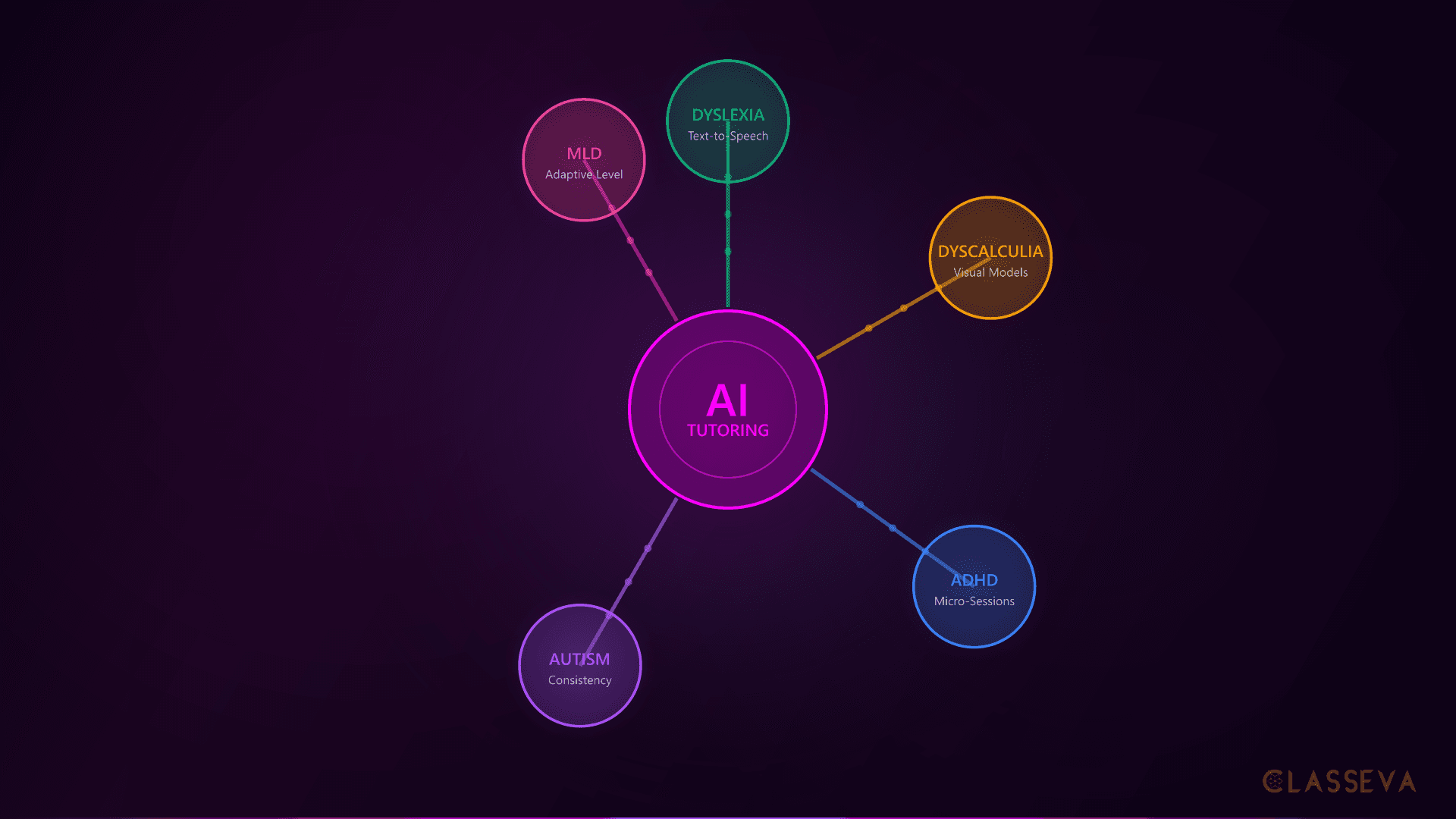
This is the model Classeva's AI tutoring follows. The AI guides students through problems step by step, asking questions and providing hints rather than handing over complete answers. The student does the thinking. The AI provides the scaffolding. It is the difference between a crutch that replaces your legs and a physiotherapist who helps you walk again.
Ask your child to show you how they use AI, not just whether they use it. Watch the conversation. Are they asking it to explain things, or are they copying and pasting answers? The interaction pattern tells you everything.
The “Could I Do This Without AI?” Test
If you take one thing from this entire post, let it be this framework. After your child uses AI for any homework task, they should ask themselves one question: “Could I now do this on my own, without the AI?”
If the answer is yes, the AI helped them learn. That is good use. If the answer is no, the AI did the work for them. That is cheating, regardless of how the work was produced.
How the Test Works in Practice
| Task | How AI Was Used | Could Do Without AI? | Verdict |
|---|---|---|---|
| English essay | Asked AI to explain what "pathetic fallacy" means, then wrote the paragraph | Yes | Legitimate |
| Maths homework | Pasted 10 equations into ChatGPT and copied answers | No | Cheating |
| Science report | Wrote report, asked AI to check for factual errors | Yes | Legitimate |
| History essay | Asked AI to write the essay, then changed a few words | No | Cheating |
| French vocabulary | Asked AI to quiz them on 30 new words | Yes | Legitimate |
Applying the test to real homework scenarios.
This test is powerful because it is honest and simple enough for any student to apply. It does not require them to understand complex ethical frameworks. It just asks: did you learn something, or did the machine do the learning for you?
Teach your child this test explicitly. Say it to them: “After you use AI for anything, ask yourself: could I do this without it now? If not, you have not done the homework, the AI has.”
What Schools Are Doing About AI
School responses to AI range from complete bans to active integration. The majority sit somewhere in the middle: aware that AI exists, unsure exactly what to do about it, and gradually developing policies. This inconsistency is one of the biggest challenges parents face.
Exam Board Policies
While schools may differ, the exam boards have been clear. AQA, Edexcel (Pearson), and OCR have all explicitly stated that AI-generated content in coursework or NEA constitutes malpractice. This applies to any assessed work submitted for qualifications. The consequences can range from receiving zero marks for the piece of work to disqualification from the entire subject.
| Exam Board | Position on AI in Coursework | Consequence |
|---|---|---|
| AQA | AI-generated content is malpractice | Zero marks to full disqualification |
| Edexcel (Pearson) | Submitting AI work as own is malpractice | Zero marks to full disqualification |
| OCR | AI-generated coursework is not permitted | Zero marks to full disqualification |
All major UK exam boards treat AI-generated coursework as malpractice.
Many schools are now integrating AI literacy into the curriculum: teaching students what AI is, how it works, and how to use it responsibly. This is a positive development. Rather than pretending AI does not exist, schools are helping students develop the critical thinking skills to use it well.
The Exam Reality Check
Here is the fact that should sharpen every parent's thinking on this issue: GCSEs and A-levels are handwritten, timed, and AI-free.There is no ChatGPT in the exam hall. No AI assistance during those two or three hours that determine your child's grades.
A student who uses AI to produce their homework but cannot perform in exams will be exposed. The gap between homework quality and exam performance will be obvious to teachers, parents, and ultimately to the student themselves. The purpose of homework is to build the skills that exams test. Shortcutting homework with AI defeats the entire point.
Skills at Risk from AI Dependence
The conversation about AI in education is not just about ethics. It is about skills. Every time a student lets AI do the work, they miss an opportunity to develop abilities they will need in exams and beyond.
If your child uses AI to write their English essays, they will never develop their own written voice. If they use AI to solve maths problems, they will never build the mathematical reasoning that evidence-based revision techniques are designed to develop. If they use AI for critical analysis, they will never learn to form and defend their own arguments.
The fundamental purpose of homework is to practise and develop these skills. AI that shortcuts this process does not save time. It steals learning.
Ask your child: “If I took away ChatGPT right now and gave you this task on paper with a time limit, could you do it?” If the answer is no, the homework is not building the skills they need for their exams.
Practical Advice for Parents
The good news is that you do not need to be a technology expert to guide your child through this. The framework is straightforward, and the conversation can be surprisingly simple once you have the right approach.
Seven Steps to Guide Your Child's AI Use
Have the conversation
Talk openly about AI tools. Ask your child if they are using them and how. Make it a discussion, not an interrogation. Most students will be honest if the conversation feels safe.
Set clear expectations
"You can use AI to help you understand something, but you cannot use it to do the work for you." This single sentence covers most situations.
Check the school’s policy
Ask your child’s school what their AI policy is. If they have one, follow it. If they do not, your home expectations fill the gap until they do.
Teach the "Could I do this without AI?" test
Give your child the framework from this post. After any AI-assisted homework, they should be able to answer YES to this question. If not, they need to go back and actually learn the material.
Watch for warning signs
A sudden improvement in homework quality without corresponding improvement in test scores or class participation may indicate over-reliance on AI. Ask teachers for their perspective.
Encourage responsible use
AI as a tutor is genuinely valuable. Encourage your child to use AI to explain concepts, generate practice questions, and get feedback on work they produced themselves. This is not cheating; it is smart revision.
Remember the exam reality
GCSEs and A-levels are handwritten, timed, and AI-free. The student who cannot write an essay or solve equations without AI will be exposed when it matters most. Homework builds those exam skills.
Warning Signs of Over-reliance
How do you know if your child has crossed from using AI as a learning tool to depending on it as a crutch? Watch for these patterns:
Healthy AI Use
- •Can explain homework answers when you ask
- •Test scores match homework quality
- •Uses AI alongside other revision methods
- •Willing to attempt tasks without AI first
- •Asks AI specific questions, not "do my homework"
Warning Signs
- •Cannot explain their own homework answers
- •Homework quality far exceeds test performance
- •Refuses to attempt anything without AI first
- •Homework is done suspiciously fast
- •Writing style changes dramatically between home and school
If you notice these warning signs, it does not mean your child is deliberately cheating. More often, they have slipped into a pattern of convenience without realising how much learning they are bypassing. A calm, non-judgemental conversation using the “Could I do this without AI?” framework is usually enough to reset expectations.
If your child is struggling with homework battles and turning to AI out of frustration rather than laziness, the underlying issue may be that they need additional support. AI tutoring that guides rather than gives answers, like Classeva, can provide that scaffolding while keeping the student in the driving seat.
Banning AI tools entirely is usually counterproductive. Your child will likely use them anyway, just secretly. It is far better to set clear expectations about how to use AI responsibly than to pretend the tools do not exist. Guide the behaviour; do not try to prevent access.
The students who will thrive in the AI era are not those who avoid the tools entirely, nor those who let AI do everything for them. They are the students who learn to use AI as a genuine learning partner: asking it to explain what they do not understand, test what they think they know, and challenge them to think more deeply. That is the goal for your child, and it starts with a single conversation at home.
For more on how AI can support your child's learning responsibly, see our guides on AI tutoring versus human tutoring and the best AI learning tools for students in 2026.