AI Tutoring for Children With SEN and Learning Difficulties
For children with Special Educational Needs and Disabilities (SEND), the gap between what they need and what they receive in school is often enormous. Class sizes are too large for individualised attention, teaching assistants are overstretched, and waiting lists for EHCP assessments can stretch beyond six months. AI tutoring for children with SEN and learning difficultiesoffers something genuinely new: infinitely patient, always available, personalised instruction that adapts to each child's pace.
This is not about replacing specialist human support. It is about filling the gaps that currently leave too many children without the help they need. One observation that stuck with me from my time in tutoring was how many parents of SEN children felt abandoned by the system. They knew their child needed more support. They just could not access it quickly enough.
The SEND Support Gap in UK Schools
Approximately 1.6 million children in England have identified Special Educational Needs, according to DfE statistics. That is around 17% of all pupils. The most common types of SEN include Speech, Language and Communication Needs (SLCN), Moderate Learning Difficulty (MLD), Social, Emotional and Mental Health needs (SEMH), and Specific Learning Difficulties (SpLD) such as dyslexia, dyscalculia, and dyspraxia.
Despite these numbers, funding for SEND support in schools is under severe national pressure. The Education Select Committee has repeatedly flagged the gap between the support children are entitled to and what they actually receive. Many families wait six months or longer for an initial EHCP assessment, and even children with existing plans often receive limited one-to-one time during the school day.
Why Traditional Support Falls Short
The fundamental problem is capacity. A teaching assistant supporting a class of 30 cannot give individualised attention to five children with different SEN profiles simultaneously. A SENCO managing 80 or more children across a school cannot provide the depth of support each child deserves. And private specialist tutoring, at £50 to £80 per hour, is out of reach for most families.
| SEN Type | Core Challenge | What the Child Needs |
|---|---|---|
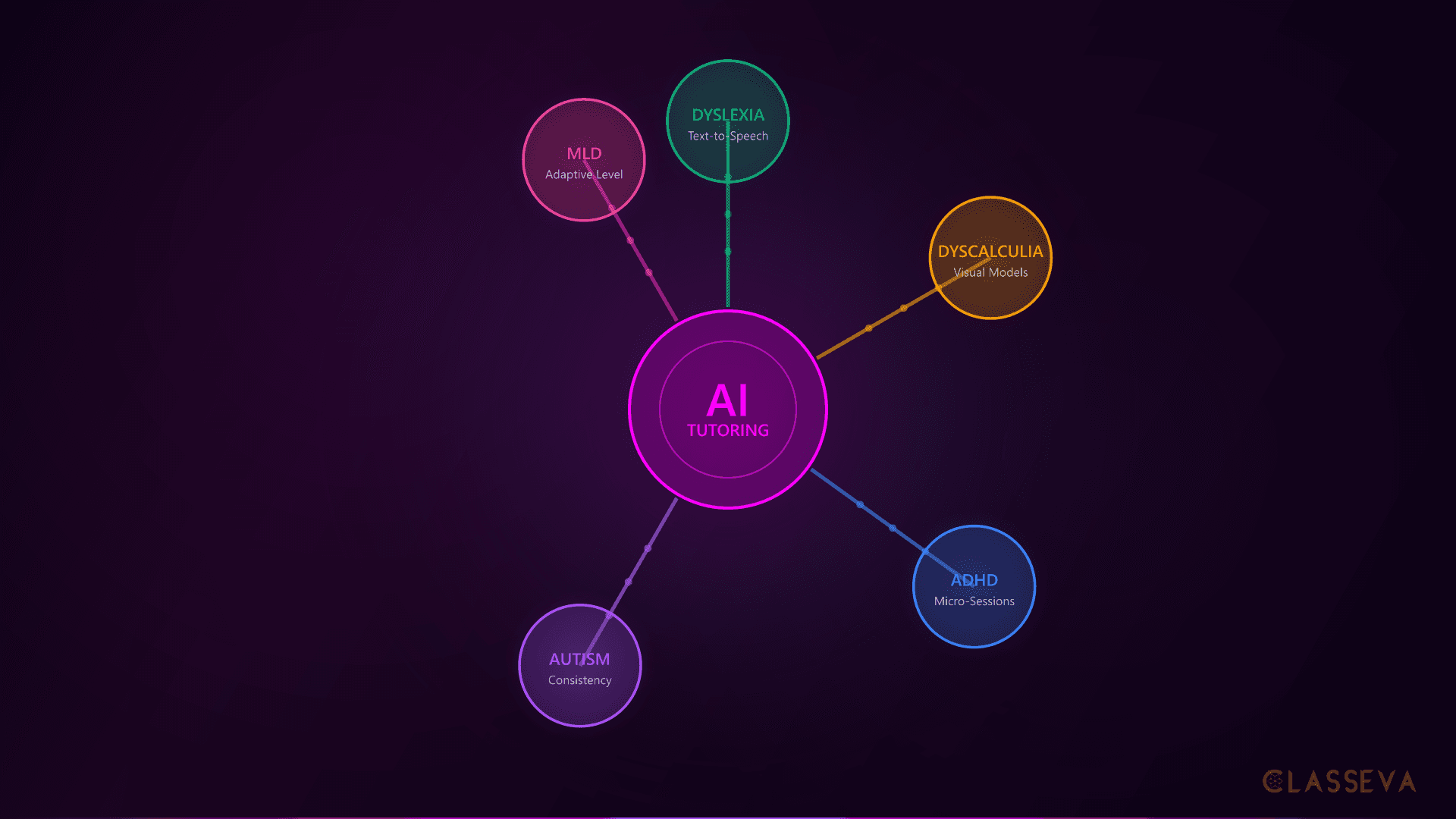
| Dyslexia (SpLD) | Decoding written text | Multi-sensory input, verbal alternatives, patient repetition |
| Dyscalculia (SpLD) | Processing numerical concepts | Visual models, step-by-step breakdowns, immediate feedback |
| ADHD / Attention | Sustaining focus | Short sessions, flexible pacing, engagement rewards |
| Autism Spectrum | Unpredictable social cues | Consistent responses, literal language, special interest integration |
| Moderate Learning Difficulty | Processing speed and complexity | Adaptive difficulty, multi-sensory content, small-step progress |
Source: DfE SEN categories. Each type requires different adaptations that AI can provide at scale.
This is where AI learning support for SEN children becomes genuinely valuable. Not as a replacement for any of these human roles, but as a tool that can provide the kind of patient, personalised, always-available practice that children with SEN desperately need and rarely get enough of.
How AI Tutoring Helps Children With SEN
The strength of AI tutoring is not that it understands your child's emotions or builds a relationship with them. It is that it can adapt instantly to how your child learns, repeat explanations without ever losing patience, and be available at 9pm on a Sunday when no human tutor would be. For children with SEN, these qualities matter enormously.
Dyslexia
For a dyslexic child, the biggest barrier is often not understanding the subject itself. It is decoding the written words on the page. AI for dyslexia students can remove this barrier entirely by providing text-to-speech (so the child hears the question read aloud), accepting verbal answers (so they do not need to write), and offering customisable display settings like larger fonts, different background colours, and increased line spacing.
Crucially, an AI tutor can break complex instructions into smaller, simpler steps, reducing cognitive overload. And a child can ask the same question ten times without a flicker of impatience from the AI. For children who have spent years feeling embarrassed about asking for help, that consistency is transformative.
If your child has dyslexia, look for AI tools that offer text-to-speech and verbal input. The goal is to separate the reading difficulty from the subject content, so your child can demonstrate what they actually know.
Dyscalculia
Dyscalculia makes numerical processing genuinely difficult in a way that goes beyond “being bad at maths.” Children with dyscalculia often struggle to hold numbers in working memory, understand place value, or see relationships between quantities. AI can help by providing visual representations of mathematical concepts: bar models, number lines, diagrams, and animated step-by-step breakdowns that show each calculation as a series of small, manageable moves.
The immediate feedback loop is especially valuable here. When a child makes an error, the AI can catch it instantly and explain exactly where the reasoning went wrong, before the mistake becomes a habitual pattern. Traditional classroom teaching often cannot provide this: a teacher marking books that evening will not catch the moment a misconception forms.
ADHD and Attention Difficulties
Children with ADHD do not lack intelligence. They lack the neurological support for sustained attention in conventional formats. A 50-minute maths lesson with 29 other children is not designed for a brain that works in bursts. AI tutoring for special needs children with attention difficulties works because it can deliver content in short, focused chunksof five to ten minutes, matching the child's natural attention cycle rather than fighting against it.
Traditional Classroom
- •50-minute fixed lessons
- •Must keep pace with 29 other students
- •Social pressure to sit still and stay quiet
- •Missed content if attention drifts
- •Homework battles at the end of a long day
AI Tutoring
- •5 to 10 minute focused sessions
- •Pace adapts to the child in real time
- •No social pressure or judgement
- •Can pause, break, and return without penalty
- •Available when focus is naturally highest
Features like progress tracking, streaks, and rewards help maintain engagement for children whose brains respond strongly to immediate reinforcement. And the flexibility to learn at 7am (when some ADHD children are most alert) rather than during a 2pm lesson (when medication may be wearing off) can make a meaningful difference.
Autism Spectrum
For many autistic children, the social environment of a classroom is the biggest obstacle to learning. Reading a teacher's tone, interpreting ambiguous instructions, navigating group work, and managing the sensory overwhelm of a busy room all consume cognitive resources that should be going towards the actual lesson content.
AI removes almost all of these barriers. It responds the same way every time: no confusing social cues, no sarcasm, no unpredictable reactions. It uses clear, literal language without ambiguity. And perhaps most valuably, it can incorporate a child's special interests into learning. Teaching fractions through Minecraft. Explaining physics through space exploration. This is not a gimmick; research consistently shows that autistic children engage more deeply when learning connects to their areas of intense interest.
Many autistic children find asking questions in class extremely anxiety-inducing. An AI tutor provides a completely judgement-free space where a child can ask anything, as many times as they need, without worrying about how they appear to classmates or the teacher.
Moderate Learning Difficulties
Children with Moderate Learning Difficulties (MLD) typically process information more slowly and need more repetition to consolidate understanding. In a classroom, this often means they are placed in the “bottom group” and carry the psychological weight of that label. AI tutoring removes the grouping entirely. The child works at their own level without any visible comparison to peers.
AI also excels at providing multi-sensory content: combining text, images, audio, and interactive elements so that learning enters through multiple channels. Progress tracking that celebrates small gains is critical for motivation. A child who moves from answering 3 out of 10 correctly to 5 out of 10 has made genuine progress, and AI can recognise and reinforce that in a way a busy classroom teacher may not have time to.
What AI Tutoring Cannot Do
It would be irresponsible to discuss AI education for SEND in the UK without being clear about its limitations. AI is a powerful learning tool, but it is not a therapist, a diagnostician, or a replacement for the human relationships that children with SEN often need most.
AI tutoring cannot provide a formal diagnosis or assessment of SEN. It cannot replace a qualified SENCO, educational psychologist, or specialist teacher. It cannot offer the empathy, emotional support, or relationship-building that many SEND children need. And it cannot manage challenging behaviour or support a child in emotional crisis.
The Human Support That Remains Essential
Parents should continue pursuing EHCP assessments and school-based interventions regardless of whether they use AI tools at home. A child who needs speech and language therapy will not get that from an AI tutor. A child who needs occupational therapy for sensory processing will not find it in any app. AI fills the academic practice gap. It does not fill the therapeutic gap.
The right way to think about AI tutoring is as one tool within a broader support system. It sits alongside (not above or instead of) the SENCO, the teaching assistant, the specialist teacher, and the educational psychologist. When I speak to parents building Classeva into their child's routine, the ones who see the best results are those who treat it as a supplement that extends what the school is already doing.
AI vs Traditional SEND Support: Where Each Excels
Rather than framing this as a competition, it helps to understand where each type of support has genuine strengths. AI and human tutoring serve different functions, and for SEND children this distinction matters even more.
| Capability | AI Tutoring | Human Specialist |
|---|---|---|
| Availability | 24/7, unlimited sessions | Limited hours, often waiting lists |
| Patience | Infinite, never frustrated | Human, can vary day to day |
| Personalisation speed | Adapts in real time | Needs observation over weeks |
| Emotional support | None | Essential for wellbeing |
| Formal assessment | Not possible | Qualified to diagnose and assess |
| Behaviour management | Cannot intervene | Trained strategies |
| Cost | Free or low monthly fee | Typically £50 to £80 per hour |
| Curriculum alignment | Exact specification match | Depends on tutor knowledge |
AI and human support are complementary, not competitive. The best outcomes come from using both.
Practical Advice for Parents
If your child has SEN and you are considering AI tutoring, here is what the families I have worked with have found most effective. The key principle is simple: AI works best as a regular, low-pressure supplement, not as an intensive intervention.
Starting With AI Tutoring at Home
Try it together first
Sit with your child during the first few sessions. Watch how they respond. Some children love the independence immediately; others need reassurance that the AI is there to help, not to test them.
Start with areas of strength
Use the AI for subjects your child already enjoys, not just their weakest areas. Building confidence in strong subjects supports motivation across the board.
Keep sessions short
For most SEN children, 10 to 15 minutes of focused AI tutoring is more effective than 45 minutes of increasingly distracted engagement. Quality of attention matters more than quantity of time.
Build a regular routine
Three short sessions per week is better than one long session on a Sunday evening. Regularity helps children with SEN feel secure and builds the habit gradually.
Monitor what they are actually doing
Ensure the AI is being used as a learning tool, not just a way to get homework answers. Check in on progress reports and ask your child to explain what they covered.
Be patient with progress
AI tutoring works through consistent, repeated exposure over weeks and months. Do not expect dramatic results after three sessions. Look for small, steady improvements.
Coordinating With Your Child's School
Always inform the SENCO if you are using AI tutoring at home. This is not about asking permission. It is about ensuring the approaches are coordinated. If the school is using a particular method for teaching phonics to your dyslexic child, and the AI is using a different method, the conflicting approaches can create confusion rather than progress.
Ask the SENCO: “What specific areas would benefit most from extra practice at home?” Then use the AI to target those exact areas. This makes the AI tutoring an extension of the school's plan rather than a separate, uncoordinated effort.
For parents of children awaiting EHCP assessments, AI tutoring can also provide valuable evidence. If you can show that your child engages well with personalised, adaptive content but struggles in classroom settings, this data point supports the case for additional formal support. The IPSEA (Independent Provider of Special Education Advice) website has excellent guidance on the EHCP process.
How Classeva Supports SEND Learners
Classeva's AI tutoringwas built to adapt to every student, and that includes children with SEN. The AI follows the student's exact exam board specification, so it never goes off-topic or wastes time on irrelevant content. Explanations can be repeated without limit, broken down into smaller steps, or approached from a completely different angle if the first explanation does not land.
It covers GCSE and A-Level curriculum content with personalised pathways, and it is available 24/7. That last point matters more than people realise for SEND families. When your child has a good focus window at 8pm on a Wednesday, they can use it. When they need to revisit something explained in class three weeks ago, it is there. The SENDIASS network recommends that parents explore all available support options, and AI tutoring is increasingly part of that picture.
Classeva supplements school-based SEND support. It does not replace your child's SENCO, teaching assistant, or any specialist intervention. The best AI learning tools work within the existing support system, not outside it.
If your child has SEN and you want to see whether AI tutoring could help them, the simplest next step is to try a free session together. Sit with them, see how they respond, and take it from there.