How AI Tutoring Works: A Simple Guide for Parents
When I tell parents that their child can get tutoring from an AI, I get one of two reactions. Either a blank stare followed by “So, like a robot reading a textbook?” or genuine curiosity mixed with scepticism: “But can a computer actually teach?”
Both reactions are fair. The phrase “AI tutoring” sounds either futuristic or gimmicky depending on your frame of reference. But having built Classeva and watched thousands of students use it, I can tell you that what actually happens during an AI tutoring session is far more practical and far less sci-fi than most parents imagine. This guide explains how AI tutoring works in plain English, with no jargon and no hype.
What Is AI Tutoring?
AI tutoring is software that uses artificial intelligence to teach your child. Instead of a human tutor sitting across the table, your child interacts with an AI that can explain concepts, generate practice questions, mark answers, and adapt its approach based on how your child is doing.
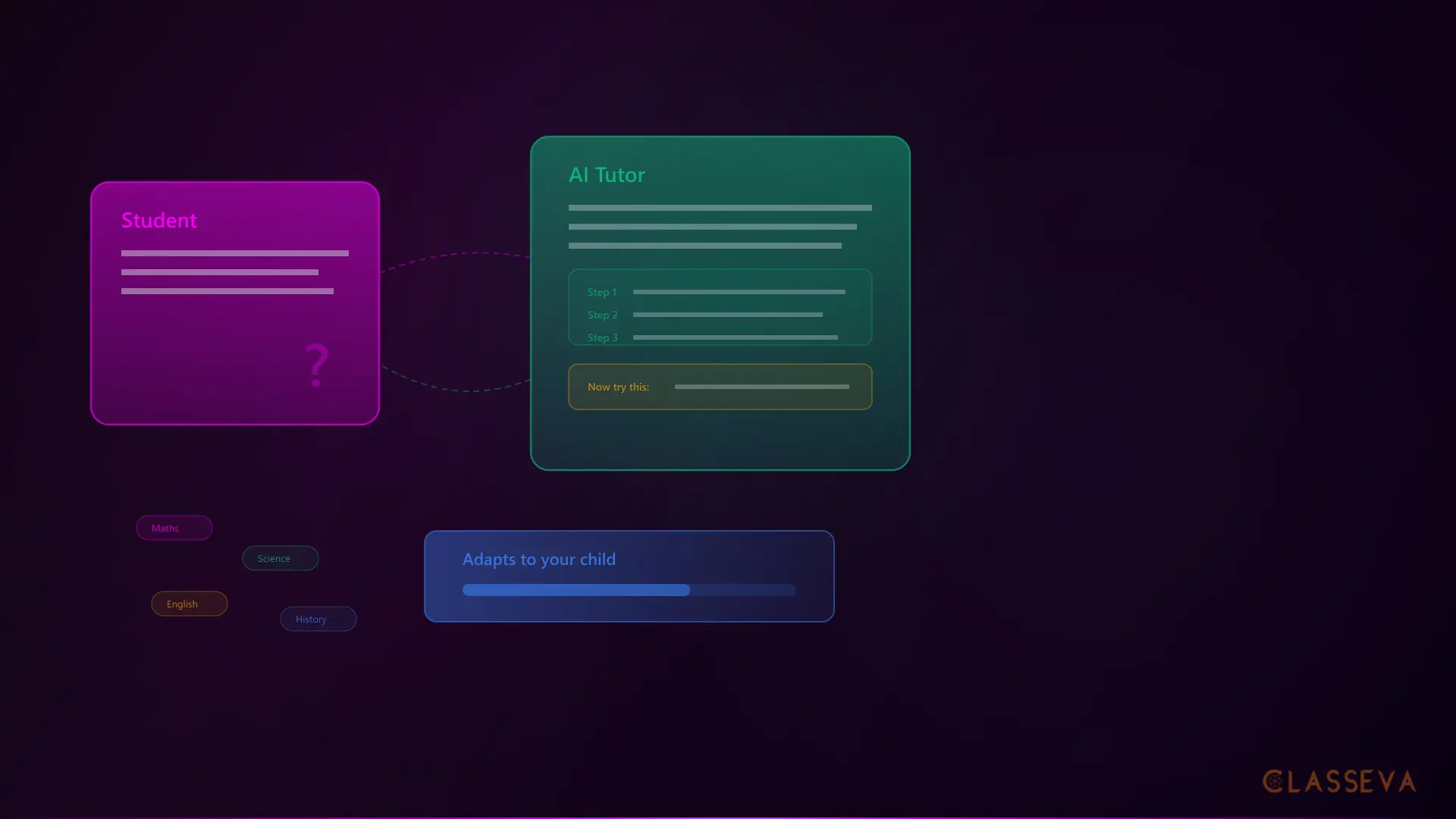
The key word is adapt. A textbook gives everyone the same explanation. A video gives everyone the same walkthrough. An AI tutor adjusts. If your child is studying GCSE Foundation maths, the explanations are simpler and the questions are targeted at grades 1 to 5. If they are on Higher, the AI pushes further. If they get three questions on fractions right in a row, it moves on. If they get one wrong, it pauses to explain why.
How It Differs from Google or YouTube
Parents sometimes ask why their child cannot just use Google or YouTube instead. The difference comes down to three things: relevance, interaction, and feedback.
Google / YouTube
- •Shows results for everyone, not tailored to your child’s exam board
- •Passive: your child watches or reads but doesn’t practise
- •No feedback on whether they actually understood
- •Easy to get distracted by unrelated content
AI Tutoring
- •Adapts explanations to your child’s level and specification
- •Interactive: asks questions and checks understanding
- •Instant feedback with explanations when wrong
- •Focused on learning, no ads or distractions
Google is a search engine. It finds information. AI tutoring teaches information. That distinction matters enormously when your child is trying to understand a topic they are struggling with, not just find facts about it.
How an AI Tutoring Session Works
If you have never seen how an AI tutor works in practice, here is what a typical session looks like, step by step. This is based on how Classeva works, but most dedicated AI tutoring platforms follow a similar pattern.
Starting a Session
Your child opens the platform on their phone, tablet, or laptop. No special software needed, no downloads. They can either type a question in their own words (“Explain photosynthesis” or “Help me with quadratic equations”) or browse a structured topic menu and select exactly what they want to revise.
On Classeva, that menu is mapped directly to the official exam board specifications. So a student doing AQA GCSE Biology can navigate to Topic 4: Bioenergetics and select Photosynthesis. Every topic matches what will actually appear on their exam paper.
The Feedback Loop
The AI generates an explanation tailored to your child's level. Then it asks them a question to check they understood. When they answer, the AI does not just say “correct” or “incorrect.” If they got it right, it explains why the answer works and moves on. If they got it wrong, it shows the correct method step by step, explains where the mistake was, and then asks a similar question to check the concept has clicked.
The instant feedback loop is the single most important feature of AI tutoring. In a classroom, a student might not find out they misunderstood a topic until the marked test comes back two weeks later. With AI tutoring, they find out within seconds and correct the misunderstanding immediately.
This is not theoretical. Research on formative feedback (Black and Wiliam, 1998) consistently shows that immediate, specific feedback is one of the most powerful drivers of learning. AI tutoring delivers exactly that, every single session.
How the AI Adapts Over Time
The longer your child uses an AI tutoring platform, the better it gets at helping them. The AI tracks which topics they find easy, which ones trip them up, and which they have not covered yet. Over time, it builds a picture of their strengths and weaknesses and can recommend where to focus next.
This is what “personalised learning” actually means in practice. It is not a marketing buzzword. It is the AI noticing that your child gets algebra questions right 90% of the time but only scores 40% on probability, and suggesting they spend their next session on probability instead.
What AI Tutoring Is Not
Understanding what is AI tutoring also means understanding what it is not. There are several common misconceptions that I hear from parents regularly, and clearing these up matters.
| Misconception | Reality |
|---|---|
| It’s a search engine | It generates tailored explanations, not web results |
| It replaces school | It supplements classroom teaching, not replaces it |
| It’s cheating | Using it to understand and practise is learning; copying without understanding is a usage issue |
| It’s one-size-fits-all | Good platforms are mapped to specific exam boards (AQA, Edexcel, OCR) |
| It’s just ChatGPT | Dedicated platforms are purpose-built for education with curriculum alignment |
Common misconceptions about AI tutoring, corrected.
The ChatGPT Question
This is the concern I hear most often, so it deserves its own section. Yes, ChatGPT can answer questions about GCSE topics. But it was not designed for education. It does not know which exam board your child is studying. It cannot generate questions mapped to a specific specification. It does not track progress or identify weak areas. And it can occasionally produce confident-sounding answers that are factually wrong.
Think of it like this: ChatGPT is a brilliant generalist who knows something about everything. A dedicated AI tutoring platform is a specialist who knows exactly what is on your child's exam paper. When your child has 12 weeks until their GCSE exams, they need the specialist.
Ask ChatGPT and a dedicated AI tutoring platform the same question: “Give me five practice questions on AQA GCSE Biology Topic 4.3: Metabolism.” Compare the results. You will quickly see the difference in specificity and exam relevance.
Common Parent Concerns, Answered
Every parent I speak to about AI tutoring for students UKhas concerns. That is sensible. You are entrusting your child's education to a technology most adults did not grow up with. Here are the questions I hear most, answered honestly.
Will My Child Just Copy Answers?
This is the number one concern, and it is a valid one. The short answer: good AI tutoring platforms are designed to prevent exactly this. They do not just hand over answers. They show the working, explain the reasoning, and then give the student a similar question to attempt themselves. It is the difference between handing someone a completed crossword and teaching them how to solve the clues.
Could a student copy AI-generated answers onto their homework without understanding them? Yes, in the same way they could copy from a friend or a textbook. That is a usage issue, not a tool issue. If you are worried, watch your child use the platform once. You will quickly see whether they are engaging with the explanations or just copying text.
Is the Content Accurate for UK Exams?
This depends entirely on which platform your child uses. General AI chatbots pull from global knowledge and may give correct information that is irrelevant to your child's specific exam. A student asking about “cell biology” on a general AI might get a university-level explanation when they need GCSE Foundation tier content.
Dedicated platforms like Classeva are built differently. Every topic is mapped to official exam board specifications from AQA, Edexcel, and OCR. The content is not generic biology; it is AQA GCSE Biology Topic 4.1.1, with questions styled to match what actually appears on the exam paper.
AQA, Edexcel, and OCR all cover the national curriculum, but they structure their exams differently. The number of papers, the weighting of topics, and the style of questions vary between boards. Your child needs content matched to their board, not a generic overview.
Is It Safe, and How Much Does It Cost?
Platforms designed specifically for students focus on educational content. Classeva does not expose your child to the wider internet, advertising, or inappropriate material. The AI is constrained to curriculum content and educational interactions.
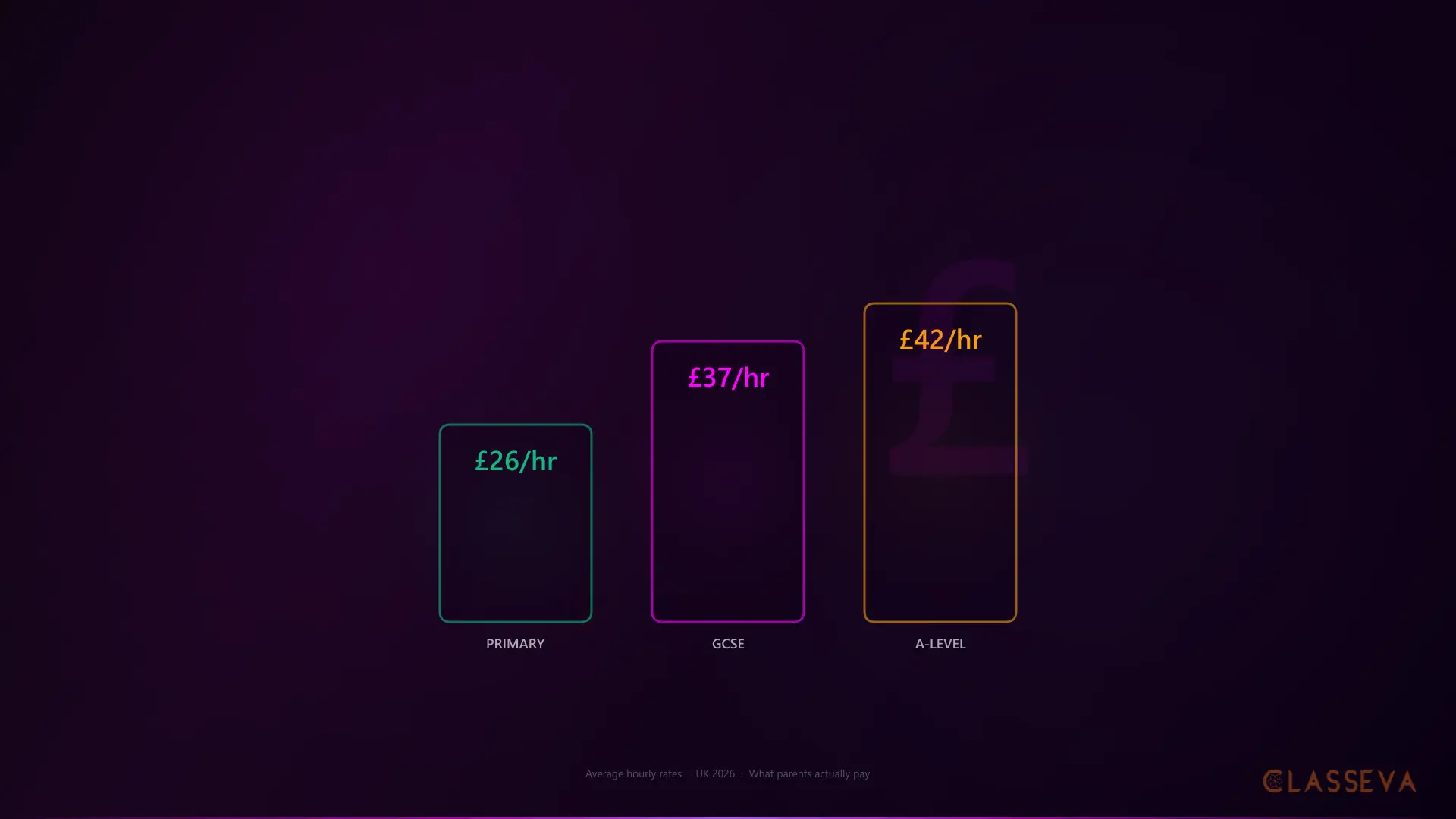
On cost, this is where AI tutoring transforms the landscape. Private tutors in the UK typically charge between £25 and £60 per hour, with some London-based tutors charging more. A monthly AI tutoring subscription typically costs less than a single hour of human tutoring, with unlimited access.
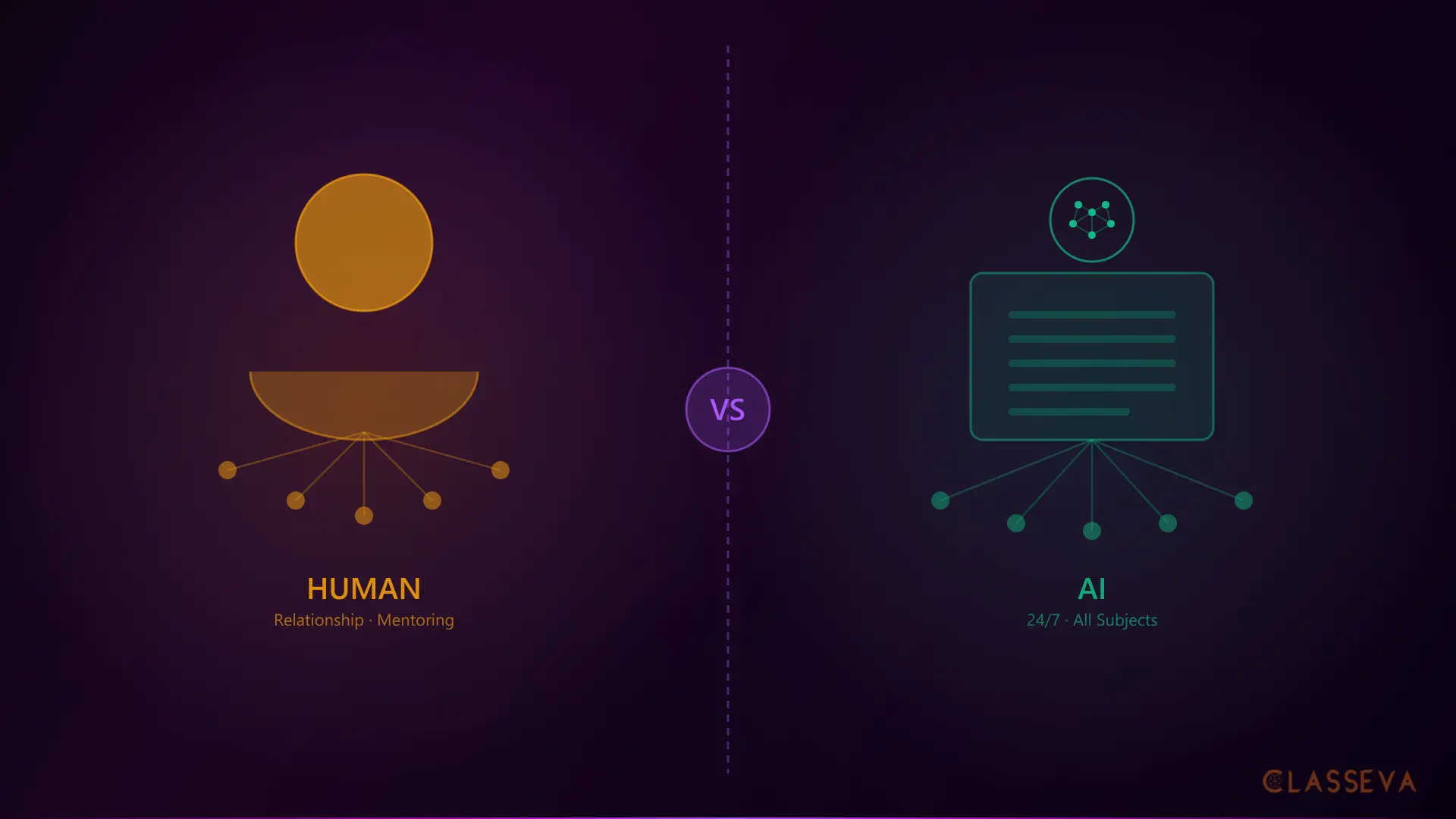
That does not mean AI tutoring replaces human tutors entirely. For students with specific learning needs or those who need the emotional connection of a mentor, a human tutor may still be valuable. But for curriculum-based revision, exam practice, and filling knowledge gaps, AI tutoring delivers the same content at a fraction of the cost. Our guide on when to get a tutor covers this decision in more detail.
Getting the Most from AI Tutoring
Like any tool, AI tutoring works best when used well. From watching how students interact with Classeva, I have noticed clear patterns in what separates students who benefit enormously from those who barely engage.
Daily Practice Beats Weekly Sessions
Research on spaced practice (Cepeda et al., 2006) consistently shows that spreading learning across multiple short sessions is far more effective than concentrating it into one long block. Fifteen to twenty minutes of AI tutoring daily is worth more than a two-hour session once a week.
This is one area where AI tutoring has a genuine advantage over human tutors. A human tutoring session is typically one hour, once a week. AI tutoring is available every day, at any time. Your child can do a quick 15-minute session after school, or at 9 PM before bed, or on the bus home. The flexibility means they can build the daily habit that research shows is most effective.
Encourage Practice, Not Just Answers
The real value of AI tutoring is in the practice, not the explanations. If your child only uses it to get answers to homework questions, they are using perhaps 20% of its capability. The other 80% is in generating exam-style questions, working through topics methodically, and building the retrieval practice habit that research consistently identifies as the most effective revision technique (Dunlosky et al., 2013).
Watch a session first
Sit with your child for their first AI tutoring session. You will see exactly what it does, and your child will see that you take it seriously.
Set a daily routine
Even 15 minutes a day builds momentum. Link it to an existing habit: after dinner, before screen time, or on the bus home from school.
Focus on weak topics
Encourage your child to practise subjects they find difficult, not just the ones they enjoy. The AI will direct them, but your encouragement helps.
Use it for exam practice
In the weeks before exams, AI tutoring is ideal for timed question practice. Your child can do an exam-style question, get it marked instantly, and learn from any mistakes.
Keep the conversation going
AI tutoring does not replace your interest in their education. Ask what they worked on today. Their answer will tell you how engaged they are.
If your child is nervous about asking questions in class (and many are), AI tutoring fills that gap. There is no judgement, no embarrassment, and no rush. They can ask the same question five different ways until it makes sense, and nobody will know.
AI Tutoring and the Bigger Picture
AI tutoring is not magic, and it is not a replacement for engaged teaching, parental support, or your child's own effort. It is a tool. Like any tool, its value depends on how you use it.
What makes it genuinely different from previous “EdTech” tools is the adaptability. Revision apps give every student the same flashcards. Video platforms give every student the same explanation. AI tutoring adjusts. It meets your child exactly where they are, whether that is struggling with basic fractions in Year 7 or fine-tuning their understanding of organic chemistry mechanisms for an A-Level exam.
The traditional tutoring model serves families who can afford £40 to £60 per hour for weekly sessions. Having worked in that industry, I saw first-hand that quality was inconsistent, availability was unreliable, and many families were priced out entirely. AI tutoring does not solve every problem, but it makes personalised academic support accessible to every family with an internet connection. That is why I built Classeva.
Traditional Tutoring
- •£25–£60 per hour, once a week
- •Quality varies enormously between tutors
- •Fixed schedule: if the tutor cancels, you miss a week
- •Not always aligned to your child’s exact exam board
AI Tutoring
- •Fraction of the cost, unlimited access
- •Consistent quality every session
- •Available 24/7 on any device
- •Mapped to AQA, Edexcel, and OCR specifications
If you are curious, the best way to understand AI tutoring explained for parents is simply to try it. Let your child start a free session on Classeva and watch what happens. You will understand more from ten minutes of seeing it in action than from any article, including this one.
For parents weighing up their options, our guide on when to get a tutor for your child covers the full picture. And if your child is already revising for GCSEs, our best GCSE revision resources guide shows how AI tutoring fits alongside other tools.