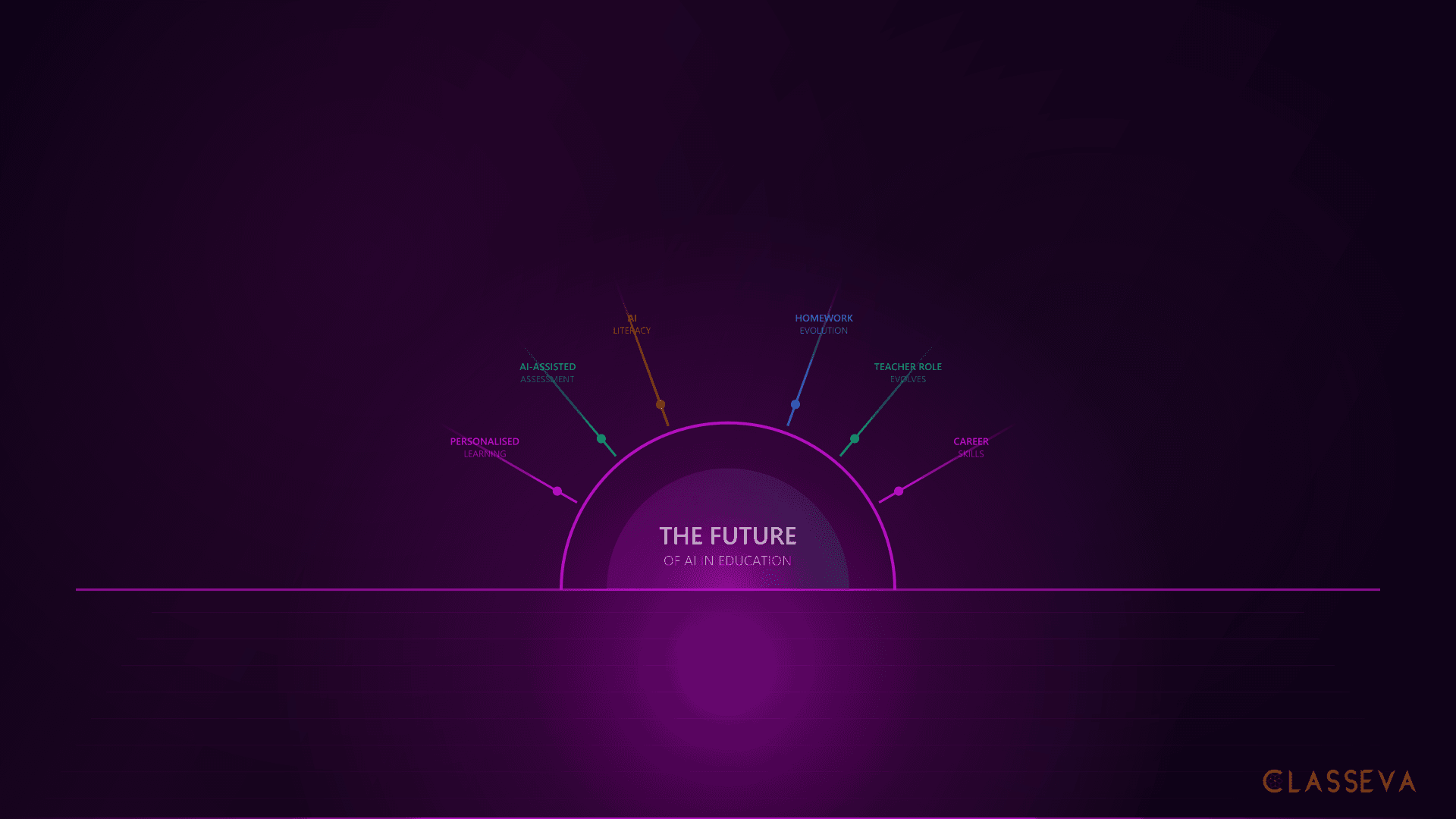
The Future of AI in UK Education: What Parents Should Expect
Within the next five years, your child’s experience of school will change more than it has in the past thirty. AI-powered tools are already reshaping how students learn, how teachers teach, and how schools operate. The question for parents is not whether this will happen, but how to make sure your child benefits from it.
Having built Classeva and spent years working in the UK tutoring industry, I have watched this shift from the inside. The technology is moving fast, but the fundamentals of good education remain the same. This guide covers what is actually changing, what is staying the same, and what you can do as a parent to stay ahead.
Where AI in UK Education Stands Today
AI in UK classrooms is not a future prediction. It is happening now. The future of AI in UK education is being shaped by decisions schools are making today, and parents who understand the current landscape are better placed to navigate what comes next.
What Schools Are Already Using
Thousands of UK schools already use AI-powered platforms. Sparx Maths adapts homework difficulty to each student’s level. Century Tech covers multiple subjects with AI-driven personalisation. Hegarty Maths tracks student progress through video-based learning and quizzes. These are not experimental pilots: they are embedded in daily school routines.
Teachers themselves are using AI for lesson planning, creating differentiated resources, and generating initial feedback on student work. Many schools have moved beyond asking should we use AI? to asking how do we use it well?
| Area | How AI Is Used Now | What Is Coming Next |
|---|---|---|
| Learning Platforms | Adaptive homework and quizzes (Sparx, Century Tech) | Fully personalised learning pathways across all subjects |
| Teacher Tools | Lesson planning, resource creation, initial marking | Automated formative assessment with detailed diagnostics |
| Student Tools | ChatGPT, Claude, Gemini for study help | Curriculum-aligned AI tutors (like Classeva) built for responsible use |
| School Admin | Attendance tracking, timetabling | Predictive analytics for student support and intervention |
| Assessment | Practice question generation | AI-assisted formative feedback; human-marked summative exams |
Source: DfE AI in Education guidance (2023); Classeva industry analysis
The Policy Landscape
The Department for Education published its guidance on generative AI in education to help schools adopt AI responsibly. The Curriculum and Assessment Review (2025-26) is actively examining how AI should influence curriculum design and assessment structures.
The picture is one of cautious encouragement. The government wants schools to adopt AI, but there is no national standard yet for how. This means your child’s school may be ahead of the curve, or it may not have a formal AI policy at all.
Schools are developing AI policies independently. Ask your child’s school what their AI strategy looks like. The DfE guidance is a good starting point for the conversation.
Personalised Learning at Scale
The single biggest change AI brings to education is personalised learningthat actually works at scale. Until now, true personalisation meant one-to-one tutoring: expensive, geographically limited, and dependent on the tutor’s quality. AI changes the equation entirely.
What Personalised AI Learning Actually Looks Like
This is not about giving every child a tablet and hoping for the best. Genuine AI personalisation means the technology understands not just what a student got wrong, but why. A child who answers a fractions question incorrectly because they do not understand equivalent fractions gets a different response from one who understands the concept but made an arithmetic error. The AI adapts its teaching approach accordingly.
From working with families across the UK while building Classeva, I have seen how transformative this can be. One parent told me her daughter had been stuck on the same topics for months with a human tutor. Within three weeks of using AI-driven revision that adapted to her specific gaps, her mock scores jumped by two grades. The technology identified weaknesses the tutor had missed because AI tracks every single response, not just the ones that happen to come up in a tutoring session.
Platforms like Classeva already do this: the AI follows the student’s exact exam board specification, identifies knowledge gaps in real time, and adjusts the difficulty and focus of each session automatically. This is the same personalised learning approach that top private schools charge thousands for, made accessible to every family.
What This Means for Your Family
As personalisation becomes the norm, you may notice your child learning at a different pace from classmates in the same year group. Two children in Year 10 maths might be working on different topics at different levels. This is not a failure of the system: it is the system working as intended, meeting each child where they are rather than forcing everyone through identical content at the same speed.
If your child’s school uses an adaptive platform, ask for access to the parent dashboard. Seeing which topics your child finds easy and which they struggle with is far more useful than a termly report card.
How Exams and Assessment Will Change
This is the question parents ask most often: will AI change GCSEs and A-Levels? The short answer is yes, but not in the way you might expect.
Formative vs Summative Assessment
AI will have its biggest impact on formative assessment: the ongoing checks of understanding that happen throughout the year. Currently, a teacher marking 30 exercise books can give each student a tick, a cross, and perhaps a brief comment. AI can provide instant, detailed, personalised feedback on every answer: why it was wrong, what the student should review, and what to try next.
Summative assessment(GCSEs, A-Levels, SATs) will remain human-marked for the foreseeable future. AQA, Edexcel, and OCR are cautious about AI marking for accountability and fairness reasons, and rightly so. Parents can be confident that their child’s final grades will continue to be determined by human examiners.
Formative Assessment
- •Ongoing throughout the year
- •AI will provide instant, detailed feedback
- •Personalised to each student's gaps
- •Already happening in adaptive platforms
Summative Assessment
- •GCSEs, A-Levels, SATs
- •Will remain human-marked
- •Exam boards are cautious about AI marking
- •Question style may evolve over time
Will Exam Questions Change?
Here is the more interesting question. If AI can answer any factual recall question instantly, what is the point of testing whether a student can recall facts? The Curriculum and Assessment Review is actively considering this.
Expect a gradual shift toward exam questions that test analytical thinking, problem-solving, and application. Instead of “State three causes of the First World War,” you might see “Evaluate which cause of the First World War was most significant, using evidence to support your argument.” AI can answer the first question. Only a student who genuinely understands the material can answer the second.
This shift is already visible in the higher-mark questions on current GCSE papers. The most effective revision techniques are those that build genuine understanding, not just memorisation.
Your child still needs to learn facts and content. You cannot analyse something you do not understand. But the balance of assessment will shift toward testing what students can do with knowledge, not just whether they can recall it.
AI Literacy: The New Core Skill
Ten years ago, “digital literacy” entered the curriculum because every child needed to understand how to use computers safely and effectively. We are at the same inflection point with AI. AI literacy is becoming a core skill, and schools will increasingly teach it.
What AI Literacy Includes
AI literacy is not about teaching every child to code neural networks. It means understanding:
How AI works (at a basic level)
What large language models are, how they generate responses, and why they sometimes produce confident-sounding nonsense. Students who understand this are far less likely to blindly trust AI output.
How to prompt AI effectively
The difference between asking "tell me about photosynthesis" and "explain the light-dependent reactions of photosynthesis for AQA GCSE Biology, including the role of chlorophyll." Effective prompting is a skill that transfers to professional life.
How to evaluate AI outputs critically
Recognising when AI has hallucinated facts, checking sources, comparing AI answers against authoritative references. This is critical thinking applied to a new medium.
The ethical implications of AI
Bias in training data, privacy concerns, intellectual property, environmental costs. Students need to be thoughtful users, not passive consumers.
Parents should expect AI literacy to appear in the curriculum, possibly as part of computing, PSHE, or a new standalone element. The EdTech UK community is actively working with the DfE on what this should look like.
In the meantime, you can start at home. When your child uses AI for revision, ask them: “How do you know that answer is correct?” and “What would you do if the AI got it wrong?” These two questions build more AI literacy than any formal curriculum.
How Homework and Coursework Will Evolve
If AI can write a passable essay in thirty seconds, traditional take-home coursework faces an obvious problem. Schools and exam boards are already responding, and parents should expect significant changes to how homework is set and assessed.
The Shift in Assessment Methods
The direction of travel is clear. Assessment will move toward methods where AI cannot do the work for the student:
| Method | Why It Works in an AI World | Already Used By |
|---|---|---|
| In-class timed assessment | No access to AI tools; tests genuine understanding | Most schools for mock exams and controlled assessments |
| Process-based marking | Students show drafts, working, and thinking over time | GCSE English (draft process for creative writing) |
| Oral examination | Students explain and defend their answers verbally | Modern foreign languages, university admissions |
| Practical and portfolio work | Hands-on tasks that require physical demonstration | GCSE Art, D&T, Science required practicals |
| Collaborative projects | Group work assessed on individual contributions | Some BTEC and vocational qualifications |
Assessment methods that are resilient to AI shortcuts
The exam boards are also updating malpractice policies. AQA, Edexcel, and OCR have all published updated guidance making clear that submitting AI-generated work as your own is academic malpractice, with the same consequences as any other form of cheating.
The Teacher’s Role Becomes More Human
This is perhaps the most counterintuitive change. As AI enters education, teaching becomes more human, not less. AI can deliver content, generate questions, mark multiple-choice tests, and track data. What AI cannot do is inspire curiosity, build a relationship with a struggling student, lead a Socratic discussion, or notice that a child seems withdrawn today.
The teachers I speak to are broadly positive about this shift. Most did not enter teaching because they love marking exercise books at midnight. They entered teaching because they want to make a difference in young people’s lives. AI frees them to spend more time doing exactly that.
AI Handles
- •Content delivery and explanation
- •Practice question generation
- •Initial marking and feedback
- •Progress data tracking
- •Differentiated resource creation
Teachers Handle
- •Inspiring curiosity and motivation
- •Building relationships and trust
- •Leading discussions and debates
- •Pastoral care and wellbeing
- •Developing critical thinking
For parents, this means the quality of teaching (human interaction, mentoring, discussion) becomes even more important than the quality of content delivery. When choosing a school, ask not just about results, but about how teachers use the time AI frees up.
Career Implications for Today’s Students
Many of the jobs your child will do in twenty years do not exist yet. This is not scaremongering: it was true twenty years ago (social media manager, app developer, data scientist were not careers in 2006), and the pace of change is accelerating.
Which Skills Will Matter Most
The students who will thrive are not the ones who can outperform AI at factual recall. They are the ones who can work with AI as a tool while bringing distinctly human capabilities to the table. Careers advice in schools will need to account for which roles AI will augment, which it will replace, and which entirely new roles it will create.
The pattern I see from speaking to employers and university admissions teams is consistent: they want young people who can think clearly, communicate persuasively, adapt to new tools quickly, and work well with others. These are the skills parents should actively invest in, alongside academic achievement.
AI will not replace people. People who use AI well will replace people who do not. Encourage your child to become confident and critical users of AI tools, not dependent on them and not afraid of them.
This is why platforms like AI-powered tutoring tools are so valuable: they teach students to interact with AI productively while learning curriculum content. The student practises both the subject and the skill of working with AI simultaneously.
What Will Not Change
For all the changes ahead, certain fundamentals of education are not going anywhere. Parents who keep these in perspective will make better decisions about their child’s learning.
| What Stays the Same | Why It Matters |
|---|---|
| Foundational knowledge | You need to understand maths to use a calculator effectively. You need to understand science to evaluate AI output on scientific topics. Knowledge is the foundation analysis is built on. |
| Human connection | No AI can replace a teacher who inspires curiosity, builds confidence, and genuinely cares about a child. School is about relationships as much as content. |
| Formal examinations | Controlled-condition exams will remain the primary summative assessment method, though question styles may evolve. |
| Social and emotional development | Friendships, resilience, teamwork, conflict resolution, and emotional maturity develop through human interaction, not screens. |
The pillars of education that technology cannot replace
When I built Classeva, the core design principle was that AI should complement human teaching, not replace it. The technology handles content delivery, practice, and feedback. The human relationships, whether with teachers, parents, or peers, handle everything else. That balance is the key to getting AI in education right.
Seven Things Parents Can Do Now
You do not need to become an AI expert overnight. These seven practical steps will help you support your child through the changes ahead.
Understand AI rather than fear it
AI in education is not a threat to your child. It is a tool that, used well, provides better and more personalised learning than any previous technology. Spend twenty minutes exploring an AI tool yourself to understand what your child is working with.
Support AI literacy at home
When your child uses AI for revision, ask: "How do you know that answer is correct?" and "What would happen if the AI got this wrong?" These questions build critical evaluation skills that will serve them for life.
Maintain balance
AI should supplement human teaching, reading, physical activity, and social interaction. It is one tool in the toolkit, not the entire toolkit. Set clear boundaries on screen time and ensure AI use is purposeful, not passive.
Stay informed about your school's approach
Ask your child's school about their AI strategy at the next parents' evening. Read the DfE guidance on generative AI in education. The more you understand, the better conversations you can have with teachers.
Invest in human skills
Creativity, communication, critical thinking, empathy, and adaptability are the skills AI cannot replicate. Encourage debating, creative writing, team sports, drama, music, and any activity that develops these capabilities.
Choose AI tools designed for education
Curriculum-aligned platforms like Classeva are built with responsible AI principles: they follow the exam specification, provide accurate content, and support learning rather than shortcutting it. General-purpose chatbots carry more risks for students.
Remember the fundamental goal
Help your child become a curious, resilient, independent learner who can think critically and communicate effectively. AI changes HOW they learn. It does not change WHAT they need to become.
The single most impactful thing you can do right now is try a free AI tutoring session on Classeva alongside your child. Seeing how AI-powered learning works first-hand is worth more than reading any number of articles about it. You will quickly understand both the potential and the limitations.
The future of AI in UK education is not something that happens to your family. It is something you can actively shape by making informed choices about the tools, schools, and study approaches your child uses. The parents who engage with these changes now will give their children a meaningful advantage, not because the technology itself is magic, but because understanding it early builds confidence, competence, and critical thinking that compounds over years.