AI Study Techniques for Different Learning Styles
Most parents hear “AI for studying” and immediately picture their child pasting an essay question into ChatGPT and copying the answer. That is not what this post is about. When used correctly, AI study techniques can transform revision by adapting to how your child actually learns: whether they think in pictures, learn through conversation, or need to work through problems hands-on.
During my time working in tutoring, one frustration I kept hearing from parents was that their child “just doesn't get it” no matter how many times it is explained. The problem was rarely intelligence. It was almost always that the explanation came in only one format. A good tutor adjusts their approach until something clicks. AI, used properly, does the same thing on demand.
The Right Mindset: AI as Study Partner
Think of AI the same way you would think of a patient, always-available tutor who can explain the same concept ten different ways without getting frustrated. That is genuinely useful. What it is not is a replacement for the student doing the hard work of understanding, practising, and committing information to memory.
What AI Study Help Actually Looks Like
AI study help for GCSE and A-Level students works best as scaffolding. The AI provides the structure, the prompts, the questions, and the feedback. The student provides the effort, the thinking, and the answers. This distinction matters because research consistently shows that active engagement with material (retrieval practice, elaboration, self-testing) produces far stronger learning than passive consumption.
AI Doing the Work
- •Student pastes question, copies answer
- •AI writes the essay for them
- •No learning happens
- •This IS cheating
AI as Study Partner
- •Student asks AI to quiz them
- •AI explains where they went wrong
- •Student builds understanding
- •This is smart revision
The “Could I Do This Without AI?” Test
A simple rule your child can apply after every AI study session: “Could I now answer this question, explain this concept, or solve this problem withoutthe AI in front of me?” If the answer is yes, the session was productive. If no, they have been reading rather than learning, and need to switch to a more active technique.
AI should make your child think harder, not think less. If a study session with AI feels effortless, something has gone wrong. Genuine learning requires struggle.
Visual Learning With AI
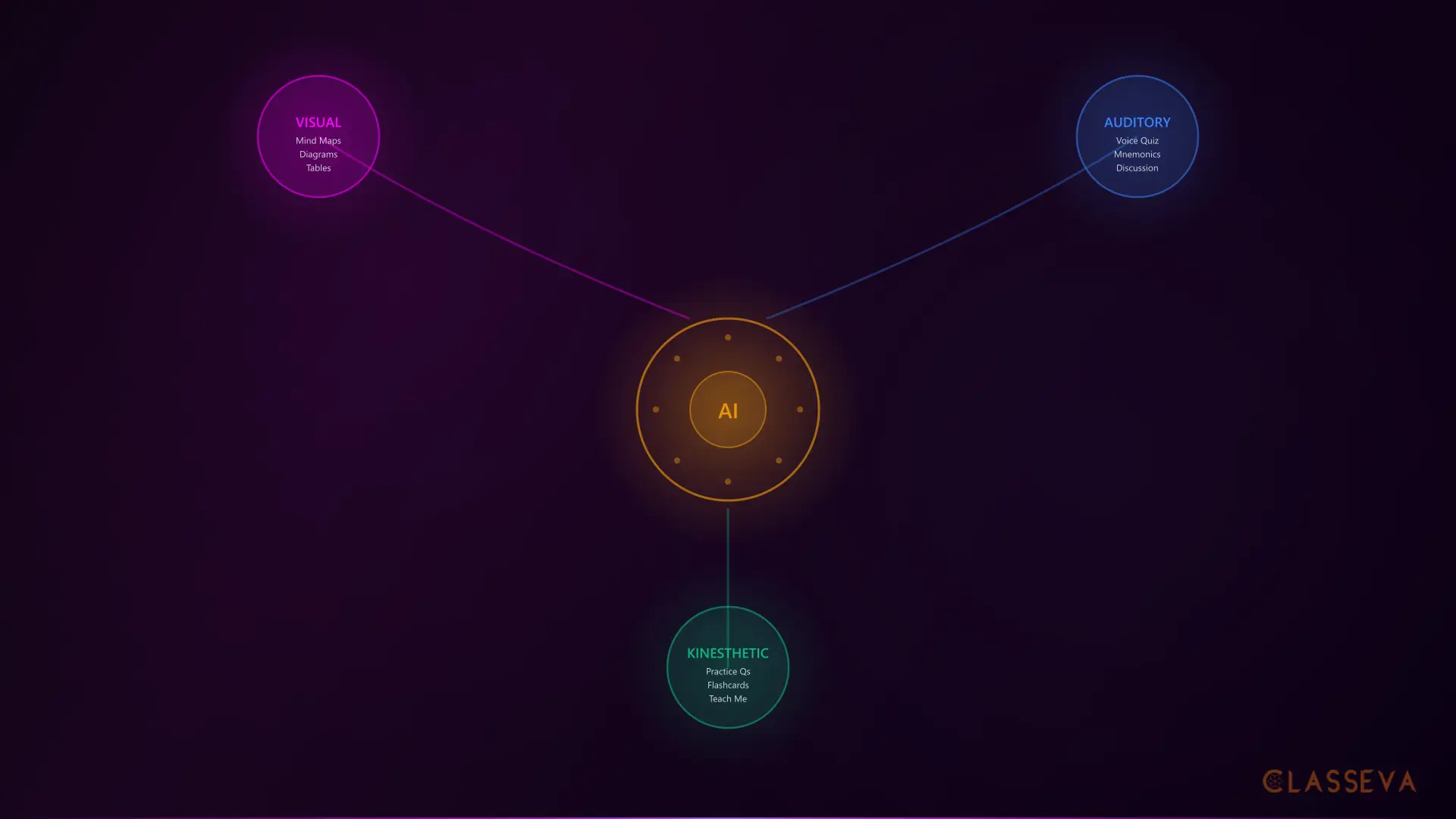
Students who think in pictures, diagrams, and spatial layouts can use AI study techniques to generate visual structures they then build by hand. The combination is powerful: AI handles the information architecture, and the student creates the physical visual. This activates dual coding (processing information through both verbal and visual channels), which research from Paivio (1971) shows significantly improves retention.
Diagrams, Flowcharts, and Mind Maps
Rather than staring at a blank page wondering how to organise a topic, your child can ask AI to provide the structure. The critical step is that they then draw it themselves rather than simply reading the AI output.
Ask AI for a mind map structure
Prompt: "Give me a mind map structure for the themes in Macbeth with three sub-branches per theme." The AI produces the hierarchy; your child draws it.
Request flowchart descriptions
Prompt: "Create a flowchart showing the stages of mitosis, including what happens at each stage." Your child sketches the flowchart from the description.
Generate timeline frameworks
Prompt: "Give me a timeline of the key causes of WWI, with dates and one-sentence descriptions." Your child creates a visual timeline on paper or a whiteboard.
The act of translating text into a visual is where the learning happens. If your child just reads the AI-generated structure without creating anything, the benefit drops dramatically. Having worked with hundreds of students, I can say confidently that the ones who drew their own diagrams from AI prompts retained far more than those who passively read AI summaries.
Comparison Tables and Infographic Summaries
AI is excellent at organising information into side-by-side comparisons. For subjects where students need to contrast two processes, two characters, or two events, a well-prompted comparison table creates instant clarity.
| Visual AI Technique | Example Prompt | Best For |
|---|---|---|
| Mind map structure | "Mind map of themes in An Inspector Calls" | English Literature, History |
| Comparison table | "Compare photosynthesis and respiration side by side" | Biology, Chemistry |
| Flowchart description | "Flowchart of how a bill becomes law in the UK" | Politics, Citizenship |
| Timeline framework | "Timeline of Cold War events 1945 to 1991" | History, Politics |
| Poster bullet points | "Summarise the water cycle in 5 points for a poster" | Geography, Science |
Visual AI study techniques with example prompts
If your child is using AI for visual revision, set one rule: they must physically create every visual the AI describes. Reading a mind map structure is passive. Drawing it from memory ten minutes later is active recall combined with dual coding.
Auditory Learning With AI
Students who learn through hearing, discussing, and verbalising can use AI as an endlessly patient conversation partner. Many AI revision tools now support voice interaction, making it possible to have a genuine spoken discussion about GCSE or A-Level content at any time.
Conversation and Verbal Quizzing
One of the most underused AI study methods is simply having a conversation. Voice features in tools like the ChatGPT mobile app or Claude allow students to discuss topics out loud, which is particularly effective for subjects that require extended reasoning like History and English Literature.
For verbal quizzing, the key is to set explicit rules in the prompt. Without them, AI will give away the answer too quickly.
“Ask me 10 questions about GCSE Biology cell division. Wait for my answer before telling me if I am right or wrong. If I get it wrong, explain why, then ask me a follow-up question on the same topic.”
This forces the student to retrieve information from memory before receiving feedback, which is exactly how retrieval practice works. Dunlosky et al. (2013) identified retrieval practice as one of the most effective study techniques across all age groups.
Mnemonics and Podcast-Style Summaries
AI can generate mnemonics on demand for any list, sequence, or set of terms. Students who find acronyms and memory hooks useful can ask AI to create them for specific content.
| Auditory Technique | How It Works | Time Needed |
|---|---|---|
| Voice conversation | Discuss a topic with AI using voice features | 10 to 15 minutes |
| Verbal quizzing | AI asks questions; student answers aloud | 10 to 20 minutes |
| Mnemonic generation | "Give me a mnemonic for the order of planets" | 2 to 5 minutes per set |
| Podcast-style summary | "Explain key themes of An Inspector Calls as a podcast" | 5 minutes to read aloud |
| Record and replay | Student reads AI summary aloud, records it, replays | 15 to 20 minutes |
Auditory AI techniques ranked by time investment
The podcast-style summary technique works particularly well. Ask AI to explain a topic “as if you are a podcast host giving a five-minute overview for a GCSE student.” The resulting text is conversational, structured, and easy to read aloud. Students can record themselves reading it and replay during commutes or before bed.
Kinesthetic Learning With AI
Students who learn by doing, making, and physically engaging with material can use AI to generate the raw materials for hands-on practice. This is arguably where AI study techniques are most powerful, because generating practice questions, problems, and interactive scenarios used to be the bottleneck for self-directed learners.
Practice Questions and Guided Problem-Solving
The single most effective way a hands-on learner can use AI is to generate unlimited, graded practice questions tailored to their exam board. Past papers are finite. AI-generated questions are not.
For problem-solving, the guided approach matters enormously. Instead of asking AI for the answer, your child should ask it to be a coach:
“I am going to try to solve this physics problem. Guide me step by step. Do not give me the answer. Just tell me if I am on the right track, and give me a hint if I am stuck.”
This transforms AI from an answer machine into a Socratic tutor. The student does the working, makes the decisions, and learns from their errors, while AI provides just enough scaffolding to prevent them giving up entirely.
Flashcards, Role-Play, and “Teach Me” Mode
AI can generate flashcard sets in seconds. The technique works best when the student then creates physical flashcards from the AI output, writing them by hand. Research from Mueller and Oppenheimer (2014) found that handwriting produces stronger encoding than typing, so the extra step of physically creating the cards matters.
Role-play is an underappreciated technique for History and English. Ask AI to pretend it is a journalist interviewing Napoleon about the causes of the French Revolution, or a literary critic debating the themes of Lord of the Flies. The student must respond in character, which forces deeper engagement than simply reading.
The most powerful kinesthetic technique of all is “Teach Me” mode. Your child explains a topic to the AI as if teaching it, and asks the AI to identify any mistakes or gaps. This combines retrieval practice (pulling information from memory), elaboration (explaining in your own words), and immediate feedback (AI highlights errors). It is very nearly impossible to cheat using this technique, because the student must demonstrate understanding to get useful feedback.
Traditional Practice
- •Finite past papers
- •No instant feedback
- •Works through textbook in order
- •Revision ends when papers run out
AI-Enhanced Practice
- •Unlimited question generation
- •Immediate, detailed feedback
- •Targets weak areas specifically
- •Adaptive difficulty that scales up
Subject-Specific AI Prompts That Work
General advice only takes you so far. Here are proven AI study prompts for specific GCSE and A-Level subjects. Each prompt is designed to force the student into active learning rather than passive reading.
Maths and Science Prompts
| Subject | AI Prompt | What It Does |
|---|---|---|
| Maths | "Generate 5 quadratic equation questions, increasing difficulty" | Graded practice with progression |
| Maths | "I got 7.5 for this. Is that correct? Here is my working..." | Error diagnosis with student working |
| Biology | "Quiz me on AQA required practicals for GCSE Biology" | Exam-board-specific retrieval practice |
| Physics | "Explain speed vs velocity three different ways" | Multi-modal explanation |
| Chemistry | "Create 20 flashcards on key terms for GCSE Chemistry" | Flashcard generation for hands-on study |
Maths and Science AI prompts that force active learning
For Maths specifically, the error diagnosis prompt is transformative. Rather than asking AI to solve the problem, the student shows their working and asks where they went wrong. This builds the metacognitive skill of identifying their own mistakes, which is exactly what examiners reward in the method marks on GCSE Maths papers.
English, History, and Languages
| Subject | AI Prompt | What It Does |
|---|---|---|
| English Lit | "What are the key themes in Macbeth? Give one quote per theme" | Quote bank with thematic context |
| English Lit | "I wrote this paragraph analysing Lady Macbeth. What is strong and what could I improve?" | Peer-review-style feedback |
| History | "Argue FOR and AGAINST: The Treaty of Versailles caused WWII" | Debate structure for essay planning |
| History | "Create a timeline of key Cold War events, 1945 to 1991" | Chronological framework |
| French | "Have a conversation with me in French about my weekend" | Immersive speaking practice |
| Spanish | "Test me on 20 vocabulary words from Mi ciudad" | Targeted vocabulary retrieval |
English, History, and Languages AI prompts
Languages are where AI genuinely shines as a study partner. Having an on-demand conversation partner who corrects grammar mistakes in real time solves one of the biggest problems in language revision: you cannot practise speaking alone. AI voice features now make this possible at any time, which is particularly useful for students who do not have a native speaker at home.
For English Literature, the paragraph feedback prompt is extremely valuable. The student writes an analytical paragraph about a character or theme from one of the set texts, then asks AI to assess it. This mirrors the kind of teacher feedback that normally takes days to receive.
What AI Does Well and Badly for Studying
Being honest about AI's limitations is just as important as knowing its strengths. Parents and students who understand both will get far more value from AI revision tools than those who treat AI as infallible.
Where AI Excels
AI is genuinely transformative for a handful of specific study tasks. These are areas where it consistently outperforms traditional methods.
Explaining concepts multiple ways
If your child does not understand an explanation, AI can rephrase it as an analogy, a diagram description, a story, or a step-by-step walkthrough. A textbook gives you one explanation. AI gives you as many as you need.
Generating unlimited practice questions
Past papers run out. AI does not. Students can generate questions at any difficulty level, for any topic, for any exam board, as many times as they need.
Providing instant, detailed feedback
Instead of waiting days for a teacher to mark work, students get immediate feedback on their answers, with explanations of what went wrong and why.
Patient repetition without judgement
AI never gets frustrated, never sighs, and never makes a student feel stupid for asking the same question a fourth time. For students with low confidence, this matters enormously.
Where AI Falls Short
AI is not perfect, and pretending otherwise does students a disservice. Three specific weaknesses matter for exam preparation.
AI occasionally produces plausible-sounding information that is factually wrong. This is especially dangerous for subjects like History, where an incorrect date or attribution could lose marks. Always cross-check important facts against the exam board specification or a trusted revision resource like The Learning Scientists.
AI also cannot replace genuine understanding. It can produce beautifully structured answers that a student might read and think they understand, when in fact they are simply recognising the words rather than building the underlying mental model. This is why the active techniques above (teach me mode, guided problem-solving, verbal quizzing) matter so much. They force genuine engagement.
Finally, AI cannot provide emotional support. When your child is stressed, anxious, or unmotivated before exams, they need a human. A parent, a teacher, a friend. AI can generate a revision plan, but it cannot notice that your child has been crying, or that they have not eaten, or that they are quietly giving up. That is your job, and it matters more than any study technique.
How Parents Can Help
You do not need to be a tech expert to help your child use AI productively. In fact, the most helpful thing you can do is ask simple questions about how they are using it.
Practical Steps for Parents
Explore AI study tools together
Sit with your child and try a few study prompts. Show them the difference between "give me the answer" (bad) and "quiz me on this" (good). Even 20 minutes of guided exploration sets the right habits.
Encourage the "Teach Me" approach
Ask your child to explain a topic they have been revising. If they can explain it clearly to you, they understand it. If they cannot, that is the gap to focus on. AI's "teach me" mode does this automatically.
Set clear AI boundaries
AI for learning (generating questions, getting explanations, testing knowledge) is productive. AI for doing (writing coursework, solving homework to copy) is not. Making this distinction explicit prevents confusion.
Remind them to cross-check facts
AI can occasionally give incorrect information, especially specific dates, statistics, or mark scheme requirements. Encourage your child to verify anything important against their textbook or the exam board website.
Consider structured AI tutoring
Tools like Classeva are specifically designed for UK exam boards, so the content is curriculum-aligned and the study techniques are built in. This removes the guesswork of prompt engineering.
The parent who understands why their child uses AI for revision is in a much stronger position than the parent who either bans it entirely or ignores it completely. AI study tools are not going away. Teaching your child to use them well is one of the most practical things you can do for their exam preparation.
If you want to explore how AI study help for GCSE and A-Level works in a structured, curriculum-aligned environment, Classeva's AI tutoring is designed to do exactly that: follow the specification, adapt to your child's level, and use the active learning techniques described in this post. For more on how your child can revise effectively across all subjects, see our guides to proven GCSE revision techniques and the best AI learning tools for students.