Edexcel GCSE Combined Science Grade Boundaries 2026
The Edexcel GCSE combined science grade boundaries confuse parents more than almost any other qualification. Your child does not receive a grade between 1 and 9. They receive a double grade like 7-7, 6-5, or 4-4, and that pair comes from a single total across all six papers. No other GCSE works quite this way.
Speaking from experience working with GCSE students, I found that parents who understood how the double grading system works were far better placed to interpret mock results and support revision. Those who did not understand it often overreacted to small mark changes or misread what a grade boundary actually meant. This guide explains how Edexcel 1SC0 boundaries work, shares the real numbers from 2025, and shows you how to use that data sensibly.
What Is the Edexcel Double Grade System?
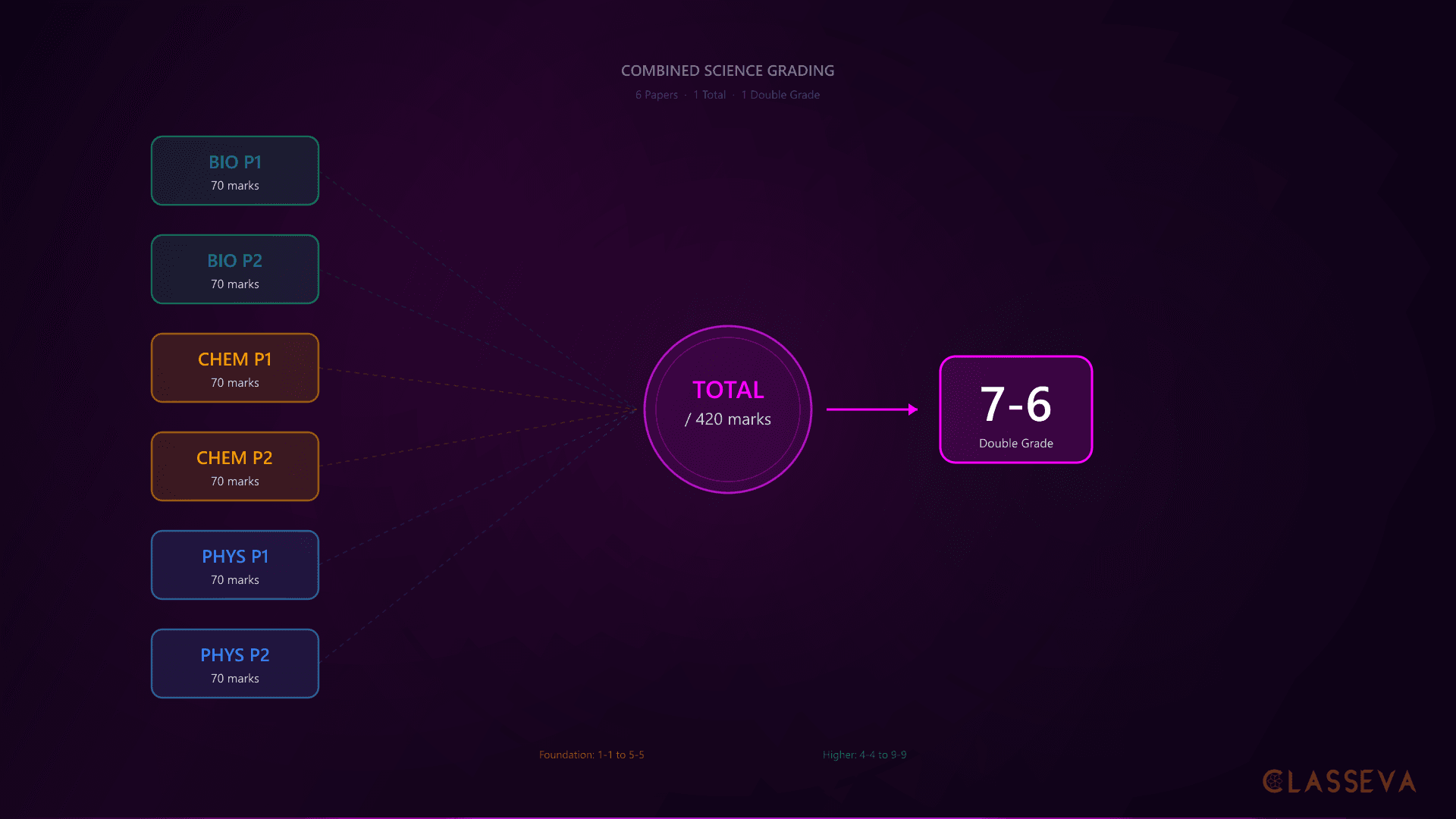
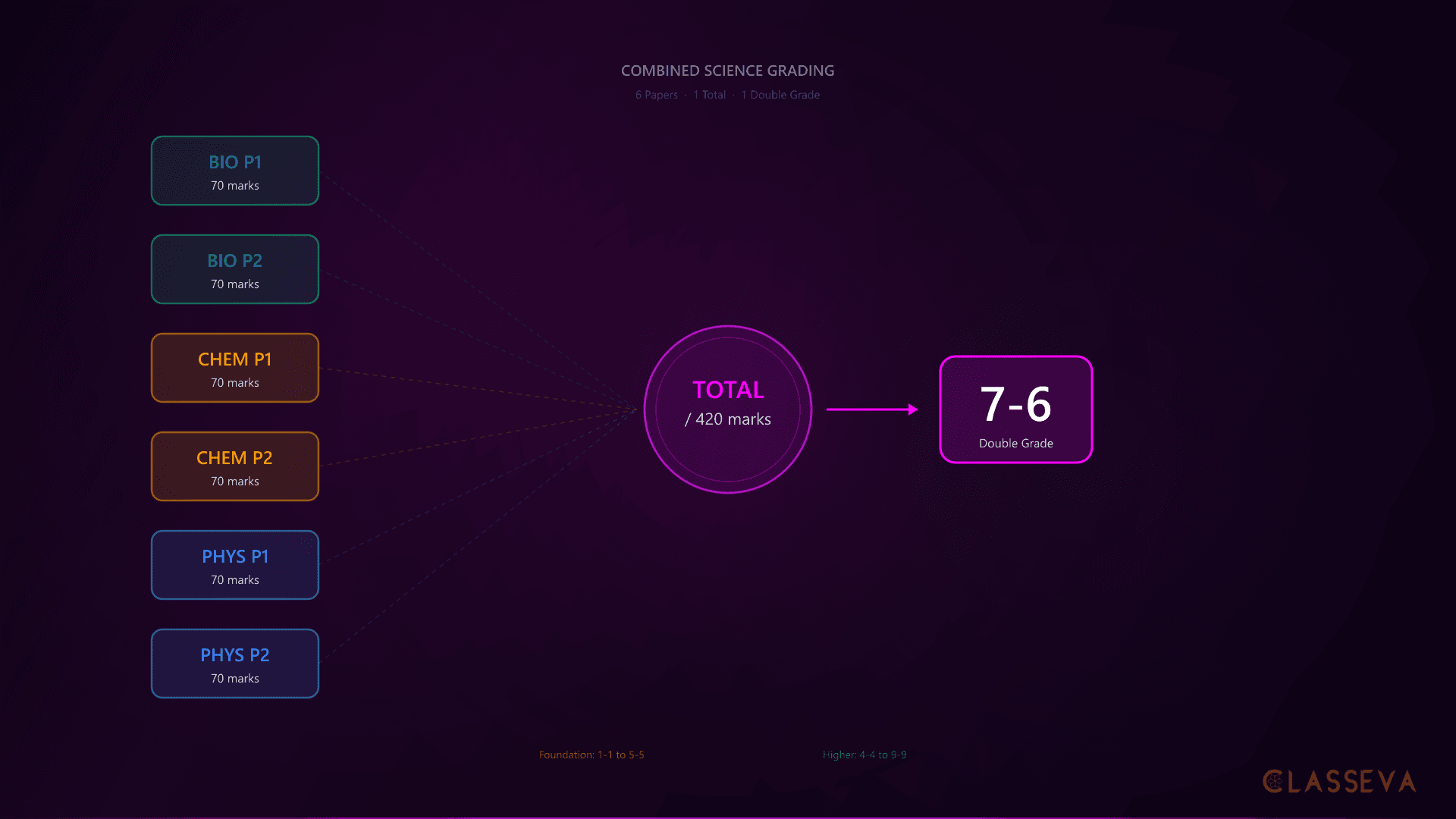
The Edexcel GCSE combined science double grade is a pair of numbers that represents two separate GCSEs from one qualification. Pearson adds all six paper marks together into a single total, then applies 17 grade boundaries to that total. The position of your child's total within those boundaries determines both numbers in the pair simultaneously.
The 17 Possible Grade Combinations
There are exactly 17 possible outcomes, running from 9-9 at the top to 1-1 at the bottom. The full list covers every equal grade (9-9, 8-8, 7-7, 6-6, 5-5, 4-4, 3-3, 2-2, 1-1) and every adjacent pair (9-8, 8-7, 7-6, 6-5, 5-4, 4-3, 3-2, 2-1). That accounts for all possible results. No other combinations exist.
The two numbers in an Edexcel Edexcel double science grade boundary result can never differ by more than one. A student who performs strongly in Biology but weakly in Physics will not receive a 9-5; they will receive a result closer to the average, such as 7-6. This is because a single total mark drives both numbers simultaneously.
Why Adjacent Grades Only?
The adjacent-only rule comes from how Ofqual designed the combined science grading system. The qualification awards two GCSEs but uses a single assessment total. Ofqual set the rule that each boundary must be placed so the two numbers either match or sit next to each other, preserving the principle that both GCSEs reflect overall performance across all three sciences. A spread of more than one grade between the two numbers would suggest very different abilities in each science, which the single-total approach cannot support.
The practical consequence for your child: a strong performance in Biology does compensate for a weaker Chemistry result, because only the combined total matters. But no single subject can carry the whole qualification.
How Edexcel 1SC0 Papers Are Structured
Edexcel 1SC0 is the qualification code for Pearson Edexcel GCSE (9-1) Combined Science. It runs across six papers: two Biology papers, two Chemistry papers, and two Physics papers. Each paper carries 60 marks. The six papers together produce a total of 360 marks, and the Edexcel 1SC0 grade boundaries are applied to that combined total.
The Six Papers Explained
Each paper lasts 1 hour 10 minutes. The paper codes follow a consistent naming pattern: the first digit indicates whether it is the first or second paper in that subject, followed by B (Biology), C (Chemistry), or P (Physics), then H (Higher) or F (Foundation).
| Paper Code | Subject | Marks | Duration |
|---|---|---|---|
| 1SC0/1BH (or 1BF) | Biology Paper 1 | 60 | 1h 10m |
| 1SC0/1CH (or 1CF) | Chemistry Paper 1 | 60 | 1h 10m |
| 1SC0/1PH (or 1PF) | Physics Paper 1 | 60 | 1h 10m |
| 1SC0/2BH (or 2BF) | Biology Paper 2 | 60 | 1h 10m |
| 1SC0/2CH (or 2CF) | Chemistry Paper 2 | 60 | 1h 10m |
| 1SC0/2PH (or 2PF) | Physics Paper 2 | 60 | 1h 10m |
Edexcel 1SC0 paper structure. H = Higher tier, F = Foundation tier. Source: Pearson Edexcel qualification specification.
One thing that trips up many parents: your child sits either the Higher papers or the Foundation papers across all six. They cannot mix tiers, sitting Higher for Biology and Foundation for Physics. The tier decision applies to the whole qualification. Speak to the Head of Science before the entry deadline if you have any doubts about which tier your child is entered for.
Foundation vs Higher Tier
Foundation tier covers double grades 1-1 up to 5-5. Higher tier covers 4-4 up to 9-9. The overlap at 4-4 and 5-4 means students on the boundary between tiers can achieve those grades on either, but only Higher can reach 6-6 and above.
Foundation Tier
- •Grade range: 1-1 to 5-5
- •Maximum double grade: 5-5
- •More structured, accessible questions
- •No U grade risk for grades above 1-1
- •Best for students targeting 4-4 or 5-5
Higher Tier
- •Grade range: 4-4 to 9-9
- •Access to 6-6, 7-7, 8-8, 9-9
- •More complex multi-step questions
- •Risk of U if below the 4-4 boundary
- •Required for students targeting 6-6 or above
Edexcel Combined Science Grade Boundaries 2026
The Edexcel GCSE combined science grade boundaries 2026 will be published on results day in August 2026. Until then, the 2025 boundaries give the most reliable guide to where marks are likely to fall. These are the actual boundaries from the Pearson Edexcel grade boundaries page for June 2025.
Do not treat the 2025 boundaries as fixed targets for 2026. Grade boundaries shift each year based on paper difficulty and the overall performance of the cohort. A student targeting 7-7 cannot assume they need exactly 227 marks in 2026. Use past data to understand the range, not to set a precise target.
Higher Tier Boundaries
In June 2025, Edexcel set these Higher tier boundaries for 1SC0, applied to a total of 360 marks across all six papers.
| Double Grade | Marks (out of 360) | Approx. % |
|---|---|---|
| 9-9 | 284 | 79% |
| 9-8 | 269 | 75% |
| 8-8 | 255 | 71% |
| 8-7 | 241 | 67% |
| 7-7 | 227 | 63% |
| 7-6 | 207 | 58% |
| 6-6 | 187 | 52% |
| 6-5 | 167 | 46% |
| 5-5 | 147 | 41% |
| 4-4 (minimum) | 127 | 35% |
Edexcel 1SC0 Higher tier grade boundaries, June 2025. Grade 7-7 is highlighted. Source: Pearson Edexcel grade boundaries, June 2025.
The gap between 4-4 and 7-7 on Higher tier was 100 marks in 2025. That spread across six papers works out at roughly 17 extra marks per paper. It sounds like a lot, but it is the equivalent of one additional correct medium-length question per exam.
Foundation Tier Boundaries
| Double Grade | Marks (out of 360) | Approx. % |
|---|---|---|
| 5-5 (maximum) | 215 | 60% |
| 5-4 | 194 | 54% |
| 4-4 | 174 | 48% |
| 4-3 | 151 | 42% |
| 3-3 | 128 | 36% |
| 3-2 | 105 | 29% |
| 2-2 | 82 | 23% |
| 2-1 | 59 | 16% |
| 1-1 | 37 | 10% |
Edexcel 1SC0 Foundation tier grade boundaries, June 2025. Grade 4-4 is highlighted as the standard pass. Source: Pearson Edexcel grade boundaries, June 2025.
Why the Grade 5 Overlap Matters
Look at the grade 5-5 comparison. On Foundation, it required 215 out of 360 marks in 2025, roughly 60% of the total. On Higher, it required 147 marks, just 41%. Students on Foundation who are targeting a 5-5 face a significantly harder percentage target than those on Higher who are aiming for the same double grade.
This counterintuitive pattern often surprises parents. If your child is a borderline student capable of 5-4 or 5-5, the Higher tier route to that grade may actually be less demanding in terms of the percentage of marks needed, even though the Higher papers contain harder questions. The tier choice for a student predicted 5-4 deserves a careful conversation with their science teacher.
How to Read Your Child's Total Mark
After mocks, your child's school may give them a mark on each individual paper or a predicted grade. The most useful number you can have is the raw total across all six papers out of 360. That is the figure you compare against Edexcel double science grade boundaries.
Converting a Mock Total to a Double Grade
Collect the raw marks from each paper
Ask the school for the score on each of the six mock papers individually. If the mocks used past Edexcel papers, these marks are directly comparable. If the school wrote its own mocks, the comparison is approximate but still useful.
Add all six marks together
The sum of all six scores gives you the mock total out of 360. A student who scored 38, 35, 32, 40, 30, and 28 has a total of 203.
Compare against the 2025 boundaries
Use the tables above. A total of 203 in 2025 would fall just below the 7-6 boundary (207) and just above the 6-6 boundary (187), placing the student at around 6-6. Remember: 2026 boundaries will differ.
Identify the weakest papers
Compare each individual paper mark against 60. Papers well below half (under 30) are where focused revision will gain the most marks and lift the combined total most efficiently.
What the 2025 Data Tells Us
The 2025 boundaries reveal something useful about how Edexcel sets its thresholds. On Higher, the grade 9-9 boundary (284 out of 360, roughly 79%) was higher than many parents expected, reflecting papers that rewarded secure knowledge across all three subjects rather than excellence in just one or two.
The 4-4 boundary on Higher at 127 marks (35%) shows that students do not need to answer the majority of questions correctly to achieve the standard pass. But 35% across six papers still demands genuine understanding of the core content in all three sciences. Students who revise only one science in depth and neglect the others typically struggle to clear this threshold, because the single combined total penalises imbalance.
After your child's mocks, ask the school: “Which of the three sciences scored lowest?” The weakest subject is where revision hours produce the greatest combined total gain. Improving a Physics mark from 25 to 40 out of 60 adds 15 marks to the total and can shift a result by one or even two double grades. Improving Biology from 50 to 55 adds only 5 marks and rarely changes the double grade. See our guide on how GCSE science grade boundaries work generally for a cross-board view.
What Moves a Grade in Edexcel Combined Science?
Grade boundaries are fixed after the exam. What your child can control is their total mark. These are the revision strategies that reliably add marks across all six Edexcel Combined Science papers.
Where Marks Are Lost
Edexcel Combined Science papers consistently show the same patterns in examiner reports. Marks are lost in three recurring ways.
Imprecise scientific language.Edexcel mark schemes require the exact terminology from the specification. “The enzyme becomes denatured” earns marks. “The enzyme stops working” does not, even when the student clearly understands the concept. This language precision gap is the single biggest differentiator between grade 5-5 and grade 6-6 students in my experience of watching students prepare for science GCSEs.
Missing working in calculations. Physics and Chemistry papers carry calculation questions where method marks are awarded even when the final answer is wrong. A student who writes the correct formula and substitutes the values correctly earns 2 out of 3 marks even with an arithmetic error. Students who skip straight to an answer earn 0 when wrong.
Neglecting required practicals. Edexcel specifications include a set of required practicals that appear on every exam series. Questions about apparatus, method, variables, and results are predictable and highly preparable. Students who have genuinely run the practicals and understand the reasoning behind each step pick up marks that others leave behind.
According to Ofqual's GCSE outcomes data, Combined Science is the most widely sat GCSE after English and Maths. Around 925,800 combined science results were issued in summer 2025 in England. That scale means the examiner reports for Edexcel Combined Science are packed with data on exactly where marks are lost, published on the Pearson website each year after results day. Reading these reports is one of the highest-value revision resources available and almost nobody does it.
For a comparison across exam boards, see our guides on AQA combined science grade boundaries 2026 and OCR combined science grade boundaries 2026. If your child is considering Triple Science instead, our combined science vs triple science comparison explains the trade-offs clearly. For the broader picture of how all GCSE science grades work, the GCSE science grade boundaries overview covers all boards and route types.
Where to Find Edexcel Grade Boundaries
Edexcel publishes all GCSE grade boundaries free of charge on its website. No third party can give you more accurate data than the primary source. The Pearson grade boundaries page holds archives going back to the introduction of the 9-1 system, making it straightforward to see how the 1SC0 boundaries have shifted across years.
| What You Need | Where to Find It |
|---|---|
| 2026 boundaries (published results day) | qualifications.pearson.com, grade boundaries section |
| Historical boundaries 2017 to 2025 | Same Pearson page, select year from dropdown |
| Individual paper mark schemes | Pearson website, search 1SC0 plus paper code |
| Examiner reports | Pearson website, published August each year after results |
| JCQ national statistics | jcq.org.uk, Results section |
All Edexcel 1SC0 grade boundary resources are free and available directly from Pearson and JCQ.
If your child is also considering how their Combined Science grade compares to other Edexcel subjects, our guides on Edexcel GCSE Biology, Edexcel GCSE Chemistry, and Edexcel GCSE Physics cover the Triple Science equivalents with the same depth. Students aiming at A-levels in science after Combined Science may also find it helpful to read about Edexcel A-level Biology grade boundaries to understand what lies ahead.
Book a brief conversation with your child's science teacher after mock results come back. Ask two questions: “Which of the three sciences is performing weakest?” and “Is our tier choice still right given these mock marks?” Those two answers are worth more than any amount of boundary-watching in the run-up to exams.
Key Takeaways
- Edexcel GCSE Combined Science (1SC0) produces a double grade from 9-9 to 1-1 based on the total across six papers worth 360 marks.
- There are 17 possible grade combinations; the two numbers can only be the same or adjacent (7-7 and 7-6 are valid; 7-5 is not).
- In June 2025, the Higher tier 7-7 boundary was 227 out of 360 marks (63%); the 4-4 boundary was 127 marks (35%).
- Foundation tier caps at 5-5 and requires 60% for that grade; Higher tier requires only 41% for 5-5, making Higher sometimes easier to achieve a 5 on than Foundation.
- The weakest of the three sciences is where revision hours have the greatest impact on the combined total, because all six papers feed a single number.
- Edexcel GCSE combined science grade boundaries 2026 will be published on results day in August 2026; use the 2025 data as a directional guide, not a precise target.
- Exact boundaries are free at qualifications.pearson.com; examiner reports published each August reveal precisely where marks are lost and found.