GCSE Science Grade Boundaries: What Marks Do You Need?
GCSE science grade boundaries confuse more parents than any other subject. The reason is simple: Combined Science does not grade like a normal GCSE. Instead of a single number, your child receives a double grade like 7-6 or 5-4. That double grade is calculated from a total across six separate exam papers. No other GCSE works this way.
When I was working in tutoring, the most common question from parents in February and March was always the same: “What marks does my child need for a grade 7 in science?” The honest answer is that nobody knows until results day. But understanding how the system works, and what approximate ranges have looked like historically, gives you a much better framework for interpreting mock results and guiding revision.
This guide explains how GCSE science grade boundarieswork for both Combined and Triple Science, shows approximate mark ranges for each grade, and covers the practical things that actually move your child's grade up.
Why GCSE Science Grade Boundaries Are Different
Most GCSEs work the same way: your child sits two or three papers, the marks are added up, and a grade is assigned based on the total. Science breaks this pattern because of the way Combined Science is structured.
Combined Science: The Double Grade System
Combined Science (sometimes called “Trilogy” on AQA or “Double Award”) is worth two GCSEs. Your child studies all three sciences but in less depth than Triple Science. The result is reported as a paired grade where the two numbers can differ by at most one: 7-7, 7-6, or 6-6, but never 7-5.
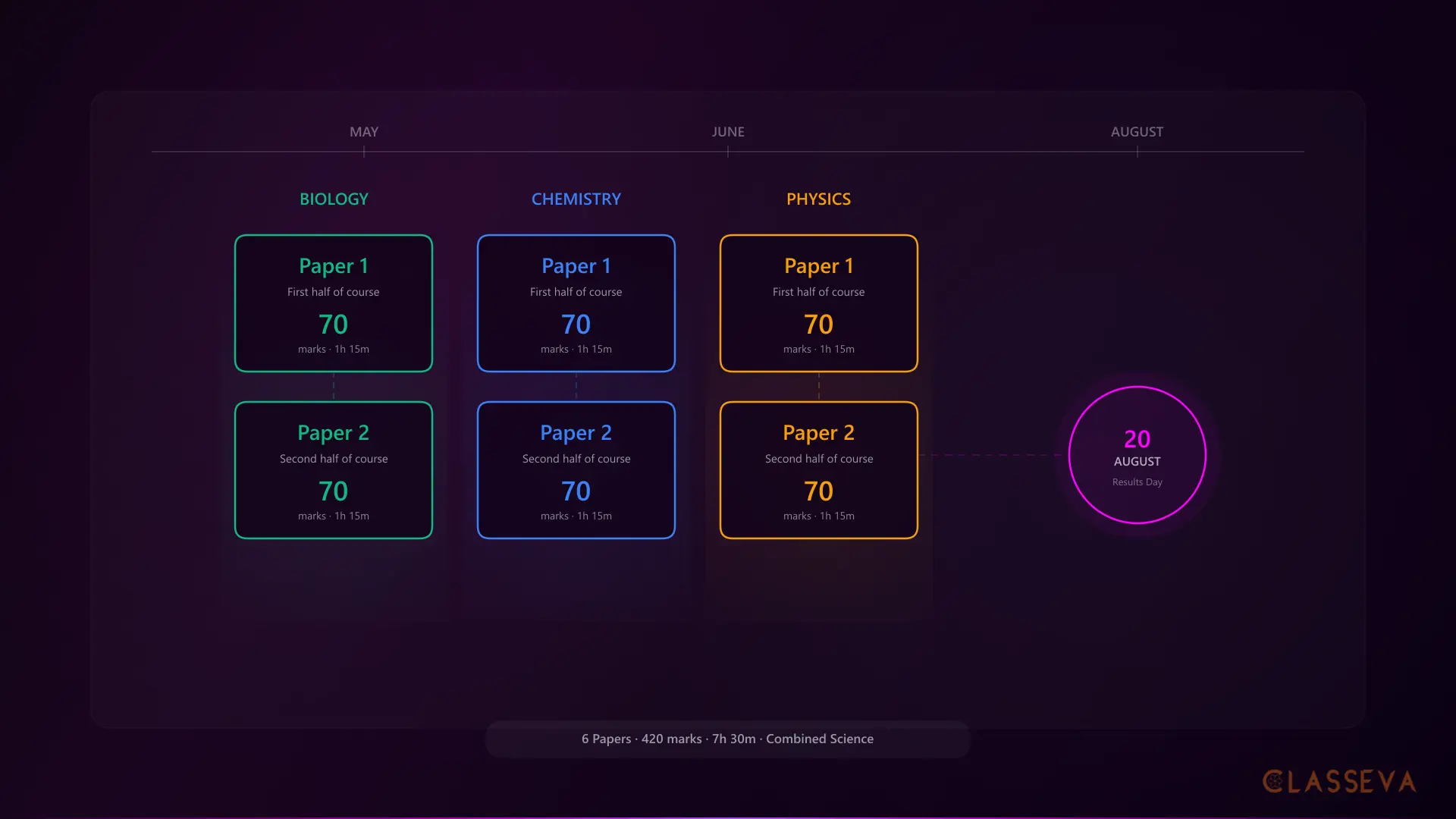
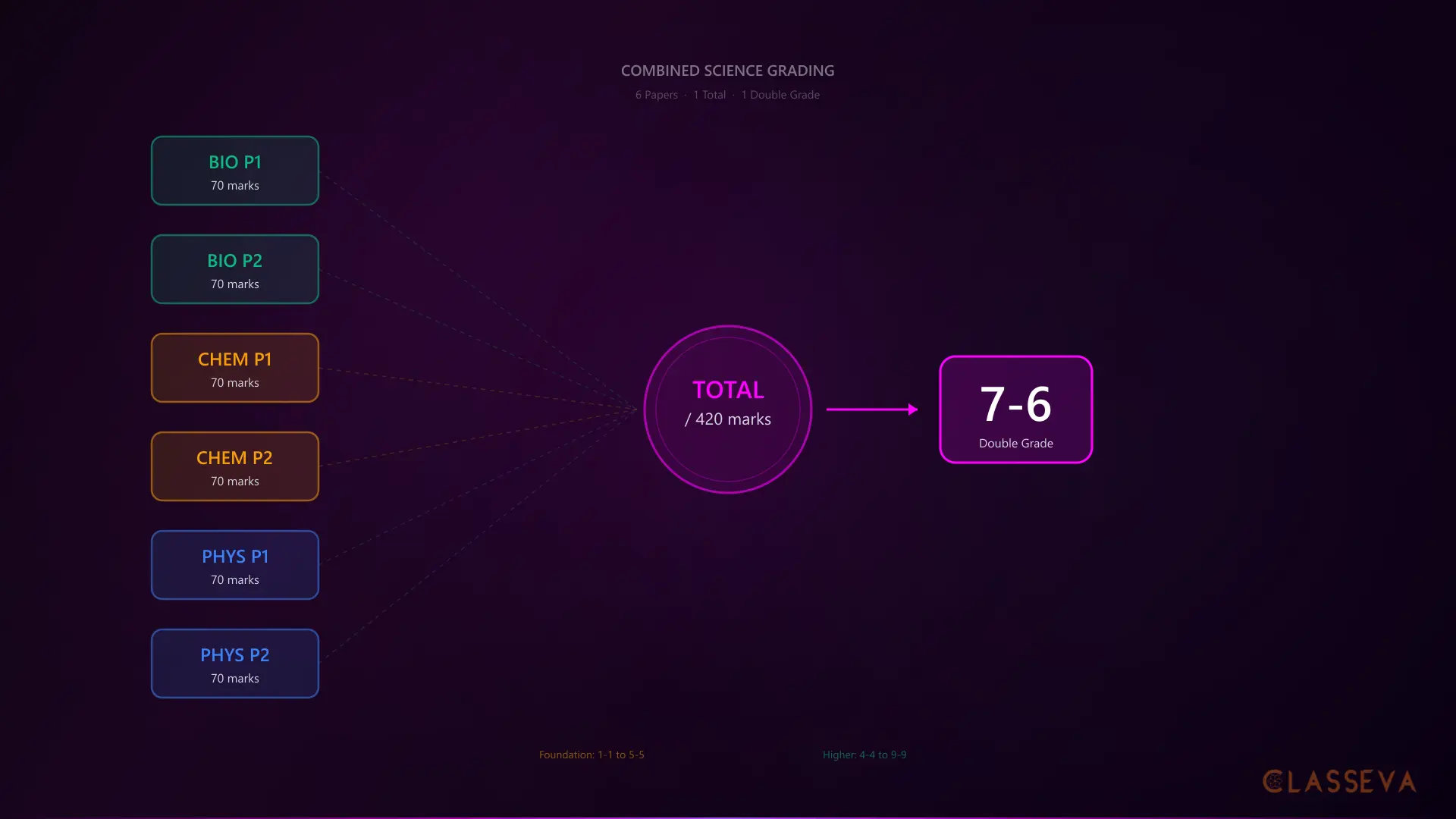
The grade comes from the total marks across all six papers. That is two Biology papers, two Chemistry papers, and two Physics papers. For AQA (the most common board for science), each paper is worth 70 marks, giving a total of 420. The boundary is applied to this combined total, not to individual subjects.
Your child does not get separate Biology, Chemistry, and Physics grades in Combined Science. One total mark across six papers produces one double grade. A strong performance in Biology can compensate for a weaker performance in Physics, and vice versa.
Triple Science: Three Separate Grades
Triple Science (Separate Sciences) is more straightforward. Each subject is its own GCSE with its own grade. Biology has two papers (200 marks total on AQA), Chemistry has two papers (200 marks), and Physics has two papers (200 marks). Each subject has independent grade boundaries. A grade 8 in Biology, 6 in Chemistry, and 7 in Physics is perfectly possible.
How Combined Science Grades Are Calculated
The calculation is surprisingly simple once you know the structure. Your child sits six papers. The raw marks from all six are added together. That single total is compared against the grade boundaries to produce the double grade.
What the Six Papers Look Like
On AQA (the most widely used board for Combined Science), each paper is 70 marks and lasts 1 hour 15 minutes. The six papers are:
| Paper | Subject | Marks | Duration |
|---|---|---|---|
| Paper 1 | Biology | 70 | 1h 15m |
| Paper 2 | Biology | 70 | 1h 15m |
| Paper 3 | Chemistry | 70 | 1h 15m |
| Paper 4 | Chemistry | 70 | 1h 15m |
| Paper 5 | Physics | 70 | 1h 15m |
| Paper 6 | Physics | 70 | 1h 15m |
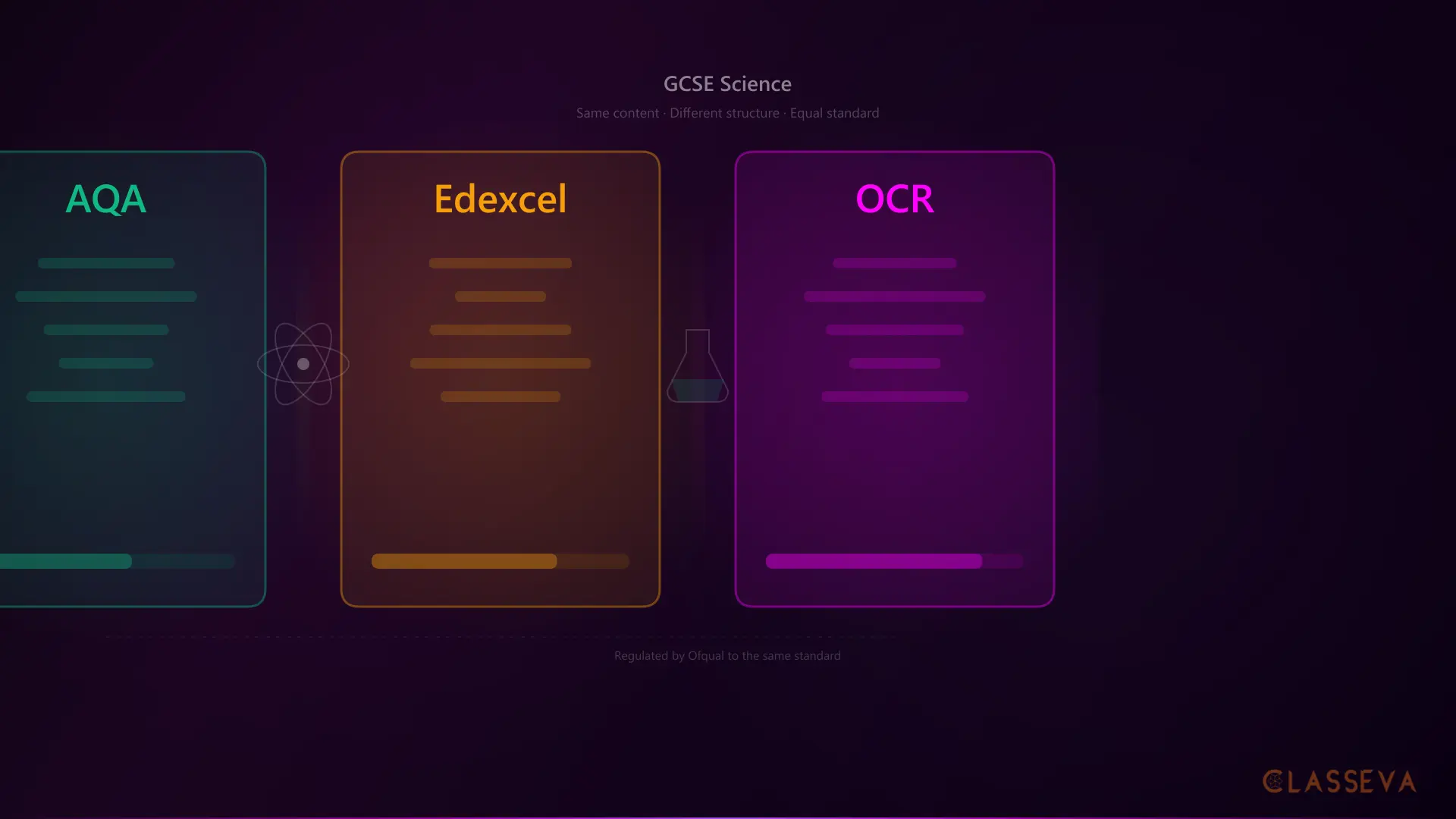
AQA Combined Science: Trilogy (8464). Edexcel and OCR follow a similar six-paper structure with different mark totals.
Edexcel Combined Science has six papers too, but each is worth a different number of marks (60 marks per paper, 360 total). OCR Gateway uses the same six-paper format. The principle is identical: all six papers contribute to one combined total.
Foundation vs Higher Tier
Just like GCSE Maths grade boundaries, Combined Science has two tiers:
Foundation Tier
- •Grades 1-1 to 5-5
- •More structured questions
- •Accessible entry point
- •Maximum grade: 5-5
Higher Tier
- •Grades 4-4 to 9-9
- •More complex multi-step problems
- •Harder calculation questions
- •Risk of U if below grade 4-4
Your child sits the same tier for all six papers. They cannot mix Foundation for Biology with Higher for Chemistry. The tier decision applies to the entire Combined Science qualification. Speak to the Head of Science if you are unsure which tier your child is entered for.
Approximate GCSE Science Grade Boundaries
These approximate ranges are based on historical data from recent exam series. Actual boundaries are published by each exam board on results day and vary every year depending on paper difficulty. Use these as rough guides, not guarantees.
Do not treat these percentages as fixed targets. A parent who tells their child “you need 60% for a grade 7” is setting up expectations that may be 30 marks too high or too low depending on the year. Focus on maximising every mark rather than hitting a specific number.
Combined Science: Higher Tier
| Double Grade | Approx. % of Total | Approx. Marks (out of 420) |
|---|---|---|
| 9-9 | 75–85% | 315–357 |
| 8-8 | 65–75% | 273–315 |
| 7-7 | 50–60% | 210–252 |
| 6-6 | 40–50% | 168–210 |
| 5-5 | 30–40% | 126–168 |
| 4-4 (minimum) | 20–30% | 84–126 |
Approximate ranges based on recent AQA Combined Science Higher boundaries. Actual figures vary by year.
Combined Science: Foundation Tier
| Double Grade | Approx. % of Total | Approx. Marks (out of 420) |
|---|---|---|
| 5-5 (maximum) | 65–75% | 273–315 |
| 4-4 | 45–55% | 189–231 |
| 3-3 | 30–40% | 126–168 |
| 2-2 | 20–30% | 84–126 |
| 1-1 (minimum pass) | 15–20% | 63–84 |
Approximate ranges based on recent AQA Combined Science Foundation boundaries.
Notice the overlap at grade 5-5. On Foundation, it requires roughly 65 to 75 percent of marks, which is a very high bar. On Higher, a 5-5 requires only about 30 to 40 percent. This is why tier choice matters so much: a student targeting grade 5 will generally find it easier on Higher tier, even though Higher papers are more demanding.
Triple Science Boundaries
Triple Science grade boundaries are set independently for each subject. The percentage ranges are broadly similar to Combined Science but applied to each subject's 200-mark total (on AQA). A grade 7 in Biology might require around 55% of 200 marks (110 marks), while a grade 7 in Physics might require 52% in the same year. Each subject boundary reflects the difficulty of those specific papers.
You can check exact historical grade boundaries for every exam board on the AQA grade boundaries archive and in Ofqual's official GCSE grade outcomes data. These are the authoritative sources, updated each August.
Why GCSE Science Grade Boundaries Feel Unpredictable
Science boundaries shift more dramatically than many other subjects, and there are specific reasons for this. Understanding them helps you stay calm when you hear “the Chemistry paper was really hard” on exam day.
Six papers amplify variation
With six contributing papers, one unusually hard paper can shift the overall boundary by 10 to 15 marks. In a two-paper subject like English, one hard paper has a proportionally larger effect on the total, but in science, the six-paper spread means the total mark range is wider and boundaries have more room to move.
Required practicals are unpredictable
Questions based on the required practicals can be straightforward recall or complex application. Students who have genuinely done the practicals find them easy; those who have only read about them struggle. This creates wide score variation within a single cohort.
Mathematical content varies in difficulty
Science papers include calculations, graph interpretation, and data analysis. The difficulty of these questions varies significantly year to year. A physics paper with a complex multi-step calculation in question 6 will produce a different mark distribution than one with a simple substitution.
Ofqual maintains standards, not marks
Ofqual ensures that a grade 7 in 2026 represents the same standard as a grade 7 in 2025. But the raw marks needed to reach that standard can differ substantially. This is by design: it keeps grades fair even when papers vary in difficulty.
Five Things That Matter More Than Boundaries
Having watched hundreds of students prepare for science GCSEs, I can say confidently that the students who focused on maximising their marks across all six papers consistently outperformed those who fixated on hitting a specific boundary number. Here are the five areas that make the biggest difference.
1. Precise Scientific Language
Science mark schemes are famously strict about terminology. “The enzyme's active site changes shape so the substrate can no longer fit” earns full marks. “The enzyme changes” earns nothing. This is where students lose the most marks, and it is the easiest problem to fix.
Encourage your child to practise writing answers using the exact scientific terms from the specification. The difference between a grade 5 and a grade 7 often comes down to language precision rather than content knowledge. They might understand the concept perfectly but lose marks because they have not used the correct terminology.
2. Required Practicals Are Free Marks
Every GCSE science specification lists required practicals that your child must know. Questions about these practicals appear on every exam series. For each practical, your child should know: the aim, the method, the equipment, the independent and dependent variables, the control variables, expected results, and how to improve accuracy.
Students who learn the practicals systematically gain marks that others simply leave on the table. These questions test recall and application, not creativity, which means they are highly preparable.
3. Show all working in calculations. Science papers award method marks even when the final numerical answer is wrong. Writing out the formula, substituting values, and showing units can earn 2 out of 3 marks on a question where the student makes a calculation error. The same applies to equation recall: writing the correct equation is often worth a mark on its own.
4. Revise weak topics, not comfortable ones. The most common pattern I saw working in tutoring was students spending revision time on topics they already understood because it felt productive. A student scoring 85% on Biology but 40% on Physics will gain far more from targeted Physics revision than from perfecting Biology further. In Combined Science, where all three subjects feed into one grade, this cross-subject focus is critical.
5. Use past papers strategically. Complete timed past papers under exam conditions, then mark them using the official mark scheme. The mark scheme teaches your child exactly what examiners want to see. After marking, compare the total to historical boundaries for that board. This gives a realistic grade estimate that is more useful than any prediction. Find past papers and mark schemes on the science revision guide.
How to Use Mock Results to Estimate a Grade
Mock exams are the best tool parents have for understanding where their child stands. But the grade your child's school assigns on a mock report is often based on internal boundaries that may not match the real exam boundaries.
Get the raw marks for each paper
Ask the school for the actual marks your child scored on each of the six mock papers, not just the overall grade. You need the raw numbers.
Add the six marks together
If your child scored 45, 42, 38, 35, 30, and 28 across the six papers, the total is 218 out of 420.
Compare to historical boundaries
Look up the most recent published boundaries for your child's exam board on the AQA or Edexcel website. A total of 218 might sit at a grade 6-5 in one year and a 5-5 in another. This gives a realistic range.
Identify the weakest papers
The papers with the lowest scores are where the biggest gains are possible. In the example above, Physics (30 and 28) has the most room for improvement. Even modest gains of 10 marks per Physics paper would push the total to 238, potentially moving the grade up.
The gap between grade 4 and grade 7 in Combined Science is often narrower than parents expect. On AQA Higher, the difference has historically been around 100 to 130 marks across 420. That is roughly 15 to 20 extra marks per paper. Focused revision on the weakest subject can realistically move a student up two to three double grades.
What Parents Should Focus On
After working with parents through the GCSE science revision period, the pattern is clear: the parents who make the biggest difference are those who help their child work smarter, not those who try to decode the grading system.
Confirm the exam board and tier
Check whether your child is taking AQA, Edexcel, or OCR, and whether they are entered for Foundation or Higher. This determines which grade range is available and which past papers to use.
Get the specification
Every specification is free on the exam board's website. It lists every topic that can be tested. If your child is doing AQA Combined Science, search for "AQA 8464 specification". It is the single most useful document for revision planning.
Focus revision on weak subjects
Because all six papers feed into one total in Combined Science, improving the weakest subject raises the overall grade more efficiently than perfecting the strongest. Use mock results to identify which of the three sciences needs the most attention.
Practise required practicals
Required practical questions appear on every paper. If your child can recall the aim, method, variables, and expected results for each practical, they gain marks that many students miss. This is one of the highest-value revision activities in science.
Use past papers with mark schemes
Timed past papers followed by self-marking with the official mark scheme teaches exam technique faster than any other method. The mark scheme shows exactly how examiners award marks, which trains your child to write answers in the way that earns credit.
Grade boundaries are set by people you will never meet, after papers you cannot control. The marks your child earns are within your influence. Every hour spent on targeted revision, tackling the hardest science topics, and practising exam technique is an hour that pushes the total higher, regardless of where the boundaries end up falling.
If your child is finding science revision overwhelming, structured exam preparation that follows the specification topic by topic can help them build confidence systematically rather than revising randomly.