GCSE Science Exam Dates 2026: Complete Timetable
One thing that caught parents off guard more than anything else during my time at a tutoring company was the sheer number of science papers their child had to sit. A parent would book extra sessions “for the science exam” only to discover there were actually six separate papers spread across several weeks. Combined Science or Triple Science, Biology, Chemistry, Physics, Paper 1 and Paper 2 for each. The GCSE science exam dates 2026 are not a single date. They are six papers for Combined Science students and six papers for Triple Science students, scattered across the May to June exam window.
This guide covers everything you need: which route your child is on, how many papers they sit, the exam board dates, how required practicals are tested, and what happens on results day. If you want to understand the content of each paper, see our GCSE Science paper structure guide.
When Are GCSE Science Exams in 2026?
GCSE science exams run from May to June 2026. Your child will sit either six papers (Combined Science) or six papers (Triple Science) across this window. The papers are typically spread so that Biology, Chemistry, and Physics do not fall on consecutive days, giving students time to switch focus between subjects.
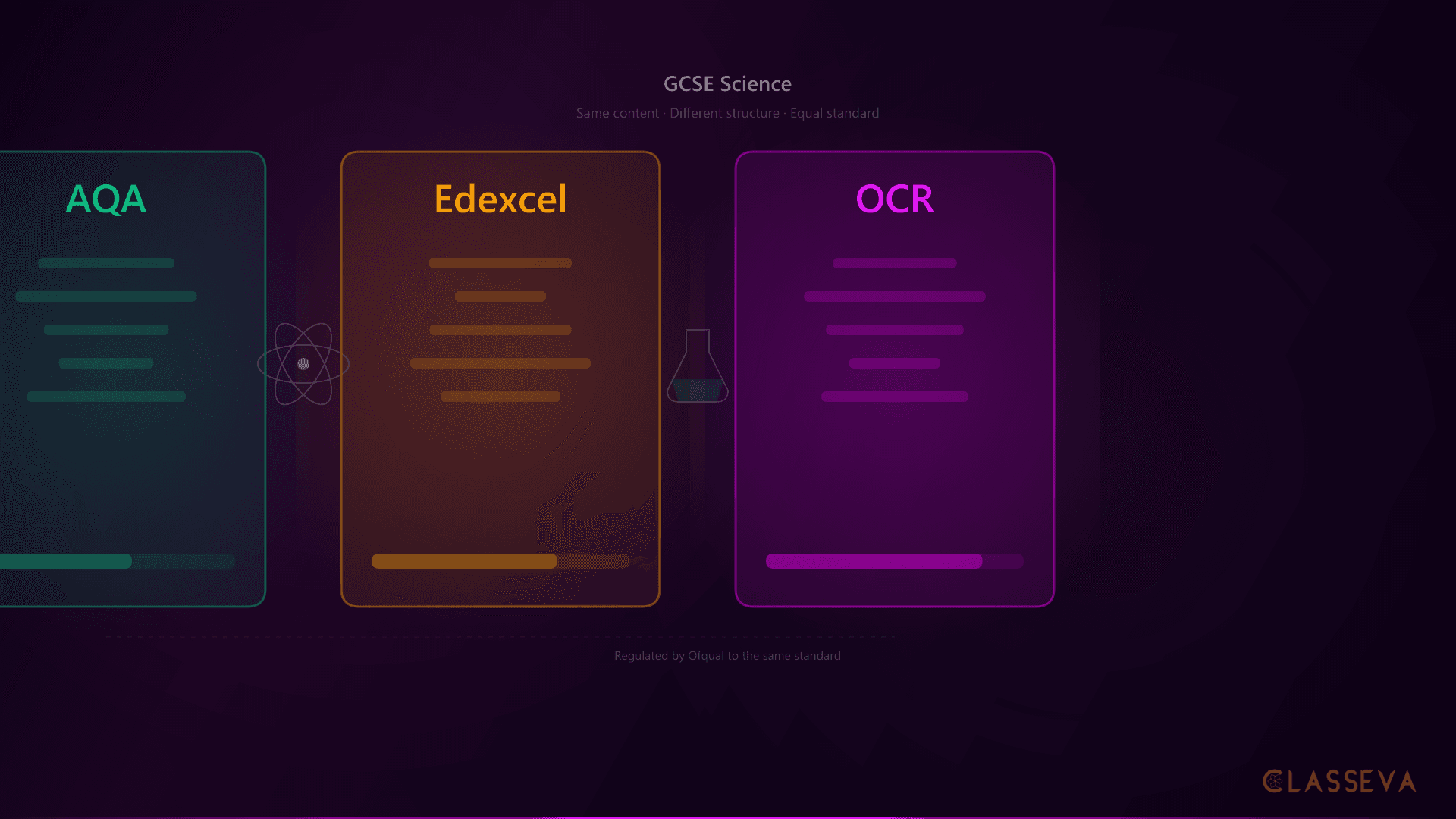
The exam window and structure are the same every year. What changes is the specific dates assigned to each paper. These are set by the exam boards (AQA, Edexcel, OCR) and coordinated by the Joint Council for Qualifications (JCQ) so that major subjects do not clash.
Combined vs Triple: The Key Difference
The first thing to establish is which route your child is on. Most students take Combined Science (Trilogy), which is by far the most popular option. In 2025, Combined Science had 925,606 entries, making it the single most-entered GCSE across all subjects. Triple Science entries are much lower: 183,539 for Biology, 174,088 for Chemistry, and 165,927 for Physics.
Combined Science (Trilogy)
- •Counts as 2 GCSEs
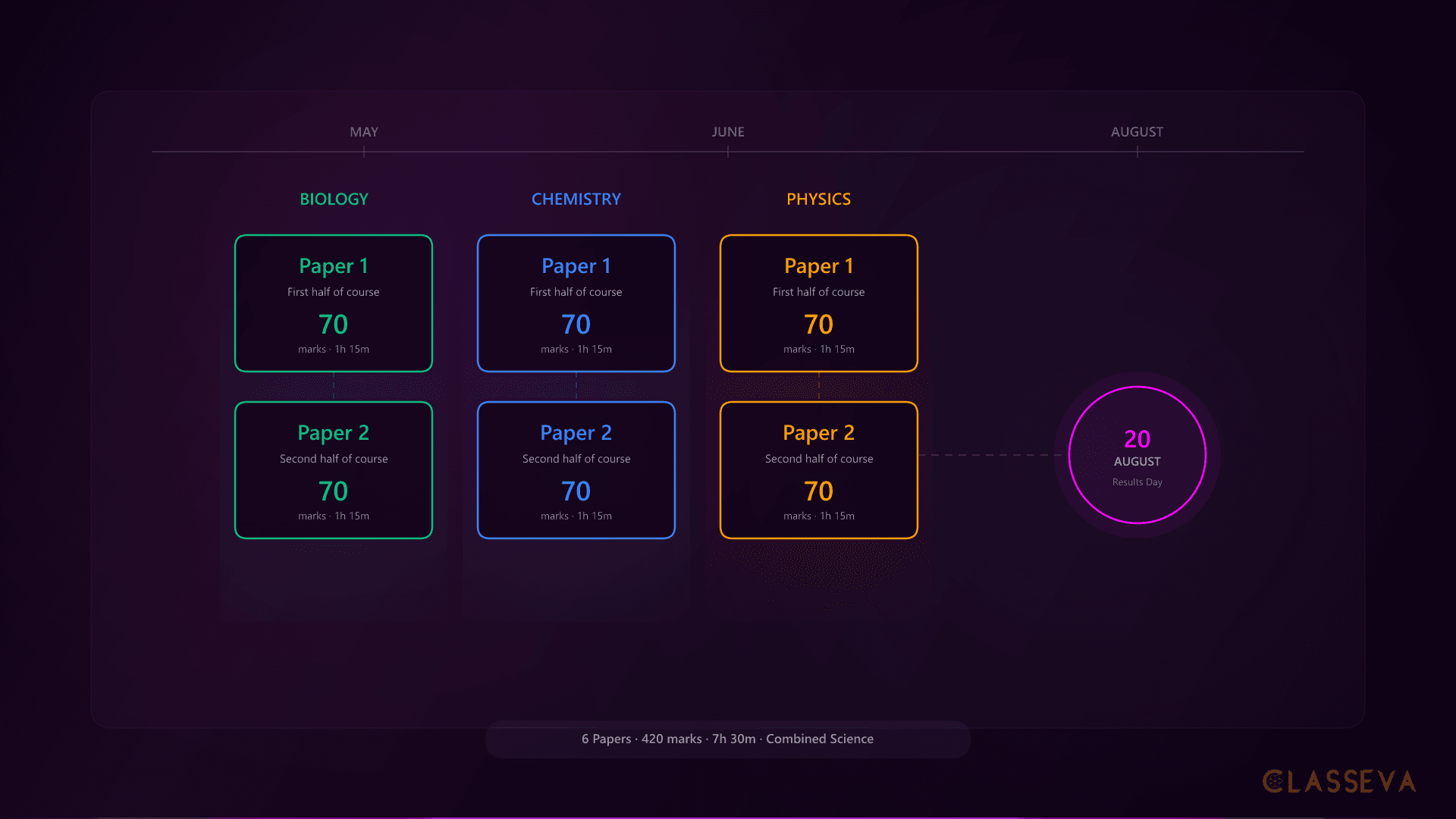
- •6 papers: 2 Biology + 2 Chemistry + 2 Physics
- •Each paper: 1h 15m, 70 marks
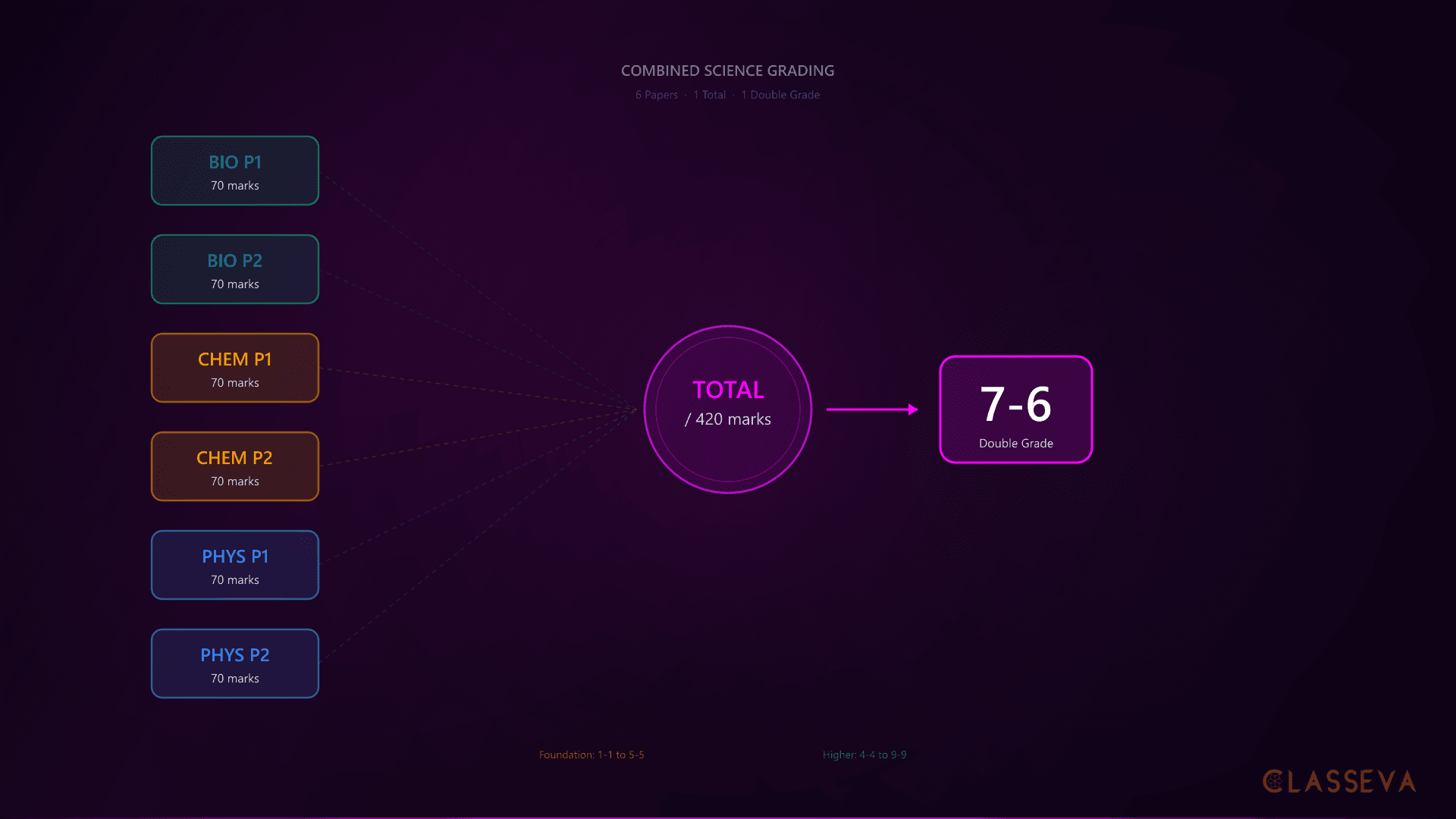
- •Double grade (e.g. 7-6 or 5-5)
- •Foundation (1-1 to 5-5) or Higher (4-4 to 9-9)
- •925,606 entries in 2025 (most popular GCSE)
Triple Science (Separate)
- •Counts as 3 separate GCSEs
- •6 papers: 2 Biology + 2 Chemistry + 2 Physics
- •Each paper: 1h 45m, 100 marks
- •Individual grades per subject (e.g. Biology 8, Chemistry 7)
- •Foundation or Higher tier per subject
- •Self-selecting cohort: 40%+ graded 7-9 in 2025
If you are not sure which route your child is on, ask the school. It is usually decided in Year 9 or early Year 10, and the choice affects how many GCSEs your child receives. For a deeper comparison, see our Combined vs Triple Science guide.
Morning and Afternoon Sessions
Morning (AM) sessions typically start at 9:00 AM and afternoon (PM) sessions begin at 1:30 PM. Science papers can fall in either session. Your child's school may adjust start times slightly for students with access arrangements or exam clashes, but the standard times are set nationally by the JCQ.
Combined Science Paper Structure
AQA Combined Science: Trilogy (specification 8464) is the most common combined science qualification. It has six papers in total, two for each science discipline. Each paper is 1 hour 15 minutes and worth 70 marks, giving a total of 420 marks across all six papers.
Paper 1 and Paper 2 cover different topics in each subject. Paper 1 is typically the first half of the course content and Paper 2 the second half. This matters for revision: your child should not be trying to revise all of Biology the night before Biology Paper 2 if they only need the second half of the specification.
How the Double Grade Works
Combined Science awards a double gradesuch as 7-7, 6-5, or 4-3. The two numbers can differ by at most one grade. This double grade counts as 2 GCSEs on your child's certificate. It is calculated across all six papers combined, not per subject. A student could perform strongly in Biology and Physics but weaker in Chemistry, and the overall double grade reflects the average.
Foundation tier covers grades 1-1 to 5-5. Higher tier covers grades 4-4 to 9-9. Your child sits the same tier across all six papers. The school decides the tier, usually confirmed by spring of Year 11.
Triple Science Paper Structure
Triple Science students study Biology, Chemistry, and Physics as three separate GCSEs. For AQA, each subject has two papers: Paper 1 (1h 45m, 100 marks) and Paper 2 (1h 45m, 100 marks). That gives 200 marks per subject and 600 marks across all three. The papers are longer and go into greater depth than Combined Science, covering additional topics unique to the separate qualifications.
| Subject | Spec Code | Papers | Each Paper | Total Marks |
|---|---|---|---|---|
| Biology | 8461 | 2 (Paper 1 + Paper 2) | 1h 45m, 100 marks | 200 |
| Chemistry | 8462 | 2 (Paper 1 + Paper 2) | 1h 45m, 100 marks | 200 |
| Physics | 8463 | 2 (Paper 1 + Paper 2) | 1h 45m, 100 marks | 200 |
AQA Triple Science specification codes and paper structure. Each subject is a standalone GCSE.
The total exam time for Triple Science is 10 hours 30 minutes across all six papers, compared to 7 hours 30 minutes for Combined Science. This is a significant commitment, and it is worth understanding before your child chooses this route. For the full topic breakdown, see our guides on GCSE Biology topics, Chemistry topics, and Physics topics.
Why Triple Science Grades Look Higher
In 2025, over 40% of Triple Science entries were graded 7-9 across all three subjects, with 27.1% achieving grade 7+ in Biology, 30.5% in Chemistry, and 29.8% in Physics. These rates look dramatically higher than most other GCSEs, but there is a straightforward explanation: Triple Science is a self-selecting cohort. Schools typically offer it only to their strongest science students. The high top-grade rates reflect the ability of the students taking it, not that the exams are easier.
GCSE Science Exam Dates by Board
All three major exam boards set their science papers within the May to June window, but exact dates differ. The GCSE science timetable 2026is published by each board individually. AQA is the most widely used board for GCSE Science in England. Edexcel uses different specification names (Combined Science is called “Combined Science” under code 1SC0; the separate sciences use codes 1BI0, 1CH0, 1PH0).
You can find the official AQA GCSE Science dates at the AQA Science subject page, and the Edexcel timetable at Pearson's exam timetables page.
How to Confirm Your Child's Dates
Check which route and board your child is on
Ask the school whether your child is doing Combined Science or Triple Science, and which exam board (AQA, Edexcel, or OCR). The specification code will be on past papers and school resources.
Check the official exam board timetable
AQA publishes dates at aqa.org.uk/subjects/science. Edexcel publishes timetables at qualifications.pearson.com. These contain exact dates for every paper.
Wait for the personalised school timetable
Schools issue individual timetables in the spring term. These include room numbers, seat allocations, and any access arrangements. This is the definitive document for your child.
Required Practicals in the Exam
One detail that surprises many parents is that required practicals are tested in the written exam papers, not as separate practical assessments. Your child will face questions about specific experiments they carried out during the course. These are not vague “describe an experiment” questions. They ask about specific equipment, specific variables, and specific results.
How Practicals Are Tested
AQA Combined Science has approximately 21 required practicals across the three subjects. AQA Triple Science has around 8 per subject (24 total). Questions on required practicals typically account for about 15% of each paper. They test whether your child can identify independent, dependent, and control variables, describe the method step by step, explain why specific equipment was chosen, and predict or interpret results.
Many students revise the theory but forget the practicals. For each required practical, your child should be able to draw and label the equipment setup from memory, list the variables, and describe what results to expect. Our required practicals guide covers every experiment they need to know.
Using the Gaps Between Science Papers
Because science papers are spread across the full exam window, there are gaps of days (sometimes a week or more) between papers. These gaps are some of the most productive revision time your child will have. After sitting Biology Paper 1, they know exactly which topics felt shaky, and they can target those before Biology Paper 2. The same applies to Chemistry and Physics.
Smart Gap Revision
- •Review topics from the paper just sat while they are fresh
- •Focus only on Paper 2 content for the next subject
- •Do one timed past paper for the upcoming exam
- •Revisit required practicals for the next paper
Common Mistakes
- •Trying to revise all three sciences at once
- •Ignoring the paper they just sat and moving on
- •Spending the gap on subjects they already feel confident in
- •Not practising under timed conditions
Having worked with hundreds of students preparing for science exams, the pattern was always clear: students who treated each gap as a focused sprint on the next paper saw measurable improvements between Paper 1 and Paper 2. The ones who continued with generic revision across all topics did not. The gap is not a break. It is a chance to be strategic. For more science-specific revision strategies, see our how to revise for GCSE Science guide.
Five Things Every Parent Should Know
Science exams are spread across the entire exam window
Your child may have Biology Paper 1 in early May and Physics Paper 2 in late June. This is normal. Check the personalised timetable from school so you know exactly which days are science days.
Paper 1 and Paper 2 cover different topics
Paper 1 covers the first half of the course, Paper 2 the second half. Your child should not be revising all of Biology for Paper 2. They need only the Paper 2 topics. This is true for Combined and Triple.
Required practicals appear in the written papers
There is no separate practical exam. Questions about specific experiments (method, equipment, variables, results) appear in the written papers and account for roughly 15% of the marks.
Combined Science entries increased while triple fell
In 2025, Combined Science entries rose 2% to 925,606. Triple Science entries fell 6% across all three subjects. The trend is toward combined, so if your child is on this route, they are in the majority.
The equations sheet matters for Physics
Physics papers provide some equations on a formula sheet but require students to memorise others. Your child must know which equations are given and which must be recalled from memory. This is a common source of lost marks.
Combined Science had 925,606 entries in 2025, making it the most popular GCSE overall. That is more than Maths (831,556) and English Language (811,672). If your child is doing Combined Science, they are part of the largest GCSE cohort in the country.
Results Day: 20 August 2026
GCSE results day 2026 is Thursday 20 August. Students typically collect results from school from around 8:00 AM, though some exam boards offer online access from 6:00 AM. For a full guide on what to expect, see our GCSE results day parent guide.
What the Grades Mean
Combined Science results appear as a double grade on the certificate, such as 7-6 or 5-5. The two numbers can differ by at most one grade. This double grade counts as 2 GCSEs for sixth form entry and UCAS points. Triple Science students receive three separate grades, one for each subject.
| Route | Example Grade | GCSE Count | What It Means |
|---|---|---|---|
| Combined | 7-6 | 2 GCSEs | Strong performance, both grades above the "strong pass" threshold |
| Combined | 4-3 | 2 GCSEs | Grade 4 is a standard pass; grade 3 is below pass |
| Triple | Bio 8, Chem 7, Phys 7 | 3 GCSEs | Three separate strong grades, each counting individually |
| Triple | Bio 5, Chem 6, Phys 5 | 3 GCSEs | Solid performance across all three sciences |
Combined Science awards a double grade counting as 2 GCSEs. Triple Science awards three individual grades.
If your child is considering A-Level sciences, most sixth forms require a minimum of grade 6 (or grade 6-6 in Combined) for entry. Some selective sixth forms require grade 7 or above. Check entry requirements early, particularly if your child is on Foundation tier, which caps at grade 5 (or 5-5 in Combined). For a broader understanding of the grading system, see our guide to what GCSEs are.