AQA GCSE Combined Science Grade Boundaries 2026
The AQA GCSE combined science grade boundaries 2026 will be published on results day, 20 August 2026. Until then, historical data reveals one thing parents often find more confusing than the marks themselves: Combined Science does not produce a single grade. Your child receives a double grade such as 7-6 or 5-5, drawn from a 17-point scale running from 9-9 down to 1-1. No other GCSE works this way, and most parents I spoke to when I worked in tutoring had never encountered it before results day.
That unfamiliarity is worth fixing before August. Understanding the double-grading system, how AQA's six papers feed into a single 420-mark total, and what percentage ranges have historically matched each double grade gives you a much clearer picture of where your child stands and what revision will actually move the needle.
What Is the Double-Grading System in AQA Combined Science?
AQA Combined Science: Trilogy (qualification code 8464) is worth two GCSEs. Because it spans Biology, Chemistry, and Physics, Ofqual designed a double-grade scale to reflect that breadth. Rather than a single number from 1 to 9, your child's combined total maps onto a paired grade where the two numbers are either equal or adjacent.
Why There Are 17 Possible Grade Combinations
The 17 valid combinations run from 9-9 down to 1-1, each step either holding the same number or dropping by one. The full scale is: 9-9, 9-8, 8-8, 8-7, 7-7, 7-6, 6-6, 6-5, 5-5, 5-4, 4-4, 4-3, 3-3, 3-2, 2-2, 2-1, 1-1. A combination like 7-5 cannot occur because the gap between the two numbers would be two. Each step in the scale has its own grade boundary, which is why 17 boundaries appear in the published AQA 8464 grade boundaries tables rather than the 9 boundaries you see in a single-grade subject.
The two numbers in a Combined Science double grade can only differ by one. A grade of 7-6 is valid. A grade of 7-5 is not. This means the 420 total mark maps to exactly one of 17 possible combinations, with no gaps between adjacent combinations on the scale.
One Total Mark, Not Three Separate Grades
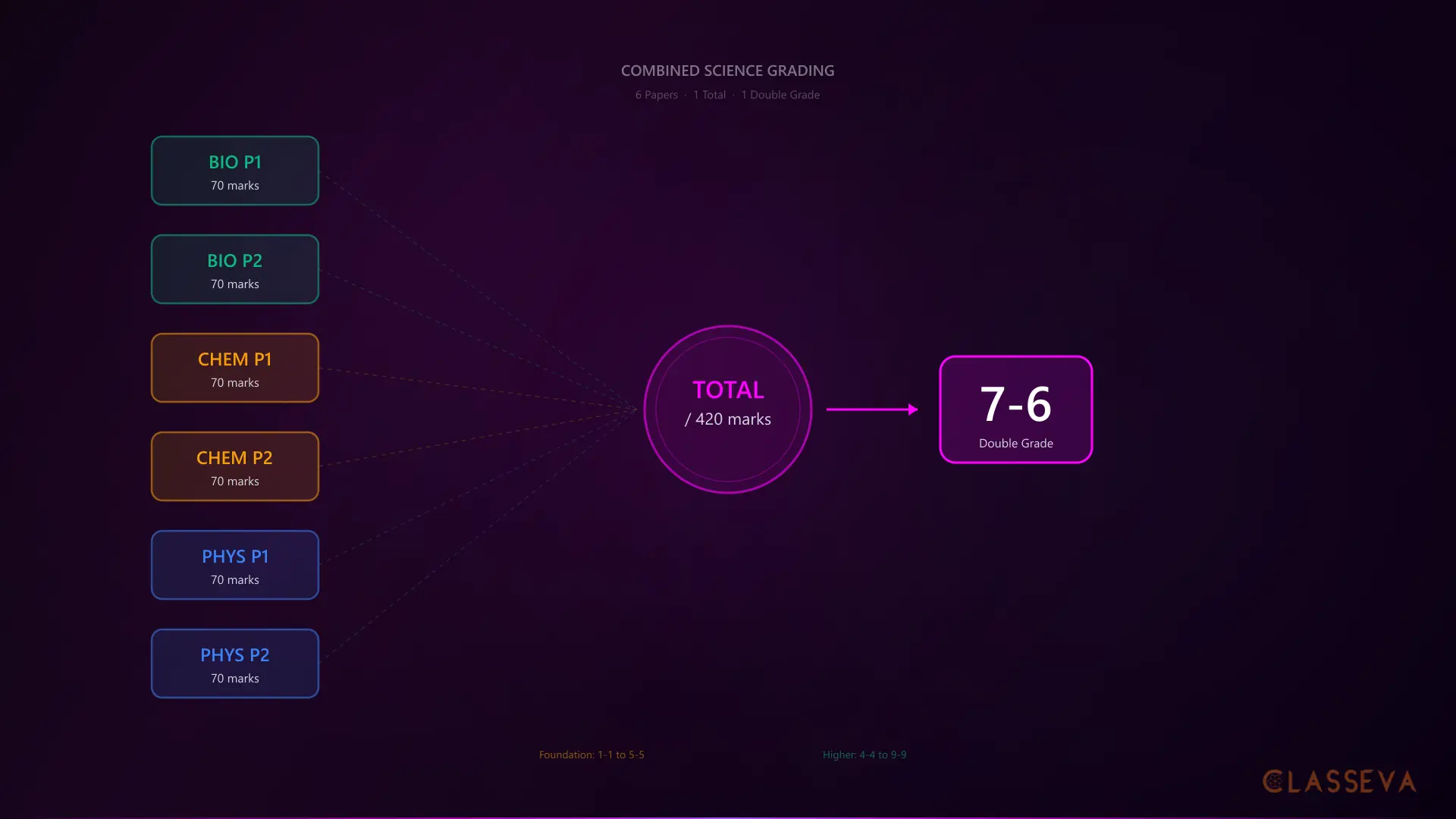
Perhaps the biggest misconception parents carry into results day: AQA Combined Science does not give your child separate Biology, Chemistry, and Physics grades. All six paper marks are added together to produce a single total out of 420. That total is compared against the published AQA grade boundaries to produce the double grade.
A student who scored 65 on both Biology papers, 55 on both Chemistry papers, and 45 on both Physics papers has a total of 330 out of 420. That total determines the double grade, regardless of the subject imbalance. Strong Biology compensates for weaker Physics within that same combined total.
How the Six Papers Work in AQA Combined Science
AQA Combined Science: Trilogy (8464) is a linear qualification: all six papers are sat at the end of Year 11 in the same exam series. According to the AQA 8464 specification, each paper carries 70 marks and lasts 1 hour 15 minutes, making the total 420 marks across the full qualification.
Paper-by-Paper Breakdown
| Paper | Subject | Topics Covered | Marks | Duration |
|---|---|---|---|---|
| Paper 1 | Biology | Cell Biology, Organisation, Infection and response, Bioenergetics | 70 | 1h 15m |
| Paper 2 | Biology | Homeostasis and response, Inheritance and evolution, Ecology | 70 | 1h 15m |
| Paper 3 | Chemistry | Atomic structure, Bonding, Quantitative chemistry, Chemical changes, Energy changes | 70 | 1h 15m |
| Paper 4 | Chemistry | Rate and extent of change, Organic chemistry, Chemical analysis, Atmosphere, Resources | 70 | 1h 15m |
| Paper 5 | Physics | Energy, Electricity, Particle model of matter, Atomic structure | 70 | 1h 15m |
| Paper 6 | Physics | Forces, Waves, Magnetism and electromagnetism | 70 | 1h 15m |
Source: AQA Combined Science: Trilogy (8464) specification. All six papers carry equal weight at 16.7% each.
Why All Six Papers Matter Equally
Each paper contributes exactly 16.7% of the overall qualification. There is no downweighting for a subject your child finds harder. A student who sits Physics Paper 5 and scores 35 out of 70 has placed 35 marks into the total, the same contribution as 35 marks from Biology Paper 1. This equal weighting is why improving the weakest subject delivers more grade movement than polishing an already-strong one.
Ask your child's school which papers each subject covers and request individual paper marks from mock results. Knowing that your child scored 62 on Biology Paper 1 but only 38 on Physics Paper 6 tells you far more than an overall mock grade. Those individual totals pinpoint exactly where the 420-mark total can be raised. Compare against our broader GCSE science grade boundaries guide for context across all boards.
Foundation vs Higher Tier in AQA Combined Science
Foundation tier (8464F) and Higher tier (8464H) use different papers with different questions. Your child sits the same tier for all six papers: there is no mixing Biology on Foundation with Physics on Higher. The tier decision applies to the whole qualification, and both tiers share the same 70-marks-per-paper, 420-mark structure.
Foundation Tier: Grades and Mark Ranges
Foundation tier covers double grades 1-1 to 5-5. The questions are more structured and accessible, designed to give students a secure route to a standard pass at grade 4-4. The maximum available grade is 5-5, so if your child is regularly scoring above 65% on Foundation practice papers, they may be capped unnecessarily.
| Double Grade | Approx. % of 420 marks | Approx. Mark Range |
|---|---|---|
| 5-5 (maximum on Foundation) | 65–75% | 273–315 |
| 4-4 (standard pass) | 45–55% | 189–231 |
| 3-3 | 30–40% | 126–168 |
| 2-2 | 18–28% | 76–118 |
| 1-1 | 10–18% | 42–76 |
Approximate Foundation tier ranges based on recent AQA 8464 historical data. Actual boundaries vary each year and are published on results day.
Higher Tier: Grades and Mark Ranges
Higher tier (8464H) covers grades 4-4 to 9-9 and includes more complex multi-step questions, a wider range of required practical applications, and harder calculation questions. The risk of Higher tier is the U grade: any total below the 4-4 boundary receives an ungraded result, not a 3-3.
| Double Grade | Approx. % of 420 marks | Approx. Mark Range |
|---|---|---|
| 9-9 | 75–85% | 315–357 |
| 8-8 | 65–75% | 273–315 |
| 7-7 | 50–60% | 210–252 |
| 6-6 | 40–50% | 168–210 |
| 5-5 | 30–40% | 126–168 |
| 4-4 (minimum on Higher) | 20–30% | 84–126 |
Approximate Higher tier ranges based on recent AQA 8464 historical data. Grade 7-7 is highlighted as the most commonly asked-about boundary. Actual boundaries are published on results day.
Do not tell your child they need “60% for a grade 7.” The actual boundary shifts every year depending on how hard the six papers are. In some years a grade 7-7 has been achievable with under 50% of the marks; in others it has required over 60%. Focusing on a specific percentage target risks either false confidence or unnecessary stress. Focus on maximising marks across all six papers instead.
The Tier Decision for AQA Combined Science
The school makes the tier entry decision, usually in February or March of Year 11. If your child is predicted a grade 5-5 or 6-5, the tier decision deserves a conversation with the Head of Science.
Foundation Tier (8464F)
- •Grades 1-1 to 5-5 available
- •Maximum grade: 5-5
- •More accessible question types
- •No U grade risk
- •Best for students predicted 1-1 to 5-4
Higher Tier (8464H)
- •Grades 4-4 to 9-9 available
- •Access to grades 6-6 and above
- •More complex questions and calculations
- •U grade risk below 4-4 boundary
- •Required for students targeting 6-5 or above
One pattern I noticed working with Year 11 students: parents who discovered their child was on Foundation tier in March were often surprised, because the predicted grade on Foundation (perhaps a 4-4) looked reasonable on paper. The hidden cost is that a student who improves dramatically through spring revision cannot access anything above 5-5 on Foundation. If there is any genuine upside potential, Higher tier preserves the ceiling. For a full comparison, see our guide on Combined Science vs Triple Science.
AQA 8464 Grade Boundaries in Practice
The AQA GCSE combined science grade boundaries 2026 will appear on the AQA grade boundaries page on 20 August 2026, the same morning students receive their results. Until then, only historical tables are publicly available.
Where to Find Official Boundaries
AQA publishes boundaries free of charge. Search for qualification code 8464 to see separate tables for Foundation (8464F) and Higher (8464H). Each table lists all 17 double-grade boundaries as raw mark totals out of 420. The JCQ results statistics page publishes national-level grade outcome data each August, showing the proportion of entries receiving each grade nationally, which gives useful context for how common each double grade is in a given year.
| Source | What it shows | When available |
|---|---|---|
| AQA grade boundaries (aqa.org.uk) | Exact raw mark boundaries for 8464F and 8464H, all 17 combinations | Results day, August each year |
| AQA grade boundaries archive | Historical boundary tables going back several years | Available year-round |
| JCQ results statistics (jcq.org.uk) | National percentage of students reaching each grade | August each year |
All sources are free to access. Do not pay for grade boundary data.
Using Past Data After Mock Exams
If your child's school used an actual AQA past paper series for mock exams, you can look up the historical boundaries for that series and compare your child's total directly. Add the marks from all six mock papers. Check whether the school used Foundation or Higher papers. Then compare the total against the historical 8464F or 8464H boundary table from that series.
Collect the raw mark for each of the six mock papers
Ask the school for individual paper marks, not just the overall mock grade. You need the actual number of marks scored on each paper out of 70.
Add the six marks to get the total out of 420
Sum all six papers. A student scoring 55, 52, 48, 44, 38, and 36 has a total of 273 out of 420.
Identify which AQA past series the school used
Ask whether the mock used AQA papers from a specific year (e.g. June 2024 series). This tells you which historical boundary table to consult.
Compare the total against the AQA 8464 archive
Find the series in AQA's grade boundaries archive and check where 273 falls relative to the 17 double-grade boundaries for that year. This gives a realistic grade estimate, not a guarantee.
Identify the two or three papers with the lowest marks
These are the papers where extra revision will produce the biggest jump in the overall total. A 10-mark improvement on Physics Paper 5 raises the total by 10 marks, the same as a 10-mark improvement on Biology Paper 1.
The gap between grade 4-4 and grade 7-7 on AQA Higher has historically been around 100 to 130 marks out of 420. That is roughly 17 to 22 extra marks per paper across six papers. A focused revision programme that adds 15 marks on Physics (a common weak subject) can move a 5-5 student to 6-5 or higher without changing anything else. Compare boundaries across boards using our GCSE science grade boundaries guide.
What Actually Moves Your Child's Grade Up
Grade boundaries are set after the papers are sat. There is nothing your child can do to influence where the boundaries fall, but there is a great deal they can do to increase the number of marks they put into the 420-mark total.
Target the Weakest Science First
Because all six papers feed into one total, improving the weakest science delivers the biggest return. A student scoring 60, 58, 55, 52, 30, and 28 across the six papers has a total of 283 out of 420. The Physics papers are contributing only 58 marks out of a possible 140 for the two Physics papers combined. A focused Physics revision push that adds 20 marks to those two papers raises the total to 303, potentially moving across two double-grade boundaries.
After each mock, rank your child's six paper scores from lowest to highest and focus the next revision cycle on the bottom two papers. This cross-subject targeting is specific to Combined Science and more productive than the subject-by-subject approach students naturally take. See our how to revise for GCSE science guide for practical revision strategies per topic.
Required Practicals and Scientific Language
Two areas consistently separate students near a grade boundary from those above it: required practical questions and scientific language precision.
Every AQA Combined Science paper includes questions based on the 21 required practicals your child must have completed during the course. These questions are highly preparable: your child should know the aim, method, key variables, and expected results for each practical. Students who have genuinely done the practicals in class find these questions straightforward; those who have only read a summary lose marks that are, in a meaningful sense, free.
Scientific language precision matters because AQA mark schemes award marks for the exact terminology from the specification. “The enzyme changes shape” does not earn the same mark as “the active site changes shape so the substrate no longer fits.” Working through past papers with the official mark scheme teaches your child to write answers the way examiners award marks, which is a faster route to grade improvement than re-reading a textbook. Find past papers on the AQA 8464 assessment resources page.
For students targeting grade 7-7 or above, the AQA double science grade boundaries at that level typically require close to 55% of the total marks on Higher tier. The fastest route there is not memorising more content but consistently applying what is already known to unfamiliar exam questions. If your child wants to compare their options, our Combined Science vs Triple Science guide explains when separate sciences give a better outcome. For AQA-specific biology boundaries, see also AQA GCSE Biology grade boundaries 2026, and for AQA Physics, see AQA GCSE Physics grade boundaries 2026.
Key Takeaways
- AQA GCSE combined science grade boundaries 2026 are published on results day, 20 August 2026, on the AQA grade boundaries page.
- Combined Science (8464) produces a double grade from 9-9 to 1-1 based on all six papers combined, not separate Biology, Chemistry, and Physics grades.
- There are 17 valid double-grade combinations. Adjacent grades (e.g. 7-6) are valid; gaps of two (e.g. 7-5) are not.
- Foundation tier (8464F) caps at 5-5; Higher tier (8464H) runs from 4-4 to 9-9 with a U grade risk below the 4-4 boundary.
- Historical data suggests a grade 7-7 on Higher tier has required roughly 50 to 60% of the 420-mark total, but exact boundaries shift every year based on paper difficulty.
- Targeting the weakest science is the highest-return revision strategy because all six papers contribute equally to the same total.
- Required practical questions and mark-scheme language precision are the two fastest ways to add marks near a grade boundary.