OCR GCSE Combined Science Grade Boundaries 2026
The OCR GCSE combined science grade boundaries 2026 work differently from every other GCSE your child sits. Instead of one number, they receive two: a double grade such as 6-6 or 7-6. That double grade is calculated from six separate exam papers covering Biology, Chemistry, and Physics combined. No other core GCSE produces this kind of result, and it baffles a large number of parents every August.
The specific mark thresholds for 2026 will only be published on results day by OCR. But the grading system itself does not change year to year, and understanding how it works now, before exams, gives you a much clearer lens for interpreting mock results and having useful conversations with your child's teachers.
What Makes OCR Combined Science Grading Different?
OCR GCSE Combined Science (J250) counts as two GCSEs. Because it covers double the content, it produces a double grade rather than a single number. Instead of receiving a 6, your child receives something like 6-6 or 6-5. This double grade reflects their overall performance across all three sciences combined, not separate grades for each subject.
The 17 Double Grade Combinations
The double-grading system generates 17 possible outcomes. Students can receive grades from 9-9 at the top to 1-1 at the bottom, with adjacent combinations available in between. The rule is firm: the two numbers can only be identical or differ by one, so a student cannot receive 7-5 or 8-6 even if their marks put them between those bands.
| Grade Group | Possible Combinations | Old Grade Equivalent |
|---|---|---|
| Top | 9-9, 9-8 | Above A* |
| High | 8-8, 8-7 | A* to A |
| Strong pass | 7-7, 7-6 | A |
| Good pass | 6-6, 6-5 | B |
| Standard pass | 5-5, 5-4 | C (high) |
| Pass | 4-4, 4-3 | C |
| Below pass | 3-3, 3-2 | D to E |
| Low | 2-2, 2-1 | E to F |
| Minimum | 1-1 | G |
The 17 double grade combinations in OCR Combined Science, showing old-grade equivalents as a rough guide. Source: Ofqual and gov.uk
The old-grade comparisons in the table above are approximate guides only. Ofqual confirmed that grade 7-7 aligns broadly with the old grade A, and grade 4-4 aligns with the old grade C. But the new scale offers more differentiation at the top, which is why 9-9 sits above what the old A* could capture.
How the Double Grade Is Calculated
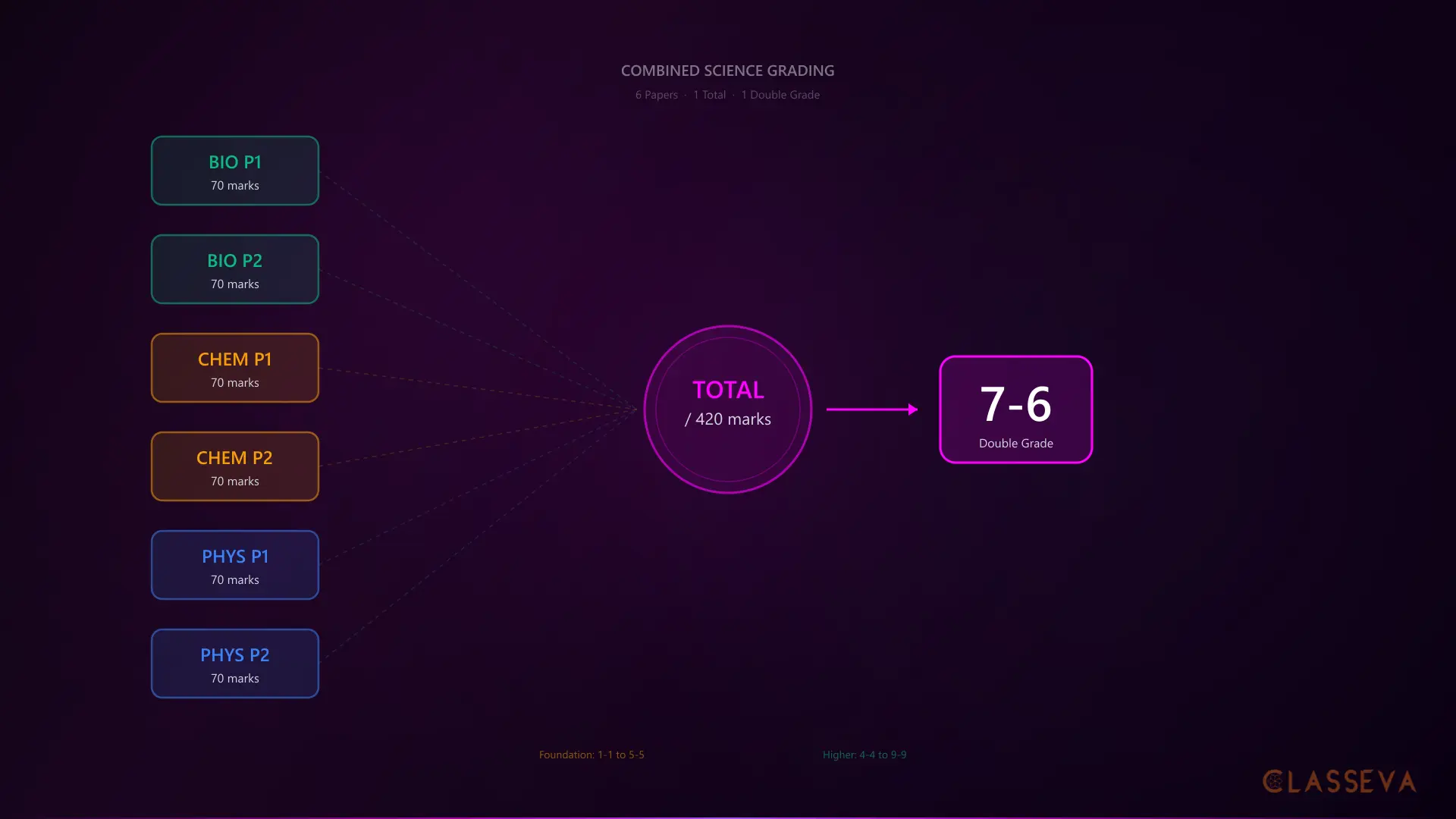
OCR adds together your child's marks from all six papers into a single total out of 360. It then applies 17 grade boundaries to that total. The result is your child's double grade. Crucially, strong performance in Biology can compensate for weaker Physics, because the system looks at the overall total rather than assigning separate grades to each science.
OCR sets 17 boundaries on the 360-mark total. Your child's combined mark falls between two boundaries, and that determines the double grade. The larger number always comes first (9-8, not 8-9), and the two numbers can only differ by one grade at most.
The OCR J250 Paper Structure
OCR J250 has twelve individual papers across both tiers. Each student sits exactly six, depending on whether their school has entered them for Foundation or Higher. Each paper is worth 60 marks, so the total across all six papers is 360 marks. This total is what the double-grade boundaries are applied to.
Foundation Tier Papers (J250/01 to J250/06)
Foundation tier students sit six papers labelled J250/01 through J250/06. Two cover Biology, two cover Chemistry, and two cover Physics. The Foundation papers access double grades from 1-1 up to a ceiling of 5-5.
| Paper Code | Subject | Marks | Tier |
|---|---|---|---|
| J250/01 | Biology Paper 1 | 60 | Foundation |
| J250/02 | Biology Paper 2 | 60 | Foundation |
| J250/03 | Chemistry Paper 3 | 60 | Foundation |
| J250/04 | Chemistry Paper 4 | 60 | Foundation |
| J250/05 | Physics Paper 5 | 60 | Foundation |
| J250/06 | Physics Paper 6 | 60 | Foundation |
OCR J250 Foundation tier papers. Total: 360 marks across six papers. Source: ocr.org.uk
Higher Tier Papers (J250/07 to J250/12)
Higher tier students sit papers J250/07 to J250/12, again two Biology, two Chemistry, and two Physics. Higher tier accesses grades from 4-4 at the lower end up to 9-9 at the top. The total is also 360 marks.
| Paper Code | Subject | Marks | Tier |
|---|---|---|---|
| J250/07 | Biology Paper 7 | 60 | Higher |
| J250/08 | Biology Paper 8 | 60 | Higher |
| J250/09 | Chemistry Paper 9 | 60 | Higher |
| J250/10 | Chemistry Paper 10 | 60 | Higher |
| J250/11 | Physics Paper 11 | 60 | Higher |
| J250/12 | Physics Paper 12 | 60 | Higher |
OCR J250 Higher tier papers. Total: 360 marks across six papers. Source: ocr.org.uk
OCR J250 Grade Boundaries Explained
OCR GCSE combined science grade boundaries 2026 will not be published until results day. What we do have is the pattern from previous years: boundaries set on the 360-mark total, shifting every year based on paper difficulty. The figures below are historical ranges drawn from multiple years of OCR J250 data and are intended to set expectations, not predict exact 2026 thresholds.
Foundation Tier Grade Ranges
Foundation tier produces double grades from 1-1 to 5-5. Historically, the 5-5 boundary on Foundation has required roughly 65 to 75 percent of the 360 total marks. The 4-4 standard-pass boundary has typically fallen around 45 to 55 percent.
| Double Grade | Typical % of 360 marks | Approximate mark range |
|---|---|---|
| 5-5 (Foundation ceiling) | 65% to 75% | 234 to 270 |
| 5-4 | 55% to 65% | 198 to 234 |
| 4-4 (standard pass) | 45% to 55% | 162 to 198 |
| 4-3 | 35% to 45% | 126 to 162 |
| 3-3 | 25% to 35% | 90 to 126 |
| 2-2 | 12% to 22% | 43 to 79 |
| 1-1 | Below 12% | Below 43 |
Approximate OCR J250 Foundation tier grade ranges based on historical patterns. Actual 2026 boundaries will differ. Source: ocr.org.uk historical data
Higher Tier Grade Ranges
Higher tier produces double grades from 4-4 at the lower end (where the Foundation ceiling ends) up to 9-9. A student scoring below the 4-4 boundary on Higher receives a U grade, not a 3-3. That is the single biggest grading risk for Higher tier students whose marks are borderline.
| Double Grade | Typical % of 360 marks | Approximate mark range |
|---|---|---|
| 9-9 | 85% to 92% | 306 to 331 |
| 9-8 | 78% to 85% | 281 to 306 |
| 8-8 | 70% to 78% | 252 to 281 |
| 8-7 | 63% to 70% | 227 to 252 |
| 7-7 | 55% to 63% | 198 to 227 |
| 7-6 | 48% to 55% | 173 to 198 |
| 6-6 | 40% to 48% | 144 to 173 |
| 6-5 | 33% to 40% | 119 to 144 |
| 5-5 | 26% to 33% | 94 to 119 |
| 4-4 (minimum on Higher) | 16% to 26% | 58 to 94 |
Approximate OCR J250 Higher tier grade ranges based on historical patterns. Grade 7-7 and 4-4 highlighted as commonly referenced boundaries. Actual 2026 boundaries will differ.
Parents ask me about grade 9-9 more than any other boundary. The honest answer is that it depends heavily on how difficult OCR sets the 2026 papers. In years with challenging papers, students have reached 9-9 with around 85 to 87 percent. In more accessible years, the threshold has pushed closer to 90 percent. No one outside OCR's awarding panel knows where it will land for 2026 until the papers are marked.
Foundation vs Higher: The OCR Decision
Foundation tier caps at 5-5. Higher tier starts at 4-4 and reaches 9-9. Your child sits one or the other, not both, and the decision is typically made by the school in Year 11. For most students predicted a strong 4-4 or above, Higher tier is the right choice. For students whose mock results are marginal, Foundation provides a safer path to securing that 4-4 pass.
The Overlap at Grade 5-5
Both tiers can produce grade 5-5. A student near the boundary who sits Foundation could achieve 5-5 with a strong performance. The same student on Higher, if their mark falls below the 5-5 threshold but above the 4-4 threshold, would receive 4-4 instead. Higher tier demands more from borderline students because the paper questions are harder. Choose the tier where your child demonstrates the strongest consistent performance in mock conditions, not the tier that offers the best possible outcome.
Foundation Tier
- •Double grades: 1-1 up to 5-5
- •No U grade risk for engaged students
- •Papers are more accessible in style
- •Ceiling at 5-5 regardless of marks
- •Best choice when 4-4 is the target
Higher Tier
- •Double grades: 4-4 up to 9-9
- •U grade if marks fall below 4-4 boundary
- •Papers include harder required content
- •Needed for grades 6-6 through 9-9
- •Best choice for students targeting 5-5 or above
The U Grade Risk on Higher Tier
If your child scores below the 4-4 boundary on Higher tier, OCR awards a U (ungraded), not a 3-3 or 3-2. That U counts as a failed GCSE and does not contribute to any qualification. The U grade risk is real for students whose total mark across six papers falls short of the 4-4 threshold. Schools generally manage this risk by monitoring mock performance, but if you have concerns, ask directly whether your child is safely above the 4-4 boundary on their current Higher tier performance.
Parents sometimes assume that if their child struggles on Higher, the grade will just drop to 3-3. It will not. On Higher tier, below the 4-4 boundary means U (ungraded). For a student predicted borderline 4-4, Foundation tier gives a more reliable route to a graded outcome.
How to Use Grade Boundaries After Mocks
The most useful moment to look at OCR double science grade boundaries is after your child sits a past-paper mock. At that point, you have an actual mark to compare. Before that, OCR J250 grade boundaries are useful background context but cannot drive specific revision decisions.
Reading a Mock Result
When your child brings home a Combined Science mock result, ask the school which OCR J250 past papers were used and whether they sat Foundation or Higher. If the school used genuine past papers, you can look up that year's historical boundaries on the OCR grade boundaries archiveand compare your child's total across all six papers to the published thresholds for each double grade.
Add up marks across all six papers
The double grade is based on a single total out of 360. Add all six paper marks together before making any comparison.
Confirm which past paper series was used
Ask the school whether the mock used genuine OCR J250 past papers and which series (e.g., June 2024 Higher). Only compare against that specific year's published boundaries.
Look up the OCR J250 boundary for that series
Visit ocr.org.uk, navigate to grade boundaries, and find the J250 qualification boundaries for the relevant year. The PDF lists both Foundation and Higher tier double-grade thresholds.
Identify the margin above or below the next boundary
If your child's total is 15 marks above the 6-6 boundary and 30 marks below 7-7, they are more securely in the 6-6 band than if the margin were only 5 marks.
Plan revision by science, not just by total
Although the grade is awarded on the total, ask the school for a breakdown by paper. If Chemistry papers account for most lost marks, that tells you where revision should focus first.
Ask your child's science teacher for a subject-by-subject breakdown of mock marks, not just the combined total. Even though OCR J250 grades on the total, knowing whether Biology or Physics is dragging the overall score down tells you where revision effort has the biggest return. This is one of the most useful conversations parents can have before the final exams.
Where to Find OCR J250 Grade Boundaries
OCR publishes all GCSE grade boundaries on its website, free of charge, on results day each August. You do not need to pay any third-party service for this data. The 2026 boundaries will appear alongside boundaries from previous years, which remain in the archive.
| Resource | URL | What It Contains |
|---|---|---|
| OCR grade boundaries (current) | ocr.org.uk/administration/grade-boundaries/ | Current and upcoming series boundaries including J250 |
| OCR grade boundaries archive | ocr.org.uk/administration/grade-boundaries/grade-boundaries-archive/ | Historical series back to 2017 for OCR J250 |
| JCQ national results statistics | jcq.org.uk/examination-results/ | National grade distribution data across all exam boards |
| Ofqual outcomes data | analytics.ofqual.gov.uk | Cross-board comparisons and national standards monitoring |
Free authoritative sources for OCR GCSE Combined Science J250 grade boundary data.
For a broader understanding of how grade boundaries work across all GCSE subjects, our guide to GCSE grade boundaries explained covers the awarding process in detail. If you are also looking at how OCR compares to AQA and Edexcel for Combined Science, the GCSE science grade boundaries post covers all three boards side by side.
Parents comparing OCR Combined Science results to those sitting the same subject at AQA may also find our AQA GCSE combined science grade boundaries 2026 post useful. For Edexcel, see the Edexcel GCSE combined science grade boundaries 2026 guide. And if your child is considering whether Combined Science or Triple Science is the right choice, our Combined Science vs Triple Science comparison breaks down the differences in how grades work, what content is covered, and which path suits different students.
According to JCQ national results statistics, OCR is the third most widely used exam board for GCSE sciences in England. AQA and Edexcel account for a larger share of entries, but OCR's Gateway Science suite (J250) and Twenty First Century Science suite are both well-established qualifications with the same grade standards.
One thing I found when working with families during results season is that the double grade surprises parents who expected a single number. A child who scores 210 out of 360 on Higher tier might receive a 6-5 rather than a 6, and parents sometimes worry that the two different numbers indicate inconsistency. They do not. It simply means the total mark fell in a zone where OCR's awarding panel placed the boundary between two adjacent grades. The result is a perfectly normal outcome and is understood by schools, colleges, and universities in exactly the same way as a single-subject grade.
Sixth-form colleges and colleges of further education specify Combined Science entry requirements using the double grade format. A common requirement for A-level Biology or Chemistry is a 6-6 in Combined Science, or a 6 in the relevant Triple Science subject. If your child holds a 6-5, it is worth asking the college directly whether that meets their threshold, because some will accept adjacent-grade combinations and some will not. OCR's J250 qualification page provides guidance on grade equivalencies that colleges can use when assessing entry requirements.
For OCR Biology, Chemistry, or Physics at A-level, the combination of your child's OCR J250 double grade and their A-level specification performance will both be considered. See our guides on OCR A-level Biology grade boundaries 2026, OCR A-level Chemistry grade boundaries 2026, and OCR A-level Physics grade boundaries 2026 for the next stage of the journey.
Key Takeaways
- OCR GCSE Combined Science (J250) produces a double grade from 9-9 to 1-1. There are 17 possible combinations, and the two numbers can only be the same or one apart.
- The double grade is calculated from the total of all six paper marks, out of 360. Strong Biology performance can compensate for weaker Physics because the grading works on the total.
- Foundation tier caps at 5-5. Higher tier starts at 4-4. Students who score below the 4-4 boundary on Higher receive a U (ungraded), not a 3-3.
- OCR GCSE combined science grade boundaries 2026 will not be published until results day in August 2026. Historical ranges suggest Higher tier grade 7-7 typically requires around 55 to 63 percent of the 360 total marks.
- Use past OCR J250 boundaries as a guide after mock exams, not as a fixed target. The 2026 papers will differ in difficulty and the boundaries will shift accordingly.
- Ask your child's teacher for a subject-by-subject breakdown of mock performance. The grade is awarded on the combined total, but individual science scores tell you where to focus revision.
- The official source for all OCR J250 boundaries is ocr.org.uk. The data is free and includes historical series back to 2017.