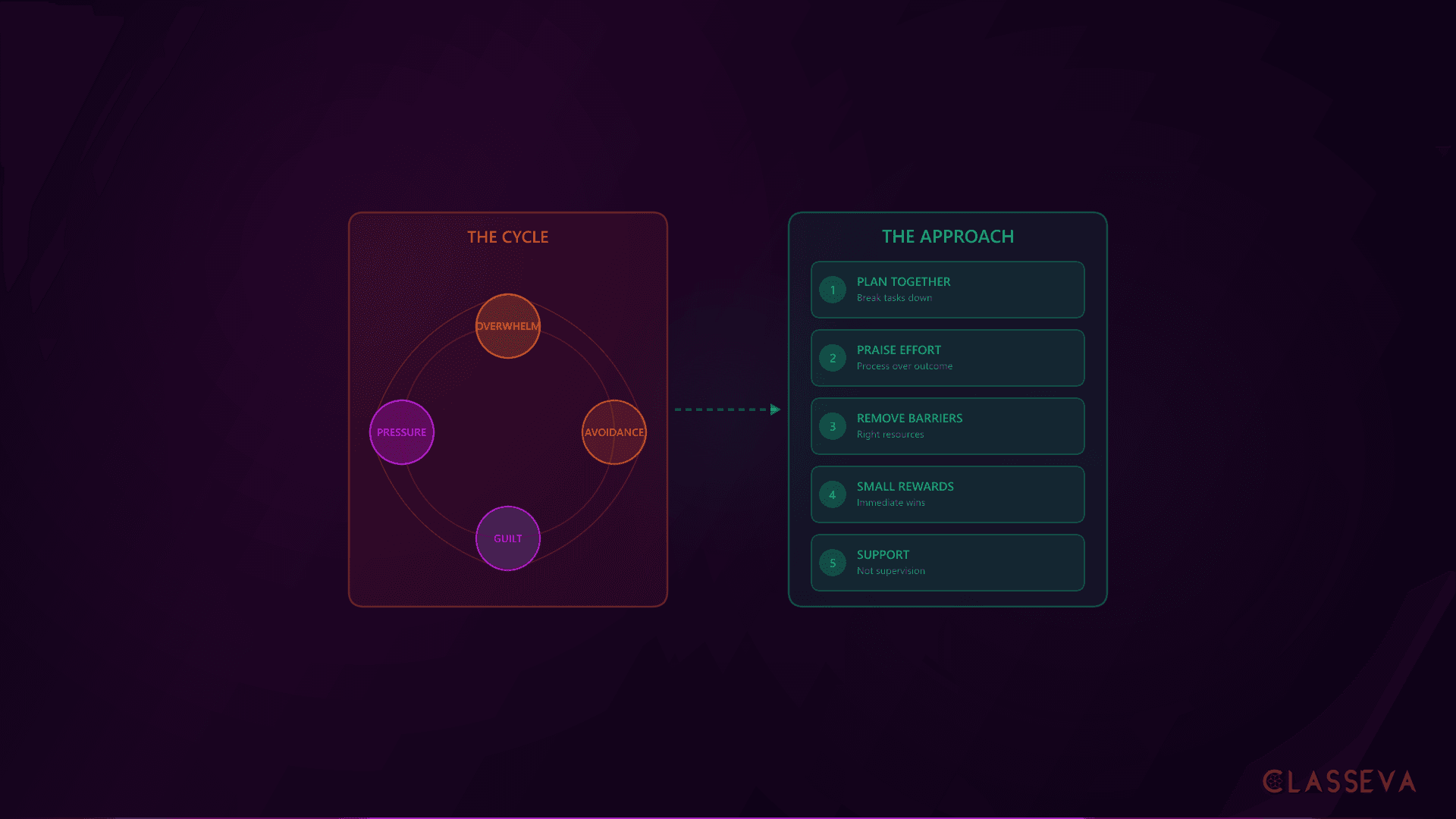
Homework Battles: How to End the Nightly Struggle
You know the scene. It is half five, dinner is on, and you ask: “Have you got any homework?” The answer is either “No” (a lie), “I'll do it later” (they won't), or silence followed by a slammed door. The homework battle is one of the most common sources of daily conflict between parents and teenagers, and it plays out in kitchens across the country every single evening.
During my time working in tutoring, the parents who came to us were often less worried about grades than they were about the nightly fight. One mother told me she dreaded 4 PM more than Monday mornings. The homework itself was rarely the problem. The conflict around it was destroying their evenings.
This guide is about ending that cycle. Not by forcing compliance, but by understanding why your teenager resists and putting structures in place that make the fight unnecessary.
Why Homework Causes Nightly Conflict
Before you can fix the homework struggle, you need to understand what is actually driving it. In almost every case I saw, the resistance had nothing to do with laziness. It came from one of three places.
The Autonomy Battle
Teenagers are developmentally wired to seek independence. This is not a flaw; it is a feature. Their brains are practising the decision-making they will need as adults. When a parent says “Do your homework now,” the teenager hears “I am controlling your time.” The resistance is not about homework. It is about being told what to do.
Research in self-determination theory (Deci and Ryan, 1985) consistently shows that autonomy is one of three core psychological needs. When it is threatened, people push back, regardless of age. Your teenager is not being difficult on purpose. They are responding to a perceived loss of control over their own evening.
Exhaustion and Cognitive Load
A typical school day runs from 8:30 AM to 3:30 PM. Add the commute, extracurriculars, and social navigation (which is genuinely exhausting for teenagers), and your child arrives home having already spent seven or eight hours concentrating. Asking them to immediately switch to more academic work is like asking someone to go for a run after finishing a marathon.
This does not mean homework should be skipped. But it explains why “do it the moment you walk through the door” backfires for most teenagers. They need a transition period.
Avoidance as a Coping Mechanism
Sometimes your teenager won't do homework because they genuinely do not understand it. Starting a task you cannot do feels awful. Rather than admitting they are stuck (which feels vulnerable, especially in front of parents), they avoid the task entirely.
Perfectionism also drives avoidance. Some students would rather hand nothing in than produce work they consider poor. If your child is a high achiever who suddenly stops doing homework, this may be the cause.
Five Strategies That Actually Reduce Conflict
These are the homework battles parents tips that consistently worked with the families I saw during my time in the tutoring industry. None of them involve standing over your child or shouting. All of them require a shift in approach from both sides.
Establish a Routine, Not a Rule
“Homework happens between 5 and 7 PM” is fundamentally different from “Do your homework now.” The first is a structure. The second is an order. Teenagers comply with structures far more willingly because they retain a sense of choice within them.
Let your teenager decide when within the window they start. Some prefer to get it done immediately after a snack. Others need an hour to decompress first. Both are fine. The point is consistency: the same window every day removes the daily negotiation that triggers conflict.
Rule (triggers resistance)
- •"Do your homework right now."
- •"No screen time until it is done."
- •"Why haven't you started yet?"
Routine (preserves autonomy)
- •"Homework window is 5 to 7. You choose when."
- •"Phone goes in the kitchen during the window."
- •"What are you planning to tackle first?"
One important note: the routine needs to be agreed together, not imposed. Sit down at the weekend and discuss what works. If your teenager helped design the routine, they are far more likely to follow it.
Create a Homework-Friendly Environment
The physical environment matters more than most parents realise. A quiet space with minimal distractions, good lighting, and all materials within reach reduces the friction of starting. If your teenager does homework at the kitchen table while younger siblings run around, you are setting them up to fail.
Some teenagers work better with background music; others need total silence. Let them experiment. Research from the University of Wales (Perham and Vizard, 2011) found that music with lyrics impairs reading comprehension, but instrumental music or white noise can help some students focus. If it is working, do not fight it.
The phone is the biggest environmental obstacle. This is not about trust. Smartphones are designed by teams of engineers to capture attention. Having the phone in another room during the homework window is not a punishment; it is removing an obstacle that even adults struggle with. Frame it as a deal: “Phone out of the room during the window, back as soon as you are done.”
Break the “I Don't Have Homework” Cycle
If your child frequently claims they have no homework, check the school's homework platform. Most secondary schools now use Satchel One (formerly Show My Homework), Google Classroom, or a similar system. If you do not have login details, email the form tutor and ask. This is a reasonable request, and schools expect it.
The key is to normalise checking rather than making it accusatory. “Let's have a quick look at what is coming up this week” works far better than “I know you are lying about not having homework.” One is collaborative. The other starts a fight.
The Two-Minute Rule
This is the single most effective technique I have seen for the homework struggle parentsface every evening. When your teenager says “I can't be bothered,” suggest this: “Just open the document and read the first question. If after two minutes you still can't face it, we will talk about why.”
The psychology behind this is straightforward. Starting a task is almost always harder than continuing it. Once your teenager has read the first question and written even a single sentence, the inertia breaks. The two-minute commitment feels manageable, and it frequently turns into 20 or 30 minutes of productive work.
Crucially, if they stop after two minutes and genuinely cannot continue, honour the deal. Ask what is blocking them. It might be that they do not understand the task, that they are overwhelmed by volume, or that something happened at school. The two-minute rule is a diagnostic tool as much as a motivational one.
Helping Without Doing
There is a critical difference between supporting your child's homework and doing it for them. One builds capability. The other creates dependency. Knowing where the line sits is one of the most important homework routine tips a parent can learn.
What Genuine Support Looks Like
The most helpful thing a parent can do is ask questions, not provide answers. “What is this homework asking you to do?” forces your teenager to process the task. “What is the first step?” breaks down overwhelm. “What have you already tried?” validates their effort before you intervene.
Clarify the task
Ask them to explain what the homework is actually asking. This alone often unlocks the path forward.
Identify the first step
Break the task into the smallest possible starting action. "Open the document" or "Write the date and title" counts.
Check understanding
If they cannot explain the concept, the issue is comprehension, not motivation. That needs a different solution.
Step back
Once they are working, leave the room. Hovering signals that you do not trust them to do it independently.
When the Work Is Beyond Your Knowledge
Many parents feel helpless when the homework involves topics they never studied or have long forgotten. GCSE maths has changed significantly since most parents were at school, and subjects like computer science or combined science may be entirely unfamiliar. This is completely normal.
If your child consistently does not understand the work, the first step is contacting the subject teacher. The issue is with the learning, not with homework compliance. In the meantime, AI tutoring tools like Classevacan fill the gap: instant explanations tailored to your child's exam board, worked examples, and practice problems available at 7 PM on a Tuesday when no human tutor is around.
“Finish your homework and you can use your phone” and “No phone until homework is done” describe the same outcome. The first frames it as earning a reward. The second frames it as a punishment. Teenagers respond far better to the first framing.
Pick Your Battles Wisely
Not every piece of homework carries the same weight. A 10-minute vocabulary exercise is not worth the same energy as a GCSE coursework draft. If your child consistently does 80% of their homework, that is a far better outcome than a nightly war that makes them associate learning with conflict.
Save your energy for the assignments that genuinely matter: coursework, assessed tasks, and mock exam preparation. If a low-stakes homework gets missed occasionally, it is not a crisis. The school will manage the consequence (usually a short detention or a note home), and that natural consequence is often more effective than any parental lecture.
Some parents respond to homework avoidance by cancelling all leisure activities until grades improve. This almost always backfires. Extracurriculars, sport, and social time are not distractions from learning; they are essential to your teenager's wellbeing. A stressed, isolated teenager does worse academically, not better.
If your child has genuine homework overload (multiple teachers setting large tasks on the same night), help them prioritise. Which task is due first? Which carries marks? Which can be done quickly? If the overload is consistent, email the head of year. Schools are supposed to coordinate homework across departments, and sometimes they need reminding.
When to Escalate Beyond the Home
Most homework battles can be resolved with the strategies above. But there are situations where the problem goes deeper than routine or motivation, and those need a different response.
Building Independent Homework Habits
The goal of all of this is not to supervise your child's homework forever. It is to build the independent habits they will need for GCSE revision and beyond. As a general rule: in Years 7 and 8, more parental involvement is normal and expected. By Years 10 and 11, your child should be managing homework largely on their own.
The transition happens gradually. In Year 7, you might check the homework platform together every evening. By Year 9, you check once a week. By Year 10, you only check if your child raises a problem. Each step back is deliberate and discussed: “You have been managing this well. I am going to step back to weekly check-ins. If you need me, I am here.”
Years 7 to 8
- •Daily homework window with parental presence nearby
- •Regular check of the school homework platform together
- •Active help with understanding new secondary school expectations
Years 10 to 11
- •Teenager manages their own homework timetable
- •Parent checks in weekly or when asked
- •Focus shifts from homework compliance to exam preparation
Warning Signs That Need School Involvement
Contact the school if you see any of the following patterns. These suggest something beyond ordinary homework resistance.
Complete and sustained refusal
If your child never does homework despite consistent routines and supportive strategies, there may be a pastoral issue such as bullying, friendship problems, or an undiagnosed learning difficulty.
Consistent lack of understanding
If they regularly cannot do the homework because they do not understand the content, request a meeting with the subject teacher. The issue is the learning, not compliance.
Anxiety or distress around homework
If homework consistently triggers tears, panic, or extreme avoidance, step back. No homework is worth damaging your child's mental health or your relationship with them.
Sudden change in behaviour
A student who previously did homework without issue and suddenly stops may be dealing with something at school. Ask, listen, and involve the form tutor if needed.
Start with the form tutor, not the head teacher. Form tutors have the best overview of your child's pastoral situation and can coordinate with subject teachers. Most homework issues are resolved at this level without further escalation.
Remember that your relationship with your teenager matters more than any individual homework assignment. From everything I observed working with families, the parents who maintained a strong, trusting relationship through the GCSE years had children who performed better in the end, regardless of how many homework tasks were missed along the way.
If you are looking for broader strategies on motivating your teenager to revise for exams, that is a separate challenge with its own set of approaches. And if screen time is a central part of the conflict, addressing the digital environment specifically can make a real difference.