Is AP Psychology Hard? The 2025 Redesign Decoded
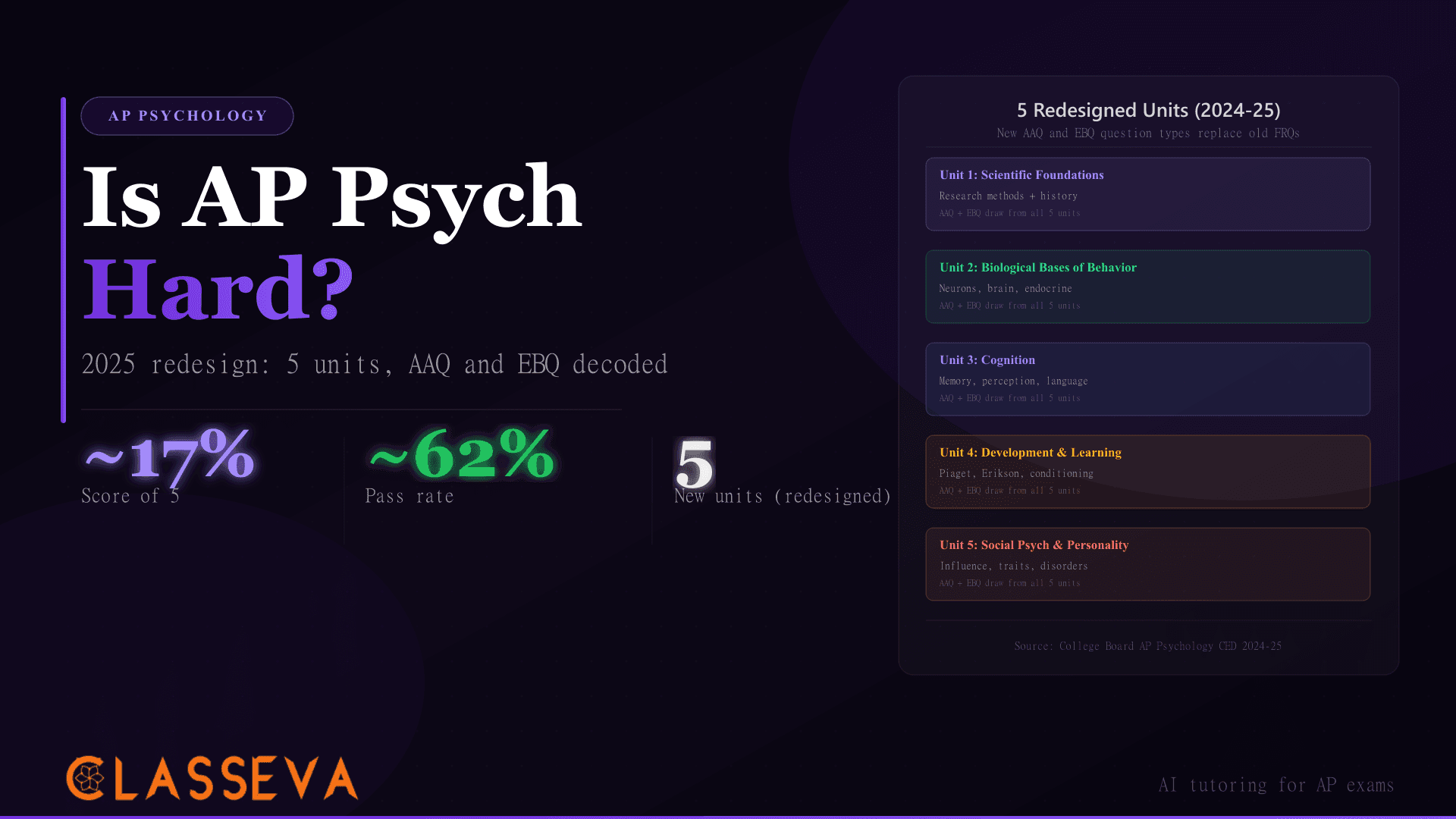
AP Psychology earns a 5-rate somewhere between 16% and 18%, one of the higher rates across all AP subjects. Comparing 2025 AP Psych to the exam most prep resources still describe is a mistake, though: the course was redesigned for the 2024-25 academic year, collapsing nine units into five and replacing the old free-response format with two distinct question types. Any prep guide written before 2024 describes a different test.
How Hard Is AP Psychology?
AP Psychology has a pass rate around 60-65% and a 5-rate between 16% and 18%, placing it in the accessible tier of AP exams. [VERIFY: 2025 College Board AP Score Distributions at apstudents.collegeboard.org/courses/ap-psychology] That 5-rate sits above AP Physics 1 (roughly 7%) and AP Chemistry (roughly 11-13%), though below the highest-performing exams like AP Chinese or AP Japanese. The word "easy" gets thrown around AP Psych discussions a lot, and the historical data supports a gentler curve than most lab sciences. But the 2024-25 redesign added meaningful analytical complexity through the new FRQ types, so students who approach it as a no-prep course are gambling.
Pass Rate and 5-Rate
AP Psychology consistently generates one of the more favorable score distributions across all AP exams. The approximate breakdown below reflects recent College Board data; verify exact 2025 figures at AP Central's AP Psychology exam page.
| Score | Approximate % | What It Means |
|---|---|---|
| 5 | ~17% | Exceptional: college credit at most schools |
| 4 | ~20% | Strong: credit at most schools |
| 3 | ~24% | Pass: credit at some schools |
| 2 | ~22% | Below passing |
| 1 | ~17% | No credit |
Source: College Board AP Psychology Score Distributions (approximate figures; verify at apstudents.collegeboard.org). Mean score approximately 2.9-3.1.
How AP Psych Compares to Other APs
AP Psychology sits comfortably in the accessible tier of AP exams, but calling it the easiest AP misses the context of the redesign. The table below uses 2025 data where available.
| AP Exam | 5-Rate | Pass Rate | Core Challenge |
|---|---|---|---|
| AP Physics 1 | ~7% | ~43% | Conceptual physics + math reasoning |
| AP Chemistry | ~11-13% | ~56% | Math-heavy lab and reaction reasoning |
| AP English Language | ~11% | ~59% | Timed rhetorical writing under pressure |
| AP Psychology | ~16-18% | ~61% | Conceptual breadth + new AAQ/EBQ format |
| APUSH | 14.2% | 73.7% | Historical argumentation across 9 periods |
| AP Calculus AB | 20.3% | 64.2% | Calculus problem-solving and applications |
Sources: College Board Score Distributions 2025. AP Psychology figures approximate (verify at collegeboard.org). APUSH and Calc AB 2025 figures confirmed.
What Changed in the 2025 AP Psychology Redesign?
The College Board redesigned AP Psychology for the 2024-25 academic year, and the changes ran deeper than a unit renumbering. The original course organized its content across nine units: biological bases, sensation and perception, states of consciousness, learning, cognition, developmental psychology, motivation and emotion, personality, and social psychology. The redesigned course compresses those nine into five, centered on foundational categories rather than discrete topic lists. The first administration of the redesigned exam was in May 2025.
College Board redesigned AP Psychology to align with how psychology is taught at the college level: fewer siloed topics, more emphasis on research methods, data interpretation, and the application of psychological frameworks across domains. The AAQ and EBQ question types reflect that shift directly.
From 9 Units to 5
The consolidation from nine units to five did not delete content. It reorganized content under broader umbrellas, and added more explicit emphasis on research design and data literacy throughout each unit. A student who memorized the old nine-unit breakdown will find that the psychology content still applies; what changed is how the exam tests it.
What Are AAQ and EBQ?
The biggest structural shift in the redesigned exam is not the unit count. It is the free-response format. The old AP Psychology exam used two questions that both asked students to define psychological terms and apply them to a given scenario. The redesigned exam replaces that with two distinct question types, the Article Analysis Question (AAQ) and the Evidence-Based Question (EBQ), each testing different analytical skills.
The Article Analysis Question (AAQ)
The AAQ presents an excerpt from a real or representative psychological research article. Students must read the excerpt and respond to questions about the research design, methods, and psychological concepts embedded in the text. The task requires both content knowledge and the ability to analyze scientific writing at the level of a first-year college course. Students who have only memorized vocabulary definitions without understanding how psychological research works will struggle here.
The AAQ reflects one of the College Board's stated goals for the redesign: placing greater emphasis on research literacy. Psychological science runs on empirical research, and the new format rewards students who can read a study description and explain what the researchers did, why they did it, and what the findings suggest.
The Evidence-Based Question (EBQ)
The EBQ provides a set of evidence, which may be a scenario, a data set, a graph, or a described stimulus, and asks students to apply psychological concepts to explain or predict what the evidence shows. EBQs typically include multiple sub-questions that build on each other, so a student who misidentifies the psychological concept being tested in the first part will compound the error in subsequent parts.
The AAQ tests whether you can read and analyze research. The EBQ tests whether you can apply psychological knowledge to new evidence. Both demand more than content recall. The student who memorizes Pavlov's dogs but cannot explain why a researcher chose a within-subjects design will lose points on the AAQ. The student who recognizes classical conditioning but cannot apply it to a novel scenario will lose points on the EBQ.
What Do the 5 Redesigned Units Cover?
The five units in the redesigned AP Psychology course are not arbitrary groupings. Each covers a foundational domain of psychological science, and the College Board's current Course and Exam Description (CED)specifies the approximate exam weight for each unit. Students should study to the CED, not to any prep book's chapter structure, because the weighting determines where points concentrate.
Unit 1: Scientific Foundations of Psychology
Covers the history of psychology, major perspectives (behavioral, cognitive, humanistic, biological, psychodynamic, sociocultural, evolutionary), research methods, statistical analysis, and ethical standards. This unit carries extra weight in the redesign because both the AAQ and EBQ draw heavily on research literacy.
Unit 2: Biological Bases of Behavior
Covers neuroscience fundamentals: neurons and synaptic transmission, brain structure and function (lobes, limbic system, brainstem), the endocrine system, genetics and behavior, and sleep. This unit replaces what was previously covered across separate "Biological Bases," "States of Consciousness," and parts of "Sensation and Perception" units.
Unit 3: Cognition
Covers sensation and perception, states of consciousness, memory (encoding, storage, retrieval, forgetting), thinking and language, and intelligence. The consolidation here is substantial: what were three separate old units (Sensation and Perception, States of Consciousness, Cognition) now appear under one umbrella.
Unit 4: Development and Learning
Covers lifespan development (physical, cognitive, social) across all stages, classical and operant conditioning, observational learning, and the key developmental theorists: Piaget, Vygotsky, Erikson, Kohlberg, Ainsworth. The learning content here combines what was previously the entire "Learning" unit with "Developmental Psychology."
Unit 5: Social Psychology and Personality
Covers social influence (conformity, obedience, group behavior), attitude formation and change, attribution theory, stereotypes and prejudice, personality theories (psychoanalytic, humanistic, trait, social-cognitive), and abnormal psychology including psychological disorders and their treatment. This is the broadest unit in the redesigned course.
How Much Should You Study for AP Psych?
Most students find 3-4 hours per week sufficient during the school year, assuming their AP Psychology class covers the CED content on schedule. That translates to roughly 90-120 hours over a 30-week course. Compare that to AP Biology (typically 4-6 hours per week) or AP Chemistry (5-8 hours) and AP Psych remains one of the lighter time commitments among AP sciences and social sciences.
The 3-4 hour estimate holds for content review. Students who want strong FRQ performance should budget additional time for AAQ and EBQ practice specifically. Answering practice questions under timed conditions is the only reliable way to build the analytical fluency those question types demand.
Building the Study Habit
The spacing effect, documented in Robert Bjork's research on memory and learning, shows that distributing study across multiple sessions produces stronger retention than the same number of hours crammed into one session. For AP Psych, that means daily short reviews (20-30 minutes) beat three-hour weekend marathons. The five redesigned units each introduce new terminology and conceptual frameworks; spacing review sessions lets those frameworks consolidate between sessions.
Rereading your notes is the least effective study method for AP Psych. Active recall, testing yourself on concepts before looking them up, produces significantly stronger retention according to Roediger and Karpicke's 2006 research on retrieval practice. Make a habit of writing what you remember about a concept before checking the definition. This also prepares you directly for the EBQ, which asks you to retrieve and apply concepts to new evidence.
What If You Are Using an Older Textbook?
Any AP Psychology textbook published before 2024 describes the wrong exam structure. The unit organization (nine units vs five), the FRQ section (two similar application questions vs AAQ and EBQ), and the emphasis on research methods all changed with the redesign. Barron's, Princeton Review, and Kaplan guides published for the 2023 or earlier exam seasons are particularly misleading in their FRQ chapters.
The underlying psychology content in older books remains accurate and teachable. Pavlov's classical conditioning, Piaget's stages, Milgram's obedience studies, Erikson's psychosocial stages, the major personality theories: none of that changed. What changed is how the exam tests it. Use your older textbook for content review, and supplement it with two things: the current College Board AP Psychology CED for accurate unit structure and exam weighting, and official College Board practice AAQ and EBQ prompts for FRQ preparation.
If someone tells you to "study Units 1-9 in order," they are describing the pre-2024 course. The current course has five units. Download the official College Board AP Psychology Course and Exam Description and use it as your primary guide for what the current exam tests.
How to Know If You Are Ready
Three questions reveal readiness for AP Psychology more reliably than any practice-test score alone.
Can you explain a psychological concept using a novel scenario?
Pull any concept from the five units: classical conditioning, cognitive dissonance, the availability heuristic, Erikson's identity stage. Now explain it using an example that did not appear in your textbook. If you can, you are ready for EBQ questions. If you can only define it, you are not.
Can you read a research description and identify what the researcher did?
Find any simple psychology study description online or in your textbook. Without looking at the analysis, write out: the hypothesis, the independent and dependent variables, whether it was an experiment or a correlational study, and one limitation of the design. If that process flows naturally, you are ready for AAQ questions.
Have you done timed FRQ practice under the new format?
College Board releases practice AAQ and EBQ prompts in the AP Classroom portal. Time yourself. Students who can answer one AAQ and one EBQ within the allotted exam time, with coherent psychological reasoning, are ready. Students who have only reviewed content but never written a timed response are not, regardless of how well they know the material.
The AP Psychology resources hub on Classeva organizes study materials aligned with the five redesigned units. For context on how AP Psych credit transfers to college coursework, the AP Credit Savings Calculator shows the tuition value of a 4 or 5 at specific schools.
For students also considering AP Biology or AP Chemistry as part of a pre-med track, the AP Chemistry difficulty breakdown and the comparison between APUSH and AP Psych difficulty (see is APUSH hard?) give useful perspective on where AP Psych sits in the broader landscape. The AP World History difficulty analysis covers another social science AP for comparison.
AP Score Predictor
If you have taken a College Board-released practice test or unit assessment under timed conditions, the AP Score Predictor maps your performance to a projected AP Psychology score range. Enter your practice results to see where you stand and which areas to prioritize in the weeks remaining before the May exam.
AP Score Predictor
Enter your AP Psychology practice test results to see your projected score range and identify which units need the most attention before May.
Key Takeaways
- AP Psychology's 5-rate (roughly 16-18%) ranks above most AP sciences, placing it in the accessible tier of AP exams by raw score data.
- The College Board redesigned AP Psychology for the 2024-25 academic year, consolidating nine units into five organized around foundational psychological domains.
- The old two-question FRQ format is gone. The redesigned exam uses two distinct question types: the Article Analysis Question (AAQ) and the Evidence-Based Question (EBQ), both of which demand analytical skills beyond content recall.
- Any prep guide, textbook, or online course from before 2024 describes a different exam. Supplement all older materials with the current College Board CED.
- Expect 3-4 hours of study per week during the school year, with heavier preparation in the final four to six weeks before the May exam.
- The five redesigned units are: Scientific Foundations, Biological Bases of Behavior, Cognition, Development and Learning, and Social Psychology and Personality.
- Research literacy matters more than it did before. Both the AAQ and EBQ reward students who understand how psychological research works, not just what famous studies found.