AP Psychology Unit 1 Review: Biological Bases of Behavior
AP Psychology Unit 1 covers the Biological Bases of Behavior, the single block where neurons, neurotransmitters, brain structures, the endocrine system, and genetics all live in the redesigned course. The 2024-25 redesign collapsed what used to span three separate modules into one pillar, so this unit now carries more vocabulary than any other early in the year. Get it wrong and the rest of the course wobbles, because every later pillar assumes you already know how a signal moves from neuron to brain region to behavior.
Reading the revised Course and Exam Description side by side with the old one, the change that jumps out is consolidation. The College Board did not just rename units. It folded the former Biological Bases, Sensation and Perception, and States of Consciousness content into a single biological foundation, then bolted research methods onto every pillar as a formal science practice. That means a Unit 1 question on this exam can ask you to read a study about neurons and interpret its statistics in the same breath. This review walks the biology in the order the exam tests it and maps the new AAQ and EBQ free-response formats so you know what a Unit 1 prompt actually looks like. If you are still deciding whether to take the course, start with the is AP Psychology hard breakdown.
What Does AP Psychology Unit 1 Cover?
Unit 1 covers how biology produces behavior and mental processes. The redesigned AP Psychology framework places it first because every other pillar builds on it. You study how neurons communicate, how the brain divides labor across regions, how hormones act as a second messaging system, and how genes and the environment interact to shape who a person becomes.
How the Redesign Reorganized the Old Modules
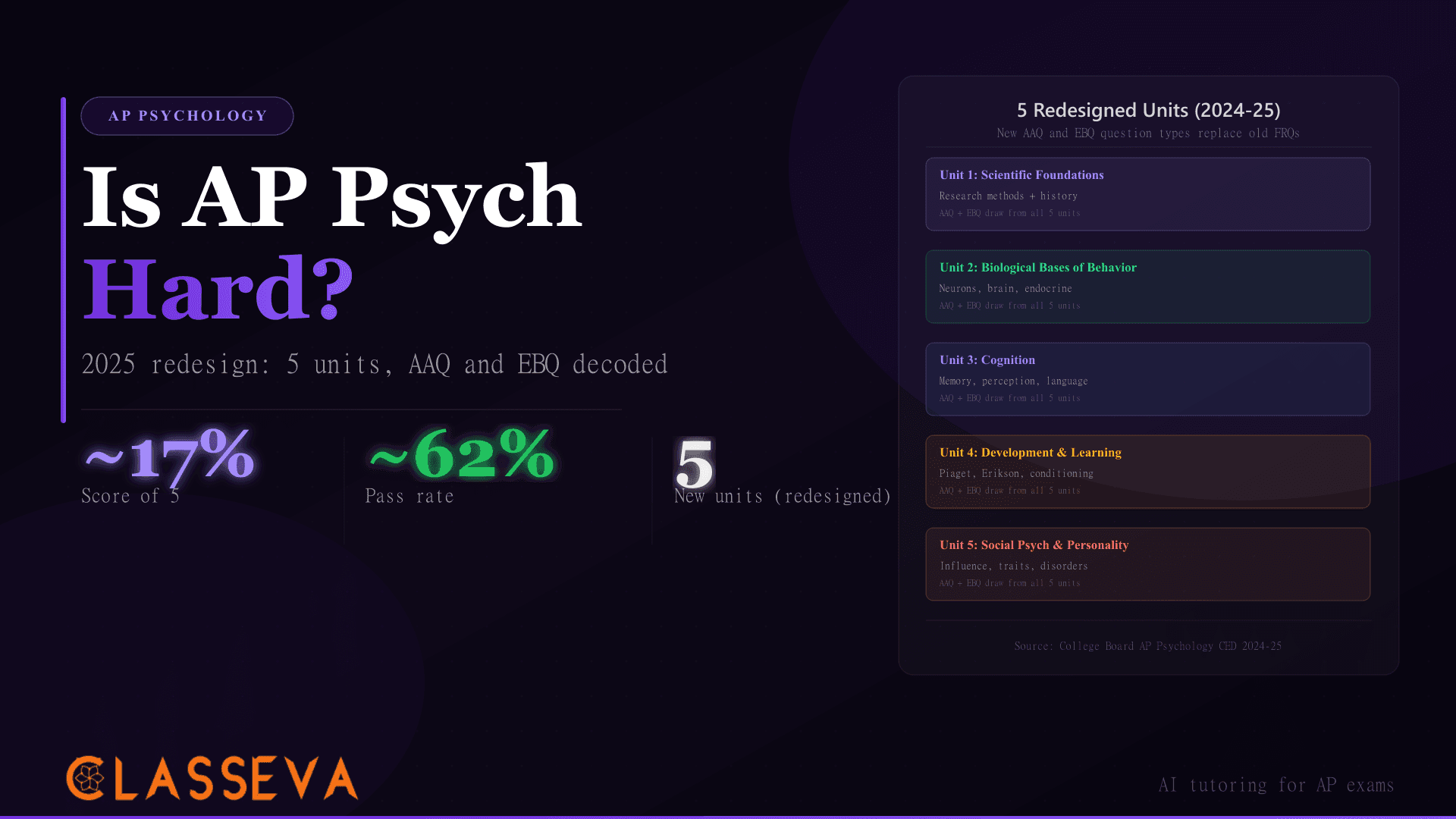
The College Board cut the course from nine modules to five pillars in the 2024-25 redesign: Biological, Cognitive, Developmental, Social and Personality, and Mental and Physical Health. Unit 1 (Biological) absorbed content that used to be scattered. The old standalone units on sensation, perception, and states of consciousness no longer exist as separate chapters. Their biological content now sits inside this pillar, which is why a single Unit 1 review has to stretch from the action potential to sleep stages.
Old Course (pre-2024)
- •9 separate units or modules
- •Biological Bases of Behavior was one module
- •Sensation, perception, consciousness stood alone
- •FRQs: concept application and research design
- •100 multiple-choice questions, 5 choices each
Redesigned Course (2024-25)
- •5 pillars based on APA core domains
- •Unit 1 absorbs the biological foundation
- •Sleep and sensation fold into the biological pillar
- •FRQs: Article Analysis (AAQ) and Evidence-Based (EBQ)
- •75 multiple-choice questions, 4 choices each
The Six Topic Areas in Unit 1
Unit 1 breaks into six teaching areas. Each one shows up on the exam, and each connects to the next. The table below pairs every area with the terms the College Board expects you to apply, not just recognize.
| Topic Area | Core Concepts | What the Exam Asks |
|---|---|---|
| Nervous system | CNS vs PNS, somatic vs autonomic, sympathetic vs parasympathetic | Match a body response to the correct division |
| Neural firing | Resting potential, threshold, action potential, all-or-none, refractory period | Sequence the steps of a neuron firing |
| Neurotransmitters | Acetylcholine, dopamine, serotonin, GABA, glutamate, norepinephrine, endorphins | Link a behavior or disorder to a neurotransmitter |
| Brain structures | Lobes, limbic system, cerebellum, brain stem, hemispheric specialization | Predict the effect of damage to a region |
| Endocrine system | Hormones, pituitary gland, adrenal glands, cortisol | Contrast hormonal and neural signaling |
| Genetics and methods | Nature vs nurture, twin studies, EEG, fMRI, heritability | Interpret a research design and its data |
Source: AP Psychology Course and Exam Description, College Board (2024-25 redesign).
How Is the Nervous System Organized?
The nervous system splits into two main divisions: the central nervous system (brain and spinal cord) and the peripheral nervous system (every nerve outside it). The peripheral system then divides again, into the somatic system that controls voluntary muscles and the autonomic system that runs automatic functions like heart rate. This branching structure is the spine of AP psych nervous system questions.
Central and Peripheral Divisions
The central nervous system processes and integrates information. The brain interprets signals; the spinal cord relays them and handles reflexes without waiting for the brain. The peripheral nervous system carries messages in both directions: sensory neurons send input toward the central system, and motor neurons carry commands back out to muscles and glands. When a Unit 1 question describes a person pulling a hand off a hot stove before feeling pain, it is testing whether you know the spinal cord can trigger a reflex arc on its own.
The Autonomic Branch and the Stress Response
The autonomic nervous system runs on two opposing branches. The sympathetic branch triggers the fight-or-flight response: it speeds the heart, dilates the pupils, and floods the body with energy. The parasympathetic branch reverses all of that, slowing the heart and shifting the body toward rest and digestion. AP Psychology loves to test this pairing with a scenario, describing a startled hiker or a calming breath, then asking which branch is active. The answer hinges on direction: arousal means sympathetic, recovery means parasympathetic.
Sympathetic: arouses the body for action (heart rate up, digestion paused, glucose released). Parasympathetic: calms the body afterward (heart rate down, digestion resumes). A reliable memory hook: parasympathetic restores the body to a parallel resting state. If a prompt describes a physical reaction to threat or excitement, the sympathetic branch is firing.
How Does a Neuron Fire an Action Potential?
A neuron fires when incoming signals push it past its threshold, triggering an action potential that sweeps down the axon. At rest, the neuron sits near negative 70 millivolts. When enough excitatory input arrives, sodium channels open, positive ions rush in, and the charge flips. That electrical spike travels the length of the axon at full strength, the core of any AP psychology neurons question.
Neuron Anatomy: Dendrites, Axon, Myelin
Three parts of the neuron do most of the work. Dendrites receive signals from other neurons. The cell body, or soma, integrates those signals and decides whether to fire. The axon carries the action potential away toward the next cell, often wrapped in a fatty myelin sheath that speeds transmission. Gaps in the myelin, called nodes of Ranvier, let the signal jump rather than crawl, which is why myelin damage in conditions like multiple sclerosis slows neural messages so dramatically.
The All-or-None Principle
The all-or-none principle means a neuron either fires completely or not at all. There is no partial action potential. Once the stimulus crosses threshold, the spike travels at full strength regardless of how strong the original trigger was. A stronger stimulus does not make a bigger action potential. It makes neurons fire more often and recruits more neurons. The College Board tests this with a deceptively simple distractor: students who think a more intense stimulus produces a larger spike pick the wrong answer.
A louder sound or a brighter light does not produce a taller action potential. The action potential is fixed in size by the all-or-none principle. Stimulus intensity is encoded by frequency of firing and the number of neurons recruited, not by the height of any single spike. Write frequency and recruitment in your FRQ answer, not amplitude.
What Do Neurotransmitters Actually Do?
Neurotransmitters are chemical messengers that carry a signal from one neuron to the next across the synapse. When the action potential reaches the axon terminal, it triggers the release of these chemicals into the gap. They bind to receptors on the next neuron, either exciting it toward firing or inhibiting it. Each AP psych neurotransmitter has a signature role, and the exam tests whether you can match the chemical to the behavior.
Crossing the Synapse
The synapse is the microscopic gap between two neurons where chemical communication happens. Vesicles in the sending neuron release neurotransmitter molecules into the synaptic cleft. Those molecules drift across and lock into receptor sites on the receiving neuron, like a key in a lock. Leftover neurotransmitter is then cleared through reuptake, where the sending neuron reabsorbs it. Many psychiatric drugs work precisely here: SSRIs block serotonin reuptake, leaving more of it active in the synapse, which is a favorite real-world hook for application questions.
For the exam, hold seven neurotransmitters and one function each. The table below is the working set the CED expects you to apply. Notice the pattern the College Board favors: it describes a symptom or behavior, then asks for the chemical, so study each one paired with what too much or too little produces.
| Neurotransmitter | Primary Role | Imbalance Example |
|---|---|---|
| Acetylcholine (ACh) | Muscle movement, learning, memory | Low ACh links to Alzheimer's memory loss |
| Dopamine | Reward, motivation, motor control | Low dopamine links to Parkinson's; excess links to schizophrenia |
| Serotonin | Mood, sleep, appetite | Low serotonin links to depression |
| Norepinephrine | Alertness, arousal | Tied to the stress and fight-or-flight response |
| GABA | Main inhibitory messenger | Low GABA links to anxiety and seizures |
| Glutamate | Main excitatory messenger | Excess can overexcite and damage neurons |
| Endorphins | Pain relief, pleasure | Released during exercise or injury |
Source: AP Psychology Course and Exam Description, College Board (2024-25 redesign).
Which Brain Structures Should You Know?
Know the brain from the bottom up: brain stem for survival, cerebellum for movement, limbic system for emotion and memory, and the four cortical lobes for higher thought. The exam rarely asks you to simply name a part. It describes damage to a region or a deficit in behavior, then asks which structure is responsible. This is the heart of AP psych brain structures questions, and grouping the parts by job makes them stick.
The Four Cortical Lobes
The cerebral cortex divides into four lobes, each handling a different category of processing. The frontal lobe governs decision-making, planning, and movement through the motor cortex; the famous Phineas Gage case study shows what happens when it is damaged. The parietal lobe processes touch and body position via the somatosensory cortex. The occipital lobe handles vision at the back of the head. The temporal lobe processes hearing and helps with language and memory. When a prompt mentions a specific deficit, the lobe is usually the answer the rubric wants.
Limbic System, Cerebellum, and Brain Stem
The deeper structures handle older, more automatic jobs. The limbic system runs emotion and memory: the amygdala drives fear and aggression, the hippocampus forms new memories, the hypothalamus controls hunger, thirst, and the release of hormones, and the thalamus relays incoming sensory signals to the cortex. Below the limbic system, the cerebellum coordinates balance and smooth movement, and the brain stem, including the medulla, keeps breathing and heartbeat running without conscious effort. Damage to the hippocampus, the lesson of the patient H.M., leaves a person unable to form new long-term memories, a case the exam returns to often.
Patient H.M. had his hippocampus removed to treat severe seizures. The surgery stopped the seizures but left him unable to form new long-term memories, while his older memories stayed intact. AP Psychology uses this case to test the hippocampus’s role in memory consolidation. If a prompt describes someone who cannot form new memories after brain injury, the hippocampus is the structure in question.
How Does the Endocrine System Differ From the Nervous System?
The endocrine system sends chemical messages through hormones in the bloodstream, while the nervous system sends electrical signals through neurons. The difference is speed and duration. Neural signals travel in milliseconds and fade fast. Hormonal signals move slowly through the blood but last far longer, which is why a wave of adrenaline keeps your heart pounding long after a scare has passed.
The pituitary gland is the master gland, directing other glands on orders from the hypothalamus. The adrenal glands sit atop the kidneys and release epinephrine and cortisol during stress, linking the endocrine system directly to the sympathetic nervous response. This overlap is exactly what the exam probes: it asks you to explain how the brain and bloodstream cooperate to produce a single stress reaction. For the broader study habits that make this kind of integration stick, the research on active recall versus passive review applies directly to memorizing this many interlocking terms.
How Does Unit 1 Test Research Methods?
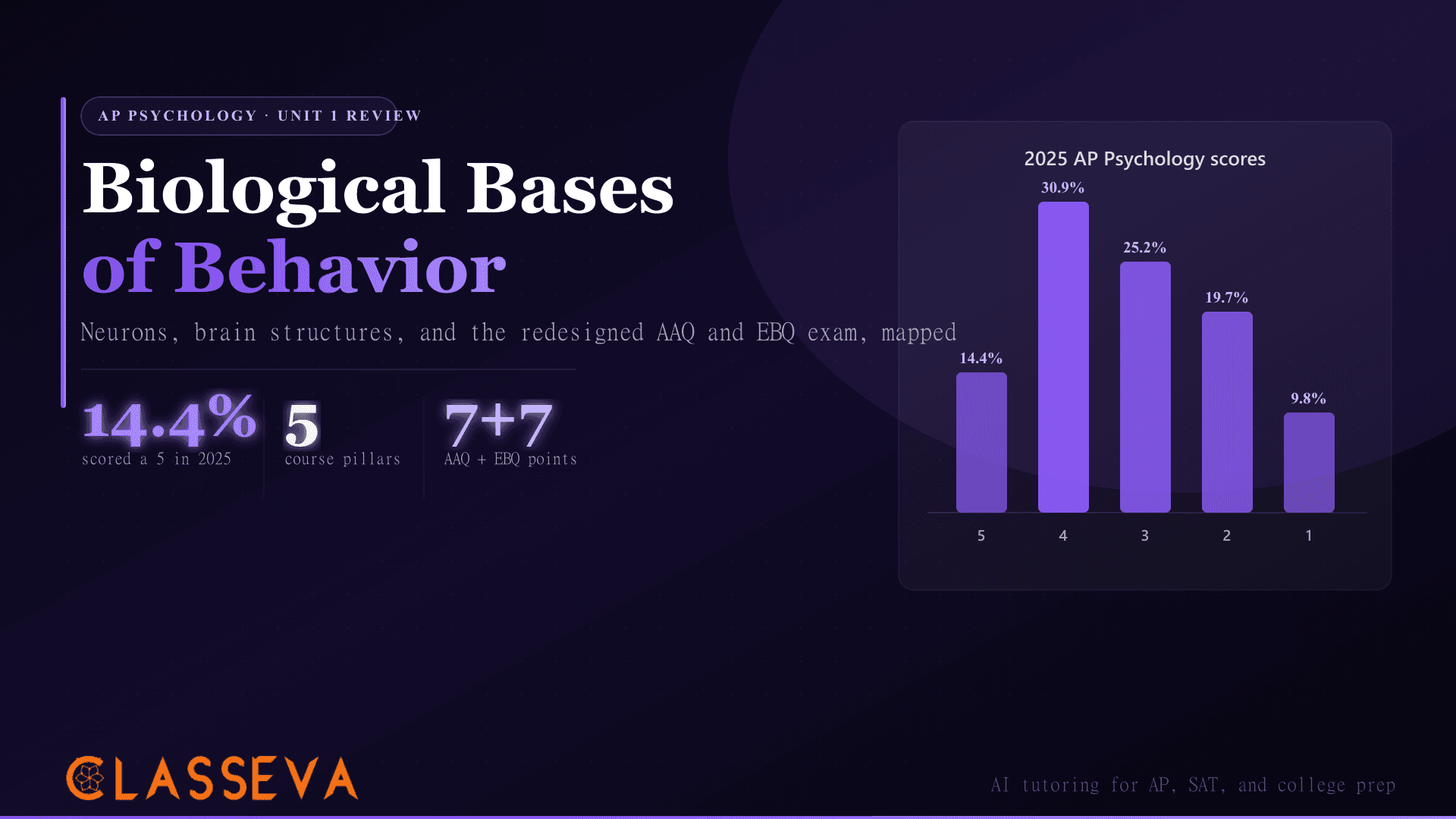
Research methods are no longer a separate unit. The redesign turned them into a science practice woven through every pillar, so a Unit 1 question can hand you a study about neurons and ask you to evaluate it. You need to identify independent and dependent variables, spot the control group, recognize ethical guidelines, and interpret basic statistics like correlation coefficients and measures of central tendency. The College Board's AP Psychology score distributions show how this design rewards data fluency over rote recall.
The New AAQ and EBQ Free-Response Questions
The redesign replaced the old FRQs with two source-based questions. The Article Analysis Question (AAQ) presents one summarized peer-reviewed study; you answer six parts, identifying design elements and interpreting its statistics for up to 7 points in about 25 minutes. The Evidence-Based Question (EBQ) gives you three studies on one topic; you make a claim and defend it with the sources across three parts for up to 7 points in about 45 minutes. The official AP Psychology exam page lays out the full format, and biological topics can anchor either question.
| Feature | Article Analysis (AAQ) | Evidence-Based (EBQ) |
|---|---|---|
| Sources provided | 1 peer-reviewed study | 3 peer-reviewed studies |
| Question parts | 6 parts | 3 parts |
| Points available | 7 points | 7 points |
| Suggested time | ~25 min (10 min reading) | ~45 min (15 min reading) |
| Core skill | Design + data interpretation | Claim + evidence argument |
Source: AP Psychology Exam Revisions, College Board (2024-25). Section I is 75 multiple-choice questions in 90 minutes.
Studying for the AAQ rewards practice with real data sets, not flashcards. Build the habit of reading a study summary and immediately naming its variables, sample, and limitations. The spacing work behind effective review applies here too; spreading these reps over weeks beats cramming, as the research on spaced practice versus cramming shows. For the timing of the whole exam season, the junior year planning timeline helps you slot AP study where it fits.
Estimate Your AP Psychology Score
Once you have worked through Unit 1 and a couple of practice sections, it helps to translate raw performance into a projected score. The score predictor below converts your estimated multiple-choice and free-response results into a likely 1 to 5, so you can see whether your Unit 1 mastery is pulling its weight before the May exam.
AP Score Predictor
Enter your estimated multiple-choice and free-response performance to project your likely AP Psychology score from 1 to 5.
Sleep and consciousness sit inside this biological pillar too, and the science on how rest consolidates what you study is directly relevant to memorizing Unit 1. The post on sleep and learning research explains why a full night after a study session locks in the material better than an all-nighter ever could.
Key Takeaways
- Unit 1 is the biological foundation. The redesigned course folds neuroscience, sensation, and consciousness into one pillar, so this unit carries the heaviest vocabulary load of the year.
- Trace one signal end to end. A signal moves from neuron to synapse to brain region to behavior; learning it as one chain beats memorizing four disconnected lists.
- The action potential is all-or-none. A neuron fires fully or not at all; stimulus intensity changes firing frequency and neuron count, never the size of the spike.
- Match neurotransmitters to behavior. Know seven core chemicals and what their excess or deficiency produces, since the exam describes a symptom and asks for the cause.
- Group brain structures by job. Brain stem and cerebellum for survival and movement, limbic system for emotion and memory, four lobes for higher processing.
- The endocrine system is the slow messenger. Hormones in the blood act slower but longer than neural signals, and they cooperate with the brain during stress.
- Know the AAQ and EBQ cold. Both free-response questions are source-based and worth 7 points each, and research methods now appear in every unit including this one.
Frequently Asked Questions
Common questions about AP Psychology Unit 1, the redesigned exam, and how biological content shows up across the course.