Is AP Computer Science Principles Hard? The Beginner CS AP
AP Computer Science Principles is the most approachable computer science AP on paper: in 2025, 61.7% of students scored a 3 or higher and the exam tests no specific programming language. Building Classeva, the question I kept hitting was why a course this beginner-friendly still trips up so many students, and the answer is not the exam. It is the Create performance task, a project that stretches across the entire school year and quietly carries 30% of the final score.
Is AP Computer Science Principles Hard?
AP Computer Science Principles is one of the easier AP exams to pass but harder than its reputation suggests, because the year-long Create performance task adds work most students underestimate. Most of the AP CSP difficulty lives outside test day. The 70-question end-of-course exam rewards conceptual understanding over memorization, while the project component, worth 30% of the grade, demands months of planning, coding, and documentation. Beginners who keep pace with the project do well; those who cram it in April do not.
Score Distribution and Pass Rate
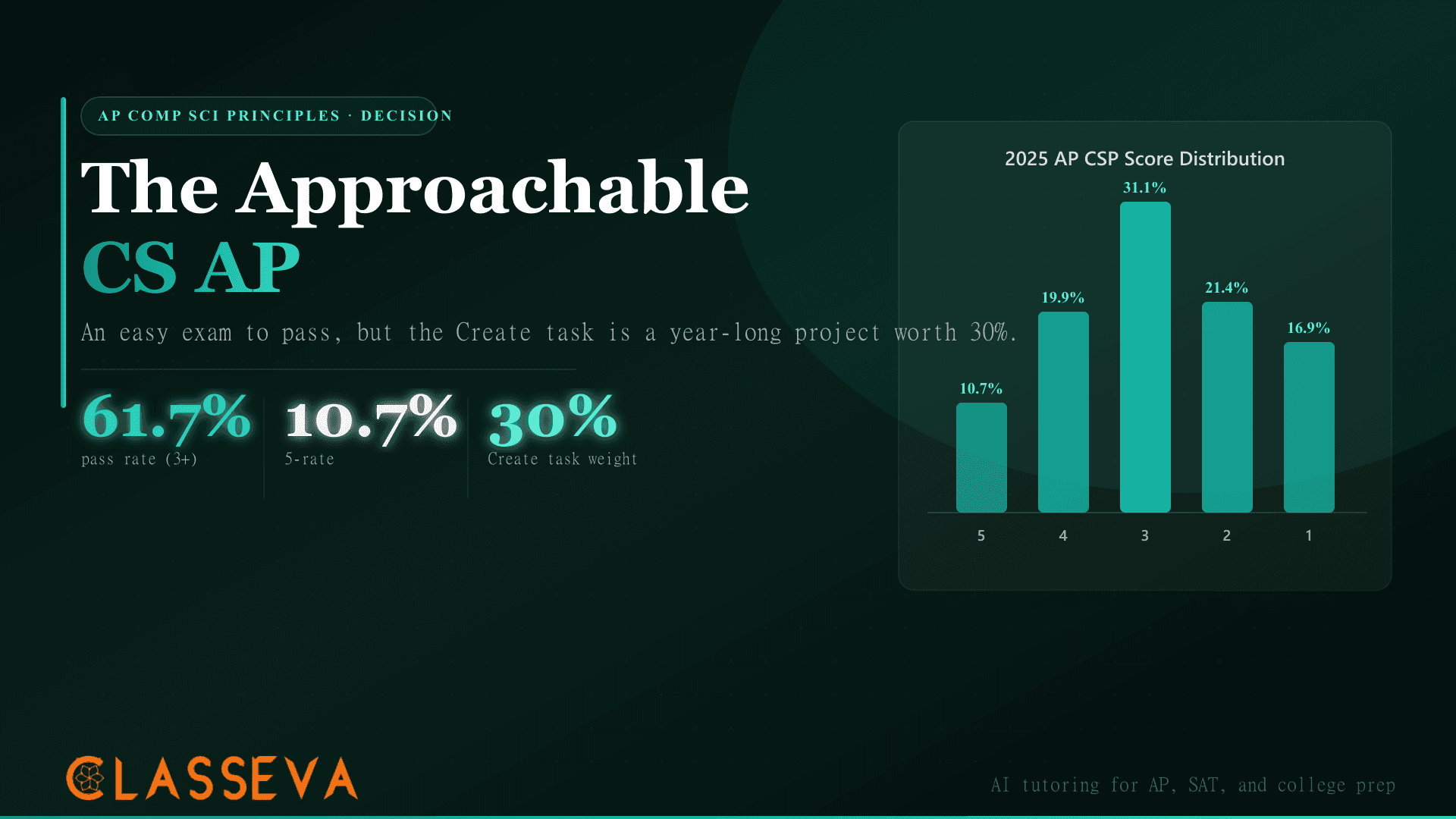
AP CSP posts a friendlier distribution than most STEM AP exams. In 2025, 10.7% of students earned a 5, 19.9% a 4, and 31.1% a 3, producing a pass rate of 61.7% on a mean score of 2.86. According to the College Board AP CSP score distributions, roughly 176,000 students sat the exam in 2025. The AP CSP 5 rate of 10.7% trails the 5-rate on the Java-heavy AP CSA, but the large 3-band is the signature feature here: a third of all test-takers land exactly at the qualifying line.
| AP Score | 2025 % of Test-Takers | College Readiness Signal |
|---|---|---|
| 5 | 10.7% | Extremely well qualified |
| 4 | 19.9% | Well qualified |
| 3 | 31.1% | Qualified |
| 2 | 21.4% | Possibly qualified |
| 1 | 16.9% | No recommendation |
2025 AP CSP score distribution. Source: College Board AP Score Distributions.
Where the Difficulty Actually Lives
The exam is approachable; the Create performance task is the real workload. Students treat AP CSP as a light course because the multiple-choice exam reads like reasoning puzzles rather than calculus. Then April arrives, and the project they ignored counts for nearly a third of their grade. The hard part of AP CSP is not any single concept. It is sustaining a multi-month project alongside the rest of a junior or sophomore schedule.
How Is the AP CSP Exam Structured?
AP CSP splits into two graded parts: a 70-question end-of-course exam taken in May, worth 70% of the score, and the Create performance task submitted earlier through the AP Digital Portfolio, worth 30%. There is no traditional free response section written on exam day. The project replaces it, which is what makes AP CSP structurally different from every other AP exam.
The 70-Question End-of-Course Exam
The end-of-course exam runs 70 multiple-choice questions across two hours. Most questions present a scenario, a snippet of pseudocode written in College Board’s exam reference language, or a data and impact prompt, then ask you to reason about it. Five questions reference the program you built for the Create task, so the two halves of the course connect. Because the language is pseudocode, you are not memorizing syntax, you are reasoning about how code behaves.
The Create Performance Task
The AP CSP Create task asks you to design, code, and document a program of your own. The AP CSP performance task allots a minimum of 9 hours of in-class time, but the planning, debugging, video recording, and written Personalized Project Reference push most students well past that. You submit three artifacts through the AP Digital Portfolio: the program code, a video of the program running, and the written reference. The deadline lands at the end of April, weeks before the exam.
Students leave the Create performance task until the final weeks because nothing forces them to start in the fall. By April, they are coding, recording, and writing the Personalized Project Reference under deadline pressure while also studying for the end-of-course exam. The 9-hour allotment is a floor, not a target. Start your program in winter, not spring, and the project stops being the hard part of the course.
What Are the 5 Big Ideas in AP CSP?
AP CSP organizes its content around five Big Ideas, each carrying a fixed weight on the end-of-course exam. They span the breadth of computing, from how programs are built to how computing affects society. According to College Board’s course framework, Algorithms and Programming carries the heaviest weight, followed by the Impact of Computing. You can confirm how each school treats a score using College Board’s AP credit policy search.
| Big Idea | Exam Weight | What It Covers |
|---|---|---|
| Algorithms and Programming | 30–35% | Code logic, abstraction, procedures, lists, algorithms |
| Impact of Computing | 21–26% | Ethics, bias, privacy, the digital divide, safe computing |
| Data | 17–22% | Storing, processing, and drawing meaning from data |
| Computer Systems and Networks | 11–15% | The internet, fault tolerance, parallel computing |
| Creative Development | 10–13% | Collaboration, program design, the development process |
The 5 AP CSP Big Ideas and their end-of-course exam weights. Source: College Board AP CSP course framework.
Why Algorithms and Programming Dominates
Algorithms and Programming carries the largest share of the exam, 30 to 35%, because it underpins both the multiple-choice questions and the Create task. Master this Big Idea and you cover the questions that ask you to trace pseudocode, evaluate Boolean logic, and reason about procedures and lists. The skills here are the same ones you use to build your Create program. Time spent on this Big Idea pays off twice: once on the exam and once on the project.
AP CSP vs AP CSA: Which Is Harder?
The AP CSP vs CSA decision comes down to one fact: for a student with no coding background, AP CSP is the easier course because it never asks you to write syntactically correct Java by hand under exam pressure. AP CSA is Java-only, with four hand-coded free response questions. AP CSP is conceptual and language-agnostic, scored on a 70-question reasoning exam plus a project. The two share a name and almost nothing else.
AP Computer Science Principles (CSP)
- •No prior coding required; language-agnostic exam
- •70 multiple-choice questions plus the Create performance task
- •30% of the score is a year-long project, not exam-day writing
- •Covers computing broadly: data, the internet, ethics, algorithms
- •Roughly 176,000 test-takers in 2025; broad, mixed-experience population
- •Credit usually satisfies a general education computing requirement
AP Computer Science A (CSA)
- •Java-only; assumes you can write code by hand
- •40 multiple-choice questions plus 4 hand-coded FRQs
- •Tests OOP, inheritance, recursion, 1D and 2D arrays
- •Equivalent to a first-semester college Java course
- •Smaller, self-selected pool; many arrive with coding experience
- •Credit often maps to a technical CS prerequisite for majors
The 5-Rate Gap Explained
AP CSA posts a higher 5-rate than AP CSP, but the gap measures the population, not the difficulty. AP CSA draws students who deliberately opted into programming, many with prior coding experience from robotics or personal projects, which compresses the lower end of its distribution. AP CSP draws a broader, mixed-experience pool, including first-time coders. The CSP 5-rate of 10.7% does not mean the material is harder than CSA. It means the student pool is wider. If you want the full breakdown of the Java side, the AP Computer Science A difficulty guide walks through the four FRQ types in detail.
Students who take AP CSP first enter AP CSA with mental models for abstraction, procedures, and program flow already in place. The pseudocode reasoning in CSP transfers directly to reading Java in CSA. Plenty of strong CS students run the sequence CSP in sophomore year, then CSA in junior year, building from concepts to syntax rather than learning both at once.
Should You Take AP CSP or AP CSA?
Choose AP CSP if you have never written code or want a broad introduction to computing; choose AP CSA if you already program and want technical CS credit. The decision hinges on one fact about you: have you written code that ran and produced output? That single data point predicts how comfortable each course will feel.
If You Have No Coding Background
Start with AP CSP. The course teaches programming logic from zero and never demands fluency in a specific language on exam day. You learn abstraction, algorithms, and data handling through approachable tools, then apply them in a project you scope yourself. Beginners who jump straight to AP CSA often spend the fall fighting Java syntax instead of learning computer science. CSP builds the foundation that makes that later jump manageable.
If You Already Code
Skip ahead to AP CSA. Students who have written Python, JavaScript, or any other language will find AP CSP’s conceptual pace slow and its Create task a documentation exercise rather than a coding challenge. The technical depth and college credit value sit with CSA. If your schedule allows only one CS AP and you already program, CSA gives engineering and computer science applicants the stronger signal. For a wider scheduling view, the AP Statistics difficulty breakdown pairs naturally with a CS course for quantitative majors.
How Much Work Is AP CSP, Really?
The AP Computer Science Principles workload is light on average but uneven: outside class, most students spend 2 to 4 hours per week, and the load shifts hard across the year. Fall and winter run light: concepts, pseudocode practice, and the early planning of your Create program. Spring spikes hard. The Create task deadline in late April collides with end-of-course exam review, and students who postponed the project face both at once.
| Phase | Months | Focus | Typical Weekly Load |
|---|---|---|---|
| Foundations | Sept–Dec | Concepts, pseudocode, Big Ideas 4 and 5 | 2–3 hours |
| Build | Jan–Mar | Code the Create program; draft the reference | 3–4 hours |
| Finish and Review | Apr | Submit Create task, then review for the exam | 4–6 hours |
A realistic AP CSP workload curve. Front-loading the Create task flattens the April spike.
The students who find AP CSP hard are almost always the ones who treated the first two phases as free time. Build your program in the Build phase, not the Finish phase. That single scheduling choice is the difference between a calm April and a frantic one. For broader timing strategy across your junior-year course load, the junior-year college planning timeline shows where AP deadlines fall against testing and applications.
Project Your AP CSP Score
If you are mid-course, the fastest way to know where you stand is to map your current practice performance to a projected score band. Classeva’s AP Score Predictor estimates your likely score from your practice results so you can see whether the Create task or the end-of-course exam needs more attention before April.
AP Score Predictor
Enter your AP Computer Science Principles practice results to project your score band and see whether the Create task or the end-of-course exam needs more focus before the deadline.
Students deciding whether to chase AP CSP credit at a specific college can think about the financial side too. If you already code and might add CSA later, comparing how a pair of CS AP scores stacks up against a CS-degree path is worth a look in the coding bootcamps vs CS degree comparison. Students stacking multiple credit paths can also read about earning college credit through CLEP exams alongside AP. And if AP CSP is your first AP, the AP Precalculus difficulty guide covers another approachable starting course for underclassmen.
Key Takeaways
- AP CSP is the beginner-friendly CS AP. It requires no prior coding and tests no specific language, unlike Java-only AP CSA. The end-of-course exam reasons over pseudocode, not memorized syntax.
- The 2025 pass rate was 61.7% with a 10.7% 5-rate and a mean of 2.86, across roughly 176,000 students. A third of all test-takers landed exactly on the qualifying 3.
- Your grade has two parts: a 70-question end-of-course exam worth 70% and the Create performance task worth 30%, submitted through the AP Digital Portfolio by late April.
- The Create performance task is the real workload. College Board allots 9 hours minimum, but the program, video, and Personalized Project Reference take far longer. Start in winter to avoid the April crunch.
- Five Big Ideas structure the exam. Algorithms and Programming carries the most weight at 30 to 35%, so it earns the most study time and also powers the Create task.
- AP CSP’s lower 5-rate than AP CSA reflects population, not difficulty. CSP draws a broad, mixed-experience pool; CSA draws self-selected coders.
- Take CSP first if you do not code, CSA first if you do. Running CSP then CSA builds from concepts to Java syntax rather than learning both at once.