APUSH Period 3 Review: Revolution and Founding 1754-1800
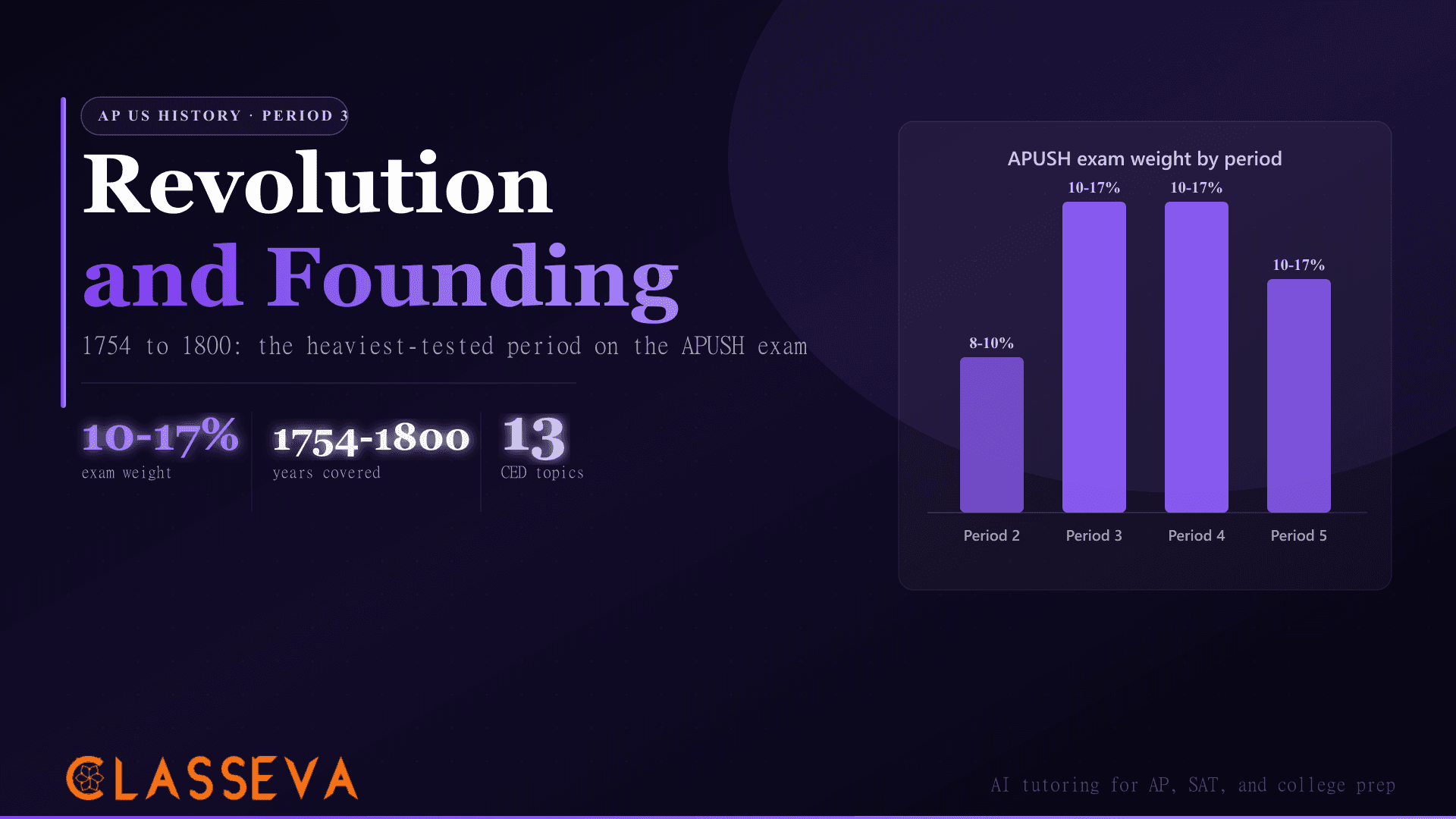
This APUSH Period 3 review covers 1754 to 1800, the period that carries 10-17% of the exam score, the largest share assigned to any single period in the College Board AP US History course framework. That weighting is not an accident. The years from APUSH Period 3 1754 through 1800 contain the founding documents, the founding debates, and the founding precedents that the rest of the course measures everything against.
Studying how the College Board structures its document-based questions across release years, one pattern stands out for this period: examiners reward students who can trace a line of cause and effect, not students who memorize the Stamp Act and the Constitution as separate flashcards. The Declaration did not appear from nowhere. It grew out of Enlightenment arguments and a decade of taxation disputes. The Constitution did not appear from nowhere either. It grew out of the visible failures of the Articles of Confederation. This APUSH Period 3 review follows that causal spine from the French and Indian War to the election of 1800, the same way the exam tests it. For the bigger picture of how the whole course is built and graded, the is APUSH hard breakdown walks through the exam structure in full.
Why This APUSH Period 3 Review Starts with the Weighting
Any useful APUSH Period 3 review starts with the weighting because Period 3 is the most tested period in the course. It produced the constitutional framework every later period reacts to. At 10-17% of the exam, it outweighs every other period and ties directly to the course themes of Politics and Power and America in the World. A student who masters the causation here can write half the long essay prompts in the course.
How Much of the Exam Is Period 3?
Period 3 represents 10-17% of the total AP US History exam, the heaviest weighting of any of the nine chronological periods. On the 55-question multiple-choice section, that range works out to roughly 6 to 9 questions. The period also feeds the document-based question, which draws from 1754 to 1980, and the long essay, which offers a 1491-1800 option that lands squarely on the Revolution and the founding. The College Board exam format page lays out the full section structure and timing.
Compare that to the periods on either side. Period 2 (1607-1754) carries 8-10%, and Period 4 (1800-1848) carries 10-17% as well, but Period 3 packs more frequently tested documents into a shorter span. The Declaration, the Constitution, The Federalist Papers, and Washington Farewell Address all sit inside these 46 years.
The Period 3 Timeline at a Glance
The cleanest way to hold Period 3 in memory is as a sequence of turning points spaced across 46 years. Each event sets up the next. The French and Indian War creates debt, the debt creates taxes, the taxes create resistance, and resistance escalates into independence and a search for stable government.
How Did the Colonies Move from War to Revolution?
The colonies moved from loyal subjects to rebels in a single decade, 1763 to 1775, driven by money. This is the heart of the APUSH revolution period: Britain won a continental empire in the French and Indian War but ran up a war debt it expected the colonies to help repay. New taxes met colonial arguments about representation, and each cycle of tax and protest hardened both sides.
The French and Indian War and Its Debt
The French and Indian War (1754-1763) was the North American theater of the global Seven Years War, and Britain victory reshaped the continent. France ceded Canada and its claims east of the Mississippi, and Britain emerged dominant but deeply in debt. To prevent costly conflict with Native nations, the Crown issued the Proclamation of 1763, barring colonial settlement west of the Appalachians.
That proclamation angered colonists who had fought partly for western land. More consequentially, the war debt pushed Parliament to tax the colonies directly for the first time. The Sugar Act of 1764 and the Stamp Act of 1765 followed within two years of the peace. Colonists who had felt British in 1763 began to feel governed without consent by 1765.
Period 3 essay prompts repeatedly ask students to explain how the French and Indian War led to revolution. The strongest answers name the mechanism, not just the sequence: the war produced British debt, the debt produced direct taxation, and direct taxation collided with the colonial principle of no taxation without representation. State that chain and you have your thesis.
The Stamp Act and the Logic of Resistance
The Stamp Act of 1765 taxed printed materials and triggered the first coordinated colonial resistance. The Stamp Act Congress brought nine colonies together to protest, the Sons of Liberty organized boycotts, and colonial merchants pressured Parliament through non-importation. Parliament repealed the Stamp Act in 1766 but passed the Declaratory Act the same day, asserting its right to legislate for the colonies in all cases.
That pattern repeated. The Townshend Acts of 1767 taxed imports and provoked new boycotts. The Boston Massacre of 1770 and the Boston Tea Party of 1773 raised the temperature further. Parliament answered the Tea Party with the Coercive Acts of 1774, which colonists called the Intolerable Acts, and the First Continental Congress convened that fall. By April 1775, Lexington and Concord turned argument into war.
Students often reduce the Revolution to anger over taxes. The deeper grievance was constitutional: colonists argued they could only be taxed by legislatures they elected, and Parliament had no colonial members. The British reply, called virtual representation, claimed every member of Parliament represented every British subject. Rejecting that claim is what made the dispute revolutionary rather than a fight over a few coins.
How Did Enlightenment Ideas Become the Declaration?
Enlightenment thought gave the colonists the vocabulary of revolution. John Locke argument that government rests on consent and exists to protect natural rights ran straight into the Declaration of Independence. When colonists wrote that governments derive their just powers from the consent of the governed, they were translating Locke into a founding charter.
The Declaration of Independence as an Argument
The Declaration of Independence, adopted July 4, 1776, is structured as a legal argument, not a list of complaints. Thomas Jefferson opened with a premise: all men are created equal and hold unalienable rights to life, liberty, and the pursuit of happiness. He then stated the principle that a government failing to protect those rights may be replaced. The long list of grievances against King George III functions as the evidence that Britain had crossed that line.
For the exam, connect the Declaration backward and forward. Backward, it draws on Locke, Montesquieu, and the broader Enlightenment. Forward, its phrase that all men are created equal became the standard later reform movements measured the nation against. The document promise outran its 1776 reality, since it left slavery and the status of women untouched, and that gap fuels essay questions across multiple periods.
The Declaration was written partly to win foreign allies. By framing independence as a reasoned response to tyranny rather than a rash rebellion, the Continental Congress made the case that France and other powers could legitimately support the cause. The French alliance of 1778, secured after the American victory at Saratoga, supplied the troops, navy, and money that made Yorktown possible in 1781.
Why Did the Articles of Confederation Fail?
The Articles of Confederation failed because they built a government too weak to govern. The APUSH founding period turns on this failure. Drafted during the war and ratified in 1781, the Articles created a single-chamber Congress with no power to tax, no power to regulate commerce, and no executive or national court. States kept their sovereignty, and amending the Articles required the consent of all 13. The design reflected a deep fear of central authority after years of fighting one.
The Structural Weaknesses That Doomed It
The flaws were structural, not accidental, and they compounded one another. Without taxing power, Congress could not pay war debts or soldiers, so it printed money that lost value. Without commerce power, states taxed each other goods and undercut one another. Without a court or executive, no one enforced the few laws Congress passed. The visual below maps each weakness to the failure it produced.
The Articles were not a total failure. The Northwest Ordinance of 1787 set up a process for admitting new states as equals and banned slavery in the Northwest Territory, a genuine achievement that the exam expects you to credit. But the rebellion led by Daniel Shays in western Massachusetts in 1786-87, when indebted farmers shut down courts and the national government could not respond, convinced enough leaders that the system needed replacing, not patching.
How Was the Constitution Written and Ratified?
Delegates met in Philadelphia in summer 1787 to revise the Articles and instead wrote a new Constitution. They created three branches, a bicameral Congress, and a system of checks and balances drawn from Montesquieu separation of powers. The document then faced a year of fierce state-by-state ratification fights before it took effect in 1789.
The Compromises of 1787
The Constitution survived the convention only because delegates traded away their strongest demands. Two compromises did the heavy lifting. The Great Compromise resolved the clash between large and small states, and the Three-Fifths Compromise resolved how enslaved people would count toward representation and taxation. Both stitched together a coalition that no single plan could have held.
| Compromise | Conflict It Settled | The Resolution |
|---|---|---|
| Great Compromise | Large states wanted population-based representation; small states wanted equal votes | Bicameral Congress: House by population, Senate with two seats per state |
| Three-Fifths Compromise | Should enslaved people count toward a state representation and taxes? | Each enslaved person counted as three-fifths of a person for both |
| Slave Trade Clause | Southern states feared an immediate ban on importing enslaved people | Congress could not ban the Atlantic slave trade until 1808 |
| Electoral College | How should the president be chosen, by Congress or by voters? | Indirect election through state-appointed electors |
The four bargains that made ratification possible. Each one resolved a conflict that could have ended the convention.
Federalists vs Anti-Federalists
Ratification split the country into Federalists and Anti-Federalists. Federalists wanted a strong national government and argued that checks and balances would prevent tyranny. Anti-Federalists feared exactly that central power and insisted on a written guarantee of individual rights. The debate played out in newspapers, state conventions, and the most famous political essays in American history.
Federalists
- •Supported ratifying the 1787 Constitution
- •Wanted a strong central government
- •Leaders: Hamilton, Madison, Jay, Washington
- •Argued in The Federalist Papers (85 essays)
- •Stronger in cities and among merchants and creditors
Anti-Federalists
- •Opposed ratification as written
- •Feared central power would crush liberty
- •Leaders: Patrick Henry, George Mason, Samuel Adams
- •Demanded a Bill of Rights as the price of support
- •Stronger among rural farmers and small landholders
The Anti-Federalists lost the ratification fight but won the most lasting concession. To secure the final votes, Federalists promised to add a Bill of Rights, and James Madison drafted the first ten amendments in the new Congress. Ratified in 1791, the Bill of Rights answered the Anti-Federalist demand for explicit protection of speech, religion, the press, and due process. The compromise that ended the debate produced the amendments Americans cite most often today.
How Did Washington and Adams Shape the New Republic?
The first two presidents turned a paper constitution into a working government. George Washington, inaugurated in 1789, built the executive branch, formed a cabinet, and backed Alexander Hamilton financial program of assuming state debts and creating a national bank. John Adams, elected in 1796, inherited a country already splitting into parties and a foreign crisis with France.
The signature domestic conflict of the 1790s was Hamilton economic plan against Jefferson and Madison opposition. Hamilton wanted a strong central financial system; Jefferson feared it favored merchants over farmers and stretched the Constitution. That dispute hardened into the first party system, Federalists against Democratic-Republicans, the development that the AP US Government course later treats as the origin of American partisanship.
Foreign Policy: Jay, Pinckney, and the XYZ Affair
Foreign policy dominated the new republic because Britain and France kept pulling the young nation toward their wars. Washington answered with the Proclamation of Neutrality in 1793 and warned against permanent foreign alliances in his 1796 Farewell Address. Two treaties and one insult define the period diplomacy on the exam, and the official AP US History exam overview lists the topics the College Board expects students to connect.
| Event | Year | What Happened and Why It Mattered |
|---|---|---|
| Jay Treaty | 1794 | Settled lingering disputes with Britain and avoided war, but its pro-British tilt angered Democratic-Republicans |
| Pinckney Treaty | 1795 | Spain granted the United States navigation of the Mississippi and use of New Orleans, opening western trade |
| XYZ Affair | 1797-98 | French agents demanded a bribe to negotiate; the insult sparked the Quasi-War and rallied Federalists |
| Quasi-War | 1798-1800 | Undeclared naval conflict with France that ended in the Convention of 1800 |
The diplomacy of the 1790s, in the order it appears on the exam. Each event shows how foreign pressure shaped domestic politics.
The Alien and Sedition Acts
The Alien and Sedition Acts of 1798 marked the Federalist high-water mark and a constitutional flashpoint. Passed during the war scare with France, the Alien Acts let the president deport non-citizens, and the Sedition Act criminalized writing critical of the federal government. Democratic-Republicans saw a Federalist attempt to silence opposition before the 1800 election.
Jefferson and Madison answered with the Virginia and Kentucky Resolutions, arguing that states could judge federal laws unconstitutional. That states-rights doctrine echoes forward into the nullification crisis and the road to the Civil War, which is why the exam keeps returning to it. The Acts also helped Jefferson win the election of 1800, the first peaceful transfer of power between rival parties, the event that closes Period 3.
Estimate Your APUSH Score
Once you can trace Period 3 causation, the next question is what a given multiple-choice and essay performance turns into on the 1-to-5 scale. Mapping raw points to a likely score helps you set a realistic target and decide where to focus the rest of your study time. The predictor below estimates your AP score from practice performance.
AP Score Predictor
Enter your practice multiple-choice and free-response results to estimate your likely APUSH score and see how close you are to a 4 or 5.
A high APUSH Period 3 FRQ score depends on the same skill the predictor cannot measure: tracing causation across documents. The strongest essays name the mechanism that links one event to the next, and they deploy precise APUSH Period 3 key terms like virtual representation, the Three-Fifths Compromise, and the Virginia and Kentucky Resolutions rather than vague paraphrase.
For a sense of how a strong Period 3 grasp fits the broader course, the APUSH difficulty review breaks down the score distribution and time investment, and students comparing history options can weigh it against the AP European History difficulty breakdown. To turn passive rereading into the retrieval practice that actually moves scores, the active recall study method is the technique most worth adopting for a content-heavy exam like this one.
Key Takeaways
- Period 3 carries 10-17% of the exam, the heaviest weighting of any period, so it deserves a proportional share of your study time and a place in your essay preparation.
- Read the period as one causal chain. War debt drives taxes, taxes drive resistance, resistance drives independence, the weak Articles drive the Constitution, and ratification splits Federalists from Anti-Federalists.
- The Declaration is an argument, not a list. It applies Locke premise about consent and natural rights, then offers the grievances against King George III as evidence.
- The Articles failed by design: no taxing power, no commerce power, no executive or court, and a 13-state amendment rule that froze the system in place.
- Ratification turned on the Bill of Rights. Anti-Federalists lost the vote but won the first ten amendments, added in 1791.
- The 1790s set the precedents, from neutrality abroad and the two-party split to the contested Alien and Sedition Acts and the peaceful transfer of power in 1800.
- Connect Period 3 forward. Examiners reward students who link the founding debates to later periods, especially the states-rights logic of the Virginia and Kentucky Resolutions.