Mastering AP Biology Unit 3: Cellular Energetics
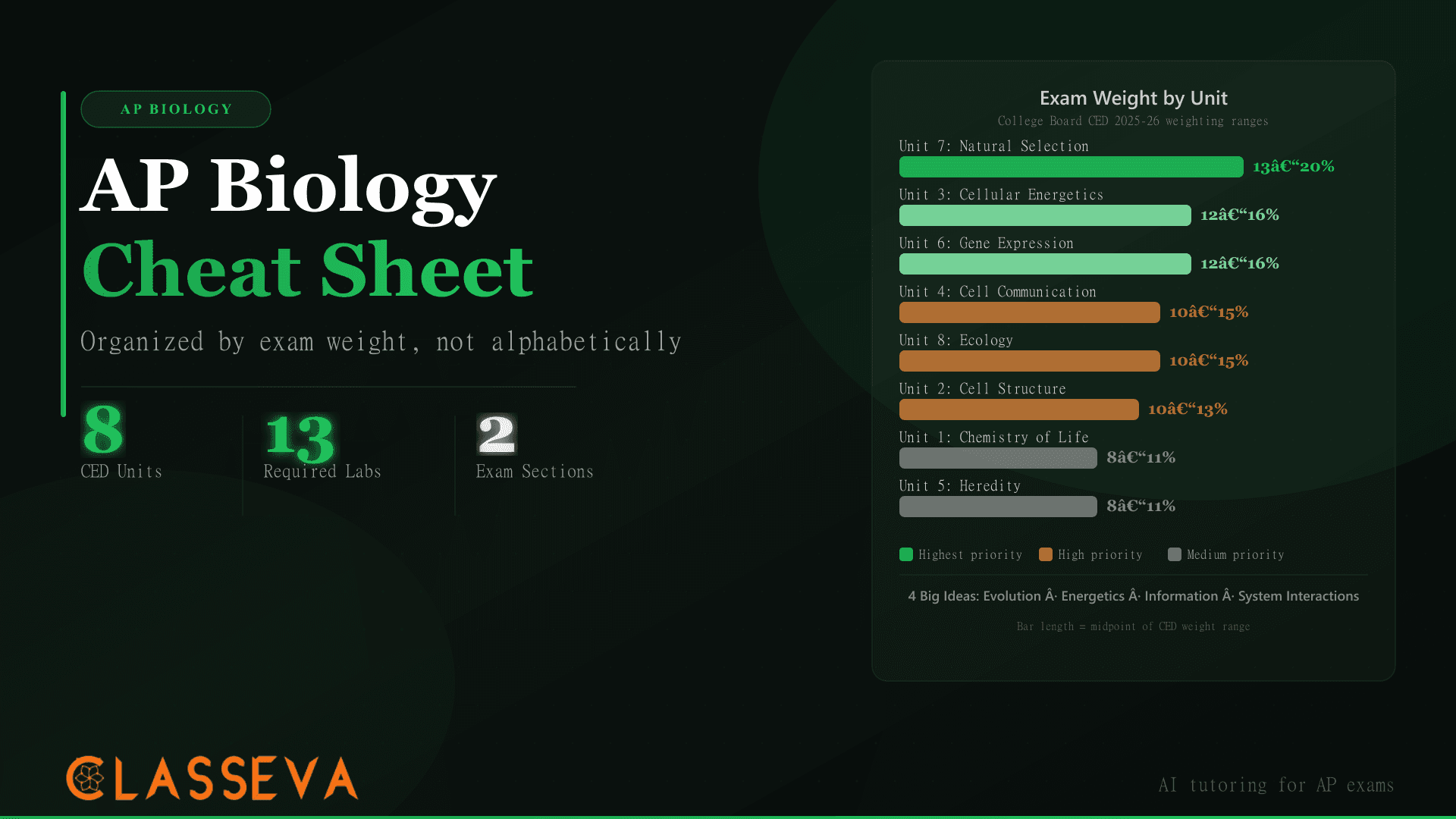
AP Biology Unit 3 carries 12-16% of the exam score, making it one of the two heaviest-weighted content units in the entire course. Only Unit 7 (Natural Selection, 13-20%) consistently outweighs it. But weight alone understates the challenge: Unit 3 also contains the most jargon-dense FRQ answers on the test, where a single missing term like “chemiosmosis” or “electron carrier” can cost two to three points on a single question.
Reviewing how the College Board writes FRQ scoring rubrics across years, what stands out about Unit 3 is this: the examiners reward students who treat photosynthesis and cellular respiration as mirror processes, not as two separate chapters to memorize in isolation. The 2023 exam tested a photosystem I mutation and asked students to predict its effect on biomass accumulation. The 2024 exam tested ATP synthesis under temperature stress. Both questions required students to trace a chain of cause and effect across the entire energetics pathway. Students who learned photosynthesis in one mental box and respiration in another could not make that connection quickly enough. This post builds both pathways in parallel, exactly the way the College Board tests them. For background on the overall exam structure and difficulty, see the AP Biology Difficulty Decoded post.
What Does AP Biology Unit 3 Actually Cover?
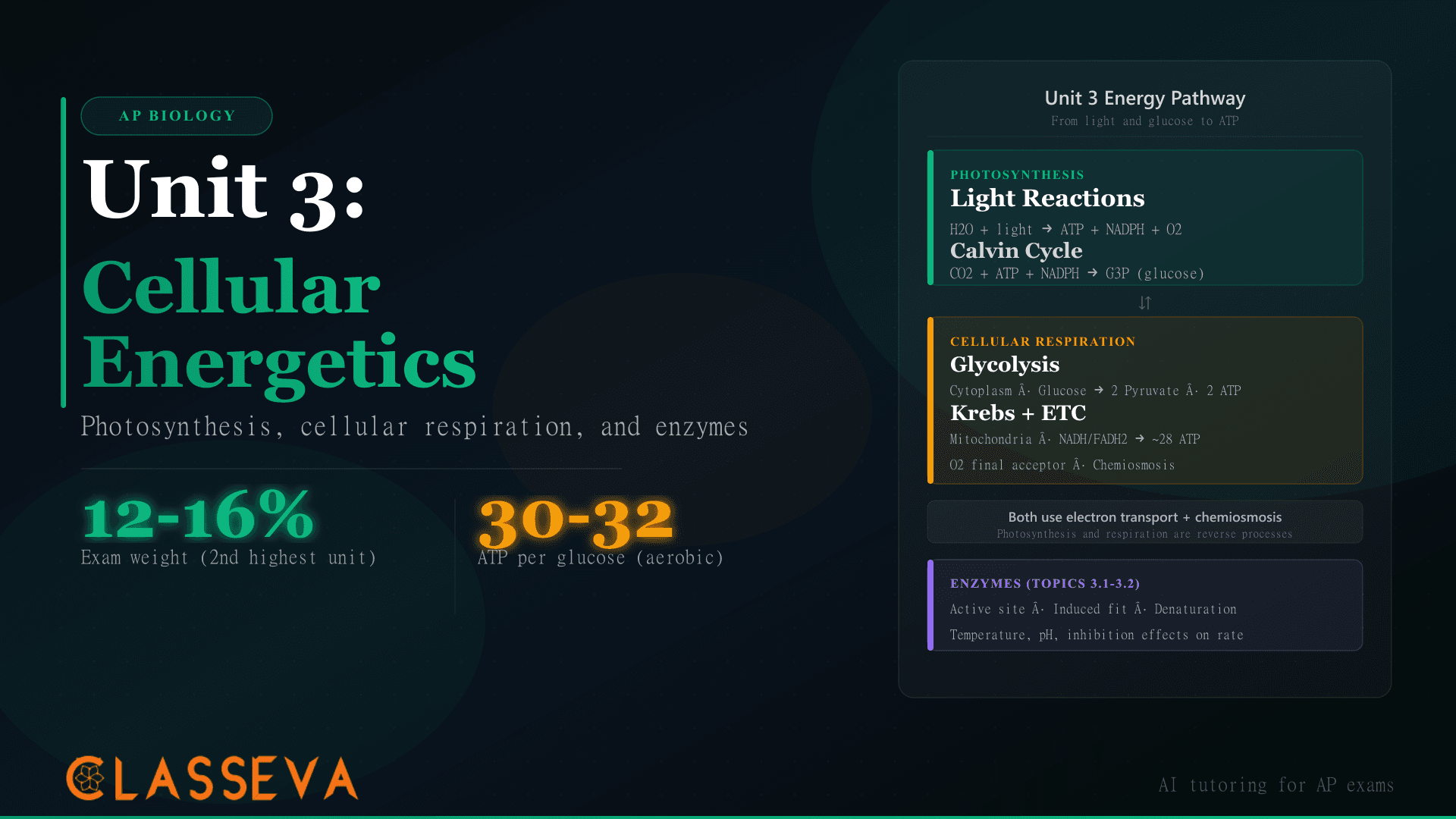
Unit 3 spans five topic areas in the College Board's AP Biology Course and Exam Description: enzymes and catalysis, environmental impacts on enzyme function, cellular energy (ATP), photosynthesis, and cellular respiration. These five topics build sequentially. Enzymes enable every reaction in the unit. ATP is the energy currency those reactions produce and consume. Photosynthesis manufactures glucose and ATP from light. Respiration breaks that glucose back down into ATP.
Topics 3.1 Through 3.5
| Topic | Content Area | Key Processes |
|---|---|---|
| 3.1 | Enzyme Structure and Catalysis | Active site, induced fit model, substrate specificity, activation energy reduction |
| 3.2 | Environmental Impacts on Enzyme Function | Temperature, pH, substrate concentration, competitive vs. noncompetitive inhibition |
| 3.3 | Cellular Energy: ATP | ATP structure, ATP hydrolysis, coupling of endergonic and exergonic reactions |
| 3.4 | Photosynthesis | Light reactions (PSII, PSI, ETC, chemiosmosis), Calvin cycle (carbon fixation, reduction, RuBP regeneration) |
| 3.5 | Cellular Respiration | Glycolysis, pyruvate oxidation, Krebs cycle, electron transport chain, fermentation |
Source: AP Biology Course and Exam Description, College Board (2025-26 CED).
How Unit 3 Connects to Big Idea 2
All Unit 3 content falls under Big Idea 2: Energetics, the AP Biology principle that living systems capture, store, and use free energy to maintain organization and perform work. The College Board frames every Unit 3 FRQ through this lens. An exam question about the electron transport chain is really a question about how cells convert chemical energy into a usable form. An enzyme activity graph question is really a question about the conditions that allow biological work to proceed. When you see Unit 3 content on the exam, ask: where does the free energy come from, and where does it go?
This unit also connects to Unit 1 (Chemistry of Life) and Unit 2 (Cell Structure). Unit 1's coverage of functional groups and macromolecules explains why glucose carries stored energy. Unit 2's membrane transport content explains how proton gradients work. If those units feel shaky, review them before going deep on Unit 3.
How Do Enzymes Actually Work?
Enzymes are biological catalysts that lower the activation energy of chemical reactions without being consumed. They make reactions fast enough to sustain life. Without them, most biochemical reactions would proceed thousands of times too slowly.
Enzyme Structure and the Active Site
Each enzyme has an active site: a three-dimensional pocket shaped by the protein's folded structure. Substrates bind to the active site through complementary shapes and weak chemical interactions (hydrogen bonds, ionic bonds, van der Waals forces). The induced fit model describes this accurately: the enzyme slightly reshapes around the substrate when binding occurs, tightening the interaction rather than simply accepting a pre-formed fit.
Enzyme specificity comes from that active site shape. Lactase hydrolyzes lactose. Amylase breaks starch. Swap the substrates and neither enzyme works. This is the molecular basis for why enzyme mutations matter on AP Biology FRQs: a single amino acid change in the active site can eliminate catalytic activity entirely, because the substrate no longer fits.
Substrate: the molecule the enzyme acts on. Active site: the enzyme region where substrate binds. Enzyme-substrate complex: the temporary structure formed when substrate is bound. Activation energy: the energy barrier the enzyme lowers. Induced fit: the conformational change in the enzyme upon substrate binding. Use these exact terms on FRQs; vague phrasing like “the enzyme grabs the molecule” earns no points.
What Factors Affect Enzyme Activity?
Four factors govern enzyme activity on the AP Biology exam: temperature, pH, substrate concentration, and inhibitors. The first two share a common graph shape that appears on FRQs repeatedly.
Reading an Enzyme Graph on the FRQ
The 2022 AP Biology FRQ 3 presented enzyme activity data under varying temperature conditions. The high-scoring response structure looked like this: identify the optimum from the graph peak, state that activity declines beyond the optimum because heat disrupts hydrogen bonds maintaining tertiary protein structure, and connect this to loss of active site conformation so the substrate can no longer bind. Three separate score points in three sentences.
A common student error: writing “the enzyme dies at high temperature” instead of “the enzyme denatures.” Enzymes are not alive. Rubrics award points for precise terminology. When an AP Biology FRQ shows an enzyme activity graph that drops at extreme conditions, your answer should name the mechanism: denaturation due to disruption of weak chemical bonds, resulting in loss of active site conformation, resulting in reduced substrate binding.
Question prompt style: “A scientist measures luciferase enzyme activity at temperatures from 20°C to 80°C. The graph shows activity rising to a peak at 37°C then falling to near zero by 70°C. Explain this pattern.”
High-scoring response: “Enzyme activity increases from 20°C to 37°C because higher temperatures increase the kinetic energy of both enzyme and substrate molecules, raising collision frequency and reaction rate. At 37°C (the optimum), the active site is complementary to the substrate and the enzyme-substrate complex forms readily. Above 37°C, thermal energy disrupts the hydrogen bonds and other weak interactions that maintain the enzyme's three-dimensional tertiary structure. The active site loses its specific shape (denatures), so the substrate can no longer bind, and reaction rate drops to near zero.”
How Does Photosynthesis Convert Light into Chemical Energy?
Photosynthesis captures light energy and stores it in the chemical bonds of glucose. The overall equation is 6CO2 + 6H2O + light energy producing C6H12O6 + 6O2. The process runs in two distinct stages inside the chloroplast: the light reactions (in the thylakoid membranes) and the Calvin cycle (in the stroma).
Light Reactions: Splitting Water and Building NADPH
The light reactions convert light energy into chemical energy stored in ATP and NADPH. Chlorophyll and other pigments in Photosystem II (P680) absorb light, exciting electrons to a higher energy state. Those electrons pass through an electron transport chain, losing energy that pumps protons (H+) from the stroma into the thylakoid lumen, building a proton gradient. ATP synthase channels those protons back across the membrane, and their flow drives ATP production via chemiosmosis.
The electrons eventually reach Photosystem I (P700), where they absorb another photon and gain energy again. NADP+ reductase uses these electrons to reduce NADP+ to NADPH. Meanwhile, Photosystem II replaces its spent electrons by splitting water molecules (photolysis): 2H2O yields 4H+ + 4e- + O2. The oxygen released is a byproduct of this water-splitting, not a direct product of glucose synthesis.
The Calvin Cycle: Fixing Carbon into G3P
The Calvin cycle runs in the stroma using the ATP and NADPH produced by the light reactions. It proceeds in three phases. In carbon fixation, the enzyme RuBisCO attaches CO2 to a 5-carbon acceptor molecule called RuBP (ribulose-1,5-bisphosphate), forming an unstable 6-carbon compound that immediately splits into two molecules of 3-phosphoglycerate (3-PGA). In reduction, ATP and NADPH convert 3-PGA into glyceraldehyde-3-phosphate (G3P), the three-carbon sugar the cycle produces. In regeneration, most G3P molecules use additional ATP to rebuild RuBP, keeping the cycle running.
For the exam, know the inputs and outputs per three CO2 fixed: 9 ATP and 6 NADPH consumed, 1 net G3P produced. Six turns of the Calvin cycle fix 6 CO2 and yield 2 net G3P molecules, which the cell can use to build glucose. RuBisCO is the most abundant enzyme on Earth, and its role as the entry point for atmospheric carbon into biological molecules is a recurring FRQ anchor.
How Does Cellular Respiration Extract Energy from Glucose?
Cellular respiration breaks glucose down into CO2 and water, capturing the released energy as ATP. The overall equation reverses photosynthesis: C6H12O6 + 6O2 yield 6CO2 + 6H2O + approximately 30-32 ATP. The process runs through four sequential stages, each in a specific cellular location.
Glycolysis and Pyruvate Oxidation
Glycolysis occurs in the cytoplasm and requires no oxygen. One glucose molecule (6 carbons) splits into two pyruvate molecules (3 carbons each), with a net yield of 2 ATP and 2 NADH. Two ATP are invested early in the process; four ATP are produced, giving the net of two. The 2 NADH carry electrons forward to the electron transport chain.
Pyruvate oxidation follows in the mitochondrial matrix. Each pyruvate loses one carbon as CO2 and converts to a 2-carbon acetyl group that attaches to coenzyme A, forming acetyl-CoA. One NADH is produced per pyruvate, yielding 2 NADH per glucose. Pyruvate oxidation also releases 2 CO2 per glucose, accounting for part of the CO2 exhaled during respiration.
The Krebs Cycle
The Krebs cycle (citric acid cycle) runs in the mitochondrial matrix and processes each acetyl-CoA through a series of reactions. Per turn: 1 acetyl-CoA yields 3 NADH + 1 FADH2 + 1 ATP (as GTP) + 2 CO2. Because glycolysis produces 2 pyruvates per glucose, the Krebs cycle turns twice per glucose molecule, yielding 6 NADH, 2 FADH2, 2 ATP, and 4 CO2 in total.
The cycle's main function is loading electrons onto electron carriers, not producing ATP directly. Most of the cycle's free energy output rides NADH and FADH2 forward to the electron transport chain. The College Board does not require knowledge of individual Krebs cycle intermediates or enzymes. Focus on the inputs (acetyl-CoA + NAD+ + FAD + ADP), the outputs (NADH + FADH2 + ATP + CO2), and the location (mitochondrial matrix).
Memorize these per-glucose totals: 6 NADH, 2 FADH2, 2 ATP, 4 CO2. The FRQ scoring rubric awards points for correctly identifying the location as the mitochondrial matrix and correctly stating that NADH and FADH2 carry electrons to the ETC. It does not award points for naming intermediate compounds like citrate or isocitrate.
The Electron Transport Chain and ATP Synthesis
The electron transport chain (ETC) sits in the inner mitochondrial membrane. Protein complexes accept electrons from NADH and FADH2, passing them down a series of redox reactions. Each transfer releases energy that pumps protons (H+) from the mitochondrial matrix into the intermembrane space, building a concentration gradient. Protons flow back through ATP synthase, and their movement drives the enzyme to attach a phosphate group to ADP, producing ATP. This coupling of electron flow to ATP synthesis is oxidative phosphorylation.
At the end of the chain, electrons combine with oxygen and protons to form water. Oxygen's role as the final electron acceptor is why cellular respiration stops without it. Each NADH entering the ETC yields approximately 2.5 ATP; each FADH2 yields approximately 1.5 ATP. The ETC produces roughly 26-28 ATP per glucose, the vast majority of aerobic respiration's total yield.
Why Are Photosynthesis and Respiration Mirror Images?
Photosynthesis and cellular respiration do not just complement each other ecologically. They share the same core mechanisms at the molecular level, running in opposite directions. This parallel is the single most-tested conceptual relationship in Unit 3. Recognizing it lets you answer FRQ predictions without memorizing separate rule sets.
Photosynthesis
- •Location: Chloroplasts (thylakoid + stroma)
- •Reactants: CO2 + H2O + light energy
- •Products: Glucose + O2
- •Electron carriers: NADP+ reduced to NADPH
- •ATP: Produced via light-driven chemiosmosis
- •Electron source: Water (H2O split at PSII)
- •Net direction: Energy stored in glucose
Cellular Respiration
- •Location: Mitochondria (matrix + inner membrane)
- •Reactants: Glucose + O2
- •Products: CO2 + H2O + ATP
- •Electron carriers: NAD+ reduced to NADH
- •ATP: Produced via gradient-driven chemiosmosis
- •Electron acceptor: Oxygen (O2 at end of ETC)
- •Net direction: Energy released from glucose
What Happens When Oxygen Is Absent?
Without oxygen, the electron transport chain stalls: no final electron acceptor means electrons cannot flow, NADH cannot offload its electrons, and the cell's NAD+ supply runs out. Without NAD+, glycolysis stops. Fermentation solves this by regenerating NAD+ from NADH without the ETC, allowing glycolysis to continue producing its modest 2 ATP.
Fermentation does not produce additional ATP. Its sole function is recycling NAD+ so glycolysis can keep running. Two pathways exist on the CED:
Lactic Acid Fermentation (animals, some bacteria)
Pyruvate accepts electrons from NADH and converts to lactate. NAD+ is regenerated. This pathway occurs in human muscle cells during intense exercise when oxygen delivery falls behind demand. Lactate accumulates temporarily until oxygen returns and the liver reconverts it to glucose via the Cori cycle.
Alcoholic Fermentation (yeast, some plants)
Pyruvate first loses a CO2 molecule to form acetaldehyde, then acetaldehyde accepts electrons from NADH and converts to ethanol. NAD+ is regenerated. This pathway is exploited in brewing and baking. The CO2 released is what makes bread dough rise.
A common FRQ asks students to design an experiment using yeast to demonstrate that fermentation occurs under anaerobic conditions. Key variables: glucose concentration (independent), CO2 production rate (dependent, measured with a gas sensor), and temperature (controlled). The control is a tube with glucose but oxygen present; yeast use aerobic respiration there instead. Knowing that CO2 is produced in alcoholic fermentation (but not lactic acid fermentation) allows you to predict which setup generates measurable CO2.
How Does the College Board Test Unit 3?
Unit 3 appears on both the multiple-choice and free-response sections. According to the AP Central past exam question archive, cellular energetics content has appeared in at least one long FRQ in every recent exam year. The 2023, 2024, and 2025 exams all included Unit 3 questions requiring students to explain mechanism, predict outcomes, or analyze experimental data.
FRQ Patterns for Cellular Energetics
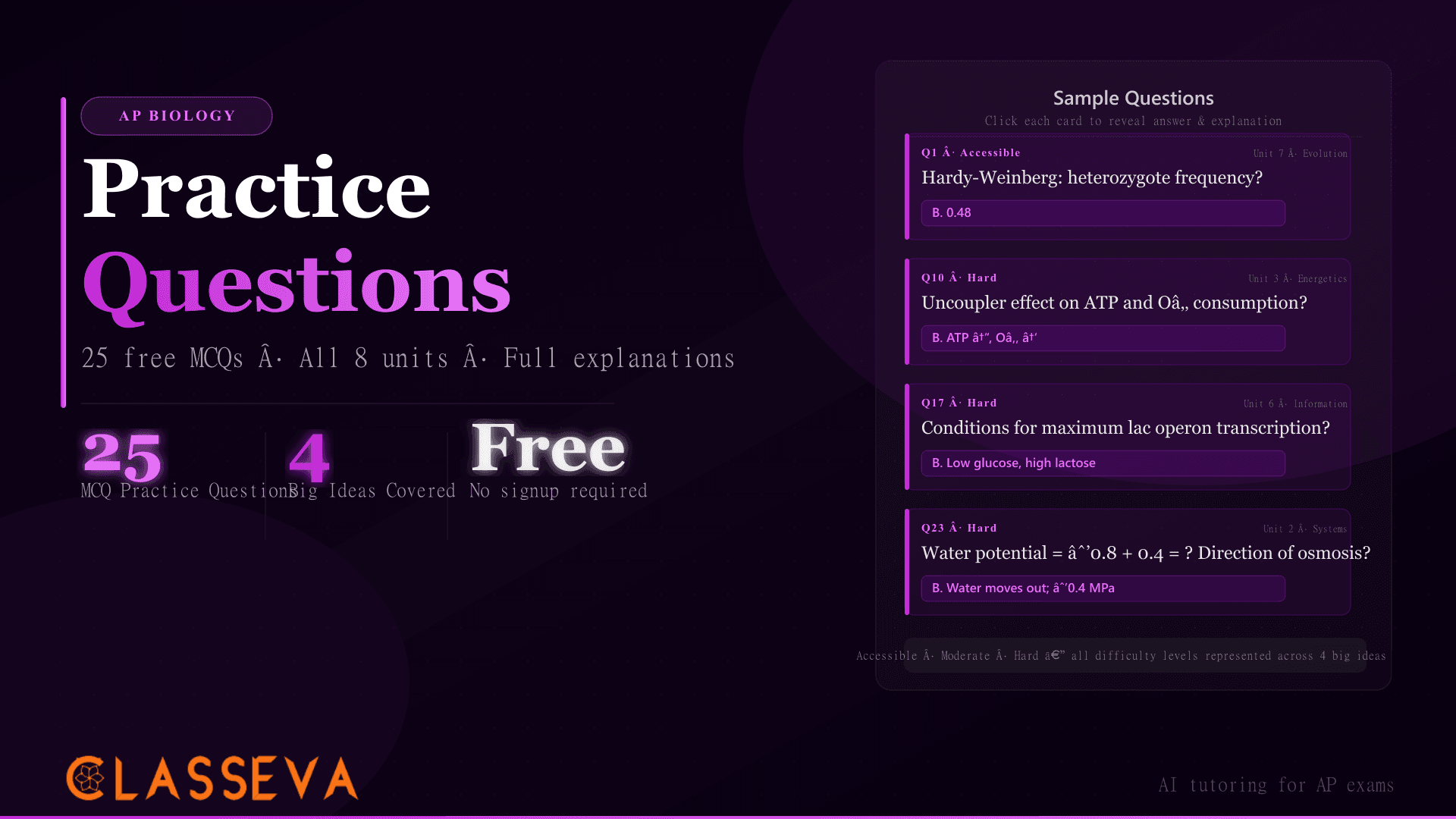
Three question structures repeat across years of AP Biology FRQs on Unit 3. First, mechanism explanation: “Explain how the electron transport chain produces ATP.” The scoring rubric requires naming electron carriers (NADH, FADH2), proton pumping across the inner membrane, concentration gradient formation, and ATP synthase driving ATP production via chemiosmosis. Second, predict-and-justify: “A researcher adds a compound that makes the inner mitochondrial membrane permeable to protons. Predict the effect on ATP production.” Answer: ATP drops because the gradient dissipates, and explain each causal step. Third, data interpretation: a graph of photosynthesis or respiration rates under experimental conditions, followed by “explain the shape of this curve.”
The 2023 AP Biology exam included a question about a CRR6 protein mutation in rice plants that reduced Photosystem I activity. Students were asked to predict the effect on NADPH production and consequently on Calvin cycle output. This type of question rewards students who understand the pathway from end to end, not just individual steps. See the AP Biology practice questions post for worked FRQ examples organized by unit.
Lab Investigations 5 and 6 on the Exam
Lab Investigation 5 (Photosynthesis) uses floating leaf disks immersed in a bicarbonate solution. Disks are first vacuum-infiltrated to remove air, making them sink. When exposed to light, photosynthesis produces oxygen that accumulates in air spaces, making the disks float. The rate of floating measures the rate of photosynthesis. On the exam, expect questions about what happens when light intensity changes, when bicarbonate concentration changes (less bicarbonate means less CO2 for the Calvin cycle), or when a photosynthesis inhibitor is applied.
Lab Investigation 6 (Cellular Respiration) uses respirometers or CO2 sensors to compare respiration rates in germinating seeds versus non-germinating (dormant) seeds. Germinating seeds respire at higher rates because cell division and growth demand ATP. Temperature changes, substrate availability, and anaerobic conditions are common experimental variables. The exam frequently asks students to explain why a control tube of glass beads is included alongside the seeds (to account for any gas volume changes due to pressure or temperature, not due to respiration).
Lab 5 (Photosynthesis): Most exam questions ask about rate changes and the variables controlling them. Know that increased light intensity raises photosynthesis rate up to a saturation point, after which CO2 availability or RuBisCO limits the rate. Lab 6 (Respiration): Most exam questions ask about experimental design and controls. Know why the non-germinating seed tube and the glass bead tube are included, and what each measures. The AP Biology resources hub has additional FRQ practice organized by lab investigation.
Estimate Your AP Biology Score
Unit 3 accounts for 12-16% of your final score. Use Classeva's AP Score Predictor to see how your current multiple-choice accuracy and FRQ performance map to projected scores, and which units to prioritize in your remaining prep time.
AP Score Predictor
Enter your estimated multiple-choice accuracy and free-response performance across AP Biology units to see your projected score and the highest-impact study areas.
Key Takeaways
- Unit 3 carries 12-16% of the AP Biology exam, the second-heaviest unit after Natural Selection. Gaps here cost significantly more points than gaps in Unit 1 or Unit 5.
- Enzymes lower activation energy via an active site whose shape depends on temperature and pH. Denaturation is irreversible; always use this term instead of “the enzyme dies.”
- Photosynthesis runs in two stages: light reactions in the thylakoid membrane produce ATP and NADPH; the Calvin cycle in the stroma uses them to fix CO2 into G3P via RuBisCO.
- Cellular respiration yields ~30-32 ATP per glucose, not the 36-38 cited in older textbooks. The electron transport chain accounts for roughly 26-28 of those, making it the most ATP-productive stage by far.
- Fermentation regenerates NAD+, not ATP. It exists to keep glycolysis running when oxygen is absent. Lactic acid fermentation occurs in animal muscle; alcoholic fermentation occurs in yeast.
- Photosynthesis and respiration share the same molecular machinery (ETC + ATP synthase + chemiosmosis) running in opposite directions. The College Board tests this symmetry regularly.
- Lab Investigations 5 and 6 appear on FRQs as data interpretation and experimental design scenarios. Know the variables, controls, and expected results for each.
For a full overview of all eight AP Biology units ranked by exam weight, see the AP Biology cheat sheet. For unit walkthroughs of adjacent content, see Unit 1 (Chemistry of Life) and Unit 2 (Cell Structure and Function). For score distribution data and what each score means for college credit, see the AP Biology Difficulty Decoded guide.