AP Biology Unit 2 Review: Cell Structure and Function
Mapping Unit 2 against five years of released AP Biology FRQs reveals one consistent pattern: membrane transport problems, usually involving water potential or tonicity, appear on virtually every exam. Students who rush through this unit in favor of higher-weighted content (Units 3, 6, and 7) consistently drop points they did not need to lose. The 10-13% weight understates how often these concepts show up as sub-parts of larger FRQs.
This AP Biology Unit 2 review follows the CED from Topic 2.1 through 2.10. Work through each section in order. The water potential calculation in the middle is the one part worth slowing down for. The rest moves quickly.
What Is on AP Biology Unit 2?
AP Biology Unit 2 covers cell structure and function, accounting for 10-13% of the exam, per the College Board CED. The unit spans 10 topics (2.1 through 2.10) and typically requires 14-16 class periods. Its content falls into four categories: cell types and organization, organelle structure and function, membrane dynamics, and the origins of organelles through endosymbiosis.
A Topic-by-Topic Overview
| Topic | Content | Why It Matters |
|---|---|---|
| 2.1 | Cell structure and subcellular components | Organelle functions; FRQ staple |
| 2.2 | Cell size: surface area to volume | Quantitative reasoning questions |
| 2.3 | Plasma membrane structure (fluid mosaic) | Foundation for all transport topics |
| 2.4 | Membrane permeability | Selective permeability + homeostasis |
| 2.5 | Membrane transport overview | Ties 2.4 to passive/active mechanics |
| 2.6 | Facilitated diffusion | Carrier proteins and channel proteins |
| 2.7 | Tonicity and osmoregulation | Osmosis, hypertonic, hypotonic, isotonic |
| 2.8 | Mechanisms of transport (active, endo/exocytosis) | ATP-dependent pumps; vesicle transport |
| 2.9 | Cell compartmentalization and endomembrane system | Secretory pathway FRQs |
| 2.10 | Origins of cell compartmentalization (endosymbiosis) | Mitochondria + chloroplasts evidence |
Source: AP Biology Course and Exam Description, College Board (2025-26 edition).
How Do Prokaryotes and Eukaryotes Differ?
Prokaryotic cells lack membrane-bound organelles, including a true nucleus. Their DNA sits in an unenclosed nucleoid region, their ribosomes are smaller (70S, not 80S), and they reproduce by binary fission. Eukaryotic cells compartmentalize functions inside membrane-bound organelles, carry linear chromosomal DNA inside a double-membrane nucleus, and use 80S ribosomes.
Structural Differences That Show Up on the Exam
Prokaryotic Cell
- •No nucleus; DNA in nucleoid region
- •70S ribosomes (smaller)
- •No membrane-bound organelles
- •Usually has a cell wall
- •Circular DNA (single chromosome)
- •Examples: bacteria, archaea
Eukaryotic Cell
- •True nucleus with double membrane
- •80S ribosomes (larger)
- •Mitochondria, ER, Golgi, and more
- •Cell wall in plants and fungi; none in animals
- •Linear chromosomes (multiple)
- •Examples: plants, animals, fungi, protists
The 70S vs. 80S ribosome distinction trips up many students. Prokaryotes have 70S ribosomes throughout the cell. Eukaryotes have 80S ribosomes in the cytoplasm, but their mitochondria and chloroplasts contain 70S ribosomes, a leftover from their prokaryotic ancestors. This detail appears in endosymbiosis FRQs.
What Do the Organelles Do?
Each organelle carries a specific function tied to the cell's ability to maintain homeostasis, produce energy, synthesize proteins, or reproduce. AP Biology questions on organelles almost always connect structure to function: knowing the organelle's shape or membrane arrangement reveals what it does. Mitochondria have a folded inner membrane (cristae) to maximize surface area for ATP synthesis; the rough ER has ribosomes embedded on its outer face because it synthesizes proteins.
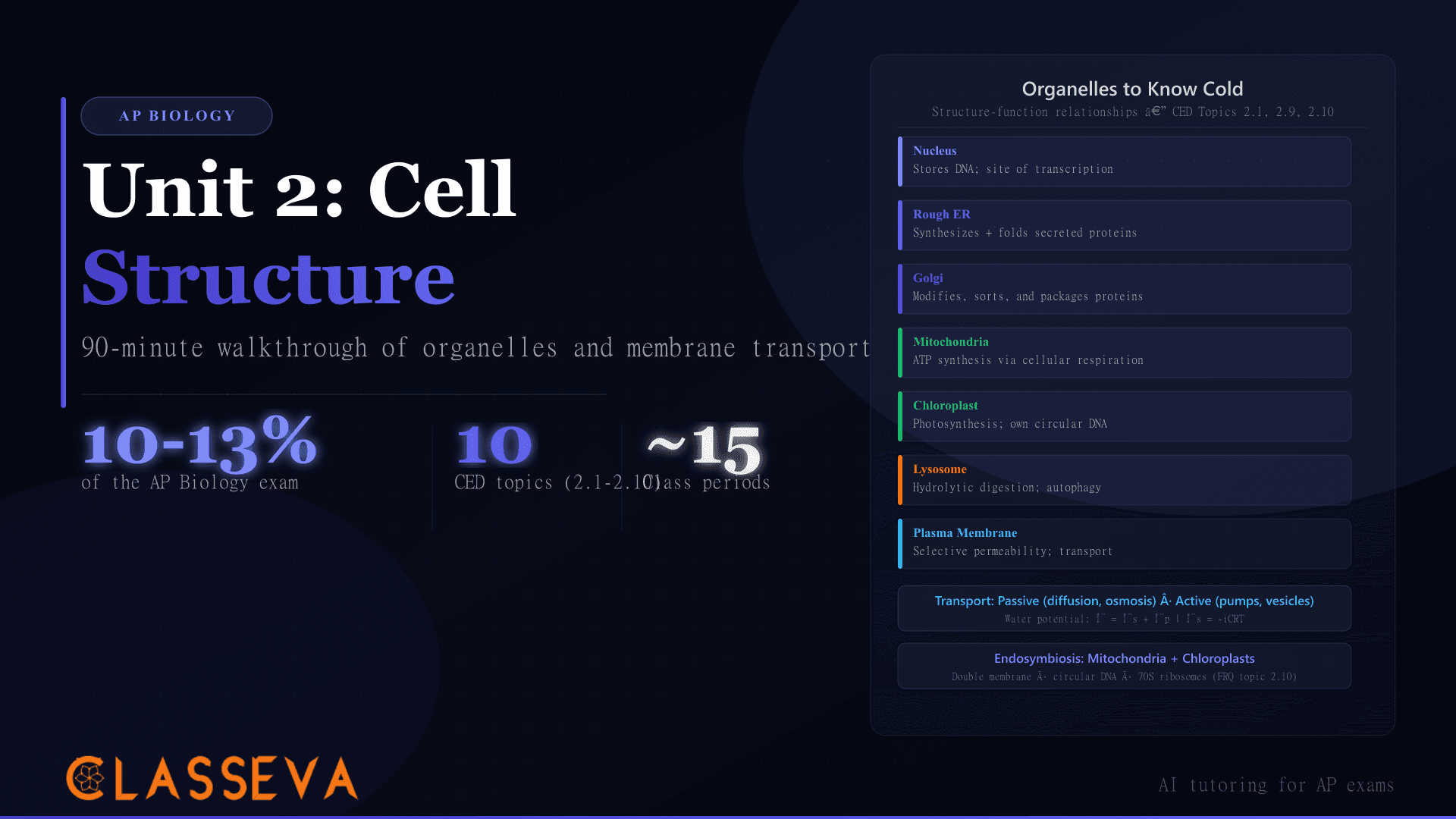
The Organelles You Must Know Cold
- Nucleus: Enclosed by a double membrane (nuclear envelope) with pores. Stores DNA; site of transcription.
- Ribosome: Synthesizes proteins by translating mRNA. Free ribosomes produce cytoplasmic proteins; those on rough ER produce secreted or membrane-bound proteins.
- Rough ER: Studded with ribosomes. Folds and modifies newly synthesized proteins before shipping them to the Golgi.
- Smooth ER: Lacks ribosomes. Synthesizes lipids, metabolizes carbohydrates, and detoxifies drugs. Stores calcium ions in muscle cells.
- Golgi apparatus: The cell's post office. Receives protein-loaded vesicles from the ER, further modifies and sorts them, then packages them for delivery to the cell membrane or lysosomes.
- Mitochondria: Double-membrane organelle with folded inner membrane (cristae). Site of aerobic cellular respiration; produces the majority of ATP through oxidative phosphorylation.
- Chloroplast (plant cells only): Double-membrane organelle with internal thylakoid membranes stacked in grana. Site of photosynthesis. Contains its own circular DNA and 70S ribosomes.
- Lysosome: Membrane-bound vesicle containing hydrolytic enzymes. Digests macromolecules, worn-out organelles (autophagy), and pathogens.
- Vacuole: Storage organelle. Plant cells have one large central vacuole that maintains turgor pressure; animal cells have multiple smaller vacuoles. The 2025-26 CED explicitly compares plant and animal vacuoles.
- Plasma membrane: Phospholipid bilayer with embedded proteins. Regulates what enters and exits the cell (selective permeability).
How the Endomembrane System Ties Them Together
The endomembrane system is the coordinated network of organelles that produce, process, and transport proteins and lipids. It includes the nuclear envelope, rough ER, smooth ER, Golgi apparatus, vesicles, and plasma membrane. Proteins destined for secretion travel a specific route: ribosomes on the rough ER synthesize the protein, the ER folds and packages it into a transport vesicle, the vesicle fuses with the Golgi, the Golgi modifies and sorts the protein, and a secretory vesicle carries the final product to the plasma membrane for exocytosis.
When an FRQ asks which organelles are involved in a secreted protein's journey, the correct answer follows this route in order: ribosome (on rough ER) → rough ER → transport vesicle → Golgi apparatus → secretory vesicle → plasma membrane. Listing these in the wrong order loses points.
How Does Membrane Transport Work?
The plasma membrane controls what enters and exits the cell through four transport mechanisms: simple diffusion, facilitated diffusion, osmosis, and active transport. The first three require no energy input. Active transport requires ATP. The distinction between moving with and against a concentration gradient separates passive from active transport, and that distinction appears in both multiple-choice and FRQ sections of the AP Biology exam.
Passive Transport vs. Active Transport
Passive transport moves molecules from regions of high concentration to regions of low concentration (down the gradient) with no direct energy cost. Simple diffusion allows small, nonpolar molecules (O2, CO2, ethanol) to pass directly through the phospholipid bilayer. Facilitated diffusion uses protein channels or carrier proteins to move ions and polar molecules (glucose, water via aquaporins) that cannot cross the hydrophobic core of the bilayer.
Active transport moves molecules against their concentration gradient using ATP. The sodium-potassium pump (Na+/K+ ATPase) moves 3 Na+ out of the cell and 2 K+ in per ATP hydrolyzed, maintaining the electrochemical gradient that powers nerve impulses. Endocytosis (bringing material in via vesicle formation) and exocytosis (expelling material via vesicle fusion) are also active, ATP-requiring processes.
Osmosis and Tonicity
Osmosis is the passive movement of water across a selectively permeable membrane from a region of lower solute concentration (higher water potential) to a region of higher solute concentration (lower water potential). Three terms describe the solute concentration of a solution relative to a cell:
- Isotonic: Solute concentration equal on both sides. No net water movement. Animal cell maintains normal shape; plant cell becomes flaccid.
- Hypotonic: Fewer solutes outside than inside. Water enters the cell. Animal cell may lyse (burst); plant cell becomes turgid (rigid) due to the cell wall.
- Hypertonic: More solutes outside than inside. Water leaves the cell. Animal cell shrivels (crenation); plant cell undergoes plasmolysis (membrane pulls from cell wall).
A red blood cell is placed in distilled water. What happens and why? Answer: the cell swells and may lyse, because distilled water is hypotonic relative to the cell's cytoplasm, so water enters by osmosis down the water potential gradient.
How Do You Solve Water Potential Problems?
Water potential (Ψ) quantifies the tendency of water to move from one compartment to another. Water always moves from higher water potential to lower water potential. On AP Biology FRQs, you calculate Ψ for a cell and for the surrounding solution, then determine which direction water flows. Getting this right requires the formula and careful attention to signs.
The Water Potential Formula
The College Board provides this formula on the AP Biology exam:
- Ψ = Ψs + Ψp (total water potential = solute potential + pressure potential)
- Ψs = -iCRT (solute potential is always negative or zero)
In the solute potential formula: i = ionization constant (1 for sucrose/glucose; 2 for NaCl; 3 for CaCl2), C = molar concentration (mol/L), R = 0.0831 L·bars/mol·K, T = temperature in Kelvin (°C + 273). Pure water has Ψ = 0 bars. Adding solutes lowers Ψs below zero. Pressure (from a cell wall pushing inward) raises Ψp above zero.
Step-by-Step: A Full Water Potential Calculation
This example follows the format of a typical AP Biology FRQ water potential problem.
Given: A plant cell has an internal solute concentration that produces Ψs = -9.0 bars, and a pressure potential of Ψp = 3.5 bars. The cell sits in an external solution of 0.3 M sucrose at 27°C (300 K).
Calculate Ψs of the external solution
Ψs = -iCRT = -(1)(0.3)(0.0831)(300) = -(0.3 × 24.93) = -7.5 bars. Sucrose has i = 1 because it does not ionize. Ψp of an open external solution = 0 bars. So Ψ_external = -7.5 + 0 = -7.5 bars.
Calculate Ψ of the cell
Ψ_cell = Ψs + Ψp = -9.0 + 3.5 = -5.5 bars. The cell has higher solute concentration (lower Ψs) than the external solution, but also has turgor pressure that partially raises its total water potential.
Compare and determine water movement direction
Ψ_cell = -5.5 bars. Ψ_external = -7.5 bars. Since Ψ_cell (-5.5) is higher than Ψ_external (-7.5), water moves from the cell into the external solution. The cell will lose water and shrink.
State the biological consequence
Water leaves the cell by osmosis. If this continues, the plant cell will undergo plasmolysis: the plasma membrane pulls away from the cell wall as turgor pressure drops to zero. The cell becomes flaccid, then plasmolyzed.
Which Unit 2 Concepts Are Highest-Yield?
Reviewing released AP Biology FRQs from the College Board shows that three Unit 2 areas appear with the highest frequency: membrane transport and water potential calculations, the secretory pathway through the endomembrane system, and evidence for endosymbiotic theory. Knowing these three areas in detail covers the vast majority of Unit 2 points available on any given exam.
Where Unit 2 Shows Up on FRQs
Water potential and osmosis problems appear almost every year, often as part of a lab-data analysis FRQ rather than as a standalone question. Students need to calculate Ψ, predict water movement direction, and explain the biological consequence. Membrane transport questions frequently pair with graph interpretation: given a graph of solute concentration over time inside and outside a cell, identify the transport mechanism and justify.
Endosymbiotic theory FRQs ask students to cite specific evidence for prokaryotic ancestry of mitochondria and chloroplasts. The four pieces of evidence expected by the College Board: double membrane (inner = prokaryote origin, outer = host membrane), circular DNA, 70S ribosomes, and binary fission. All four come from Unit 2 Topic 2.10.
Students often confuse the direction of water potential and solute potential. Water potential goes from high to low (water follows its own concentration gradient). Solute concentration has the opposite relationship: water moves toward high solute concentration. Both statements describe the same phenomenon, just from different reference points. On FRQs, phrase your answer in terms of water potential, not solute concentration, to match the College Board rubric.
For the complete AP Biology cheat sheet organized by unit weight, see the companion reference guide. For exam logistics and the 2026 exam date, see the AP Biology Exam 2026 overview. If you have already reviewed Unit 1, this walkthrough builds directly on the macromolecule and biochemistry content from that unit.
Gauge Your AP Biology Readiness
Unit 2 accounts for 10-13% of your AP Biology score, but your overall score depends on how well you perform across all eight units. After working through this walkthrough, use the AP Score Predictor to estimate where your current preparation puts you on the 1-5 scale, and which units to prioritize next.
AP Score Predictor
Enter your current unit confidence levels to estimate your AP Biology score and identify which units need the most attention before exam day.
For a deeper look at the AP Biology score data and what score earns college credit, see the AP Biology score distribution breakdown. If you want targeted practice questions for Unit 2 and other units, the AP Biology practice questions guide includes membrane transport and cell biology problems with full explanations.
The AP Biology resources hub links to the full CED, released FRQs with scoring guidelines, and score calculators for every year since 2020.
Key Takeaways
- Unit 2 carries 10-13% of the AP Biology exam and covers Topics 2.1 through 2.10, spanning cell types, organelle function, membrane dynamics, and endosymbiosis.
- Prokaryotes lack membrane-bound organelles and have 70S ribosomes; eukaryotes have both, plus linear chromosomes in a double-membrane nucleus.
- Organelles in the endomembrane system follow a defined secretory pathway: rough ER → transport vesicle → Golgi → secretory vesicle → plasma membrane.
- Passive transport (diffusion, facilitated diffusion, osmosis) requires no ATP; active transport and vesicle-based transport (endocytosis, exocytosis) require ATP.
- Water potential (Ψ = Ψs + Ψp, where Ψs = -iCRT) determines the direction of water movement: water moves from higher Ψ to lower Ψ.
- Mitochondria and chloroplasts contain double membranes, circular DNA, and 70S ribosomes. These three pieces of evidence for endosymbiotic theory are tested directly on the AP Biology exam.
- The three highest-yield FRQ topics from Unit 2 are water potential calculations, the endomembrane secretory pathway, and evidence for endosymbiosis. Mastering all three covers the bulk of available Unit 2 points on any given exam.